
AI

Search documents
2025年度产业经济十大热点事件: “科技叙事”重塑投资逻辑 “反内卷”再造产业生态
Zheng Quan Shi Bao· 2025-12-28 22:23
Group 1: AI and Technology Developments - The launch of DeepSeek-R1 in January 2025 has become a core investment theme, driving significant capital market momentum and shifting the focus from performance competition to cost, efficiency, and commercialization capabilities in the AI sector [2] - The AI industry has seen a concentration of funds towards leading companies, with notable stock performances such as the "Yi Zhong Tian" combination, which saw gains exceeding 450% [2] - The human-robotics sector has entered a commercialized phase, with over 46 billion yuan in total orders and more than 20,000 units sold, indicating a shift from conceptual collaborations to practical applications [4][5] Group 2: Film and Entertainment Industry - The film "Nezha 2" achieved a record-breaking box office of 15.4 billion yuan, marking a significant milestone for the Chinese animation industry and contributing to a total annual box office of over 50 billion yuan, a 75 billion yuan increase from 2024 [3] - The success of "Nezha 2" and other animated films reflects the growing market potential for domestic animation, providing a reference for future creative and investment strategies in the film industry [3] Group 3: Market Dynamics and Competition - The intense competition in the food delivery industry, initiated by JD's entry with a no-commission model, has led to significant market disruptions and a series of subsidy wars among major platforms, resulting in a 141 billion yuan loss for Meituan's core local business despite record user numbers [7] - Regulatory bodies have intervened to address the chaotic competition, leading to commitments from major platforms to improve service quality and return to rational development [7] Group 4: Capital Market Trends - The A-share market has seen a record high in cash dividends, totaling 2.61 trillion yuan, reflecting an increase in companies' willingness to return profits to shareholders and enhancing market resilience [11] - The emergence of "GPU dual heroes" in the capital market, with multiple domestic GPU companies going public, signifies a milestone for the domestic AI chip industry and a shift towards self-sufficiency [10] Group 5: Industry Regulation and Quality Improvement - The lithium battery supply chain has experienced a price recovery due to regulatory efforts to combat "involution" competition, with lithium carbonate futures seeing significant price increases [12] - The charging battery industry is transitioning to a more orderly development phase following regulatory changes and recalls by major brands, addressing issues of safety and compliance [13]






巴菲特谢幕、OpenAI搅动万亿市值、谷歌强势崛起......2025全球十大商业事件盘点
美股IPO· 2025-12-28 16:03
Core Insights - The year 2025 witnessed a significant reshaping of the global business landscape driven by AI, with OpenAI emerging as a "shadow giant" despite not being publicly listed, influencing market valuations through orders and narratives [1][3] - Nvidia became the world's first company to reach a market capitalization of $5 trillion, while Google aggressively pursued AI pricing power [1][3] - The year marked a collision of old and new orders, characterized by a mix of high-stakes bets and reversals, reshaping technology, capital, and the direction of the era [1][3] Group 1: Major Events - The U.S. government launched the "Stargate" initiative, committing $500 billion to build 20 large-scale AI data centers, but faced challenges in execution, leading to a significant reduction in project scope [5][6] - CoreWeave went public with a valuation of approximately $230 billion, marking the first public market pricing of AI computing power, and secured substantial long-term contracts with major clients [7][9] - Nvidia invested $5 billion in Intel, marking a strategic partnership aimed at enhancing competitiveness in the PC and data center markets [11][13] Group 2: OpenAI's Market Influence - OpenAI, although not publicly traded, became a key driver of market sentiment, with its initiatives and financial performance causing significant fluctuations in stock prices across the AI sector [15][17] - The company faced scrutiny over its financial sustainability, with concerns about its revenue and valuation mismatch leading to a decline in market confidence [19] - By the end of the year, OpenAI's perceived value shifted from a premium label to a risk exposure, reflecting the changing dynamics in the AI market [19] Group 3: Industry Dynamics - The AI competition evolved from a focus on strength to considerations of cost-effectiveness and usability, with Google positioning itself to challenge Nvidia's dominance in AI infrastructure [38][39] - The automotive industry saw a significant policy reversal in Germany, allowing internal combustion engines to remain viable beyond 2035, highlighting the tension between aggressive transition goals and market realities [33][34] - SpaceX's record number of launches in 2025 redefined the concept of "industrialized space," showcasing the potential for scalable operations in the aerospace sector [28][30]


恒越基金吴海宁:把握科技轮动 锚定高景气赛道机遇
Xin Lang Cai Jing· 2025-12-28 14:16
Core Viewpoint - The article discusses the investment strategies of Wu Haining, a fund manager at Hengyue Fund, focusing on capturing opportunities in the technology sector amidst rapid shifts in sub-sector hotspots [1]. Group 1: Investment Strategy and Performance - Wu Haining's management of Hengyue Advantage Select has yielded a one-year return of 142.56%, ranking sixth among similar funds, attributed to effective control over the rotation of high-growth technology sectors [2]. - In Q1, the fund primarily invested in smart driving, domestic computing power, and the Apple supply chain, with a notable increase in AI computing targets [2]. - By Q2, the fund reduced its holdings in smart driving due to price pressures and increased investments in the PCB sector and upstream materials, while also positioning in sectors like military, gaming, and new energy that showed signs of recovery [2]. - In Q3, the focus remained on AI computing, with some profit-taking on targets that had reached their goals, and an increased allocation to the storage sector due to a price increase cycle starting in September [2]. - For Q4, the emphasis shifted to energy storage and domestic semiconductor equipment, with a long-term positive outlook on the North American AI computing industry chain [2]. Group 2: Market Outlook for 2026 - Wu Haining anticipates continued opportunities in 2026, with liquidity being a key factor as major economies are likely to remain in a rate-cutting cycle, leading to a relatively loose funding environment [4]. - The AI industry is expected to be in its early stages, with core companies in the supply chain showing high earnings growth certainty, particularly monitoring Alibaba's AI capital expenditures and model advancements [4]. - The investment focus for 2026 includes energy storage, storage chips, AI computing, semiconductor equipment materials, and lithium solid-state batteries, along with globally competitive companies expanding in international markets [4]. - The stock selection logic will involve assessing industry growth potential and focusing on companies with high earnings elasticity, maintaining a core of familiar mid-to-long-term investments while adding short-term elastic stocks to enhance returns [4]. Group 3: Specific Investment Directions - The demand for energy storage is expected to grow significantly, with predictions of domestic shortages and price increases in 2026, while the economic viability of independent storage in China is becoming evident [5]. - The storage chip sector is entering a price increase cycle, driven by AI's demand for data storage, with AI video generation requiring significantly more storage than text or image generation [6]. - Domestic production capabilities for storage chips have reached international standards, and the etching equipment necessary for chip production is expected to benefit from the ongoing upcycle in the industry [6].
巴菲特谢幕、OpenAI搅动万亿市值、谷歌强势崛起......2025全球十大商业事件盘点
华尔街见闻· 2025-12-28 12:49
Core Insights - The article highlights significant business events in 2025, emphasizing the rise of AI competition and the reshaping of the technology landscape [4] - Key players like OpenAI, Nvidia, and Google are at the forefront of this transformation, with substantial investments and strategic partnerships [1][3] AI Competition and Investments - The U.S. government announced a $500 billion investment in AI infrastructure, dubbed "Stargate," aiming to build 20 large-scale AI data centers [5] - OpenAI's partnership with SoftBank and Oracle faced challenges, leading to a reduction in project scope and delays in execution [6] - CoreWeave, a company specializing in GPU cloud services, went public with a valuation of approximately $230 billion, marking a significant moment for AI computing rental services [7][12] Major Corporate Developments - Nvidia became the first company to reach a market capitalization of $5 trillion, driven by the demand for AI-related hardware [24][26] - The company invested $50 billion in Intel, marking a strategic alliance to enhance their competitive positions in the PC and data center markets [13][15] - OpenAI's influence on the market was profound, with its valuation and orders significantly impacting the AI industry narrative throughout the year [17][21] Market Dynamics and Trends - The article discusses the shift in the automotive industry, particularly Germany's decision to amend its 2035 ban on internal combustion engines, reflecting the tension between aggressive transformation and market realities [2][40] - Google's advancements in AI, particularly through its TPU and Gemini models, are positioned to challenge Nvidia's dominance in the AI infrastructure market [43][44] Conclusion - The events of 2025 illustrate a complex interplay of alliances, competition, and market adjustments, with companies navigating the evolving landscape of AI and technology [3][21]
美国GDP强劲增长,市场却不买账
Di Yi Cai Jing· 2025-12-28 11:16
Group 1 - The core viewpoint of the article is that the U.S. economy is experiencing structural divergence, with a strong GDP growth rate of 4.3% in Q3 2025, but this growth is not translating into widespread economic benefits for the majority of the population [1][6][7] - The GDP growth is primarily driven by consumer spending, export rebound, and government spending, with personal consumption expenditures (PCE) growing at an annualized rate of 3.5%, significantly contributed by healthcare services [2][3] - Trade factors have positively impacted GDP, with exports rebounding at an annualized rate of 8.8% and a reduction in imports, leading to a trade deficit shrinkage contributing approximately 1.59 percentage points to GDP [2][3] Group 2 - Fixed investment remains weak, with private fixed investment dragging down growth, particularly in non-AI sectors and residential investment continuing to decline [3][6] - Consumer confidence has decreased, with the index falling to 89.1 in December, indicating a negative outlook on household financial conditions for the first time in four years, contrasting sharply with the strong GDP growth [3][4] - The labor market shows signs of divergence, with the unemployment rate rising to 4.6%, and job growth slowing, particularly affecting younger and lower-skilled workers [3][4] Group 3 - The "K-shaped economy" is evident, where high-income households benefit significantly, while middle and low-income groups face rising living costs and stagnant wage growth [4][6] - The bond market reflects skepticism about the sustainability of economic growth, with 10-year Treasury yields remaining stable despite strong GDP growth, indicating a pricing in of prolonged low growth or risks [4][5] - Precious metals markets have reacted negatively to the GDP data, with gold prices surging over 70% in 2025, indicating increased market uncertainty rather than confidence in a sustainable economic recovery [5][6] Group 4 - Analysts suggest that the GDP figures may be distorted by one-time factors such as trade fluctuations and government spending, which do not support a broad-based economic recovery [6][7] - The consensus among economic indicators leans towards caution rather than optimism, with predictions of potential growth slowing to below 2% if labor market cooling continues and tariff uncertainties persist [7]
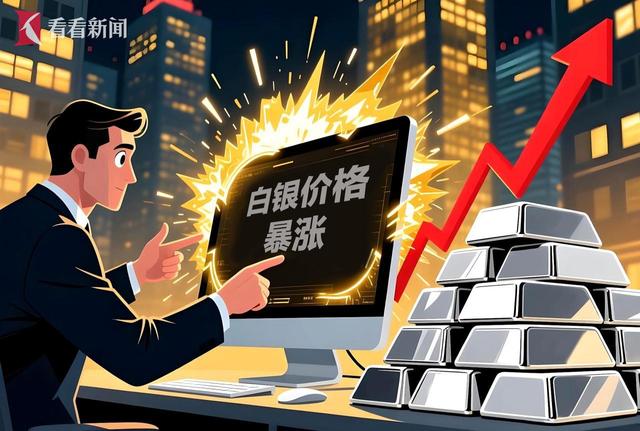
白银价格暴涨:全球新质生产力资源争夺战已经开场
Xin Lang Cai Jing· 2025-12-28 10:10
Core Insights - Recent surge in silver prices, with spot silver exceeding $79 per ounce and a year-to-date increase of over 170% [1] - The rise in silver prices is attributed to both financial speculation and fundamental shifts in demand due to its critical role in new energy and AI technologies [1] Demand and Supply Dynamics - Silver is increasingly viewed as a strategic metal, transitioning from being a "shadow" of gold to a necessity in industries such as photovoltaics, AI, and electric vehicles [1] - Demand for silver has outstripped supply for five consecutive years, leading to a ten-year low in inventory levels [1] - The primary source of silver is as a byproduct of copper and zinc mining, making it difficult to increase production [1] Industrial Applications - The industrial sector is the largest consumer of silver, with significant demand driven by photovoltaics, AI servers, electric vehicles, and medical devices [1] - Photovoltaics serve as the primary demand engine, while AI servers require 2-3 times more silver than traditional servers [1] - Electric vehicles also utilize more silver compared to conventional vehicles, indicating a structural and long-term demand increase [1] Economic Implications - The phenomenon of silver being more expensive than oil is seen as a potential warning sign of an economic crisis [2] - Companies are advised to utilize financial tools to stabilize costs and secure long-term contracts to manage price volatility [2] - Emphasis on technological innovation to reduce silver usage in applications like photovoltaic cells and the exploration of alternative materials is crucial [2] Future Outlook - The demand for silver is expected to continue growing, particularly with the expansion of computational infrastructure, leading to a sustained supply-demand gap [2] - Price fluctuations are anticipated to be significant, with high volatility becoming the new norm [2] - Companies that can secure resources, innovate in substitution technologies, and adapt to new development paradigms will thrive in the upcoming industrial revolution [2]
从概念到盈利,AI应用端迎来价值重估| A股2026投资策略②
Xin Lang Cai Jing· 2025-12-28 00:04
Core Insights - The A-share market's AI narrative is clearly defined by a "hardware-first" approach, with exponential growth in computing power driving significant revenue increases in hardware sectors like CPO, AI servers, and storage chips [1] - The focus is shifting from hardware to applications as the AI industry matures, with expectations for a dual explosion in performance and valuation for AI application companies in 2026 [1][2] - The advertising sector is leading the commercialization of AI applications, particularly in digital advertising, where companies are leveraging AI for operational efficiency and new revenue streams [1][2] Hardware Sector Performance - Industrial Fulian (601138.SH) reported a fivefold year-on-year revenue increase in AI server-related business, while Zhongji Xuchuang (300308.SZ) saw significant growth in optical module revenue [1] - The hardware infrastructure is expected to provide the necessary support for application layers, with several brokerages indicating a shift in investment opportunities from hardware to application sides in 2026 [1] Advertising Sector Developments - Applovin (APP.US) exemplifies the success of AI in advertising, with a stock price increase of up to 56 times since the launch of ChatGPT, and a 71% year-on-year revenue growth in Q1 2025 [2] - BlueFocus (300058.SZ) and Leo Group (002131.SZ) have also begun to realize AI advertising business revenue, benefiting from large existing businesses and rich data resources [2][3] Vertical Industry Applications - Companies in vertical industries such as industrial AI, tax services, and office automation are achieving significant revenue growth through AI integration [5][6] - Nengke Technology (603859.SH) reported AI business revenue of 335 million yuan, accounting for 30.79% of total revenue, driven by its AI Agent products [5] - TaxFriend (603171.SH) achieved a 42.33% year-on-year increase in net profit, attributed to AI-driven revenue growth and efficiency improvements [6] 3D Printing Innovations - The release of Google's Nano Banana Pro is expected to revolutionize the 3D printing industry by significantly reducing design cycles and costs, thus driving demand for raw materials [8] - Companies like Changjiang Materials (001296.SZ) and Yinbang Co. (300337.SZ) are positioned to benefit from the anticipated growth in the 3D printing sector [9][10] Future Outlook - The A-share AI investment landscape is expected to transition from hardware speculation to application performance validation in 2026, with companies that have deep industry knowledge and data barriers likely to see significant profit growth [10] - The common traits among successful AI application companies include strong industry expertise, focus on vertical scenarios, and clear monetization strategies [7][10]



SK Telecom Unveils A.X K1, Korea's First 500B-Scale Hyperscale AI Model
Prnewswire· 2025-12-27 23:00
Core Insights - SK Telecom has launched A.X K1, Korea's first hyperscale AI model with 519 billion parameters, aiming to position Korea among the top three global AI players alongside the U.S. and China [1][2][8] AI Model Characteristics - A.X K1 functions as a 'Teacher Model', enabling knowledge transfer to smaller models, particularly those below 70 billion parameters, and serves as foundational digital social overhead capital for the AI ecosystem [3][9] - AI models with over 500 billion parameters exhibit stable performance in complex reasoning and multilingual understanding, facilitating advanced tasks such as high-complexity coding [4] Accessibility and Public Good - The SKT consortium plans to enhance nationwide AI accessibility by offering A.X K1 through A. (A-DoT), which has over 10 million subscribers, promoting an 'AI for Everyone' framework [5][9] - Liner, a consortium member, aims to provide accurate multilingual search services using A.X K1, which is expected to enhance industrial competitiveness through various applications [6] Semiconductor Industry Validation - A.X K1 will serve as a testbed for validating Korea's semiconductor industry, crucial for addressing performance bottlenecks in high-performance AI semiconductors [7] Strategic Alignment - The SKT consortium's strategy aligns with Korea's national goal of becoming a top-three AI nation, emphasizing the importance of scaling and operating AI at a national level [8][9] Consortium Composition - The SKT consortium includes eight organizations, such as SK Telecom, Krafton, and Seoul National University, collaborating to build a full-stack sovereign AI ecosystem [9][11] Open Source and Development Support - The consortium plans to release A.X K1 as open-source to foster AI development across Korea's ecosystem, providing access to APIs and training data [13][14] Future Vision - The launch of A.X K1 marks a significant milestone in Korea's ambition to enhance its global AI competitiveness amid increasing international competition [15]


战略数据研究 | 专题报告:人民币升值下的”春季躁动“机会有何不同
Changjiang Securities· 2025-12-27 11:58
Group 1: Market Overview - The Shanghai Composite Index achieved an "eight consecutive days" rise, supported by strong domestic capital, with trading volumes exceeding 1.9 trillion CNY on December 25 and 26[4] - The offshore RMB/USD exchange rate has recently strengthened, breaking the 7.0 mark, influenced by the US interest rate cuts and a weaker dollar, becoming a key variable for future market trends[4] Group 2: Investment Strategy - The recommended trading strategy during this RMB appreciation phase is a mid-term focus on "pan-technology" and a short-term defensive approach, emphasizing sectors like commercial aerospace, robotics, and AI applications[1] - Investors are advised to maintain a low position in defensive stocks such as paper and aviation, which directly benefit from RMB appreciation, especially during the annual report forecast period[1] Group 3: Beneficiary Sectors - Beneficiary sectors are categorized into three tiers: - Tier 1: Cost and debt improvement sectors that directly benefit from RMB appreciation, showing high elasticity[4] - Tier 2: Core assets driven by capital flow, benefiting from increased attractiveness of RMB-denominated assets[4] - Tier 3: Asset revaluation opportunities due to the intrinsic value enhancement of RMB-denominated assets[4] Group 4: Historical Context - Since 2017, the RMB has experienced three rapid appreciation phases, each with different underlying logic and market conditions, including core asset bull markets and significant recovery in exports[5] - The current phase differs from previous ones, characterized by domestic capital dominance and a focus on technology-driven growth rather than economic recovery[6]
A股 2026 年度投资策略:水到渠成,万舸争腾
Changjiang Securities· 2025-12-27 08:21
Market Outlook - The market is expected to continue a slow bull trend in 2026, with signs of a profit bottom emerging and ample liquidity gradually reflecting in the performance of listed companies [4][9] - Valuation metrics indicate that the price-to-earnings ratio of stocks relative to bonds is near historical averages, with a low interest rate environment providing upward valuation momentum [9][10] - The Chinese stock market has significant room for improvement in its securitization rate, suggesting potential for further growth [9][10] Industry Allocation Outlook - The report emphasizes a focus on technology, domestic circulation, strategic security, and opening up to the outside world as key investment directions [4][10] - The technology sector is highlighted as a primary area of interest, particularly in AI applications and robotics, which are expected to drive market performance [7][10] - The cyclical recovery is anticipated, with attention on sectors such as high-tech manufacturing, new consumption patterns, and resource scarcity [10] 2025 Market Review - The market has shown a steady upward trend, characterized by a slow bull market, with technology and metals leading the gains [8][23] - Key themes included AI-driven growth, new consumption, and innovative pharmaceuticals, with significant performance from small-cap and resource stocks [23][24] - The overall market performance has been robust, with major indices achieving over 15% gains, particularly in the ChiNext and Northbound indices [23][28] Profit and Valuation Trends - As of Q3 2025, the overall revenue growth for A-shares has turned positive, with a year-on-year increase of 4.19%, and the ChiNext leading with a 15.74% increase [36][40] - Profit growth has also shown significant improvement, with A-shares experiencing an 11.45% year-on-year increase in profits, and the ChiNext achieving a remarkable 32.90% growth [36][40] - There is a structural divergence in profitability, with high valuations correlating with high growth in sectors like technology, while domestic demand sectors lag behind [42][45] Global Economic Context - The report anticipates a favorable global liquidity environment due to ongoing monetary and credit easing, particularly in the U.S., which is expected to positively impact Chinese exports [9][10] - The U.S. economy is projected to experience a mild recovery in 2026, with inflation trends remaining manageable, supporting a favorable investment climate for equities [55]