有色金属

Search documents
两融余额较上一日增加204.14亿元 电子行业获融资净买入额居首
Sou Hu Cai Jing· 2026-02-27 01:48
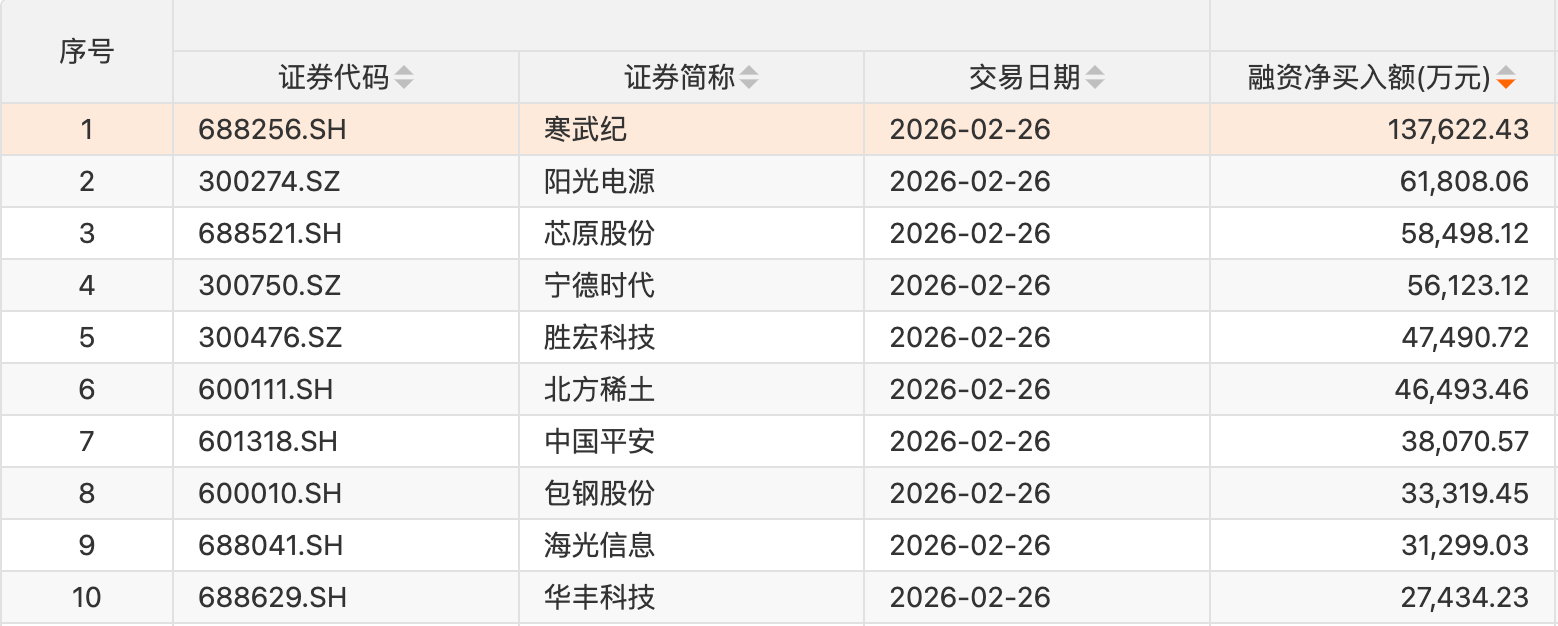
Group 1 - As of February 26, the margin trading balance in A-shares reached 26,670.4 billion yuan, an increase of 20.41 billion yuan from the previous trading day, accounting for 2.54% of the A-share circulating market value [1] - The trading volume of margin transactions on the same day was 2,572.58 billion yuan, an increase of 9.80 billion yuan from the previous trading day, representing 10.06% of the total A-share trading volume [1] - Among the 31 primary industries in the Shenwan index, 26 industries experienced net financing inflows, with the electronics industry leading at a net inflow of 4.87 billion yuan [1] Group 2 - A total of 65 stocks had net financing inflows exceeding 100 million yuan, with Cambricon Technologies leading at a net inflow of 1.376 billion yuan [1] - Other notable stocks with significant net financing inflows included Sungrow Power Supply, Chipone Technology, CATL, Shenghong Technology, Northern Rare Earth, China Ping An, Baotou Steel, Haiguang Information, and Huafeng Technology [1][2] - Research from Shingang Securities indicates that the increase in demand for data calls and the improvement in monetization capabilities of domestic AI models are expected to benefit the domestic computing power industry chain [2]






有色套利早报-20260227
Yong An Qi Huo· 2026-02-27 01:43
Report Industry Investment Rating - Not provided Core View - The report provides cross - market, cross - period, spot - futures, and cross - variety arbitrage tracking data for non - ferrous metals including copper, zinc, aluminum, nickel, and lead on February 27, 2026 [1][3][4][5] Summary by Directory Cross - Market Arbitrage Tracking - **Copper**: Spot price in China is 101830, LME price is 13256, with a ratio of 7.70; March price in China is 102930, LME price is 13326, ratio 7.70. Spot import equilibrium ratio is 7.78, profit is - 786.94; spot export profit is 68.84 [1] - **Zinc**: Spot price in China is 24460, LME price is 3366, ratio 7.27; March price in China is 24625, LME price is 3383, ratio 4.95. Spot import equilibrium ratio is 8.16, profit is - 2999.77 [1] - **Aluminum**: Spot price in China is 23490, LME price is 3151; March price in China is 23920, LME price is 3164, ratio 7.52. Spot import equilibrium ratio is 8.20 [1] - **Nickel**: Spot price in China is 138000, LME price is 17805, ratio 7.75. Spot import equilibrium ratio is 7.91, profit is 31.99 [1] - **Lead**: Spot price in China is 16575, LME price is 1944, ratio 8.51; March price in China is 16800, LME price is 1990, ratio 12.34. Spot import equilibrium ratio is 8.42, profit is 182.48 [3] Cross - Period Arbitrage Tracking - **Copper**: The spreads between the next - month, March, April, and May contracts and the spot - month contract are 210, 470, 530, and 580 respectively, while the theoretical spreads are 614, 1127, 1648, and 2169 [4] - **Zinc**: The spreads are - 75, - 20, 30, and 20 respectively, and the theoretical spreads are 226, 358, 491, and 623 [4] - **Aluminum**: The spreads are 105, 180, 235, and 280 respectively, and the theoretical spreads are 230, 360, 491, and 622 [4] - **Lead**: The spreads are 105, 110, 140, and 140 respectively, and the theoretical spreads are 208, 313, 417, and 522 [4] - **Nickel**: The spreads are - 710, - 210, - 220, and - 250 respectively [4] - **Tin**: The spread between the 5 - month and 1 - month contracts is 4190, and the theoretical spread is 8418 [4] Spot - Futures Arbitrage Tracking - **Copper**: The spreads between the current - month and next - month contracts and the spot are 710 and 920 respectively, and the theoretical spreads are 519 and 1112 [4] - **Zinc**: The spreads are 185 and 110 respectively, and the theoretical spreads are 172 and 313 (or 195 and 350 in another record) [4][5] - **Lead**: The spreads are 115 and 220 respectively, and the theoretical spreads are 159 and 270 [5] Cross - Variety Arbitrage Tracking - The ratios of copper/zinc, copper/aluminum, copper/lead, aluminum/zinc, aluminum/lead, and lead/zinc in Shanghai (three - continuous contracts) are 4.18, 4.30, 6.13, 0.97, 1.42, and 0.68 respectively; in London (three - continuous contracts) are 3.94, 4.21, 6.71, 0.93, 1.59, and 0.59 respectively [5]
港股开盘:恒指涨0.25%、科指涨0.15%,有色金属概念股走高,机器人及生物医药股活跃,芯片股、汽车股走低
Jin Rong Jie· 2026-02-27 01:29
Market Overview - The Hong Kong stock market opened higher on February 27, with the Hang Seng Index rising by 0.25% to 26,447.05 points, the Hang Seng Tech Index up by 0.15% to 5,117.24 points, and the National Enterprises Index increasing by 0.04% to 8,817.53 points. The Red Chip Index fell by 0.06% to 4,409.07 points [1] Company Performance - Baidu Group-SW reported a total revenue of 32.7 billion yuan for Q4 2025, a 5% quarter-on-quarter increase, with a NON-GAAP net profit of 3.9 billion yuan. The smart cloud infrastructure revenue reached 5.8 billion yuan, and AI high-performance computing subscription revenue grew by 143% year-on-year [2] - Galaxy Entertainment's net income for 2025 was 49.2 billion HKD, a 13% year-on-year increase, with a net profit of 10.7 billion HKD, up 22% year-on-year [2] - Hong Kong Exchanges and Clearing reported total revenue of 29.161 billion HKD for 2025, a 30% year-on-year increase, with a net profit of 17.754 billion HKD, up 36% year-on-year [2] - New World Development announced a revenue of 52.705 billion HKD for the six months ending December 31, 2025, a 31.98% year-on-year increase, with a profit of 10.247 billion HKD, up 36.21% year-on-year [2] - Chow Tai Fook reported a revenue of 10.485 billion HKD for the six months ending December 31, 2025, with a net profit growth of 15% to 1.3343 billion HKD [3] - Jiangnan Buyi's total revenue for the same period was approximately 3.376 billion yuan, a 7% year-on-year increase, with a profit of 676 million yuan, up 11.9% year-on-year [3] - Biotech company Kangsino Biologics reported total revenue of 1.068 billion yuan for 2025, a 26.18% year-on-year increase, with a net profit of 27.827 million yuan, turning profitable [3] Earnings Forecasts - Zhenhua Education Group expects 2025 revenue to be between 1.8 billion and 2.0 billion yuan, a year-on-year growth of approximately 63.3% to 81.5%, with net profit expected between 260 million and 340 million yuan, a year-on-year increase of approximately 35.2% to 76.8% [4] - Feida Holdings anticipates a net profit of no less than 100 million HKD for the year [4] Strategic Developments - NIO's subsidiary Shenji has entered into a final agreement for a 2.257 billion yuan investment related to NIO's smart driving chip business, maintaining a 62.7% indirect stake post-transaction [5] - MIRES-B has signed a memorandum of understanding with AHLL for strategic cooperation [5] - Several companies, including ZTO Express, Xiaomi Group, and NetEase Cloud Music, have initiated stock buybacks, indicating confidence in their future development [5] Market Insights - According to Ping An International, the current macro data vacuum and policy expectations around the National People's Congress may lead to continued appreciation of the RMB and increased foreign capital inflow, which could strengthen the spring market [6] - China Galaxy Securities highlights three key areas for future investment focus: rising geopolitical risks in the Middle East benefiting precious metals and energy sectors, consumer sector valuations at relatively low levels with potential for growth, and the technology sector as a long-term investment focus amid ongoing AI advancements [6]

高库存仍待消化 铜价短期震荡为主
Qi Huo Ri Bao· 2026-02-27 01:08
Group 1: Market Overview - The main copper futures contract in Shanghai has been fluctuating between 97,920 and 105,810 yuan/ton since February, with total positions decreasing by 19% due to global investment funds flowing out of previously high-performing assets [2] - The market is experiencing high inventory levels, with global copper inventory reaching 1.394 million tons, an increase of 627,000 tons year-on-year and 300,000 tons month-on-month, indicating a challenging short-term outlook due to high inventory pressure [5] Group 2: Supply Dynamics - Despite ongoing tightness in copper concentrate supply, the availability of scrap copper has alleviated some pressure, with domestic copper concentrate treatment charges at -50.53 USD/dry ton, indicating persistent tightness in the mining sector [3] - Domestic refined copper production reached a record high of 1.179 million tons in January, but is expected to decline by 3.04% in February due to fewer production days, with a recovery anticipated in March [3] Group 3: Demand Outlook - The demand side is transitioning from a low to a high season, with expectations for increased demand from downstream copper processing enterprises post-Spring Festival, although high copper prices are currently suppressing consumption [4] - The anticipated growth in demand for copper in the electric and AI sectors is expected to support medium-term consumption, with significant investments planned in infrastructure and technology [4] Group 4: Macroeconomic Factors - The market expects the Federal Reserve to maintain interest rates in March, with a 98% probability of no change, which may influence the dollar index to remain stable [5] - Geopolitical risks and policy signals from both the U.S. and China are reinforcing copper's strategic resource status, providing core macroeconomic support for copper prices [5] Group 5: Industry Challenges - The Chinese copper industry faces three main challenges: increasing reliance on foreign resources, overcapacity in the midstream processing sector, and suppressed demand due to high copper prices [6]

芝加哥联储行长:若通胀回落美联储可能多次降息
Dong Zheng Qi Huo· 2026-02-27 01:01
1. Report Industry Investment Ratings There is no information provided in the report regarding industry investment ratings. 2. Core Views of the Report - **Macro Strategy (Foreign Exchange Futures - US Dollar Index)**: The Chicago Fed President suggests that if inflation falls, the Fed may cut interest rates multiple times. The Iranian Foreign Minister claims progress in US - Iran negotiations, leading to a decline in market risk appetite and a lower US Dollar Index. The dollar index is expected to weaken in the short - term [1][12][13]. - **Macro Strategy (Stock Index Futures)**: A - shares are in a volatile consolidation phase with increasing trading volume. The spring rally is likely not over. Concerns about the overseas AI bubble are deepening, increasing short - term correction pressure on technology stocks, but they are still optimistic in the medium - term [2][16]. - **Macro Strategy (Treasury Bond Futures)**: The central bank conducted 320.5 billion yuan of 7 - day reverse repurchase operations. Stabilizing real estate policies are temporary disturbances. Before other negative factors emerge, the bond market is unlikely to fall continuously. However, potential risks such as the "Two Sessions" and supply pressure in March still exist [3][18]. - **Black Metal (Rebar/Hot - Rolled Coil)**: Brazil imposed anti - dumping duties on Chinese galvanized and aluminized zinc - coated steel coils. The inventory of the five major steel products continued to increase significantly, and the fundamental pressure is prominent. The rebound in steel prices due to short - term real estate policies is expected to be limited [4][23]. - **Agricultural Products (Sugar)**: Brazil exported 1.3138 million tons of sugar and molasses in the first two weeks of February. India's sugar production estimate for this season was significantly reduced by 1.65 million tons to 29.3 million tons, which will support domestic prices, limit exports, and reduce the global sugar supply surplus [5][33]. - **Non - ferrous Metals (Lithium Carbonate)**: Finland launched the first commercial spodumene mine in Europe. In the short - term, a bullish view is maintained, but the price may correct when supply increases in the medium - term [6][45]. 3. Summary by Relevant Catalogs 3.1 Financial News and Comments 3.1.1 Macro Strategy (Foreign Exchange Futures - US Dollar Index) - Chicago Fed President Goolsbee reiterates that if there is more evidence of inflation moving towards the Fed's 2% target, interest rates could be further cut in 2026. Fed Vice - Chair for Supervision Bowman says regulators will release a revised bank capital reform proposal by the end of March [11]. - The Iranian Foreign Minister claims progress in US - Iran negotiations, causing a decline in market risk appetite and a lower US Dollar Index. The dollar index is expected to weaken in the short - term [12][13]. 3.1.2 Macro Strategy (Stock Index Futures) - A - shares had a narrow - range consolidation. The Shanghai Composite Index fell 0.01% to 4146.63 points, the Shenzhen Component Index rose 0.19%, and the ChiNext Index fell 0.29%. The trading volume increased to 2.56 trillion yuan. AI - related stocks were affected by NVIDIA's earnings, and some sectors had significant movements [14]. - The spring rally is likely not over due to increasing trading volume. Concerns about the overseas AI bubble may lead to short - term corrections in technology stocks, but they are still promising in the medium - term. It is recommended to hold stock index long positions evenly [16]. 3.1.3 Macro Strategy (Treasury Bond Futures) - The central bank conducted 320.5 billion yuan of 7 - day reverse repurchase operations on February 26, with a net withdrawal of 7.95 billion yuan [17]. - Stabilizing real estate policies are temporary disturbances. The bond market is unlikely to fall continuously in the short - term, but potential risks such as the "Two Sessions" and supply pressure in March exist. The bond market is expected to be volatile in the short - term and face adjustment risks in the long - term [18][19]. 3.2 Commodity News and Comments 3.2.1 Black Metal (Rebar/Hot - Rolled Coil) - Brazil imposed a 5 - year anti - dumping duty of 284.98 - 709.63 US dollars per ton on Chinese galvanized and aluminized zinc - coated steel coils. South Korea made a final anti - dumping ruling on hot - rolled coils from China and Japan, with some Chinese enterprises accepting price commitments [20][21]. - The inventory of the five major steel products increased by 1.3427 million tons to 18.4611 million tons in the week ending February 26. The inventory of coils exceeded last year's peak. The market is expected to be in a weak and volatile pattern, and short - term steel price rebounds are limited [23][24]. 3.2.2 Black Metal (Coking Coal/Coke) - The coking coal price in the Changzhi market was weakly stable. After the Spring Festival, coal supply increased as mines resumed production, but demand remained weak. The market is expected to remain volatile in the short - term [25][26]. 3.2.3 Agricultural Products (Soybean Meal) - The US weekly soybean export sales net increased by 407,100 tons in the week ending February 19, down 49% from the previous week and 30% from the four - week average, and was at the lower end of the market forecast range [27]. - The US government's biofuel policy may benefit soybean crushing, but actual export data is disappointing. Domestically, the price of imported soybeans has risen, but soybean meal supply is sufficient. It is recommended to maintain the view of price volatility and pay attention to China's soybean procurement, customs policies, and reserve policies [29]. 3.2.4 Agricultural Products (Sugar) - Brazil exported 1.3138 million tons of sugar and molasses in the first two weeks of February, with a daily average export volume 44% higher than that in February last year. The sugar production estimate in India for this season was reduced by 1.65 million tons to 29.3 million tons [30][32]. - The reduction in Indian sugar production will support domestic prices, limit exports, and reduce the global sugar supply surplus. The Brazilian sugar production in the new season will have a greater impact on the international sugar market. The Zhengzhou sugar futures are expected to be in a low - level volatile pattern [33][34]. 3.2.5 Agricultural Products (Soybean Oil/Rapeseed Oil/Palm Oil) - From February 1 - 25, Malaysia's palm oil production decreased by 16.25% month - on - month [35]. - The oil market showed a differentiated trend. Soybean oil was affected by the US biofuel policy and trended strongly. The market is pessimistic about Malaysia's palm oil exports in February. It is expected that the palm oil price will continue to test the bottom, and attention should be paid to the final US biofuel policy in March [36][37]. 3.2.6 Agricultural Products (Corn) - As of February 26, the average inventory of feed enterprises across the country was 31.29 days, a decrease of 0.96 days from the previous week, a month - on - month decline of 2.98%, and a year - on - year decline of 2.43% [38]. - The corn futures price was volatile. The slowdown in grain sales during the Spring Festival, low port inventory, and downstream replenishment demand support the price. However, the price increase may be limited by downstream acceptance and potential policy grain releases. The price is expected to be volatile and slightly upward, but the 05 contract may face a technical correction [38]. 3.2.7 Agricultural Products (Pigs) - Tangrenshen expects to gradually reduce the proportion of外购仔猪 (purchased piglets) in 2026 and strive to reduce the full - cost of fattening pigs to about 12.6 yuan per kilogram. Wens Co., Ltd. plans to repurchase shares worth 800 million - 1.2 billion yuan [39][41]. - The current slaughter volume is low, and the supply pressure remains. The short - term spot price is expected to be weak. The near - month futures contracts face basis - repair pressure, while the far - month contracts may rebound after over - falling. It is recommended to wait for opportunities to go long on the far - month contracts after the negative factors are exhausted [41][42]. 3.2.8 Non - ferrous Metals (Lithium Carbonate) - Finland launched the first commercial spodumene mine in Europe, with a lithium concentrate production capacity equivalent to about 15,000 tons of lithium hydroxide. Core Lithium reached a fixed - price agreement with Glencore to sell about 5,100 dry tons of spodumene concentrate [43][44]. - In the short - term, a bullish view on lithium carbonate is maintained, but the price may correct when supply increases in the medium - term [45]. 3.2.9 Non - ferrous Metals (Lead) - On February 25, the LME 0 - 3 lead was at a discount of 46.37 US dollars per ton, and the social inventory of lead ingots in five places increased by 3,100 tons [46]. - The Shanghai lead futures were in a low - level volatile pattern. The lead market is in a state of weak supply and demand, and the price is supported by the cost of recycled smelters. It is recommended to wait and see in the short - term and consider long positions in the medium - term [46][47]. 3.2.10 Non - ferrous Metals (Zinc) - On February 25, the LME 0 - 3 zinc was at a discount of 29.64 US dollars per ton. As of February 26, the social inventory of zinc ingots in seven places increased by 10,200 tons [48][49]. - The zinc price was volatile. The LME inventory decreased, and the domestic social inventory increased. The downstream start - up was slow. It is recommended to adopt a bullish approach and continue to hold call options, while being vigilant about tariff risks [49]. 3.2.11 Non - ferrous Metals (Copper) - Mexico's mining safety risk has increased significantly, and Japan's copper and copper alloy imports in January increased by 13.51% year - on - year. The core leadership of Congo (Kinshasa)'s state - owned mining company has been replaced [50][51][52]. - The copper price is affected by the Middle East geopolitical situation and domestic policies. The domestic and overseas inventories are increasing, which restricts the price increase. It is recommended to pay attention to opportunities to go long on dips [52][53]. 3.2.12 Non - ferrous Metals (Tin) - On February 25, the LME 0 - 3 tin was at a premium of 20 US dollars per ton. The Shanghai Futures Exchange's tin futures warehouse receipts decreased by 182 tons on February 26 [54]. - The supply of tin ore may gradually ease in the short - term but is expected to be restricted in the long - term. The price is expected to be in a strong and wide - range volatile pattern, and attention should be paid to the recovery of tin ore imports from Myanmar and post - holiday consumption [54][55]. 3.2.13 Energy Chemical (Liquefied Petroleum Gas) - As of February 20, the US propane/propylene output was about 2,862 thousand barrels per day, the inventory was 725 million barrels, a decrease of 17 million barrels from the previous week, and the consumption decreased from 1,472 thousand barrels per day to 1,343 thousand barrels per day [56]. - The LPG price is expected to be strong. The domestic spot market is tepid, and the inventory is higher than last year, with a weaker destocking slope [56][57]. 3.2.14 Energy Chemical (Carbon Emissions) - On February 26, the closing price of CEA in the national carbon emissions trading market was 81 yuan per ton, the same as the previous day. The trading volume of the listing agreement was 30,000 tons, and the trading volume of the bulk agreement was 400,000 tons [58]. - The carbon market is in a policy window period. The trading price fluctuates greatly, but the price center is stable. The trading activity has cooled down, and it is recommended that enterprises with demand consider buying on dips [58][59]. 3.2.15 Shipping Index (Container Freight Rate) - An accident in the Port of Livorno, Italy, led to a 24 - hour port - wide strike, paralyzing container operations and causing a backlog of goods [60]. - The container freight rate is expected to decline in March. It is recommended to pay attention to opportunities to short the 04 contract on rallies [61][62].
上市公司高质量发展特征鲜明
Jin Rong Shi Bao· 2026-02-27 00:57
Core Insights - In 2025, A-share listed companies achieved a new level of high-quality development driven by policy guidance, focusing on governance transparency, innovation efficiency, and normalized returns [1] Governance and Innovation Enhancement - The improvement in governance became a significant driver for high-quality development, with a shift from "passive compliance" to "active value creation" in internal control and ESG practices [2] - By 2025, 99.89% of listed companies disclosed internal control deficiencies, a substantial increase reflecting enhanced regulatory enforcement and corporate compliance awareness [2] - ESG report disclosure reached 99% among A-share companies, with state-owned enterprises achieving 100% coverage, indicating a transition towards proactive integration of ESG into long-term strategies [2] Market Structure Optimization - The dual mechanism of delisting and the expansion of specialized and innovative enterprises led to significant market optimization, with a 44% year-on-year decrease in delisting rates [3] - The number of specialized and innovative enterprises rose to 2,100, directing resources towards high-innovation companies, thereby enhancing overall market vitality [3] - Average R&D intensity for specialized and innovative enterprises reached 8%, significantly higher than non-specialized counterparts, showcasing a clear focus on innovation in sectors like semiconductors and new energy [3] Shareholder Return Mechanism Maturation - In 2025, the willingness and ability of listed companies to return value to investors reached new heights, with total cash dividends amounting to 2.08 trillion yuan and share buybacks totaling 142.84 billion yuan, resulting in a combined return of 2.22 trillion yuan [4] - The trend of normalized and diversified dividends was evident, with companies like Rihua Co. increasing their dividend payout ratio by 19.66 percentage points to 57.71% [4] - The purpose of buybacks became more diverse, with 42% aimed at "market value management" and 38% for "employee stock ownership plans," indicating a mature approach to shareholder returns [4] Market Ecosystem Development - Analysts noted that leading companies are stabilizing investor expectations through substantial returns, reflecting both robust operational performance and a maturing market ecosystem focused on shareholder returns [5] - Trends in dividends included increased frequency, improved quality and transparency, driven by regulatory measures and market dynamics, fostering a virtuous cycle of "dividends—valuation increase—further dividends" [6] - Strong policy support and spontaneous market behavior are creating a new ecosystem characterized by better structure, governance, innovation, and returns [6]

金属普跌 库存增加担忧冲抵需求乐观情绪期铜自两周高点回落【2月26日LME收盘】
Wen Hua Cai Jing· 2026-02-27 00:37
Core Viewpoint - The London Metal Exchange (LME) saw a general decline in base metals prices, with copper prices retreating from a two-week high due to increased inventories and a strong US dollar, which countered positive demand recovery expectations [1] Group 1: Copper Market Analysis - LME three-month copper fell by $18, or 0.14%, closing at $13,304.50 per ton after reaching a high of $13,350 [1] - The copper premium at Yangshan, an indicator of Chinese copper import interest, rose from $33 per ton before the Spring Festival to $50 per ton [1] - LME copper inventories reached 253,600 tons, the highest level since March 2025, following an influx of 4,000 tons into US and South Korean warehouses [1] Group 2: Market Sentiment and Trends - Analysts noted that Chinese traders returned to the market quickly after the Spring Festival, contrary to typical slower returns [1] - The strong US dollar has made metals priced in dollars more expensive for investors using other currencies, contributing to price pressures [1] - Other metals on the LME generally declined, with tin being the only metal to increase, rising by $736, or 1.37%, to $54,434 per ton [2]
券商春季策略会:2026年布局锚定科技+周期
Shang Hai Zheng Quan Bao· 2026-02-26 17:56
Group 1 - The core viewpoint of the news is that securities firms are advancing their spring strategy meetings, reflecting a shift in the industry competition landscape and a transition from a traditional "research for commission" model to a "service for income" model [1][4][5] Group 2 - Securities firms are focusing on emerging sectors such as AI technology and non-ferrous metals, establishing specialized forums to discuss these areas [2] - Analysts predict significant growth in the semiconductor equipment market, with sales expected to reach $145 billion in 2026 and $156 billion in 2027, highlighting China's position as the largest semiconductor equipment market [2] - The commercial aerospace sector is anticipated to undergo transformative changes driven by technological advancements and new applications [2] Group 3 - Investment opportunities for 2026 are emerging, with a clear focus on technology sectors, particularly AI, which is seen as a core driver of market growth [3] - Analysts recommend attention to cyclical and value sectors, including non-ferrous metals and chemicals, due to ongoing geopolitical tensions affecting supply [3] - Predictions indicate a potential super cycle for oil prices in 2026, benefiting the refining sector, with recommendations to focus on oil and chemical sectors in the first half of the year [3] Group 4 - The early scheduling of strategy meetings is a response to intensified market competition and the need for securities firms to enhance their visibility and influence [4][5] - The shift from a one-way research output to a more interactive service model is driven by the pressure of reduced commissions in the public fund sector [5] - The "early bird" strategy in hosting meetings presents both opportunities and challenges, requiring firms to improve their research responsiveness and service value [5]
资产配置日报:缓步登高-20260226
HUAXI Securities· 2026-02-26 15:20
证券研究报告|宏观点评报告 [Table_Date] 2026 年 02 月 26 日 [Table_Title] 资产配置日报:缓步登高 [Table_Title2] [Table_Summary] 2 月 26 日,股债两市止盈力量均有提升,节后股市迎来两连涨,上证指数一度接近前高,部分资金阶段性兑 现,大盘股指小幅下跌,科创板块出于事件利好,延续上涨行情; 债市受制于消息面扰动与增量利多不足,市场 情绪转弱,长债板块全线调整。 权益市场放量震荡。万得全 A上涨 0.21%,全天成交额 2.56 万亿元,较昨日(2 月 25 日)放量 757 亿元。 港股方面,恒生指数下跌 1.44%,恒生科技下跌 2.87%。南向资金净流出 73.66 亿港元,其中美团和东方电气分 别净流入 3.11 亿港元和 1.25 亿港元,而中国海洋石油、阿里巴巴则分别净流出 8.94 亿港元和 8.88 亿港元。 市场博弈氛围浓厚,后续量能是关键。万得全 A 触及前高后持续震荡,前高处的亏损筹码形成上涨阻力。事 实上,尽管指数连续三日上涨,但上涨只数和涨停只数却逐日下降(2 月 24 日 4003 只上涨,共 111 只涨停; ...
国泰海通|有色:津巴布韦收紧锂精矿出口,供给扰动再现——碳酸锂行业事件点评
国泰海通证券研究· 2026-02-26 13:59
Core Viewpoint - Zimbabwe's ban on lithium concentrate exports is expected to significantly disrupt global lithium supply in the short term, leading to a bullish outlook on lithium prices [1][2]. Supply Dynamics - Zimbabwe's Ministry of Mines announced an immediate suspension of all raw and lithium concentrate exports, aiming to enhance mineral regulation and accountability. Only companies with valid mining rights and approved processing plants will be eligible for exports, which will tighten the supply side of lithium significantly [2][3]. - In 2025, China is projected to import a total of 1.19 million tons of lithium concentrate from Zimbabwe, translating to a lithium carbonate production of 148,800 tons, highlighting Zimbabwe's substantial impact on global lithium carbonate supply [2]. Policy Continuity - Zimbabwe has consistently implemented policies to restrict the export of unprocessed lithium ore since 2022, with plans to ban lithium concentrate exports by January 2027, allowing only higher-value lithium sulfate exports. This strategy aims to retain lithium processing within the country [3]. - The government has begun inspections to ensure compliance with the ban on raw ore exports, indicating a commitment to enforcing these regulations [3]. Market Fundamentals - The lithium carbonate market remains strong, with inventory levels declining for five consecutive weeks as of early February 2026. The demand recovery post-Chinese New Year is expected to further reduce inventory levels, supporting a bullish price outlook for lithium carbonate [3]. - The demand for lithium carbonate is anticipated to grow rapidly in 2026, driven by the energy storage and electric vehicle sectors, while supply disruptions from key mining regions and changes in overseas supply are expected to maintain a tight supply-demand balance [3].