航空

Search documents
中国宏观周报(2026年1月第1周)-20260105
Ping An Securities· 2026-01-05 05:25
Industrial Sector - Daily average pig iron production increased this week, while cement clinker capacity utilization rate improved[1] - The operating rate of petroleum asphalt decreased, while the operating rates for automotive semi-steel and full-steel tires fell[1] Real Estate - New home sales in 30 major cities decreased by 33.7% year-on-year as of January 2, 2026, a decline of 9.6 percentage points from the previous week[1] - The second-hand housing listing price index fell by 0.64% week-on-week as of December 22, 2025[1] Domestic Demand - Retail sales of automobiles in December 2025 were 1.928 million units, down 17% year-on-year, compared to a 7% decline in November[1] - Major home appliance retail sales dropped by 34.4% year-on-year as of December 19, 2025, a decrease of 11.3 percentage points from the end of November[1] External Demand - Port cargo throughput increased by 1.9% year-on-year as of December 28, 2025, but this was a decline of 1.2 percentage points from the previous value[1] - The export container shipping price index rose by 2.0% week-on-week, marking the third consecutive week of increase[1] Price Trends - The Nanhua Industrial Index fell by 0.3% this week, while the Nanhua Black Materials Index rose by 0.1%[1] - The wholesale price index for agricultural products decreased by 1% week-on-week, with some prices for fruits and pork rising while vegetable and egg prices fell[1]
美强行控制马杜罗,会影响到A股走势吗
Sou Hu Cai Jing· 2026-01-05 01:37
星标★IPO日报 精彩文章第一时间推送 新年伊始,国际政治突发巨大风波: 当地时间1月3日,美国总统特朗普宣布,美军已对委内瑞拉实施打击,并控制总统马杜罗及其夫人。 一时间,全球震动。 美国此举的目标很明确,就是要控制拉美,让其成为美国的安全后院,让美国持续国力强大,持续称霸世界,为世界树立美国霸权的样本。特朗普明确表 示,美国将"管理"委内瑞拉直至实施"安全"过渡。美国大型石油企业将进入委内瑞拉,投资数以十亿计美元,维修严重破败的石油基础设施,并开始创造 收益。 美国目标很清晰,但事情远不会如美国想得那么顺当。 "哪里有压迫,哪里就有反抗。"拉美国家不会心甘情愿地受美国随意摆布,世界各国也不会让美国如此随意控制一个主权国家,由此掀起的世界经济与政 治军事震荡,将会持续相当长的时间。这就是当今国际资本市场和A股市场面临的最确定的最大不确定性。 一句话,未来的资本市场,更容易受到国际政治经济军事动荡的影响,作为投资者,对此要有清醒的认知。 当然,1月5日对于短线投资者来说,油气板块可能会是一个炒作的板块。观点普遍认为,此次事件会引发油价短期波动,毕竟全球最大石油储量国受到外 界入侵,将使国内政局动荡,石油生产面 ...


行业景气度系列十:去库延续,需求仍待改善
Hua Tai Qi Huo· 2026-01-05 01:16
Report Industry Investment Rating - Not provided in the given content Core Viewpoints Manufacturing - Overall: In December, the manufacturing PMI's five - year percentile was at 57.6%, with a change of 37.3%. Four industries had their manufacturing PMI in the expansion range, 4 less than the previous month and 3 less than the same period last year [4]. - Supply: Slightly declined. The 3 - month average of the manufacturing PMI production index in December was 50.5, a 0.1 - percentage - point decrease from the previous month. Five industries showed month - on - month improvement, while 10 industries declined [4]. - Demand: Still needed improvement. The 3 - month average of the manufacturing PMI new orders in December was 49.6, a 0.4 - percentage - point increase from the previous month. Three industries showed month - on - month improvement, and 12 industries declined [4]. - Inventory: Continued destocking. The 3 - month average of the manufacturing PMI finished - goods inventory in December remained flat at 47.9. Five industries saw inventory increase, and 10 industries saw inventory decrease [4]. Non - Manufacturing - Overall: In December, the non - manufacturing PMI's five - year percentile was at 22.0%, with a change of 10.2%. Eleven industries had their non - manufacturing PMI in the expansion range, 5 more than the previous month and 1 more than the same period last year [5]. - Supply: Employment remained at a low level. The 3 - month average of the non - manufacturing PMI employee index in December was 45.5, a 0.4 - percentage - point increase from the previous month. Both the service and construction sectors increased by 0.4 percentage points [5]. - Demand: Still needed improvement. The 3 - month average of the non - manufacturing PMI new orders in December was 46.3, a 0.4 - percentage - point increase from the previous month. The service sector's new orders increased by 0.2 percentage points, and the construction sector's new orders increased by 1.7 percentage points [5]. - Inventory: Continued destocking. The 3 - month average of the non - manufacturing PMI inventory in December was 45.3, with no change from the previous month. The service sector's inventory remained unchanged, and the construction sector's inventory increased by 0.8 percentage points [5]. Summary by Directory Overview - Manufacturing PMI: In December, the manufacturing PMI's five - year percentile was at 57.6%, with a change of 37.3%. Four industries had their manufacturing PMI in the expansion range, 4 less than the previous month and 3 less than the same period last year [10]. - Non - Manufacturing PMI: In December, the non - manufacturing PMI's five - year percentile was at 22.0%, with a change of 10.2%. Eleven industries had their non - manufacturing PMI in the expansion range, 5 more than the previous month and 1 more than the same period last year [10]. Demand - Manufacturing: The 3 - month average of the manufacturing PMI new orders in December was 49.6, a 0.4 - percentage - point increase from the previous month. Three industries showed month - on - month improvement, and 12 industries declined. - Non - Manufacturing: The 3 - month average of the non - manufacturing PMI new orders in December was 46.3, a 0.4 - percentage - point increase from the previous month. The service sector's new orders increased by 0.2 percentage points, and the construction sector's new orders increased by 1.7 percentage points. Five industries showed month - on - month improvement, and 10 industries declined. Pay attention to the improvement in textiles and pharmaceuticals and the decline in petroleum [16]. Supply - Manufacturing: The 3 - month average of the manufacturing PMI production index in December was 50.5, a 0.1 - percentage - point decrease from the previous month. Five industries showed month - on - month improvement, and 10 industries declined. The manufacturing PMI employee index in December was 48.3, a 0.1 - percentage - point decrease from the previous month. Five industries showed month - on - month improvement, and 10 industries declined. - Non - Manufacturing: The 3 - month average of the non - manufacturing PMI employee index in December was 45.5, a 0.4 - percentage - point increase from the previous month. The service and construction sectors both increased by 0.4 percentage points. Eleven industries showed month - on - month improvement, and 3 industries declined. Pay attention to the decline in non - ferrous metals and农副食品 and the improvement in ferrous metals [25]. Price - Manufacturing: The 3 - month average of the manufacturing PMI ex - factory price index in December was 48.2, a 0.2 - percentage - point increase from the previous month. Seven industries saw their ex - factory prices improve, and 8 industries declined. In terms of profit, the profit trend in December increased by 0.4 percentage points, and the overall continued to converge. - Non - Manufacturing: The 3 - month average of the non - manufacturing charge price index in December was 48.3, a 0.2 - percentage - point increase from the previous month. The service sector increased by 0.3 percentage points, and the construction sector decreased by 0.2 percentage points. Eight industries showed month - on - month improvement, and 7 industries declined. In terms of profit, the profit in December remained unchanged. The service sector decreased by 0.1 percentage points, and the construction sector increased by 0.5 percentage points. Pay attention to the improvement in non - ferrous metals and the decline in petroleum [34]. Inventory - Manufacturing: The 3 - month average of the manufacturing PMI finished - goods inventory in December remained flat at 47.9. Five industries saw inventory increase, and 10 industries saw inventory decrease. The manufacturing PMI raw - material inventory in November decreased by 0.2 percentage points to 47.5. Seven industries saw inventory increase, and 8 industries saw inventory decrease. - Non - Manufacturing: The 3 - month average of the non - manufacturing PMI inventory in December was 45.3, with no change from the previous month. The service sector's inventory remained unchanged, and the construction sector's inventory increased by 0.8 percentage points. Five industries saw inventory increase, and 10 industries saw inventory decrease. Pay attention to the destocking of non - metallic products and the increase in construction inventory [42]. Main Manufacturing Industry PMI Charts - The report provides data on the PMI of various manufacturing industries, including general equipment, special equipment, automobiles, computers, motors, pharmaceuticals,农副食品, textiles, non - ferrous metals, petroleum, chemicals, ferrous metals, non - metallic products, metal products, and chemical fiber and rubber products, showing values, month - on - month changes, three - year averages, and year - on - year changes [53][54][57][58][59][66][67][68].
华泰证券今日早参-20260105
HTSC· 2026-01-05 01:09
Group 1: Macro Insights - The New Year's holiday saw a significant increase in travel and consumption, with daily cross-regional personnel flow up 19.5% year-on-year and average consumer spending rising over 30% compared to last year [2][3] - The manufacturing PMI showed a seasonal rebound, indicating a recovery in exports and manufacturing activity [2] - Real estate transactions remain low, but there is a call for stronger policy support to stabilize the market [2] Group 2: Oil and Energy Sector - The geopolitical situation in Venezuela has shifted dramatically, with the U.S. taking control of the oil industry, which may have far-reaching implications for global geopolitics and trade [3] - The potential for market-driven investments in Venezuela's oil sector could reshape the energy landscape in the Americas [3] Group 3: Investment Strategy - The spring market is expected to continue its upward trend, supported by improved PMI data and favorable liquidity conditions [6][9] - The focus for investors should be on thematic investments in sectors like commercial aerospace, humanoid robots, and domestic computing power [6] - A balanced approach is recommended, with an emphasis on high-dividend stocks and cyclical sectors such as consumer goods and energy [6] Group 4: Transportation Sector - During the New Year's holiday, the number of cross-regional travelers reached 595 million, with a daily average increase of 19.62% year-on-year, driven by a low base from the previous year [16] - The railway sector experienced the highest growth rate at 52.6%, indicating strong demand for rail travel [16] Group 5: Consumer Sector - The New Year's holiday saw a steady increase in consumer spending, with total spending reaching 847.89 billion yuan, a 6.3% increase year-on-year [17] - The report highlights structural opportunities in the consumer sector, particularly in domestic brands, AI-enabled technology consumption, and emotional spending [17] Group 6: Real Estate Sector - The emphasis on managing expectations in the real estate market has increased, with a focus on stabilizing market sentiment [18] - There is optimism for investment opportunities in well-managed real estate companies and high-dividend property management firms [18] Group 7: Chemical Industry - The polycarbonate (PC) industry is expected to enter a favorable cycle due to strong demand from the electric vehicle sector and limited new capacity additions [19] - The industry is projected to achieve high operating rates of 87% to 95% from 2025 to 2027, indicating a positive outlook for key players [19] Group 8: Technology Sector - The CES 2026 event is anticipated to shift focus towards AI-driven technologies, marking a significant transition in the consumer electronics landscape [20] - The report suggests that AI applications will be a key area to watch, with implications for various sectors including automotive and industrial applications [20] Group 9: Fixed Income Market - The bond market is expected to face mixed conditions, with short-term trading opportunities arising from new public fund sales regulations [13] - The report suggests a focus on short-term strategies and flexible operations in response to market dynamics [14]
【省人力资源社会保障厅】陕西发布重点产业链人才需求目录
Shan Xi Ri Bao· 2026-01-05 00:41
Group 1: Talent Demand in Key Industries - The Shaanxi Provincial Human Resources and Social Security Department has released a directory of talent demand for key industrial, agricultural, cultural tourism, and health care sectors, identifying 696 critical job types [1] - The industrial talent demand is primarily concentrated in semiconductor and integrated circuits, new power industries, and modern chemical industries, with Xi'an and Xianyang having the highest demand for critical positions [1] - Over 60% of the urgently needed positions require a bachelor's degree, with a significant demand for innovation and research roles [1] Group 2: Agricultural Sector Talent Needs - In agriculture, the demand for talent is mainly in the dairy, apple, and poultry meat industries, with notable shortages in specialized sectors like kiwi and traditional Chinese medicine [1] - The current workforce is predominantly in marketing roles, but there is a clear shift towards a demand for research, technical, and skilled positions, with research roles being the most sought after [1] Group 3: Cultural Tourism Sector Talent Needs - The cultural tourism sector shows a high demand for talent in cultural creativity, entertainment performances, and tourism scenic routes, while rural tourism and sports event economies lag behind [2] - Marketing roles are particularly in demand, followed by innovation and research positions, with a lower demand for skilled roles [2] Group 4: Health Care and Elderly Care Sector Talent Needs - The health care sector has the highest demand for talent, with a shortage of 47,500 positions, while the elderly care sector has a shortfall of 23,100 positions, the highest among all sectors [2] - The health care sector's critical roles include highly needed positions such as elderly capability assessors and health care providers, with a range of roles classified by urgency from high to low [2]
美强行控制马杜罗,会影响到A股走势吗
IPO日报· 2026-01-05 00:32
Core Viewpoint - The article discusses the geopolitical turmoil following the U.S. military action against Venezuela, highlighting the implications for global markets and investment opportunities amidst uncertainty [1][3][5]. Group 1: U.S. Actions and Global Reactions - The U.S. military strike against Venezuela has drawn strong condemnation from various countries, including those in Latin America, Russia, and China, who view it as a violation of international law and an infringement on Venezuela's sovereignty [3][4]. - The U.S. aims to exert control over Latin America, positioning it as a secure backyard to enhance its global dominance, with significant investments planned by U.S. oil companies in Venezuela's oil infrastructure [5][6]. Group 2: Market Implications and Investment Opportunities - The geopolitical instability is expected to create significant uncertainty in international capital markets and the A-share market, making investors aware of the potential impacts of political and military upheaval [6][7]. - Short-term trading opportunities may arise in the oil and gas sector due to expected price fluctuations, with oil prices having already increased by nearly $2 following the incident [7]. - Despite potential short-term gains, the long-term outlook for oil remains cautious due to oversupply risks, with Venezuela's oil production currently below 1% of global output, and projections indicating a surplus of 3.8 million barrels per day by Q1 2026 [7][8]. - Investors are advised to view any short-term surges in the oil and gas sector as temporary, with a focus on quick entry and exit strategies, while also being cautious about companies with significant exposure to Venezuela [8]. - The renewable energy sector may benefit from the situation, as domestic funds could shift towards alternative energy sources, further promoting the development of these sectors in China [8].

上市公司掌门人筹谋“十五五” 铿锵向未来
证券时报· 2026-01-05 00:25
Core Viewpoint - The article emphasizes the strategic plans and aspirations of various companies as they embark on the "15th Five-Year Plan" period, highlighting their commitment to innovation, technology, and global competitiveness. Group 1: BYD - BYD aims to maintain significant R&D and financial investment to solidify its position in electrification and promote smart technology, leveraging global resources for innovation [4] - The company has achieved a tenfold increase in annual sales during the "14th Five-Year Plan" and seeks to capitalize on the global expansion of Chinese brands [4] Group 2: Oriental Fortune - Oriental Fortune expresses confidence in the resilience of the Chinese economy and emphasizes the importance of financial technology in connecting wealth management with real economy financing [6] - The company aims to serve diverse stakeholders and enhance its role in the financial transformation landscape [6] Group 3: Moore Threads - Moore Threads focuses on accelerating the application of domestic GPUs across various industries, contributing to the digital transformation [8] - The company has established a comprehensive technology stack and aims to maintain high R&D investment to strengthen its competitive edge [8] Group 4: Muyuan Foods - Muyuan Foods is committed to producing safe and healthy pork products, responding to consumer demand while advancing the pig farming industry towards high-quality development [10] - The company plans to leverage technology to address industry challenges and enhance overall quality [10] Group 5: Zhongwei Company - Zhongwei Company aims to achieve 50% to 60% market coverage in high-end semiconductor equipment through organic growth and expansion over the next five to ten years [12] - The company emphasizes collaboration within the industry to enhance global competitiveness [12] Group 6: AVIC Shenyang Aircraft - AVIC Shenyang Aircraft is focused on achieving significant milestones in the "15th Five-Year Plan" by enhancing core functions and competitiveness [14] - The company aims to contribute to the construction of a strong aviation nation through strategic initiatives [14] Group 7: Huayou Cobalt - Huayou Cobalt plans to align its strategy with national planning during the "15th Five-Year Plan," focusing on creating customer value and leading industry development [16] - The company aims to become a leading technology enterprise in energy materials [16] Group 8: Aier Eye Hospital - Aier Eye Hospital integrates its development with national strategies, focusing on innovation in eye health services and technology [18] - The company aims to enhance its service network and collaborate with partners to improve public health outcomes [18] Group 9: Tinci Materials - Tinci Materials is committed to sustainable development through innovation in lithium-ion battery materials and specialty chemicals [21] - The company anticipates a new growth cycle in the lithium and energy storage industries over the next five years [21] Group 10: JinkoSolar - JinkoSolar emphasizes technology innovation as a core driver for its development, focusing on high-efficiency solar cell technologies [23] - The company aims to integrate advanced technologies with traditional manufacturing to foster new productive capabilities [23] Group 11: Jishi Media - Jishi Media aims to integrate cultural and technological advancements, focusing on becoming a leading cultural technology enterprise [25] - The company plans to leverage AI and digital transformation to enhance its service offerings [25] Group 12: China National Machinery Industry Corporation - China National Machinery Industry Corporation is focused on deepening its role in China's modernization efforts while enhancing its international competitiveness [27] - The company aims to foster new productive capabilities in emerging sectors such as green engineering and digital infrastructure [27]






新年首个交易日,A股能否延续强势?
Xin Lang Cai Jing· 2026-01-05 00:21
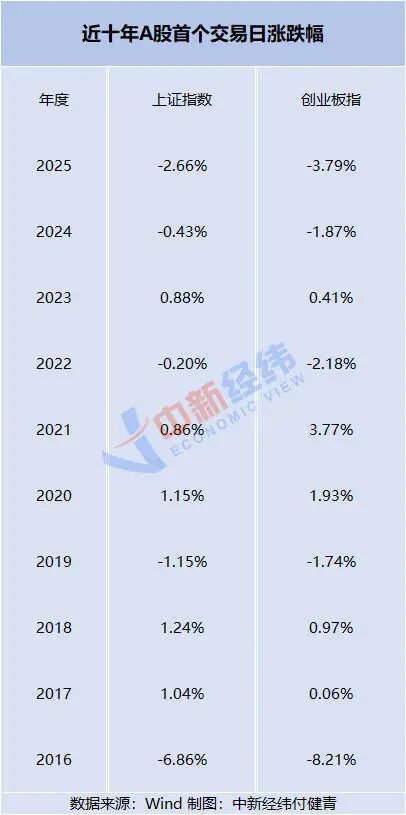
Market Performance - In 2025, the Shanghai Composite Index closed with an "11 consecutive days of gains," increasing by 18.41%, while the Shenzhen Component Index rose by 29.87%, and the ChiNext Index surged by 49.57% [1][6] - By the end of 2025, the total market capitalization of the Shanghai Stock Exchange reached approximately 64.78 trillion yuan, an increase of about 12.35 trillion yuan from the end of 2024 [1][6] - The stock fundraising amount was approximately 1.04 trillion yuan, a year-on-year increase of 343.64%, with IPO fundraising amounting to 81.3 billion yuan, up 148.75% year-on-year [1][6] Regulatory Developments - The China Securities Regulatory Commission (CSRC) solicited public opinions on the "Regulations on the Supervision of Company Secretaries of Listed Companies," aiming to enhance corporate governance [1][6] Market Outlook - Analysts from招商证券 predict that the issuance of local government special bonds is expected to accelerate, and the central budget investment will also speed up, which may lead to a positive market trend in January 2026 [3][8] - 信达证券 suggests that the strong performance of the Hong Kong stock market during the New Year holiday could positively influence the A-share market, with a favorable liquidity environment expected before the Spring Festival [4][9] Historical Trends - Over the past decade, the A-share market's performance on the first trading day of the year has shown a mixed trend, with the Shanghai Composite Index and ChiNext Index recording five gains and five losses [2][7] - In 2025, the Shanghai Composite Index fell by 2.66% on the first trading day, while the ChiNext Index dropped by 3.79% [3][8] Sector Focus - 国盛证券 recommends focusing on overseas expansion, particularly on leading brands, and highlights the potential in domestic consumption sectors such as new tourism and new retail for 2026 [4][9]
市场脱离低回报区域 可布局四条主线
Zheng Quan Shi Bao· 2026-01-04 17:30
Group 1 - The chief strategist of Guojin Securities, Miao Yiling, predicts that the ROE of the non-financial real estate sector in A-shares will increase from 7.2% to 7.9% by 2026, indicating a shift from a "low return" phase to a higher profitability rhythm [1] - Miao suggests four main investment lines: industrial resource products, equipment exports, consumer recovery, and non-bank financials, with a focus on tracking the demand for aluminum, copper, steel, and coal driven by power system construction [1] - In overseas markets, the U.S. and Europe are experiencing characteristics such as "investment exceeding consumption," profit differentiation among large and small enterprises, declining employment, and slowing wage growth, which provide a foundation for a sustained interest rate cut cycle [1] Group 2 - On the domestic consumption front, the drag of housing prices on household spending has diminished, with an increase in foreign tourists due to trade settlement rate recovery and visa-free entry, leading to improved net profit margins in sectors like aviation, hotels, duty-free, and food and beverage [2] - Financially, there is a shift of household savings towards "fixed income+" products, with pension and insurance funds continuously increasing their equity allocations; policy adjustments to lower insurance risk factors and relax brokerage leverage will resonate with the non-bank sector and ROE recovery [2]

2026,房地产要下猛药了!辽宁新年第一会今日召开!|栋察楼市早报(1.4)
Sou Hu Cai Jing· 2026-01-04 17:06
Market Insights - The article emphasizes that in 2026, significant measures will be taken to stabilize the real estate market, moving away from incremental policies to more decisive actions [6][10][12] - The commentary from the authoritative publication indicates a major shift in the government's stance on real estate, recognizing its financial attributes and importance to the national economy [3][6] Policy Changes - The article outlines three key points that reflect a reversal of negative perceptions about the real estate sector: acknowledgment of real estate as a financial asset, its role in the national economy, and the need for effective management of market expectations [5][6] - The government recognizes that housing is the most significant asset for ordinary families, and further declines in housing prices could impact social stability [9] Financial Implications - The article mentions that the concentration of household wealth in real estate ranges from 59.1% to 77.2%, significantly higher than the 20% in financial assets [7] - It is anticipated that interest rates on housing loans will decrease, with the latest rates potentially dropping to 3.05% for first-time homebuyers [18][19] Economic Initiatives - The article discusses the launch of a consumption subsidy program in Liaoning, with over 12 million yuan allocated on the first day, aimed at stimulating consumer spending through various categories including home appliances and vehicles [28][29] - The program is expected to benefit over 20,000 consumers, with a total subsidy fund of 1,223 million yuan on the first day [28] Digital Currency Developments - Starting January 1, 2026, digital yuan wallets will earn interest, marking a transition from a cash-based system to a deposit currency model [33][34] - This change is expected to enhance user engagement with digital yuan and expand its application scenarios, solidifying China's leadership in central bank digital currency initiatives [34][41]