债券

Search documents
大佬Gave警告:美联储财政部合流大局已定,明年美债或先崩,亚洲货币升值将终结黄金牛市
美股IPO· 2025-12-04 13:36
Core Viewpoint - The convergence of the Federal Reserve and the Treasury is expected to lead to a collapse of the U.S. bond market, with implications for asset allocation and investment strategies [1][5][6]. Group 1: U.S. Bond Market and Economic Implications - The current situation in the U.S. bond market mirrors Japan's, where low interest rates have led to bond sell-offs, indicating a potential crisis for U.S. bonds [5][6]. - The "Turkish scenario" is referenced, where the value of bonds and currency is sacrificed for nominal GDP growth, prompting investors to seek tangible assets like stocks and precious metals [7][8]. - The long-term impact of the Federal Reserve's policies is anticipated to manifest in the bond market first, potentially affecting the stock market and the dollar [5][6]. Group 2: Gold and Asian Currencies - The outlook for gold is closely tied to the performance of Asian currencies, particularly the undervalued Japanese yen, with a potential appreciation expected by 2026 [1][10]. - Recent trends show that gold and silver have been effective hedges against zero interest rates, with significant price increases of 55% for gold and 100% for silver this year [8][10]. - If Asian currencies appreciate, it may lead to a decrease in demand for gold as capital flows back to local assets, altering the current trading logic for gold [10][11]. Group 3: AI Market and IPO Concerns - The preparation for an IPO by AI company Anthropic raises concerns about a potential turning point in the capital-intensive bull market, suggesting a shift from rewarding spending to rewarding asset divestment [2][11][12]. - Historical patterns indicate that markets may transition from rewarding companies for high spending to penalizing them for excessive capital expenditures, which could impact the feasibility of upcoming IPOs [12][13]. - The financial metrics surrounding AI investments are daunting, with the need for AI to generate revenues significantly exceeding those of the global advertising industry to justify current valuations [15][16].


【立方债市通】河南重启土储专项债/渭南城投中票遭变相撤标/机构展望2026年货币政策
Sou Hu Cai Jing· 2025-12-04 13:00
Group 1 - Henan Province plans to issue a total of 30 billion yuan in land reserve special bonds for 36 projects [1] - The issuance of 114.7563 billion yuan in local bonds includes fixed-rate bonds [1] - The first batch of land reserve special bonds is part of a broader strategy to enhance local infrastructure [1] Group 2 - Chongqing Bank modified its bid for the "25 Weinan City Investment MTN001" bond, reducing the subscription rate from 3% to 2.5% [3] - The initial subscription amount was 1 billion yuan, which was later reduced to 500 million yuan [3] - This change occurred just before the subscription period ended, indicating potential market volatility [3] Group 3 - The People's Bank of China will conduct a 10 billion yuan reverse repurchase operation with a term of 3 months [4] - Central bank governor Pan Gongsheng emphasized the need to enhance the role of policy interest rates [4] - The aim is to improve the transmission of interest rates from central bank policies to market rates [4] Group 4 - Hubei Provincial State-owned Assets Supervision and Administration Commission plans to explore professional integration of different levels of enterprises during the 14th Five-Year Plan [7] - The focus will be on optimizing the layout and management of state-owned enterprises [7] - The initiative aims to improve the efficiency of state capital operations [7] Group 5 - The first housing voucher for guaranteed housing in Guangzhou Huangpu has been successfully exchanged, valued at 3.429 million yuan [8] - This voucher can be used to purchase properties in designated projects by December 30, 2025 [8] - The program aims to support homeowners in securing housing amid ongoing market challenges [8] Group 6 - Henan Energy Group completed the issuance of a 5 billion yuan short-term financing bond at a rate of 2.30% [9] - The funds raised will be used to repay interest-bearing debts [9] - The bond is backed by a full unconditional guarantee from China Pingmei Shenma Group [9] Group 7 - China Pingmei Shenma Group plans to issue 10 billion yuan in medium-term notes to repay interest-bearing debts [10] - The issuance will be divided into two tranches, with a total of 7 billion yuan for a 3-year term and 3 billion yuan for a 5-year term [10] - The funds are intended to strengthen the company's financial position [10] Group 8 - Xinyang Investment Group has received approval for a 10 billion yuan corporate bond issuance from the Shanghai Stock Exchange [11] - The bond is rated AA+ with a stable outlook [11] - The issuance aims to attract professional investors [11] Group 9 - Xuchang Weiwu Industrial Investment Group's 5 billion yuan corporate bond has been accepted by the Shenzhen Stock Exchange [12] - The bond is rated AA with a stable outlook [12] - The issuance is part of the company's strategy to enhance its capital structure [12] Group 10 - The Ministry of Finance plans to issue two types of book-entry discount treasury bonds totaling 100 billion yuan [13] - The bonds will have terms of 63 days and 91 days, with competitive bidding for 400 billion yuan and 600 billion yuan respectively [13] - This issuance is aimed at managing government financing needs [13] Group 11 - The appointment of Yin Chunhua and Kang Shuxia as chairman and general manager of Henan Zhongyu International Port Group has been announced [14] - This leadership change is part of a broader strategy to enhance operational efficiency [14] Group 12 - The total asset transfer of 9,470 million yuan to Gongyi Industrial Investment Development Co., Ltd. has been approved [16] - The assets include stakes in various companies and real estate [16] - This transfer is expected to optimize asset management within the company [16] Group 13 - Country Garden's debt restructuring plan for nine bonds totaling over 13.8 billion yuan has been approved by creditors [16] - This restructuring is part of the company's efforts to manage its financial obligations [16] - The approval indicates a potential stabilization in the company's financial situation [16] Group 14 - The Shanghai Stock Exchange issued a written warning to Water Development Group for violations in information disclosure [17] - The company failed to accurately disclose financial information and timely report significant borrowing [17] - This warning highlights the importance of compliance in financial reporting [17] Group 15 - The outlook for monetary policy in 2026 suggests 2-3 potential rate cuts and increased use of structural tools [19][20] - The focus will be on maintaining a low-interest environment to support economic growth [19][20] - Structural monetary policy tools will target key sectors such as consumption and technology [19][20]

债市连续调整 原因是什么?
Zhong Guo Zheng Quan Bao· 2025-12-04 12:10
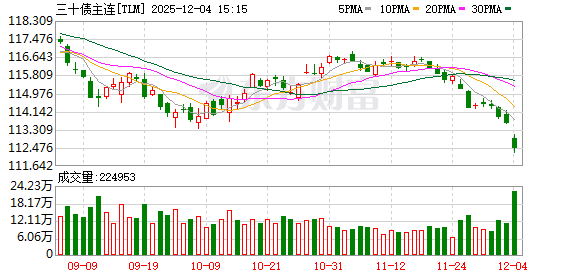
Group 1 - The bond market experienced a significant decline on December 4, with all government bond futures showing negative performance, particularly the 30-year bond futures hitting a new low since November 23, 2024 [1][3] - As of the close on December 4, the main contracts for various maturities of government bonds fell, with the 30-year bond futures down by 1.04% to 112.45, and the 10-year bond futures down by 0.35% to 107.67 [3][4] - The yields on active government bonds also increased, with the 30-year bond yield rising by 1.9 basis points to 2.26%, and the 10-year bond yield up by 1.3 basis points to 1.85% [4] Group 2 - The overall trend in the bond market has been weak since December, with cumulative declines in the main contracts for various maturities, including a 1.78% drop for the 30-year bonds [5] - Multiple factors are influencing the bond market's performance, including tightening liquidity and changing expectations regarding monetary policy, as evidenced by the People's Bank of China's recent operations [7][8] - Market sentiment remains cautious, with expectations of limited positive reactions to favorable fundamentals due to the uncertainty surrounding new public fund sales regulations [10]

信用债年末如何配置?机构建议把握结构性机会
Xin Hua Cai Jing· 2025-12-04 12:00
Core Viewpoint - The credit bond market is experiencing low-level fluctuations in yields as it approaches year-end, facing challenges such as seasonal funding volatility and weakened institutional allocation, while also presenting structural opportunities due to the release of amortized bond fund scales [1][2] Supply and Demand Dynamics - The current credit bond market shows a "generally stable, structurally differentiated" characteristic, with widening differences in yields and spreads across different segments, influenced by seasonal marginal changes in both supply and demand [2] - The yield performance indicates that AAA-rated urban investment bonds for 3 to 10 years have increased by 6 basis points (BP), while AA+ rated bonds have risen by 5 to 6 BP, contrasting with a decrease of 1 to 2 BP for AA and below rated 5-year bonds, suggesting a trend of "short flat, medium expansion, long contraction" in spreads [2][3] Market Trends - The net buying scale of credit bonds has decreased from approximately 100 billion yuan at the beginning of November to 50 billion yuan by the end of the month, with short-duration products' transaction share rising from 43% to 58% [3] - The liquidity environment remains supportive, with a stable monetary policy aimed at "steady growth," which is expected to maintain a stable funding environment in December, providing a foundation for low credit spreads [3][4] Structural Opportunities - The release of amortized bond fund scales is significant, with an estimated 1,077 billion yuan expected to open in December, which will further boost demand for 3 to 5-year credit bonds [4][5] - Institutions are beginning to position themselves for mid to long-term credit bonds, with a projected opening scale of approximately 1,300 billion yuan in the first quarter of 2026, indicating a stable demand for high-rated 5-year bonds [5] Investment Strategy - The investment strategy for December should focus on "defensive as the foundation, offensive as appropriate," emphasizing the need to control overall risk while targeting high-value bonds that meet the demand from amortized bond funds [6][7] - Recommendations include focusing on 2 to 3-year mid-short duration bonds to capture yield opportunities, particularly in high-rated (AAA, AA+) urban investment and quality industrial bonds, while avoiding sectors with excess capacity and cash flow volatility [7][8] - For stable liability accounts, it is advisable to preemptively position in 5-year high-rated bonds, as these are expected to provide value in the context of the upcoming large-scale opening of amortized bond funds [8]
债市承压深跌 谁在抛售超长债?
Di Yi Cai Jing· 2025-12-04 12:00
Core Viewpoint - The bond market is experiencing significant downward pressure, with long-term bonds facing increased selling pressure and widening yield spreads, indicating a challenging environment for investors [2][3][4]. Group 1: Market Performance - On December 4, the bond market saw a notable decline, with the 30-year government bond futures contract dropping over 1%, marking the largest single-day decline in recent times [2]. - The yield on the 30-year special government bond reached approximately 2.28%, reflecting a rise of 4 basis points [2][4]. - The yield spread between 10-year and 30-year government bonds has widened to around 43 basis points, indicating a growing divergence in bond performance [4]. Group 2: Market Dynamics - The bond market's continued decline is attributed to a lack of positive catalysts and heightened panic among investors, leading to increased selling activity, particularly from banks and non-bank institutions [5][7]. - The People's Bank of China (PBOC) reported a net bond purchase of 500 billion yuan in November, which, while an increase from the previous month, still fell short of market expectations [4][6]. - The upcoming expiration of 1 trillion yuan in 3-month reverse repos is expected to influence market liquidity and sentiment [2]. Group 3: Institutional Behavior - Banks are primarily responsible for the selling pressure, driven by the need to realize gains from previous investments and regulatory constraints on long-duration bond holdings [7][8]. - Public funds are facing redemption pressures due to new fee regulations, which may lead to further selling of long-term bonds [8][9]. - The insurance sector has shown a reduced appetite for long-term bonds, with a shift in asset allocation towards equities [8]. Group 4: Future Outlook - Analysts express a cautious short-term outlook for the bond market, with expectations of potential recovery in the long term as liquidity conditions improve and institutional demand stabilizes [10][11]. - The possibility of further monetary policy easing, including interest rate cuts, could provide support for the bond market in the future [11].
加仓!资金涌入这一方向
Zhong Guo Zheng Quan Bao· 2025-12-04 11:55
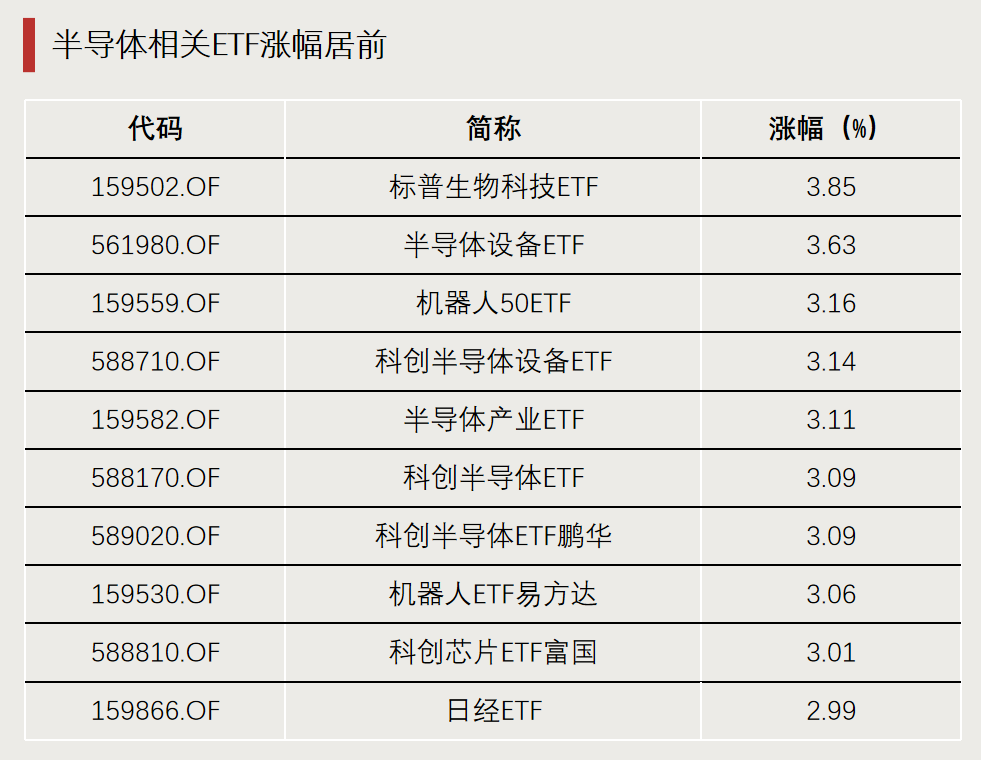
01 12月4日,三大指数涨跌不一,创业板指尾盘走强。摩尔线程12月5日将在科创板上市,相关概念股爆发,带动半导体主题ETF上涨,涨幅前 十的ETF中,有6只半导体相关ETF。 02 近期债市震荡,债券相关ETF成交活跃。12月4日,成交额前十的ETF中,7只为债券相关ETF。今日跌幅较大的30年国债相关ETF成交额较 大。科创债ETF成交持续活跃,12月1日以来,每天均有多只科创债ETF位列成交额前十名单。 03 核心资产吸金。12月3日,资金净流入居前的ETF中出现多只中证A500相关ETF、沪深300ETF等产品。 半导体相关ETF涨幅居前 12月4日,半导体产业链表现活跃。涨幅前十的ETF中有6只半导体相关ETF,其中,半导体设备ETF(561980)涨幅达3.63%,在所有A股 ETF中涨幅最高。 | 代码 | 简称 | 涨幅 (%) | | --- | --- | --- | | 159502.OF | 标普生物科技ETF | 3.85 | | 561980.OF | 半导体设备ETF | 3.63 | | 159559.OF | 机器人50ETF | 3.16 | | 588710.OF | 科 ...
【笔记20251204— 债农每日一盼:央妈今天爱吗?】
债券笔记· 2025-12-04 11:44
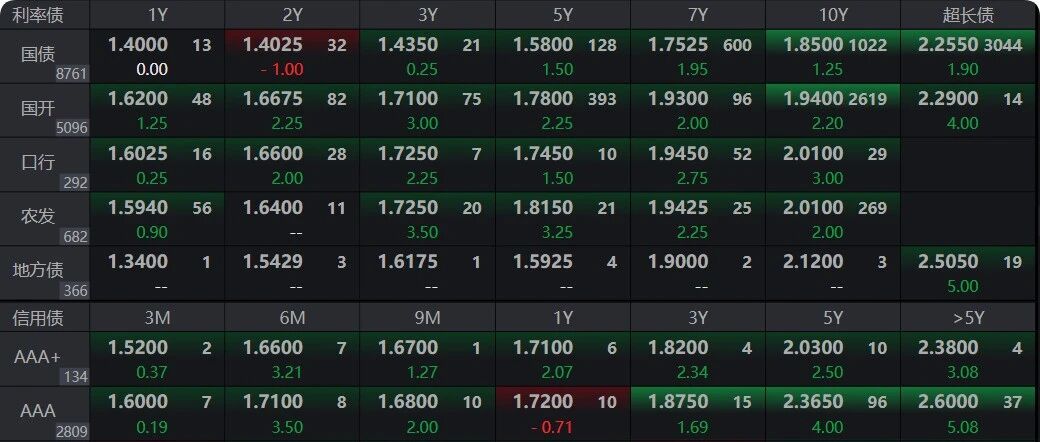
Core Viewpoint - The article discusses the current state of the financial market, focusing on the central bank's actions and their impact on liquidity and interest rates, particularly in the bond market. Group 1: Central Bank Actions - The central bank conducted a 1,808 billion yuan reverse repurchase operation, with 3,564 billion yuan maturing today, resulting in a net withdrawal of 1,756 billion yuan [1] - An announcement was made for a 10,000 billion yuan buyout reverse repurchase operation scheduled for December 5, 2025 [1][3] - The overall funding environment is described as balanced and slightly loose, with stable funding rates [1] Group 2: Interest Rate Movements - The 10-year government bond yield opened higher at 1.845% and fluctuated, reaching a peak of 1.861% before settling at 1.8500% [3] - The weighted average rates for various repo codes indicate a slight increase, with R001 at 1.36% and R007 at 1.49% [2] - The market reacted to the Financial Times' commentary on "short-term tightening and long-term easing," leading to fluctuations in bond prices and yields [3] Group 3: Market Sentiment - The article reflects a sense of uncertainty among investors, with questions about the central bank's support for the market, likening it to a daily inquiry from stock and bond investors [3] - The sentiment is further illustrated by the humorous commentary on market expectations, highlighting the disconnect between investor hopes and market realities [3]
欧元区公债收益率走高 投资者聚焦美联储政策前景
Xin Lang Cai Jing· 2025-12-04 11:31
Core Viewpoint - Eurozone bond yields rose on Thursday, following the trend of U.S. bonds, as investors focused on the Federal Reserve's policy outlook and awaited key U.S. employment data later in the day [1][5]. Group 1: Eurozone Bond Yields - The German 10-year government bond yield increased by 0.5 basis points to 2.75% [2][6]. - The market remains cautious regarding the potential for a comprehensive and credible peace agreement in Ukraine, which could alleviate inflationary pressures and support economic growth, thereby influencing the European Central Bank's policy path [2][7]. Group 2: U.S. Bond Influence - U.S. borrowing costs continue to dominate market trends, with expectations that the European Central Bank will maintain interest rates until 2027 [4][9]. - The U.S. 10-year bond yield rose by 2.5 basis points to 4.08%, following a decline on Wednesday, as data showed an unexpected decrease in private sector jobs for November [4][9]. - The German 2-year bond yield, which is more sensitive to expectations regarding the European Central Bank's policy rate, increased by 1 basis point to 2.06%, having previously reached 2.08%, the highest level since the end of March [4][9].
中加基金配置周报|中美领导人通话,俄乌谈判取得进展
Xin Lang Cai Jing· 2025-12-04 09:50
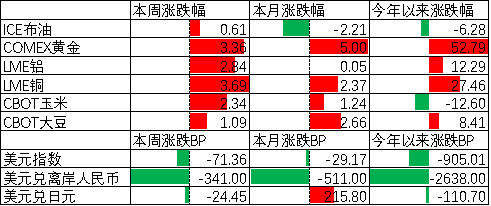
Key Points - The official manufacturing PMI in China for November is reported at 49.2, slightly up from the previous value of 49, while the non-manufacturing business activity index decreased to 49.5, down by 0.6 percentage points from the previous month [1][17] - In the U.S., the PPI for September increased by 0.3% month-on-month, with core PPI rising by 0.1%, indicating a notable acceleration in inflation [1][17] - U.S. retail sales for September grew by 0.2% month-on-month, marking the fourth consecutive month of positive growth but showing a significant slowdown and falling short of market expectations [1][17] - Durable goods orders in the U.S. for September showed an initial month-on-month increase of 0.5%, a significant deceleration from the revised 3% in the previous month, while core capital goods orders rose by 0.9%, exceeding market expectations of 0.3% [1][17] - Chinese President Xi Jinping and U.S. President Trump discussed the stability and positive direction of U.S.-China relations, emphasizing mutual benefits and cooperation [2][18] - Trump announced significant progress in the peace plan for the Russia-Ukraine conflict, with a special envoy set to meet with President Putin to finalize the agreement [3][19] - San Francisco Fed President Daly expressed support for a rate cut in December, citing a greater risk of sudden job market deterioration compared to inflation spikes [3][19] Market Review Futures Market - ICE Brent crude oil rose by 0.61% to $62.32, while COMEX gold increased by 3.36% to $4256.4 [4][22] - The U.S. dollar index fell by 71.36 basis points, with the Chinese yuan appreciating by 341 basis points against the dollar [5][22] Stock Market - The A-share market saw gains, with the ChiNext index rising by 4.54%, the largest increase among major indices, driven by improved risk appetite following the U.S.-China leaders' call [6][23] - The Hang Seng Index increased by 2.53%, and the Hang Seng Tech Index rose by 3.77%, reflecting a recovery in risk appetite [7][24] - U.S. stock markets also rebounded, with the Nasdaq index gaining 4.91%, supported by signs of resolution in the Russia-Ukraine conflict and increased rate cut expectations [8][25] Bond Market - In the bond market, credit bonds saw an upward trend, with 3Y AAA bonds rising by 5 basis points, while long-term bonds increased more than short-term ones [9][27] - U.S. Treasury yields generally declined, with the 20Y yield down by 5 basis points, influenced by Fed officials' support for a rate cut [10][28] Asset Allocation Perspective - The November PMI data indicates a slight recovery in manufacturing, while the service sector shows signs of contraction, suggesting a bottoming-out phase for the Chinese economy [11][29] - The expectation for a rate cut by the Federal Reserve has strengthened, with the probability of a December cut rising from 71% to 86% [11][29]
德银:从“点心”到“主菜”--人民币点心债市场面临大发展机遇
美股IPO· 2025-12-04 08:19
Core Viewpoint - The report from Deutsche Bank indicates that the RMB dim sum bond market is transitioning from a marginalized "niche market" to a mainstream asset class, driven by significant changes in both supply (low interest rates attracting global issuers) and demand (real trade settlement and the introduction of "Southbound Bond Connect" bringing in domestic funds) [1][3][4]. Group 1: Supply and Demand Dynamics - The supply side is experiencing an explosion, with various issuers, from Chinese tech giants to countries along the Belt and Road, entering the dim sum bond market to lower financing costs and manage currency risks [4]. - The demand side has shifted from speculative to transactional, with the stable growth of offshore RMB funds now primarily driven by real cross-border trade and capital settlement needs, providing a solid foundation for the market [4][8]. - The macro environment is also supportive, as global investors seek alternatives to USD assets, enhancing the attractiveness of dim sum bonds amid expectations of RMB appreciation [4]. Group 2: Market Growth and Participation - The dim sum bond market has shown remarkable growth, with annual issuance in RMB terms skyrocketing from 300 billion RMB in 2021 to an expected 900 billion to 1 trillion RMB in 2025, with a current market size of 1.8 trillion RMB [6]. - The participation base is expanding, with foreign issuers like the Kazakhstan Development Bank and the Indonesian government entering the market, indicating a shift from a solely Chinese issuer base to a more international one [6]. - The low interest rate environment has also led to an increase in the issuance of long-term bonds, with the issuance of bonds with maturities of 15 to 30 years rising significantly [6]. Group 3: Policy Support and Future Outlook - The Chinese government's push for RMB internationalization is providing strong support for the dim sum bond market, with a shift in policy focus towards more aggressive promotion [10]. - The "Southbound Bond Connect" has played a crucial role in alleviating demand bottlenecks by allowing mainland banks to invest directly in dim sum bonds, with a cumulative scale reaching 600 billion RMB [10]. - Looking ahead, the strong RMB is expected to further enhance the attractiveness of RMB assets, with predictions of continued appreciation, making dim sum bonds a significant opportunity for global investors [12][13].