
食品饮料

Search documents
主力资金监控:紫金矿业净卖出超15亿
Xin Lang Cai Jing· 2026-02-05 03:08
Group 1 - The main point of the article highlights that major funds have net sold over 1.5 billion in Zijin Mining [1] - In the early trading session, major funds saw net inflows in sectors such as food and beverage, pharmaceuticals, and film and television, while experiencing net outflows in the electric new energy, non-ferrous metals, and electronics sectors [1] - The electric new energy sector had a significant net outflow exceeding 15.3 billion [1] Group 2 - Pingtan Development reached the daily limit with a net buy of over 1.1 billion, leading the inflow rankings [1] - Companies like Zhongji Xuchuang, N Beixin-U, and Wangsu Technology also saw significant net inflows from major funds [1] - Zijin Mining faced the largest net sell-off, exceeding 1.5 billion, along with other companies like Tebian Electric, Xinyisheng, and Longi Green Energy experiencing notable net outflows [1]

与凯恩斯共进思想午餐:普通人如何抓住十年一遇的财富潮?
Sou Hu Cai Jing· 2026-02-05 02:57
Core Insights - The article discusses the investment strategies and market predictions for 2026, emphasizing the importance of rational decision-making amidst market noise [2] Group 1: Macroeconomic Trends - The new Federal Reserve chair is expected to initiate two interest rate cuts in the first half of 2026, with a possibility of a third cut later in the year, which will significantly alter global capital flows [6] - A weaker US dollar is anticipated, leading to a stronger Chinese yuan, with projections suggesting the yuan could surpass 6.5 against the dollar by 2026 [7] Group 2: Market Predictions - The A-share market is expected to experience a "balanced bull market" in 2026, driven by liquidity, profit improvements, and policy support [9] - Key sectors to watch include emerging industries such as integrated circuits, new displays, and biomedicine, which are set to receive policy and funding support [9] Group 3: Investment Strategies - Investors are advised to focus on "dividend assets" that provide stable returns and valuation recovery, particularly in sectors like banking, insurance, and energy [10] - The overarching investment strategy for 2026 is to align with liquidity easing, follow policy and industry trends, and maintain a balanced portfolio to navigate market fluctuations [11]


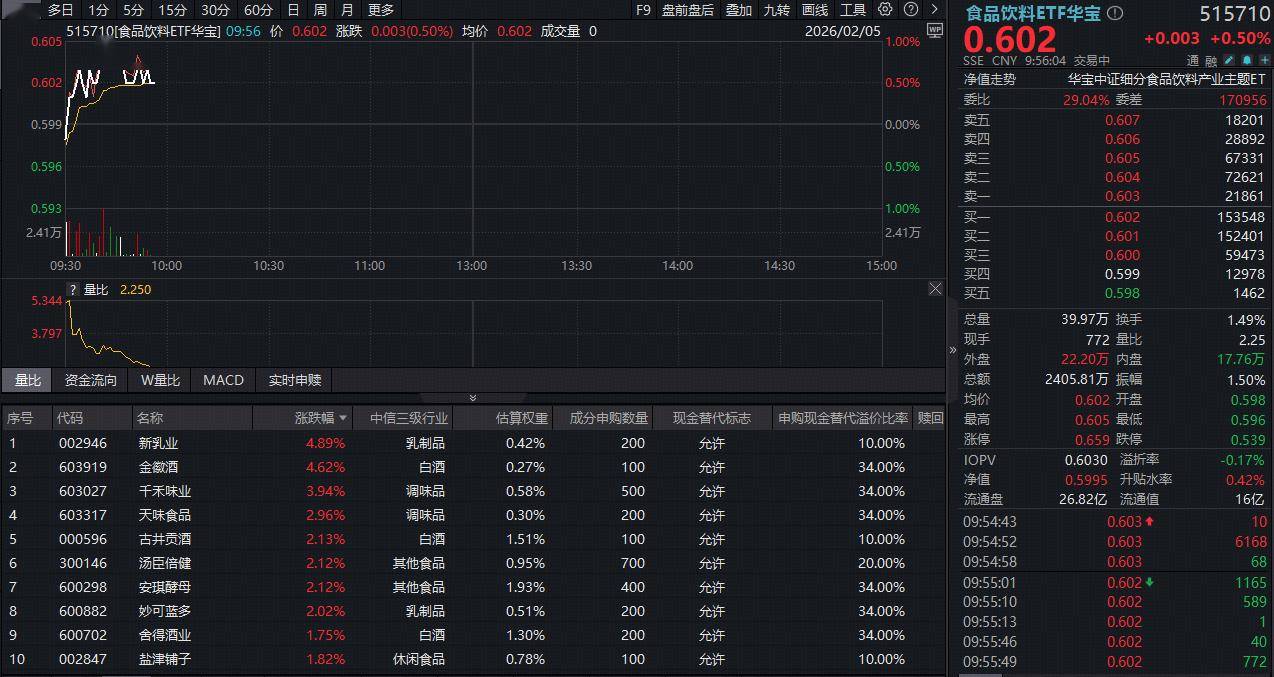
ETF盘中资讯|茅台开卖蓝莓气泡酒!吃喝板块继续上攻,食品饮料ETF华宝(515710)上探1%!
Sou Hu Cai Jing· 2026-02-05 02:51
Group 1 - The food and beverage sector continues to rise, with the Huabao Food and Beverage ETF (515710) showing a 0.5% increase as of the latest report [1] - Major consumer goods and leading liquor brands are performing well, with New Dairy and Jinhui Liquor both rising over 4%, and Qianhe Flavor Industry increasing over 3% [1] - The launch of Moutai's blueberry sparkling wine is part of its strategy to appeal to younger consumers and expand its market presence, priced at 99 yuan per bottle [2][3] Group 2 - The food and beverage sector is currently at a low valuation, with the PE ratio of the underlying index at 20.93, indicating a favorable long-term investment opportunity [3] - Analysts suggest that the food and beverage sector is showing signs of recovery, supported by government policies aimed at boosting domestic consumption [3] - The Huabao Food and Beverage ETF has a significant allocation towards leading high-end liquor stocks, with around 60% of its portfolio in this category [4]
广货行天下,金融放大招!这些“真香福利”何以点燃消费热潮
Nan Fang Du Shi Bao· 2026-02-05 02:43
Group 1 - The core idea of the articles revolves around the financial sector's role in boosting consumer spending during the upcoming Spring Festival, with various promotional activities and discounts being introduced to encourage spending [2][3][4] - The Ministry of Commerce and other agencies have launched the "2026 'Buy New Year Goods' Spring Festival Special Activity Plan," which encourages financial institutions to collaborate with key merchants to offer exclusive promotions such as consumption red envelopes and discounts [2] - Financial institutions are providing various incentives, including interest-free credit card installments and digital RMB red envelopes, which lower the barriers to consumer spending and enhance the market reach of local products, particularly "Guangdong goods" [3][4] Group 2 - Specific examples of consumer spending include significant discounts on popular products, such as a Huawei Mate80 purchased for 4249 yuan after applying various promotions, showcasing the effectiveness of financial incentives in driving sales [3] - Financial institutions like Guangzhou Bank are implementing targeted initiatives, such as "1 yuan to buy New Year goods" and random discounts, to cater to consumer needs during the festive season [4] - The integration of financial services into various consumption scenarios, including travel and entertainment, is enhancing the overall consumer experience and stimulating demand for local products [6][8] Group 3 - The introduction of personal consumption loan interest subsidy policies by the government aims to reduce financing costs for consumers, thereby increasing their purchasing power for local products [7] - The policy has been extended to include credit card installment payments, further broadening the benefits available to consumers and encouraging spending on "Guangdong goods" [7] - Financial support is also being extended to production and distribution sectors, with banks providing loans to local businesses, thereby strengthening the entire supply chain for "Guangdong goods" [8] Group 4 - The "Guangdong Goods Going Global" initiative is being promoted through events like the "Guangdong Goods New Year Festival," which aims to enhance local brand visibility and stimulate consumer interest [10] - Various local brands and products are being showcased, including traditional delicacies and modern consumer goods, to attract a wide range of consumers during the festival [11][12] - The festival will feature exclusive discounts for credit card users, further incentivizing participation and spending [13]

宝立食品20260204
2026-02-05 02:21
Summary of Poly Food's Conference Call Company Overview - Poly Food was established in 2001, initially supplying fruit powder and breadcrumbs to Yum China, later expanding to marinades and sauces. In 2018, the company entered the C-end light cooking food market with the launch of the "Kongke" pasta and went public in 2022 [2][4]. Industry Insights - The increasing chain rate in China's restaurant industry drives the demand for standardized compound seasonings, providing growth opportunities for Poly Food's B-end business. The chain rate is projected to rise from over 10% in 2018 to over 21% by 2024, still below the over 50% in the U.S. [2][7]. Core Business Model - Poly Food positions itself as a comprehensive customized solution provider, transitioning from merely selling products to offering full-service solutions. The product line includes fruit powder, marinades, seasonings, and sauces, catering to nearly all needs of Western-style dining [2][8]. Key Clients - Core clients include major Western fast-food chains such as Yum China (KFC, Pizza Hut), McDonald's, and Burger King, as well as emerging sectors like ready-to-drink tea and meat processing companies [2][9][10]. B-end Business Growth - B-end business growth is driven by collaborations with major clients and the introduction of new products. The company leverages scale benefits from partnerships and continuously develops new products to tap into emerging restaurant chains [2][11]. C-end Business Development - The C-end light cooking solution, represented by "Kongke" pasta, has rapidly gained market share since its launch in 2019, becoming the top-selling Italian pasta online. The product offers a complete home cooking experience and has expanded to include healthier and child-friendly versions [2][12]. Marketing and Sales Strategy - The "Kongke" brand initially focused on online sales through platforms like Tmall and JD, while also utilizing new media for brand promotion. The company is now actively expanding into offline channels to enhance brand presence and increase sales [2][13]. R&D Capabilities - Poly Food's R&D team consists of members with extensive experience in multinational food companies and well-known restaurant chains, enabling rapid transformation of client concepts into standardized products. The company employs a collaborative R&D model with major clients to align with market trends [2][14]. Supply Chain Advantages - The company has a robust supply chain with production bases in Shanghai, Zhejiang, and Shandong, allowing for flexible production capabilities to meet both large and small client needs. This adaptability supports the B-end business's diverse and customized requirements [2][15]. Performance Evaluation - Poly Food has established strong ties with major clients, maintaining double-digit growth despite a challenging restaurant environment. The company has developed a "BB+C" dual-driven model, enhancing cash flow and technology through B-end operations while achieving growth and profit through C-end initiatives [2][16][17]. Future Outlook - Poly Food's solid fundamentals and clear strategic path suggest long-term growth potential. The company is expected to maintain its leading position in the food industrialization wave, continuing to expand its growth boundaries and is recommended for investment in the restaurant supply chain sector [2][18].

金银巨震-风格切换-策略周中谈
2026-02-05 02:21
Summary of Key Points from Conference Call Records Industry Overview - The records primarily discuss the **gold and silver markets**, highlighting their volatility and the impact of macroeconomic factors on prices [1][2][3]. Core Insights and Arguments 1. **Volatility in Gold and Silver Prices**: The significant fluctuations in gold prices are attributed to excessive prior gains and the involvement of leveraged funds, which triggered a chain reaction of sell-offs when stop-loss mechanisms were activated. Silver, due to its dual financial and industrial nature, exhibited even greater volatility [1][2]. 2. **Weakening Dollar**: The decline of the US dollar is identified as a crucial factor driving up international metal prices, stemming from issues related to US fiscal discipline and global capital's distrust in the dollar system. Events like the Greenland purchase and rumors surrounding the Federal Reserve chairmanship have intensified expectations of dollar depreciation [1][3][4]. 3. **Potential Policies under Walsh**: The new Fed chair, Walsh, is expected to implement a combination of balance sheet reduction and interest rate cuts aimed at controlling inflation, reducing government debt burdens, and encouraging productive investment. This could lead to a stronger dollar in the long term, which may suppress resource prices but benefit high-growth sectors like AI [5][8]. 4. **European Capital Flows**: There has been a notable shift in European capital away from US assets towards European and emerging market assets, driven by US fiscal issues and geopolitical risks. This trend has weakened demand for US equities and bonds, further exacerbating dollar depreciation pressures [4][6]. 5. **Challenges of Balance Sheet Reduction**: The feasibility of the Fed's balance sheet reduction remains uncertain, as it involves managing a large volume of government debt while maintaining liquidity stability. Successful implementation could raise long-term interest rates, limit government debt expansion, and lead to a decline in risk assets [7][11]. 6. **Impact on High-Growth Sectors**: While the balance sheet reduction and interest rate cut policy may pose some negative impacts, the interest rate cuts are seen as beneficial for high-growth sectors like AI, as they lower financing costs and stimulate investment [8][9]. 7. **Market Reactions to New Fed Chair**: Historical data indicates that new Fed chairs often lead to increased market volatility, with significant declines in the S&P 500 index observed in the months following their appointment. This suggests potential risks for the market following Walsh's confirmation [12]. Other Important Insights 1. **ETF Sell-offs by National Team**: Recent concentrated sell-offs of broad-based ETFs by the national team resulted in a significant outflow of approximately 913.4 billion yuan, accounting for 60% of the total market value held at year-end. However, it is anticipated that further sell-offs will not occur, maintaining a relatively ample liquidity environment [15]. 2. **Investment Opportunities Post-Spring Festival**: The upcoming spring season is expected to present investment opportunities, particularly in technology growth sectors such as power equipment and AI, as well as in the financial sector, which has been under pressure from previous ETF sell-offs [16][18]. 3. **Sector-Specific Insights**: - The coal industry is affected by policy adjustments in Indonesia, while the food and beverage sector is under scrutiny due to low institutional positions and changing sales expectations during the Spring Festival [20]. - The long-term investment focus for 2026 is on technology and resource sectors, with a particular emphasis on TMT (AI, semiconductors) and resource commodities undergoing revaluation [21][22][23]. 4. **Strategic Value of Gold**: The current favorable outlook for gold is linked to the perceived decline of US power, suggesting that as long as Trump remains in power, gold prices may continue to rise [22]. 5. **New Valuations in Chemical and Machinery Sectors**: The chemical sector, especially large refining capacities, is seen as having strategic value that requires revaluation. Similarly, the machinery sector is expected to find new value positioning in the current environment [23].
茅台开卖蓝莓气泡酒!吃喝板块继续上攻,食品饮料ETF华宝上探1%!
Xin Lang Ji Jin· 2026-02-05 02:20
Core Viewpoint - The food and beverage sector continues to show upward momentum, with the Huabao Food and Beverage ETF (515710) experiencing a slight increase, reflecting strong performance among leading companies in the sector [1][3]. Group 1: Market Performance - The Huabao Food and Beverage ETF opened with fluctuations and reached a peak increase of 1%, ultimately rising by 0.5% as of the report [1]. - Major consumer goods stocks led the gains, with New Dairy and Jinhui Liquor both surging over 4%, and Qianhe Flavor Industry rising over 3% [1]. - Notable liquor brands such as Guizhou Moutai, Shede Liquor, and others also showed significant increases [1]. Group 2: New Product Launch - Guizhou Moutai's e-commerce platform announced the launch of a blueberry sparkling wine, priced at 99 yuan per 375ml bottle, as part of its strategy to appeal to younger consumers [2][3]. - This product launch is seen as a strategic move to enhance brand positioning and market penetration, potentially leading to rapid sales growth [3]. Group 3: Valuation Insights - The food and beverage sector is currently at a low valuation, with the price-to-earnings ratio of the underlying index for the Huabao ETF at 20.93, which is at the 11.74% percentile of the past decade [3]. - The sector is viewed as having significant medium to long-term investment value due to its current low valuation and improving market conditions [5]. Group 4: Investment Opportunities - The Huabao Food and Beverage ETF tracks the CSI segmented food and beverage industry index, with approximately 60% of its portfolio in leading high-end and mid-range liquor stocks, and nearly 40% in beverage, dairy, and seasoning sectors [4]. - Investors can also access core assets in the food and beverage sector through the Huabao ETF linked funds [4].

震荡市方显消费价值!段永平调仓买入茅台,消费ETF(159928)涨近1%冲击三连阳!港股通消费ETF汇添富(159268)涨超2%!
Xin Lang Cai Jing· 2026-02-05 02:20
Core Viewpoint - The consumer sector is experiencing a strong performance, particularly in the context of the Hong Kong Stock Connect Consumer ETF, which has seen significant inflows and notable gains in key stocks [1][5]. Group 1: Market Performance - The Hong Kong Stock Connect Consumer ETF (159268) has surged over 2%, with net inflows exceeding 46 million yuan over the past five days [1]. - Key stocks within the ETF include Baisheng China, which rose over 7%, and other notable performers like Giant Bio and Pop Mart, which increased by over 6% and 4% respectively [3][4]. Group 2: Company Earnings - Baisheng China reported a total revenue of $11.797 billion for the fiscal year 2025, marking a 4% year-on-year increase, with a net profit of $929 million, up 2% [3]. - In Q4 alone, Baisheng China achieved a revenue of $2.823 billion, reflecting a 9% increase year-on-year, and a net profit of $140 million, which is a 22% growth [3]. Group 3: Consumer Sector Insights - The consumer sector is showing a divergence in performance, with essential consumption industries experiencing a recovery while discretionary consumption faces challenges [8]. - The valuation of the consumer sector remains attractive, with the PE historical percentile for A-share food and beverage at 17%, indicating a slight increase from the previous month [9]. Group 4: Investment Trends - There is a notable shift in investment strategies, with international capital increasing its exposure to Chinese markets, particularly in consumer sectors [12]. - The report suggests focusing on leading brands in the liquor sector and those with improving fundamentals and dividend yields, such as dairy products and beer [14].





2026年开年之际促消费政策频发,消费ETF嘉实(512600)获资金关注
Xin Lang Cai Jing· 2026-02-05 02:20
Group 1 - The core viewpoint is that the consumer sector is expected to benefit from a series of consumption promotion policies in 2026, focusing on encouraging new business models rather than traditional stimulus methods [1] - The main consumption index increased by 0.86% as of 09:53 on February 5, 2026, with significant gains from companies like Beitaini (up 8.74%) and Huaxi Biological (up 6.62%) [1] - New economic models such as performance economy, cruise economy, and ice and snow economy are anticipated to receive policy support, creating structural investment opportunities in the consumer industry [1] Group 2 - The top ten weighted stocks in the main consumption index account for 67.37%, with leading companies including Kweichow Moutai and Wuliangye [1] - The consumption ETF managed by Harvest (512600) tracks the main consumption index, which includes major consumer leaders across various sectors, with over 38% weight in the liquor industry [2] - Investors can also access the consumption recovery trend through the consumption ETF linked fund (009180) [3]
茅台开卖蓝莓气泡酒!吃喝板块继续上攻,食品饮料ETF华宝(515710)上探1%!
Xin Lang Cai Jing· 2026-02-05 02:17
Core Viewpoint - The food and beverage sector continues to show upward momentum, with the Huabao Food and Beverage ETF (515710) experiencing a rise of 0.5% as of the latest update, despite market fluctuations [1][8]. Market Performance - The Huabao Food and Beverage ETF opened with volatility but reached a peak increase of 1% during the trading session [1][8]. - Key stocks in the sector, particularly in consumer goods and leading liquor brands, have shown significant gains, with New Dairy and Jinhui Liquor both rising over 4%, and Qianhe Flavor Industry increasing by over 3% [1][8]. New Product Launch - On February 4, Kweichow Moutai announced the launch of a new blueberry sparkling wine on its e-commerce platform, priced at 99 yuan per 375ml bottle, aligning with its strategy to appeal to younger consumers [2][10]. Strategic Insights - Analysts suggest that the launch of the blueberry sparkling wine is a strategic move for Moutai to enhance its brand appeal and market penetration, potentially leading to significant sales growth in the short term and establishing a foothold in the mass market in the long term [3][10]. - The food and beverage sector is currently viewed as undervalued, with the price-to-earnings ratio of the underlying index for the Huabao ETF at 20.93, placing it in the lower percentile of the past decade [3][10]. Investment Opportunities - The Huabao Food and Beverage ETF is structured to allocate approximately 60% of its portfolio to leading high-end and mid-range liquor stocks, while the remaining 40% is invested in leading companies across beverages, dairy, and condiments [4][11]. - Investors can also consider the Huabao Food and Beverage ETF linked funds for exposure to core assets in the sector [4][11]. Future Outlook - Analysts from Kaiyuan Securities indicate that the food and beverage sector is currently at a low point in terms of fundamentals and valuations, suggesting a potential for significant investment opportunities [5][13]. - The Consumer Price Index (CPI) is expected to show a mild recovery, with a projected year-on-year increase of 0.8% by December 2025, indicating a gradual improvement in industry demand [5][13].