
证券业

Search documents
中国十大最具发展潜力城市
泽平宏观· 2026-02-20 16:05
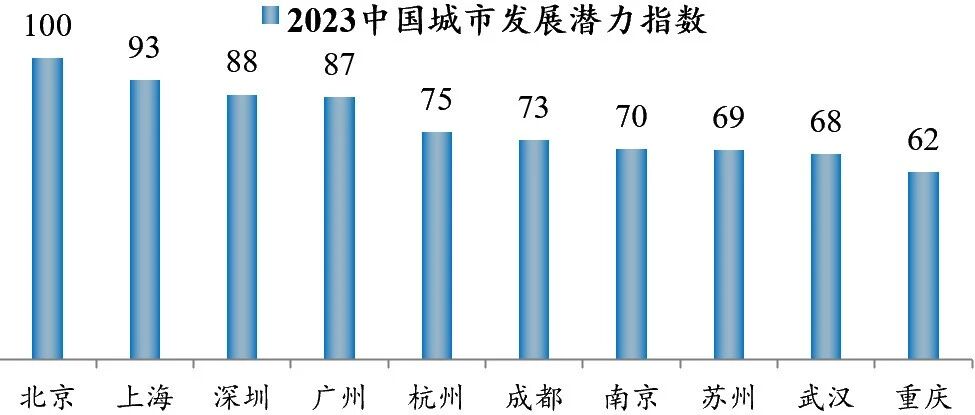
Core Viewpoint - The article discusses the competitive landscape of Chinese cities, highlighting the rapid urbanization and the emergence of new economic centers, while ranking the development potential of 337 cities in China, with Beijing, Shanghai, Shenzhen, and others leading the list [2]. Group 1: Beijing - Beijing is positioned as the political, cultural, international exchange, and technological innovation center of China, with a GDP exceeding 4.1 trillion yuan in 2022, making it the second-largest city after Shanghai [9][10]. - The service sector accounts for 84% of Beijing's economy, with finance, headquarters economy, and technological innovation as key pillars [10]. - Future plans include transforming Beijing into a world-class harmonious city while optimizing population distribution to enhance urban vitality [11][13]. Group 2: Shanghai - Shanghai has established itself as an international economic center, with a GDP of approximately 4.5 trillion yuan in 2022, and aims to rival New York in global economic influence [16][24]. - The city’s industrial structure is supported by the automotive, electronics, and financial sectors, with finance contributing 19.3% to the GDP [17][19]. - Shanghai plans to continue its open policies and develop into a globally competitive city, enhancing the Yangtze River Delta region [24]. Group 3: Shenzhen - Shenzhen's GDP surpassed 3.2 trillion yuan in 2022, marking it as the third-largest city in China, with a significant annual population increase of around 600,000 [25][26]. - The city is recognized as a leading innovation hub, with strategic emerging industries accounting for over 41% of its GDP [26]. - Future initiatives focus on enhancing collaboration within the Guangdong-Hong Kong-Macau Greater Bay Area to solidify its status as a global innovation city [29]. Group 4: Guangzhou - Guangzhou's GDP reached approximately 2.9 trillion yuan in 2022, ranking fifth nationally, with a strong manufacturing base in automotive and electronics [30][31]. - The city faces challenges in innovation capacity and financial sector development, with financial services contributing only 9.2% to the GDP [33]. - Future goals include enhancing its role as a national center city and participating in global economic cooperation [34]. Group 5: Hangzhou - Hangzhou's economy has shown robust growth, with a GDP of around 1.9 trillion yuan in 2022, driven by a vibrant private and digital economy [36][37]. - The city is recognized for its strong digital economy, with core digital industries contributing 27.1% to the GDP [37]. - Plans for the future include improving transportation infrastructure and fostering a more open and innovative business environment [41][42]. Group 6: Chengdu - Chengdu's GDP exceeded 2 trillion yuan in 2022, accounting for 36.7% of Sichuan province's economy, and it is recognized as a key economic hub in Western China [43][44]. - The electronics sector is a major contributor, with a significant portion of the industrial output [44]. - Future strategies involve enhancing its role as a national center city and collaborating with Chongqing to develop the Western economic highland [49]. Group 7: Nanjing - Nanjing's GDP approached 1.7 trillion yuan in 2022, with a per capita GDP of 179,000 yuan, ranking fifth among major cities [50][51]. - The city is focusing on developing its automotive, steel, electronics, and petrochemical industries while nurturing emerging sectors [51]. - Future aspirations include becoming an "innovation city" and enhancing its influence in the Yangtze River Delta region [54]. Group 8: Suzhou - Suzhou's GDP reached nearly 2.4 trillion yuan in 2022, making it the top city among prefecture-level cities in China [56]. - The city is recognized as a global industrial powerhouse, with significant contributions from electronics and manufacturing sectors [56]. - Future plans emphasize its role in the Yangtze River Delta urban cluster and advancing towards a high-tech manufacturing base [59].

连平:金融强国建设需要强势人民币| 马年大咖谈
Di Yi Cai Jing· 2026-02-19 03:32
Core Viewpoint - The future strength of the Renminbi (RMB) is essential for its development into a powerful currency, which is a key element for building a strong financial nation [1][2]. Group 1: Importance of a Strong Currency - A strong currency is crucial for a financial power, characterized by its widespread use in international trade, investment, and as a global reserve currency [2]. - The RMB's moderate strength will facilitate its broader use in global trade and encourage international capital to hold RMB for investments [2]. - A weak currency may lead countries to reduce their holdings of that currency in foreign exchange reserves, while a strong RMB could increase its share in global reserves [2]. Group 2: Financial Institutions - Strong financial institutions are necessary for a financial power, defined by their comprehensive services, high operational efficiency, and strong risk management capabilities [3]. - The current global competitiveness of Chinese financial institutions is relatively weak, partly due to the low global usage of the RMB [3]. - Sustained moderate strength of the RMB could enhance the international competitiveness of Chinese financial institutions by increasing their RMB-denominated assets and liabilities abroad [3]. Group 3: International Financial Centers - A strong international financial center is vital for a financial power, capable of attracting global investors and influencing international pricing systems [4]. - Shanghai's international financial center has not yet reached the level of New York or London, partly due to insufficient foreign participation and the RMB's weaker valuation [4][5]. - Historical evidence suggests that a currency must maintain strength over time to support the development of a leading international financial center [5]. Group 4: Central Banks - A strong central bank is essential for effective monetary policy and macro-prudential management, which helps prevent systemic risks [6]. - A weak currency can hinder the internationalization of the RMB and reduce its acceptance and influence globally [6]. - A relatively strong RMB supports the central bank's functions and enhances the credibility of the currency [6]. Group 5: Future Outlook - There are sufficient reasons for the RMB to appreciate moderately, despite pressures from external factors [7]. - The RMB's exchange rate should be based on supply and demand, but policy considerations are also necessary to achieve favorable economic and financial development [7].
全线拉升,黄金、白银、原油、海外主要股指集体大涨!发生了什么?
Sou Hu Cai Jing· 2026-02-18 12:27
Group 1 - European stock markets opened higher, with the UK FTSE index rising over 1% to set a new historical high, while the French CAC index increased by 0.53% and the German DAX index rose by 0.91% [1] - The Turkish banking index expanded its gains, increasing by over 3%, and the Istanbul Stock Exchange 100 index rose by 2% [2] - International oil prices surged, with Brent crude futures rising nearly 2% and WTI crude futures also increasing by nearly 2% due to Slovakia's government declaring a state of emergency for oil and planning to utilize national oil reserves [2] Group 2 - International metals strengthened, with spot gold rising by 0.8% and spot silver increasing by over 3%, while LME copper's gains expanded to 1% [3] - The US stock market saw a collective rise in major indices, with increased market expectations for future Federal Reserve interest rate cuts, as Fed's Daly indicated there is about 75 basis points of room before reaching neutral interest rates [3] Group 3 - Iran's President emphasized the commitment to rapidly implement a comprehensive strategic cooperation plan with Russia, aiming for significant advancements in bilateral relations [4] - Indirect negotiations between Iran and the US are ongoing, with a "new window of opportunity" opening despite existing differences in positions [4] - A trilateral meeting between Russia, the US, and Ukraine concluded, with discussions described as difficult but pragmatic, and plans for further talks on the Ukraine issue in the near future [4]
宏观调控精准施策 护航经济高质量发展|宏观经济
清华金融评论· 2026-02-18 08:42
Core Viewpoint - The article discusses the current economic transition in China, highlighting the balance between economic resilience and challenges such as domestic demand, real estate market adjustments, and bank net interest margins [2][3]. Group 1: Economic Policy and Coordination - The 2025 Central Economic Work Conference emphasizes the need for policy support and reform innovation, focusing on maximizing economic potential and ensuring effective coordination between fiscal and monetary policies [3]. - A "gradual reduction in reserve requirement and interest rates" is anticipated over the next two years, with a preference for reserve requirement cuts over interest rate reductions due to the current low net interest margins of commercial banks [5][6]. - The Chinese monetary policy framework differs from Western countries, as it relies more on reserve requirements rather than interest rates, allowing for significant room for reserve requirement cuts [7]. Group 2: Real Estate Market Stabilization - Recent policies aimed at stabilizing the real estate market have shown some effectiveness, with a narrowing decline in key indicators such as new housing sales and funding availability [10][11]. - The key to stabilizing expectations in the real estate market lies in improving liquidity and addressing employment and income expectations among residents [11][12]. Group 3: Investment in Human Capital - The article stresses the importance of investing in human capital to drive high-quality economic growth, advocating for increased fiscal spending on education, healthcare, and social services [13][14]. - The current financial structure in China, dominated by indirect financing through banks, needs to evolve towards a more direct financing model to better support innovation and new economic drivers [13]. Group 4: Consumer Demand Activation - Short-term fiscal measures, such as targeted transfer payments and consumption vouchers, are deemed more urgent and effective in boosting consumer spending compared to long-term tax reforms [16][17]. - Specific measures to guide demand towards service consumption in areas like elder care and childcare include government procurement and tax incentives for related services [18][19]. Group 5: Macro-Control Policies - The article suggests optimizing consumer subsidy policies and increasing support for service consumption in the aging population and childcare sectors to stimulate demand [21][22].
人民币对美元近期走强与未来前景|宏观经济
清华金融评论· 2026-02-17 13:19
Core Viewpoint - The article discusses the projected trends of the RMB against the USD, indicating a weak start in 2025 followed by a strengthening phase, with expectations of surpassing the 7.0 mark by year-end and continuing strong into early 2026. Key drivers include a weakening USD, strong economic fundamentals in China, policy guidance, and corporate behaviors [1][3]. Summary by Sections RMB to USD Exchange Rate Trends for 2025 and Early 2026 - The RMB is expected to experience three phases in 2025: a pressure period from January to April, a rebound from April to July, and a strengthening phase from July to December. The onshore RMB fell to 7.35 and the offshore RMB dropped below 7.4 during the pressure period. The rebound saw the RMB rise to 7.16 due to easing trade tensions and a 9% drop in the USD index. By year-end, the RMB surpassed the 7.0 mark, with early 2026 seeing both onshore and offshore RMB break 6.9, marking a new high since April 2023. The RMB appreciated approximately 4% against the USD over the year, while it depreciated 3.5% against a basket of currencies [2][3][5]. Key Factors Driving RMB Strength Against USD - The weakening of the USD is a primary factor, with the Federal Reserve cutting rates three times in late 2025, totaling 75 basis points, leading to a 9.7% decline in the USD index. China's economic fundamentals remain robust, with a record trade surplus of $1.19 trillion in 2025, driving corporate demand for currency exchange. Additionally, foreign capital inflow into A-shares exceeded 150 billion yuan. Policy measures from the central bank, including adjustments to the midpoint rate, have also supported the RMB's appreciation. Corporate behaviors, such as increased willingness to exchange currency due to RMB appreciation, have created a positive feedback loop [4][5]. Future Outlook for RMB to USD Exchange Rate - In the short term, a moderate appreciation of the RMB is anticipated, with many institutions predicting it could reach 6.8 in 2026. Supporting factors include the continuation of the Fed's rate cuts and strong performance in China's economy, particularly in technology and exports. However, potential risks include a rebound in US inflation, escalating geopolitical conflicts, and pressures on Chinese exports. Despite these challenges, the actual effective exchange rate remains low, which may mitigate some impacts. In the long term, a dual-directional fluctuation is expected, with the central bank aiming to maintain a stable exchange rate at a reasonable level. Companies are advised to focus on their core businesses and utilize hedging tools to manage risks [6][7][8].

从“存定期”到“多元配置”:五位普通投资者的理财变奏曲
Sou Hu Cai Jing· 2026-02-17 12:52
Group 1 - The article highlights a shift in investment strategies among Chinese investors during the Spring Festival, moving from traditional bank deposits to diversified options like gold ETFs, mutual funds, and stocks [1][13] - Investors are increasingly viewing gold as a hedge against inflation and currency devaluation, with many allocating a portion of their funds to gold ETFs [3][7][12] - The China Securities Regulatory Commission emphasizes the need for a stable market environment and plans to deepen public fund reforms to support long-term investments [12][14] Group 2 - Individual investors, such as Mr. Chen, are reallocating their assets, with 30% of his funds now in gold ETFs, reflecting a growing trend towards risk management and asset preservation [3] - Young investors like Mr. Liu are adopting more aggressive strategies, with significant portions of their investments directed towards technology-focused funds and stocks, influenced by social media and peer discussions [5] - The article notes that banks are tightening their gold investment policies to protect consumer rights and manage risks, indicating a regulatory response to the rising interest in gold investments [12]
黄金跌价了,2026年2月14日中国黄金最新价格,人民币黄金最新价
Sou Hu Cai Jing· 2026-02-15 20:13
Group 1: Gold Price Trends - Domestic gold prices fell by 32 yuan per gram, with brand gold jewelry prices ranging from 1272 to 1538 yuan per gram, and bank gold bars priced at 1124 yuan per gram [1] - The price of gold in RMB reported at 1096.99 yuan per gram, down by 25.93 yuan (a decrease of 2.31%), with fluctuations between 1084.50 and 1126.51 yuan per gram [1][3] - International gold prices are under pressure, with spot gold at 4975.42 USD per ounce (up by 54.61 USD), while COMEX futures fell by 3.08% to 4941.4 USD per ounce, indicating increased short-term volatility [2] Group 2: Market Dynamics and Consumer Behavior - Brand gold prices generally declined, with Water Bay Jewelry at 1273 yuan per gram, reflecting wholesale market advantages, while high-end brands like Chow Tai Fook and Lao Feng Xiang maintained higher prices due to craftsmanship and emotional value [1] - The recovery market for gold shows a price of 1115 yuan per gram for gold recovery (99.9% purity), indicating regional liquidity differences [4] - The market for "lucky money" gold notes is experiencing chaos, with prices significantly exceeding real-time gold prices, highlighting the emotional rather than investment value of such products [7][8] Group 3: Investment Insights and Recommendations - Short-term gold prices are highly influenced by liquidity expectations, with significant volatility observed on February 13, where international gold prices dropped nearly 200 USD in half an hour [10] - Analysts suggest that geopolitical conflicts and monetary policy shifts will support long-term gold trends, with predictions of gold prices reaching 6000-6300 USD per ounce by the end of 2026 [10] - Investment strategies should focus on bank gold bars or trading AU9999 when prices are close to 1100 yuan per gram, and consumers should prioritize products with a gold content of at least 1 gram for gift-giving [10]

资金大撤离!美国关税,突生变数!140万亿资产承压,下一个风口在哪?
券商中国· 2026-02-15 05:56
Core Viewpoint - The narrative shift in the market is driven by Trump's "affordability" politics, which is reallocating funds from "Wall Street elites" to "ordinary people," leading to a rise in small-cap value stocks while tech giants face pressure [1][3]. Group 1: Economic Policies and Market Impact - Trump's administration plans to reduce certain tariffs, which have exacerbated the "affordability crisis" for American consumers and complicated cost calculations for businesses [2][3]. - The affordability crisis is causing a change in market narrative, with small-cap value stocks gaining traction and the narrative around artificial intelligence shifting from "awe" to "poverty," resulting in increased related debt [3]. Group 2: International Market Dynamics - According to a report by EPFR Global, international developed markets, including Europe and Japan, have attracted $104 billion this year, significantly surpassing the $25 billion inflow into U.S. funds, indicating a shift in investor focus [3]. - The U.S. trade policy is creating a "new world order," prompting investors to exchange U.S. assets for international ones, suggesting a transition from U.S. exceptionalism to global rebalancing [3]. Group 3: Stock Market Trends - Despite tax cuts, the S&P 500 index has lagged behind international peers, with the dollar index dropping over 10% since the end of 2024 [4]. - The current market environment is characterized by significant volatility due to the "AI disruption" affecting various sectors, including software services and logistics [4]. - The upcoming leaders in the market are expected to be emerging markets and small-cap stocks as U.S. exceptionalism gives way to global rebalancing [4]. Group 4: Investment Opportunities - After a period of intense selling, the valuation of internet companies is becoming increasingly attractive, suggesting potential investment opportunities as the market returns to a more rational pricing logic [5].


黄金涨3.98%、白银9.7%同步走高,这波行情背后透露了什么市场玄机?
Sou Hu Cai Jing· 2026-02-15 05:54
Group 1: Market Movements - Silver surged by 9.7% and gold by 3.98% on February 7, just a week after experiencing significant declines of 36% and over 12% respectively on January 31 [1][3] - The volatility in precious metals was not merely a technical adjustment but was triggered by the nomination of Kevin Warsh as the new Federal Reserve Chairman, leading to global liquidity fears [3][4] - The extreme price fluctuations caused chaos in the physical market, with some jewelry stores halting sales of investment silver bars due to drastic price changes [3][4] Group 2: Economic Implications - Warsh's nomination raised concerns about monetary tightening, as he advocates for both interest rate cuts and balance sheet reduction, creating a paradox in market expectations [4][9] - The narrative of "de-dollarization" has been sharply corrected, with central banks increasing gold purchases, particularly China, which bought gold for 13 consecutive months [6][11] - The silver market is facing a supply shortage, with COMEX registered inventories dropping to 103 million ounces while open interest reached 429 million ounces, indicating a mismatch that could lead to forced liquidations [6][11] Group 3: Investor Behavior - There is a sharp division in market sentiment regarding future trends, with some analysts believing in the long-term decline of U.S. debt sustainability and dollar credibility, while others see potential recovery if Warsh successfully implements his policies [8][13] - The volatility has led to significant movements in funds, with some capital flowing from precious metals to U.S. Treasuries as investors reassess liquidity risks [11][13] - The current market conditions have made it difficult for ordinary investors to navigate, with high volatility and uncertainty dominating trading strategies [13]
盛松成:降准优于降息,货币政策宜采取“小步走”模式
Shang Hai Zheng Quan Bao· 2026-02-15 03:43
Core Viewpoint - The current economic environment is characterized by a transition period, with a stable economic foundation but challenges in domestic demand, real estate adjustments, and bank net interest margins. The focus is on leveraging economic potential through policy support and reform innovation [1]. Group 1: Monetary and Fiscal Policy Coordination - The preference for "reducing reserve requirements over lowering interest rates" is based on the current low net interest margins of commercial banks, which makes significant interest rate cuts less feasible. This approach aligns with China's macroeconomic governance, where fiscal policy plays a leading role and monetary policy acts in support [2][3]. - The "gradual reduction in reserve requirements and interest rates" approach is recommended due to high uncertainty, allowing for a more measured monetary policy implementation that considers market feedback [3]. - China's average reserve requirement ratio is approximately 6.3%, indicating significant room for reduction compared to Western countries, where reserve requirements have been largely eliminated [4]. Group 2: Real Estate Market Stability - Recent policies aimed at stabilizing the real estate market include adjustments to housing purchase restrictions and lowering housing fund loan interest rates, resulting in a narrowing decline in key real estate indicators such as sales and funding [6][7]. - The key to stabilizing expectations in the real estate market lies in improving liquidity and addressing employment and income expectations, which are critical for demand recovery [7]. Group 3: Investment in Human Capital - The shift from "investment in physical assets" to "investment in human capital" is emphasized, with a focus on enhancing public services in education, healthcare, and social security to drive economic growth [8][9]. - The government aims to increase fiscal spending on social welfare, which currently accounts for less than 10% of GDP, compared to 10-20% in developed countries, indicating room for growth [10]. Group 4: Consumption Activation - Short-term measures such as fiscal transfer payments (e.g., consumption vouchers) are deemed more urgent and effective for boosting consumer spending, especially for low-income groups [11][12]. - Long-term strategies should include tax reforms and targeted subsidies to stimulate demand in service sectors like elder care and childcare, which have significant growth potential [13][14][16].