光模块

Search documents
廖市无双:当前状态下,多空双方谁更占优?
2025-11-03 02:35
Summary of Conference Call Notes Industry or Company Involved - The discussion primarily revolves around the Chinese stock market, specifically focusing on major indices such as the Shanghai Composite Index, ChiNext Index, and the STAR Market (科创50). Core Points and Arguments 1. **Market Status and Key Levels** The Shanghai Composite Index has broken a critical trend line but has not stabilized above 3,950 points, which remains a significant threshold. The ability to hold above 3,936 points will determine if the upward five-wave structure continues [1][4][11]. 2. **ChiNext Index Performance** The ChiNext Index reached a new high but showed signs of fatigue. If it fails to hold above 3,171 points, it may face downward pressure and potential MACD divergence [1][3][12]. 3. **Brokerage Sector Influence** The brokerage sector acts as a market sentiment amplifier, significantly impacting overall market risk appetite. However, the sector's performance this week has been indecisive, necessitating close monitoring [1][5][15]. 4. **Sector Performance Disparity** There is a notable divergence in sector performance, with cyclical industries leading while the technology sector shows significant internal differences. The consumer sector appears weak, reflecting uncertainty in policy interpretations following the Fourth Plenary Session [1][10][19]. 5. **Investment Strategy Recommendations** It is advised not to make significant reductions or increases in positions but to consider portfolio rebalancing, favoring brokerages and cyclical sectors while watching for rebound opportunities in the consumer sector [1][17][19]. 6. **Impact of New Public Fund Regulations** New regulations for public funds will limit positive feedback mechanisms, leading to a more balanced market style and a return to fundamental stock selection. This shift will require institutional investors to adjust their strategies [1][19][21]. 7. **Market Volatility and Strategy Adjustments** The failure of momentum strategies in the current market environment suggests adopting equal-weighted index strategies or quantitative approaches to enhance performance against benchmarks [1][25][26]. 8. **Future Market Outlook** There is confidence in the overall index direction, with expectations of reaching the 4,130 to 4,200 range before the Lunar New Year. However, the current market structure allows for some rebalancing actions [1][18]. Other Important but Possibly Overlooked Content 1. **Market Reaction to Recent Events** The market's reaction to recent events has been complex, with the Shanghai Composite Index showing a jump but subsequently retreating, indicating a lack of strong momentum [1][6][10]. 2. **Investment Sentiment and Performance Metrics** Despite the ChiNext Index's recent highs, the overall market sentiment remains weak, with over 70% of stocks not showing significant gains, highlighting poor profitability across the board [1][16][22]. 3. **Sector-Specific Observations** The performance of specific sectors such as banking, real estate, and consumer goods has been lackluster, which may be tied to recent policy interpretations and market conditions [1][10][17]. 4. **Long-term Strategy for Brokerages** Brokerages are seen as having a strong potential for recovery, with a reasonable risk-reward profile, suggesting a strategic focus on this sector moving forward [1][15]. 5. **Market Dynamics and Feedback Mechanisms** The current market dynamics are influenced by feedback mechanisms that could lead to extreme trends, which the new regulations aim to mitigate, thus changing the investment landscape [1][21][22].
通信行业2025年11月投资策略暨25Q3财报总结:美持续加大AI投入,算力基础设施高景气度延续
Guoxin Securities· 2025-11-02 12:10
Group 1: Market Overview - In October, the communication sector experienced a decline of 0.45%, aligning closely with the overall market performance, ranking 20th among 31 primary industries [12][17] - The communication industry’s price-to-earnings (PE) ratio was 23.2, indicating a recovery from historical lows, while the price-to-book (PB) ratio was 2.4, reflecting a return to historical median levels [17][22] Group 2: Fund Holdings Analysis - As of Q3 2025, the market value of funds heavily invested in the communication sector reached 288.6 billion yuan, accounting for 7.14% of total fund holdings, with a quarter-on-quarter increase of 3.2 percentage points [30][34] - The concentration of fund holdings in the top ten communication stocks increased, with these stocks representing 99% of the total market value in the communication sector [34][40] Group 3: Financial Performance - In the first three quarters of 2025, the communication industry (excluding operators) saw a revenue growth of 19.57% and a net profit growth of 33.69% [2][42] - For Q3 2025 alone, non-operator communication companies reported total revenues of 185.1 billion yuan, a year-on-year increase of 19.47%, and net profits of 16.7 billion yuan, reflecting a significant growth of 47.4% [2][42] Group 4: Subsector Performance - The growth rates for revenue in the first three quarters of 2025 were led by the optical module, optical device/chip, and liquid cooling sectors, with growth rates of 63.5%, 37.1%, and 36.4% respectively [44] - Notably, the optical module sector achieved a profit growth rate of 125.7%, while AIDC and optical devices/chips also showed significant profit increases of 117.7% and 93.9% respectively [44] Group 5: Investment Recommendations - Continuous attention is recommended for the development of AI computing infrastructure, particularly in sectors such as optical devices, communication equipment, and liquid cooling [4] - The three major operators remain important assets for dividend configuration, with stable operations and increasing dividend payouts [4]






海光芯正递表港交所 2024年收入在全球专业光模块提供商中排名第十
Zhi Tong Cai Jing· 2025-11-02 09:53
Core Viewpoint - Beijing Haiguang Chip Technology Co., Ltd. (referred to as Haiguang Chip) has submitted its listing application to the Hong Kong Stock Exchange, with Huatai International as the sole sponsor [1]. Company Overview - Haiguang Chip is a provider of optoelectronic interconnect products, including optical modules and Active Optical Cables (AOC), which integrate optical modules and fiber cables for high-speed interconnects. The company's products are widely used in AI data centers to support high-speed, high-density, and energy-efficient data transmission [2][3]. - The company has established end-to-end technological capabilities from chip design to optical module manufacturing, focusing on silicon photonics technology to achieve differentiated competition [2]. Product Portfolio - The product range includes optical modules with transmission rates of 100G, 200G, 400G, and 800G, compatible with various industry standard form factors. All single-mode optical modules of 400G and above utilize silicon photonics technology [3]. - The AOC and other product lines cater to diverse customer needs, creating synergistic effects and cross-selling opportunities [3]. Market Position - According to Frost & Sullivan, Haiguang Chip ranks tenth among global professional optical module providers by revenue for 2024 and is the fastest-growing company among the top ten manufacturers from 2022 to 2024. It ranks sixth and fifth among global and Chinese professional AI optical module providers, respectively, based on 2024 revenue [3]. Technological Focus - The company is focused on next-generation optoelectronic interconnect technologies, including 6T, 3.2T, and other high-speed interconnects to meet the growing data throughput demands of AI data centers. Advanced technologies such as Near-Package Optics (NPO) and Co-Packaged Optics (CPO) are being developed to significantly reduce signal loss and improve energy efficiency [3]. Financial Performance - For the six months ending June 30, 2022, 2023, 2024, and 2025, the company reported revenues of approximately RMB 102.8 million, RMB 175.3 million, RMB 861.8 million, and RMB 698.1 million, respectively. The total comprehensive losses for the same periods were approximately RMB 60.2 million, RMB 108.6 million, RMB 17.9 million, and RMB 34.9 million [4][5].

机构研究周报:人民币有望延续走强,推动中国资产重估
Sou Hu Cai Jing· 2025-11-01 11:12
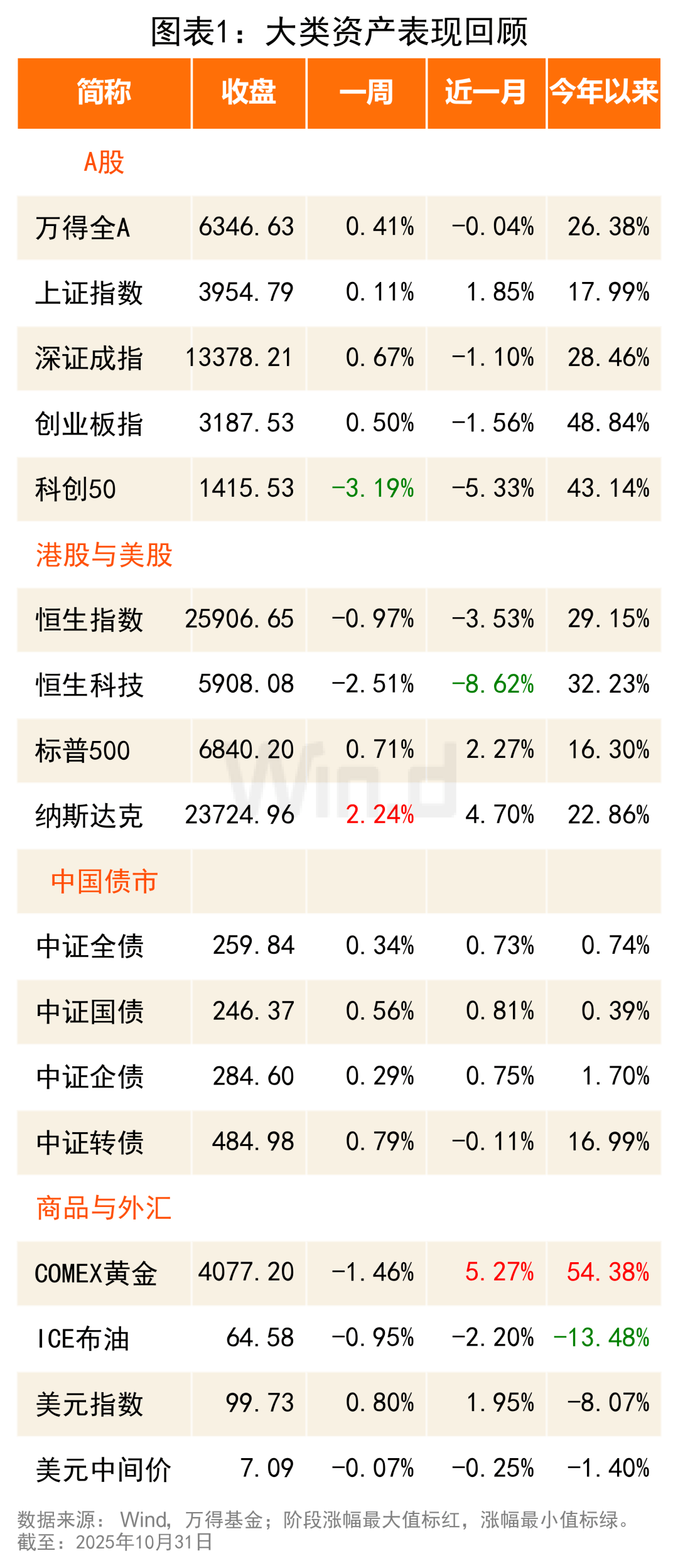
Focus Review - The official manufacturing PMI for China in October is 49.0%, down 0.8 percentage points from the previous month, indicating a decline in manufacturing activity [2] - The production index is at 49.7%, down 2.2 percentage points, suggesting a slowdown in manufacturing production [2] - The new orders index is at 48.8%, down 0.9 percentage points, indicating a decrease in market demand [2] - The employment index is at 48.3%, down 0.2 percentage points, reflecting a slight decline in employment conditions in manufacturing [2] Equity Market - Huatai Securities predicts that the RMB is likely to continue strengthening, which may lead to a revaluation of Chinese assets [3] - The RMB's appreciation is expected to benefit Hong Kong stocks and Chinese overseas asset allocation, although caution is advised regarding potential risks from US policy changes [3] - CICC maintains a positive mid-term outlook for the market but warns of short-term overheating and potential profit-taking in popular sectors [4] - In the context of the A-share market, there is a noted risk of bubble formation in some hot sectors, particularly in technology, necessitating a rational approach to risk management [5] Industry Research - CITIC Construction Investment highlights that small nucleic acid drugs may become a third major category of pharmaceuticals due to their targeted delivery and long-lasting effects [10] - Huaxia Fund expresses a long-term positive outlook on CPO optical modules, despite recent short-term sell-offs due to market fluctuations [11] - Huatai Baichuan Fund sees ample structural opportunities in Q4, driven by the "14th Five-Year Plan" focusing on technological self-reliance and innovation [12] Macro and Fixed Income - Guotai Junan notes that the Fed's hawkish stance has weakened expectations for future rate cuts, while bond market dynamics remain influenced by inflation risks [16] - Bosera Fund indicates that the bond market is becoming more attractive as liquidity improves and the Fed signals a continuation of accommodative policies [17] - CITIC Securities suggests that government bond trading operations may serve as a substitute for reserve requirement ratio cuts, with ongoing monitoring of macroeconomic recovery [18] Asset Allocation - Guolian Minsheng Investment advises a balanced allocation strategy, focusing on sectors benefiting from the "14th Five-Year Plan," such as new energy and semiconductor industries [19]
新易盛(300502)2025年三季报点评:营收短暂承压 坚信产业大趋势
Xin Lang Cai Jing· 2025-11-01 10:47
Core Insights - Company reported a significant increase in revenue and net profit for the first three quarters of 2025, with revenue reaching approximately 165.05 billion yuan, a year-on-year growth of 221.70%, and net profit of about 63.27 billion yuan, up 284.38% [1] - The company maintains a strong focus on R&D, with investments reaching 5.01 billion yuan, a year-on-year increase of 149.57%, and is actively developing cutting-edge technologies such as silicon photonics and 1.6T products [2] - The demand for optical modules is expected to remain high due to the increasing capital expenditures in AI and data centers, with major companies like Amazon, Google, Meta, and Oracle planning significant increases in their capital expenditures [3] Financial Performance - For Q3 2025, the company achieved revenue of 60.68 billion yuan, a year-on-year increase of 152.53%, but a slight quarter-on-quarter decrease of 4.97% [1] - The net profit for Q3 2025 was 23.85 billion yuan, reflecting a year-on-year growth of 205.38% and a quarter-on-quarter increase of 0.63% [1] - The gross profit margin for Q3 2025 was 46.94%, up 5.41 percentage points year-on-year, while the net profit margin was 39.30%, an increase of 6.80 percentage points year-on-year [1] Industry Outlook - The optical module industry is expected to maintain high growth and certainty, driven by the increasing demand for AI computing power and capital expenditures from major tech companies [3] - Companies are expected to continue expanding their data center capabilities, with Oracle signing a significant power procurement contract with OpenAI, indicating strong future demand [3] - The overall industry is projected to experience a favorable growth trend into 2026, supported by ongoing technological advancements and increased client demand [2][3] Investment Projections - Revenue projections for the company are estimated at 243.20 billion yuan in 2025, 511.40 billion yuan in 2026, and 732.21 billion yuan in 2027, with corresponding net profits of 88.58 billion yuan, 189.99 billion yuan, and 263.89 billion yuan [4] - The company is expected to have a price-to-earnings (PE) ratio of 39, 18, and 13 for the years 2025, 2026, and 2027, respectively, indicating a favorable investment outlook [4]

光模块双雄市值两日蒸发超千亿元
2 1 Shi Ji Jing Ji Bao Dao· 2025-11-01 08:01
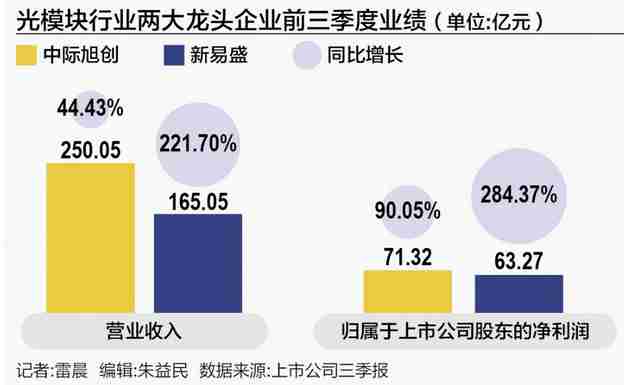
Core Viewpoint - Despite significant revenue growth reported by leading optical module companies, the market has reacted negatively, indicating concerns over the sustainability of their growth and valuation [1][14]. Financial Performance - Zhongji Xuchuang reported a revenue of 25.005 billion yuan for the first three quarters, a year-on-year increase of 44.43%, with a net profit of 7.132 billion yuan, up 90.05% [5]. - Xinyi Sheng achieved a revenue of 16.505 billion yuan, a remarkable year-on-year growth of 221.70%, and a net profit of 6.327 billion yuan, up 284.37% [5]. - In Q3, Zhongji Xuchuang's revenue was 10.216 billion yuan with a gross margin of 43% and a net profit of 3.327 billion yuan, reflecting a quarter-on-quarter increase of 30.38% [5][6]. - Xinyi Sheng's Q3 revenue was 6.068 billion yuan, showing a decline compared to Q2 due to changes in product shipment schedules [5][8]. Market Reaction - Following the earnings reports, both companies experienced significant stock price declines, with Zhongji Xuchuang dropping 8.11% and Xinyi Sheng falling 7.94% on October 31 [1][14]. - The combined market value loss for both companies over two days was approximately 114.4 billion yuan [1]. Industry Trends - The optical module industry is transitioning from high demand for 800G products to the accelerated market penetration of 1.6T products, which is expected to drive future growth [8]. - Both companies are focusing on silicon photonics technology, which is becoming a mainstream solution due to its cost advantages and high integration [8][9]. Capacity Expansion - Zhongji Xuchuang's construction projects increased significantly from 52.53 million yuan to 980 million yuan, a growth of 1,765.65% [9]. - Xinyi Sheng is gradually releasing capacity in its overseas plants, indicating a continuous process of capacity expansion [9]. Operational Challenges - Both companies are facing operational pressures due to inventory growth, with Zhongji Xuchuang's inventory rising by 52.64% and Xinyi Sheng's by 59.79% [11]. - Zhongji Xuchuang's effective tax rate increased to 15.8% due to provisions related to international tax regulations, which may impact future tax burdens [11]. Valuation Concerns - Despite high growth rates, both companies face valuation pressures, with Zhongji Xuchuang's market cap at 522.9 billion yuan and a dynamic P/E ratio of 55.27, while Xinyi Sheng's market cap is 342.2 billion yuan with a P/E ratio of 40.57 [13][14]. - The market's reaction reflects concerns over the sustainability of the growth cycle in the optical module industry and the high valuations that have become sensitive to negative news [14][17].

光模块双雄市值两日蒸发超千亿元
21世纪经济报道· 2025-11-01 08:00
Core Viewpoint - Despite significant revenue growth reported by leading optical module companies, the market has reacted negatively, indicating concerns over the sustainability of growth and valuation levels [1][10]. Financial Performance - Zhongji Xuchuang reported a revenue of 25.005 billion yuan for the first three quarters, a year-on-year increase of 44.43%, with a net profit of 7.132 billion yuan, up 90.05% [4]. - Xinyi Sheng achieved a revenue of 16.505 billion yuan, a remarkable year-on-year growth of 221.70%, and a net profit of 6.327 billion yuan, up 284.37% [4]. - In Q3, Zhongji Xuchuang's revenue was 10.216 billion yuan with a gross margin of 43% and a net profit of 3.327 billion yuan, reflecting a quarter-on-quarter increase of 30.38% [4]. - Xinyi Sheng's Q3 revenue was 6.068 billion yuan, showing a decline from the previous quarter due to changes in product shipment schedules [4][7]. Market Reaction - Following the earnings reports, both companies experienced significant stock price declines, with Zhongji Xuchuang dropping 8.11% and Xinyi Sheng falling 7.94% on October 31 [1]. - The combined market value loss for both companies over two days was approximately 114.4 billion yuan [1]. Industry Trends - The optical module industry is transitioning from high demand for 800G products to the accelerated market penetration of 1.6T products, which is expected to drive future growth [7]. - Silicon photonics technology is becoming a competitive focus due to its cost advantages and high integration, with both companies increasing their focus on this technology [7][8]. Capacity Expansion - Zhongji Xuchuang's construction projects increased significantly from 52.53 million yuan at the beginning of the year to 980 million yuan, a growth of 1765.65% [8]. - Xinyi Sheng is also expanding its overseas capacity, with gradual releases expected from its Thailand factory [8]. Supply Chain Concerns - The supply chain, particularly the availability of optical chips, is becoming a critical factor for industry growth, with Zhongji Xuchuang noting a high level of tension in chip supply due to rapid demand growth [8][9]. Inventory and Tax Risks - Both companies are facing operational pressures due to inventory increases, with Zhongji Xuchuang's inventory rising by 52.64% and Xinyi Sheng's by 59.79% since the beginning of the year [9]. - Zhongji Xuchuang's effective tax rate increased to 15.8% due to new tax regulations affecting its overseas operations, which may impact future tax burdens [9]. Valuation Pressure - As of October 31, Zhongji Xuchuang had a market capitalization of 522.9 billion yuan with a dynamic P/E ratio of 55.27, while Xinyi Sheng had a market cap of 342.2 billion yuan with a P/E ratio of 40.57, indicating significant valuation concerns [10]. - The market's reaction reflects worries about the sustainability of the optical module industry's growth cycle and the sensitivity of high valuations to negative news [10][11].

贺宛男:4000点三得三失,牛市还在吗?
Sou Hu Cai Jing· 2025-11-01 07:15
Core Viewpoint - The A-share market experienced fluctuations around the 4000-point mark, with significant declines despite positive earnings reports from listed companies for the third quarter of 2025 [1][2]. Group 1: Market Performance - The Shanghai Composite Index reached a high of 4025 points but closed at 3986 points, indicating volatility and a lack of sustained upward momentum [1]. - As of October 31, 5437 out of 5444 listed companies had disclosed their Q3 earnings, showing a 1.20% year-on-year revenue growth and a 5.34% increase in net profit attributable to shareholders [1]. Group 2: Earnings Reports - Over 1100 companies disclosed their Q3 earnings on October 31, with a notable number of large-cap stocks and loss-making companies reporting on this day [2]. - Among the top 100 companies by market capitalization, only 27 saw their stock prices rise, while 73 experienced declines, contributing to the overall market downturn [2]. Group 3: Sector Analysis - The banking sector showed sluggish growth, with 42 listed banks reporting a 0.9% revenue increase and a 1.54% net profit increase, both below the average [3]. - The liquor industry had mixed results, with Kweichow Moutai's net profit growing by 6.25%, while Wuliangye and Luzhou Laojiao reported declines of 13.7% and 7.2%, respectively [3]. - The oil sector faced significant declines, with PetroChina's net profit down 4.7%, Sinopec down 32.2%, and CNOOC down 12.6% [3]. - The construction sector also reported declines, with major companies like China Railway Construction and China Communications Construction seeing net profit decreases of 5.6% and 16.1%, respectively [3]. Group 4: Growth and Decline - Some sectors, like securities and insurance, reported strong earnings growth (24.3% and 33.5% respectively), but the market did not respond positively [4]. - The AI industry saw substantial profit increases, with companies like Zhongji Xuchuang and Newray gaining 90% and 284% in profits, but their stock prices had already surged over 100% this year [4]. Group 5: Real Estate Sector - The real estate sector is struggling, with nearly 100 companies reporting a cumulative loss of 99 billion, 283 billion, and 331 billion yuan over the first three quarters, indicating a worsening trend [4]. - The downturn in real estate is impacting related industries such as banking, construction, and home appliances, which could have broader implications for the macroeconomy [4]. Group 6: Market Outlook - Despite the recent downturn, the bull market is believed to still be intact, particularly for technology leaders in the AI sector, which continue to show strong earnings growth [5]. - The securities and insurance sectors, despite current market indifference, are expected to present future opportunities [6]. - The reduction in losses for leading companies in the renewable energy sector indicates a potential recovery, with stock prices beginning to rise [6]. - The number of rising stocks outnumbered declining stocks, suggesting that market sentiment remains positive [7].
光模块双雄:高增长审美疲劳 高估值面临压力
2 1 Shi Ji Jing Ji Bao Dao· 2025-11-01 01:33
Core Viewpoint - The market is expressing doubts about the future growth of leading optical module companies, Zhongji Xuchuang and Xinyi Sheng, despite their impressive financial performance in Q3 2025, leading to significant stock price declines [1][3][12]. Financial Performance - Zhongji Xuchuang reported a revenue of 25.005 billion yuan for the first three quarters, a year-on-year increase of 44.43%, and a net profit of 7.132 billion yuan, up 90.05% [5]. - Xinyi Sheng achieved a revenue of 16.505 billion yuan, a remarkable year-on-year growth of 221.70%, with a net profit of 6.327 billion yuan, increasing by 284.37% [5]. - In Q3 alone, Zhongji Xuchuang's revenue was 10.216 billion yuan with a gross margin of 43%, while Xinyi Sheng's revenue was 6.068 billion yuan, showing a slight decline from the previous quarter [5][6]. Growth Concerns - Despite high growth rates, there are concerns regarding the sustainability of profits and the quality of growth, particularly for Xinyi Sheng, which experienced a revenue decline in Q3 due to changes in product shipment schedules [3][5]. - Both companies are navigating a transition period between the high demand for 800G products and the accelerated market penetration of 1.6T products, which is expected to drive future growth [8]. Market Dynamics - The optical module industry is increasingly focusing on silicon photonics technology, which is becoming a mainstream solution due to its cost advantages and high integration [8]. - Zhongji Xuchuang's construction projects have surged from 5.253 million yuan at the beginning of the year to 980 million yuan, indicating a significant investment in capacity expansion to meet demand [9]. Inventory and Operational Pressure - Both companies are facing operational pressures due to inventory increases, with Zhongji Xuchuang's inventory rising by 52.64% and Xinyi Sheng's by 59.79% since the beginning of the year [10]. - Xinyi Sheng's inventory increased by approximately 700 million yuan in Q3 despite a revenue decline, raising questions about inventory management strategies [10]. Taxation and Valuation Challenges - Zhongji Xuchuang's effective tax rate increased to 15.8% in Q3 due to new tax regulations affecting its Southeast Asian operations, which may impact future tax burdens [11]. - Both companies are experiencing valuation pressures, with Zhongji Xuchuang's market capitalization at 522.9 billion yuan and a dynamic P/E ratio of 55.27, while Xinyi Sheng's market cap is 342.2 billion yuan with a P/E ratio of 40.57 [12][13]. Investor Sentiment - The market's reaction to the strong earnings reports reflects a growing fatigue regarding the high growth narrative of these companies, as investors become more sensitive to high valuations and potential risks [13].
华尔街见闻早餐FM-Radio | 2025年11月1日
Hua Er Jie Jian Wen· 2025-10-31 23:17
Market Overview - Amazon shares surged nearly 10% following strong earnings, boosting tech stocks, while major US indices closed higher. Apple opened high but closed slightly down. Meta fell 2.72%, marking a nearly 12% decline in October [3] - The 10-year US Treasury yield dipped by 0.4 basis points, with a weekly increase of 9.23 basis points. The dollar rose for three consecutive days, gaining 0.27% [3] - Bitcoin rebounded by 1.80%, testing $111,000, while Ethereum saw a rise of over 3.9% [3] - Spot gold decreased by 0.55%, trading at $4002, briefly falling below $4000. Oil prices fluctuated due to the situation in Venezuela [3] Key Economic Indicators - China's official manufacturing PMI fell to 49 in October, while the non-manufacturing index rose to 50.1, indicating expansion in three key sectors [22] - High-tech manufacturing, equipment manufacturing, and consumer goods sectors maintained expansion with PMIs of 50.5%, 50.2%, and 50.1% respectively [22] - The new orders index remained at 46.0%, indicating weak market demand in the non-manufacturing sector [22] AI Sector Developments - Nvidia reached a significant AI agreement with South Korean tech giants, deploying 260,000 Blackwell chips to create Asia's first "Industrial AI Cloud" [25] - The AI sector is witnessing a shift towards off-balance-sheet financing, with companies like Meta raising $30 billion through special purpose vehicles (SPVs) [26] Company Performance - The "hottest AI sector" saw mixed results, with "Yizhongtian" experiencing significant growth, while only Zhongji Xuchuang met high expectations with a steady increase in revenue and profit margins [23] - The lithium battery industry reported a notable recovery, with a 32.86% year-on-year increase in net profit for the first three quarters, driven by surging demand in energy storage [30] International Relations Impact - Xi Jinping emphasized the importance of open development and economic globalization during the APEC meeting, proposing five key suggestions to maintain trade stability and promote inclusive growth [20] - The meeting between Xi and Canadian Prime Minister Carney highlighted the need for mutual understanding and cooperation in various sectors, including trade and energy [20]