公用事业

Search documents
A股节后迎来开门红 上证指数站上3900点
Zhong Guo Zheng Quan Bao· 2025-10-09 21:49
Market Performance - A-shares experienced a strong opening on October 9, with the Shanghai Composite Index rising over 1% to surpass 3900 points, marking a new high in over 10 years [1] - More than 3100 stocks in the A-share market increased, with nearly 100 stocks hitting the daily limit [1] - The total trading volume exceeded 2.6 trillion yuan, with a significant increase in market activity [1][2] Index Movements - By the end of the trading day, the Shanghai Composite Index, Shenzhen Component Index, ChiNext Index, and STAR Market 50 Index rose by 1.32%, 1.47%, 0.73%, and 2.93% respectively, while the North Stock 50 Index fell by 0.18% [1] - Large-cap indices such as the Shanghai 50 Index and CSI 300 Index increased by 1.06% and 1.48%, respectively, indicating strong performance in large-cap stocks [1] Sector Performance - Strong performances were noted in sectors such as gold, rare earths, nuclear fusion, copper, and storage chips, with technology and cyclical stocks showing significant strength [1] - Among the Shenwan first-level industries, non-ferrous metals, steel, and coal sectors led the gains, rising by 7.60%, 3.38%, and 3.00% respectively [1] - Conversely, sectors such as media, real estate, and social services experienced declines, with drops of 1.43%, 1.39%, and 1.03% respectively [1] Trading Volume - The trading volume for A-shares reached 2.67 trillion yuan, an increase of 474.6 billion yuan compared to the previous trading day [2] - The trading volume in the Shanghai market was 1.2169 trillion yuan, while the Shenzhen market recorded 1.4363 trillion yuan [2] - Since August 13, the A-share market has seen trading volumes exceed 2 trillion yuan for 36 consecutive trading days [2]
【9日资金路线图】两市主力资金净流出超250亿元 有色金属等行业实现净流入
证券时报· 2025-10-09 14:34
Market Overview - The A-share market indices performed strongly today, with the Shanghai Composite Index rising by 1.32%, the Shenzhen Component increasing by 1.47%, and the ChiNext Index up by 0.73%. The total trading volume reached 2.67 trillion yuan, compared to 2.2 trillion yuan in the previous trading day [1]. Capital Flow - The net outflow of main funds from the Shanghai and Shenzhen markets exceeded 255.37 billion yuan today, with an opening net outflow of 96.89 billion yuan and a closing net outflow of 65.82 billion yuan [2][3]. - The CSI 300 index saw a net outflow of 137.82 billion yuan, while the ChiNext index experienced a net outflow of 121.83 billion yuan [2][4]. Sector Performance - The non-ferrous metals sector led the market with a net inflow of 143.63 billion yuan and a price increase of 5.23%. Other sectors with significant inflows included computers (70.68 billion yuan) and public utilities (68.68 billion yuan) [5]. - Conversely, the automotive sector faced a net outflow of 45.52 billion yuan, with a slight decline of 0.26%. The pharmaceutical and media sectors also saw outflows of 34.69 billion yuan and 32.29 billion yuan, respectively [5]. Institutional Activity - Notable institutional buying included Ganfeng Lithium, which saw a net purchase of 52.11 million yuan, and Tianji Co., with a net purchase of 44.19 million yuan. Other significant purchases were made in companies like Canxin Technology and Meili Technology [7][8].


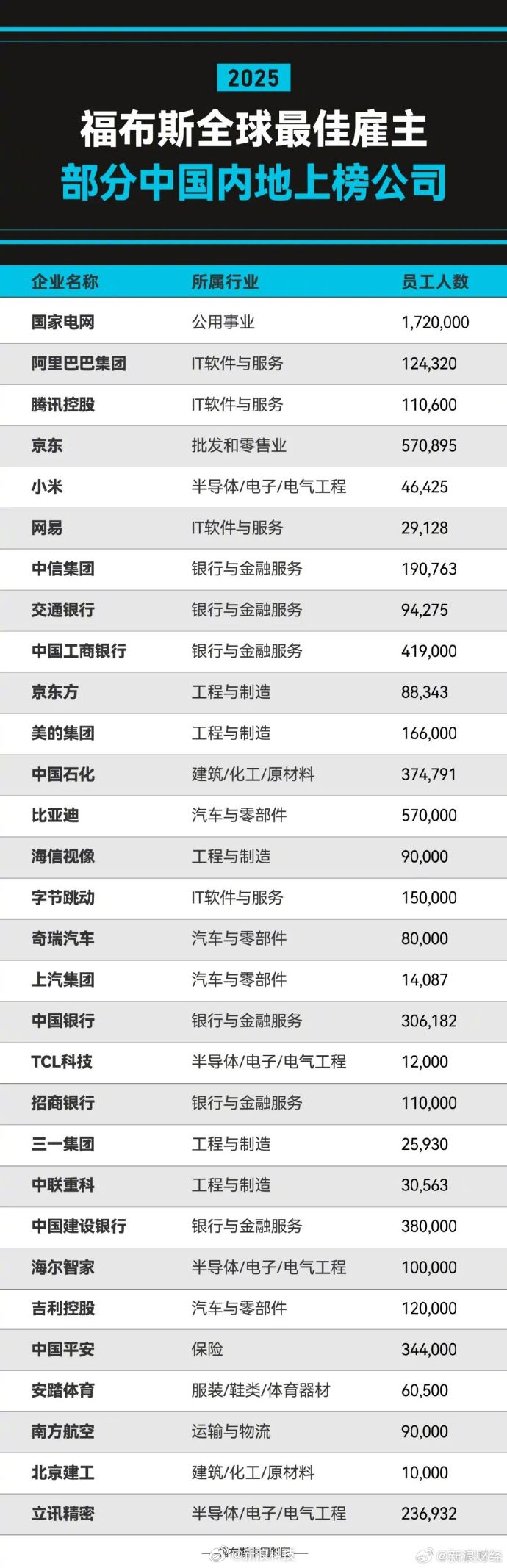
微软蝉联福布斯全球最佳雇主榜首,53家中国内地公司上榜
Xin Lang Ke Ji· 2025-10-09 12:11
半导体/电子/电气工程 236,932 【#2025福布斯全球最佳雇主#】#微软连续两年蝉联全球最佳雇主榜首#今年一共有53家中国内地公司入 选福布斯全球最佳雇主榜单。在全球榜单前五名中有三家来自IT软件与服务行业,其中微软连续两年蝉 联榜首,谷歌母公司Alphabet位列第三,Adobe排名第四。(福布斯)#53家内地公司入选福布斯全球最 佳雇主# | 2025 | | | | --- | --- | --- | | 福布斯全球最佳雇主 | | | | 部分中国内地上榜公司 | | | | 企业名称 | 所属行业 | 员工人数 | | 国家电网 | 公用事业 | 1,720,000 | | 阿里巴巴集团 | IT软件与服务 | 124,320 | | 腾讯控股 | IT软件与服务 | 110,600 | | 京东 | 批发和零售业 | 570.895 | | 小米 | 半导体/电子/电气工程 | 46.425 | | 网易 | IT软件与服务 | 29,128 | | 中信集团 | 银行与金融服务 | 190,763 | | 交通银行 | 银行与金融服务 | 94.275 | | 中国工商银行 | 银行与金 ...

经济前瞻指标小幅回升,因子选择略偏向均衡:——量化资产配置月报202510-20251009
Shenwan Hongyuan Securities· 2025-10-09 11:05
Group 1 - The report indicates that the economic leading indicators are showing signs of a slight recovery, with liquidity remaining slightly loose and credit indicators improving [3][12][19] - The economic forecast model suggests that October 2025 is at a turning point, with expectations for a slight upward trend over the next three months before entering a plateau [12][13] - The report highlights that the focus of the market is shifting towards economic indicators, surpassing liquidity concerns, with increased attention on economic and PPI-related factors [26][27] Group 2 - The liquidity environment is characterized by rising interest rates, with long-term rates exceeding the average, while overall liquidity remains slightly loose due to positive monetary supply signals [19][22] - Credit indicators have shown a slight positive trend, although the overall credit volume and structure remain low, indicating a mixed outlook for credit conditions [23][24] - The asset allocation perspective suggests a high allocation to gold due to strong momentum, while equity allocations have been slightly reduced [24][25] Group 3 - The industry selection is leaning towards sectors that are sensitive to economic conditions but less sensitive to liquidity, with a notable increase in defensive and consumer attributes [28][29] - The report identifies specific industries with the highest sensitivity to economic changes, including utilities and coal, while also highlighting sectors like media and consumer electronics for credit sensitivity [28][29] - The overall balance in industry selection reflects a decline in growth attributes, emphasizing a more defensive investment strategy [29]
公用事业行业10月9日资金流向日报
Zheng Quan Shi Bao Wang· 2025-10-09 09:38
Market Overview - The Shanghai Composite Index rose by 1.32% on October 9, with 23 out of the 28 sectors experiencing gains. The top-performing sectors were non-ferrous metals and steel, with increases of 7.60% and 3.38% respectively. The utilities sector also saw a rise of 2.60%. Conversely, the media and real estate sectors faced declines of 1.43% and 1.39% respectively [1] Fund Flow Analysis - Throughout the day, the main funds in the two markets experienced a net outflow of 19.966 billion yuan. However, 12 sectors saw net inflows, with the non-ferrous metals sector leading with a net inflow of 5.361 billion yuan, followed by the construction and decoration sector, which had a daily increase of 2.17% and a net inflow of 1.868 billion yuan [1] Utilities Sector Performance - The utilities sector increased by 2.60% with a total net inflow of 1.349 billion yuan. Out of 131 stocks in this sector, 115 rose, including 2 that hit the daily limit, while 14 fell, with 1 hitting the lower limit. Notably, 69 stocks in this sector experienced net inflows, with 7 stocks seeing inflows exceeding 100 million yuan. Shanghai Electric led with a net inflow of 425 million yuan, followed by Yangtze Power and China Nuclear Power with inflows of 260 million yuan and 225 million yuan respectively [2] Utilities Sector Fund Inflow and Outflow - The top inflow stocks in the utilities sector included: - Shanghai Electric: +10.02%, 6.00% turnover, 425.25 million yuan inflow - Yangtze Power: +1.58%, 0.47% turnover, 260.23 million yuan inflow - China Nuclear Power: +4.59%, 1.63% turnover, 224.55 million yuan inflow [2] - The top outflow stocks in the utilities sector included: - Energy Saving Wind Power: +2.51%, 3.03% turnover, -108.28 million yuan outflow - Jilin Electric Power: +1.93%, 4.99% turnover, -69.70 million yuan outflow - Shenzhen Energy: +3.61%, 1.37% turnover, -65.39 million yuan outflow [4]



大众公用:股票连续三日涨幅达20%
Xin Lang Cai Jing· 2025-10-09 08:47
大众公用公告,公司股票在2025年9月29日、9月30日、10月09日连续三个交易日内收盘价格涨幅偏离值 累计达到20%以上,属于股票交易异常波动。经自查及向控股股东、实际控制人等相关方发函确认,不 存在应披露而未披露的重大信息,包括重大资产重组、股份发行、重大交易类事项等。公司敬请广大投 资者注意二级市场交易风险,理性决策,审慎投资。 ...

美联储9月降息后,港股要走“分裂行情”?中美周期拧着走!
Sou Hu Cai Jing· 2025-10-09 07:49
Core Viewpoint - The performance of the Hong Kong stock market is influenced by the alignment of the economic cycles of the US and China, with the current situation indicating a "split" market response to the recent US interest rate cut [1][10]. Group 1: Interest Rate Cuts and Market Response - There are two types of interest rate cuts by the Federal Reserve: "preventive" and "recessionary," with historical data showing that Hong Kong stocks perform significantly better during preventive cuts [3][6]. - In the case of preventive cuts, such as in 2019, the Hong Kong stock market rose by 11%, with the Hang Seng Tech Index increasing by 20% due to cheaper financing for technology companies [6]. - Conversely, during recessionary cuts, like in 2008, the Hong Kong market plummeted by 40%, as investors favored stable sectors like utilities and consumer staples [8]. Group 2: Variables Affecting Hong Kong Stocks - The current economic cycle is misaligned between the US and China, with the US focusing on a "soft landing" while China is gradually recovering, introducing three unexpected variables that complicate the market outlook [10]. - The first variable is US political interference, particularly from figures like Trump, which could disrupt the Federal Reserve's interest rate strategy and create uncertainty in the market [10][11]. - The second variable is the impact of AI on technology stocks, which now must invest heavily in AI to remain competitive, potentially leading to a stronger performance in this sector if economic conditions are favorable [13]. - The third and most critical variable is the Chinese economic fundamentals, as many Hong Kong-listed companies rely on the mainland market for revenue; without improvement in China's economy, stock prices may struggle to rise despite US interest rate cuts [15]. Group 3: Future Market Scenarios - The Hong Kong stock market is expected to "split" in its performance based on various economic conditions: if the US continues to lower rates and China's economy shows moderate recovery, growth stocks in technology and healthcare may lead the market [17]. - If the US implements aggressive rate cuts and Chinese consumer data exceeds expectations, sectors like real estate and industrials could also benefit from lower financing costs [17]. - In a scenario where the US refrains from further cuts and China's economy shows no significant improvement, investors may need to focus on stable sectors like utilities and high-dividend stocks to mitigate risks [17]. Conclusion - The Hong Kong stock market is influenced by both US interest rate policies and Chinese economic fundamentals, with the potential for growth dependent on the strength of the underlying economic conditions in China [19].

东北固收转债分析:2025年10月十大转债-2025年10月
NORTHEAST SECURITIES· 2025-10-09 07:14
Report Summary - The report presents the top ten convertible bonds for October 2025, along with an analysis of the issuing companies, including their business profiles, financial performance, and key attractions [13][23][35] Top Ten Convertible Bonds in October 2025 1. Zhongte Convertible Bond - Rating: AAA; 9 - month - end closing price: 112.896 yuan; Conversion premium rate: 85.92%; PE - TTM of the underlying stock: 13.22 [7][13] - Company: A globally leading specialized special - steel material manufacturer with a production capacity of about 20 million tons of special - steel materials per year. It has multiple production and raw - material bases, forming a strategic layout along the coast and rivers [13] - Financials: In 2024, revenue was 109.203 billion yuan (YoY - 4.22%), net profit attributable to shareholders was 5.126 billion yuan (YoY - 10.41%). In H1 2025, revenue was 54.715 billion yuan (YoY - 4.02%), net profit attributable to shareholders was 2.798 billion yuan (YoY + 2.67%) [13] - Key attractions: It is one of the world's most comprehensive special - steel enterprises in terms of variety and specification, with leading cost - control ability and potential for external expansion [14] 2. Shanlu Convertible Bond - Rating: AAA; 9 - month - end closing price: 119.346 yuan; Conversion premium rate: 48.74%; PE - TTM of the underlying stock: 4.08 [7][23] - Company: Mainly engaged in road and bridge construction and maintenance, and also expanding into other fields. It can provide one - stop comprehensive services [23] - Financials: In 2024, revenue was 71.348 billion yuan (YoY - 2.3%), net profit attributable to shareholders was 2.322 billion yuan (YoY + 1.47%). In H1 2025, revenue was 28.575 billion yuan (YoY + 0.26%), net profit attributable to shareholders was 1.029 billion yuan (YoY + 0.89%) [23] - Key attractions: It has the concept of "China - specific valuation", potential for improvement in various aspects under the debt - resolution background, and opportunities from regional infrastructure construction and the Belt and Road Initiative [24] 3. Hebang Convertible Bond - Rating: AA; 9 - month - end closing price: 126.41 yuan; Conversion premium rate: 21.55%; PE - TTM of the underlying stock: - 168.47 [7][35] - Company: With advantages in mineral resources and gas supply, it has completed a basic layout in the chemical, agricultural, and photovoltaic fields [35] - Financials: In 2024, revenue was 8.547 billion yuan (YoY - 3.13%), net profit attributable to shareholders was 31 million yuan (YoY - 97.55%). In H1 2025, revenue was 3.921 billion yuan (YoY - 19.13%), net profit attributable to shareholders was 52 million yuan (YoY - 73.07%) [35] - Key attractions: Its phosphate mines and salt mines have good profit - making potential, and the liquid methionine business is a major profit contributor [36] 4. Aima Convertible Bond - Rating: AA; 9 - month - end closing price: 128.513 yuan; Conversion premium rate: 38.62%; PE - TTM of the underlying stock: 13.41 [7][45] - Company: The leading enterprise in the electric two - wheeled vehicle industry, mainly engaged in R & D, production, and sales of electric two - wheeled vehicles [45] - Financials: In 2024, revenue was 21.606 billion yuan (YoY + 2.71%), net profit attributable to shareholders was 1.988 billion yuan (YoY + 5.68%). In H1 2025, revenue was 13.031 billion yuan (YoY + 23.04%), net profit attributable to shareholders was 1.213 billion yuan (YoY + 27.56%) [45] - Key attractions: It may benefit from government subsidies, new national standards, and potential improvement in gross margin [46] 5. Xingye Convertible Bond - Rating: AAA; 9 - month - end closing price: 120.859 yuan; Conversion premium rate: 29.02%; PE - TTM of the underlying stock: 5.43 [7][54] - Company: One of the first joint - stock commercial banks in China, evolving into a modern financial service group [54] - Financials: In 2024, revenue was 212.226 billion yuan (YoY + 0.66%), net profit attributable to shareholders was 77.205 billion yuan (YoY + 0.12%). In H1 2025, revenue was 110.458 billion yuan (YoY - 2.29%), net profit attributable to shareholders was 43.141 billion yuan (YoY + 0.21%) [54] - Key attractions: It has stable asset quality and scale growth [55] 6. Wentai Convertible Bond - Rating: AA -; 9 - month - end closing price: 128.918 yuan; Conversion premium rate: 20.93%; PE - TTM of the underlying stock: - 23.14 [7][66] - Company: A globally leading semiconductor enterprise adopting the IDM model, providing R & D, manufacturing, and testing services [66] - Financials: In 2024, revenue was 73.598 billion yuan (YoY + 20.23%), net profit attributable to shareholders was - 2.833 billion yuan (YoY - 339.83%). In H1 2025, revenue was 25.341 billion yuan (YoY - 24.56%), net profit attributable to shareholders was 474 million yuan (YoY + 237.36%) [66] - Key attractions: After focusing on the semiconductor business, it benefits from market recovery and has growth potential in the automotive and consumer electronics fields [67] 7. Chongyin Convertible Bond - Rating: AAA; 9 - month - end closing price: 121.778 yuan; Conversion premium rate: 31.87%; PE - TTM of the underlying stock: 5.88 [7][77] - Company: An early local joint - stock commercial bank in the upper reaches of the Yangtze River and Southwest China, with a wide range of business scopes [77] - Financials: In 2024, revenue was 13.679 billion yuan (YoY + 3.54%), net profit attributable to shareholders was 5.117 billion yuan (YoY + 3.8%). In H1 2025, revenue was 7.659 billion yuan (YoY + 7%), net profit attributable to shareholders was 3.19 billion yuan (YoY + 5.39%) [77] - Key attractions: It can benefit from the development of the Chengdu - Chongqing economic circle, has stable asset - scale growth, and effective risk - control strategies [78] 8. Tianye Convertible Bond - Rating: AA +; 9 - month - end closing price: 120.562 yuan; Conversion premium rate: 48.06%; PE - TTM of the underlying stock: 146.42 [7][89] - Company: A leading enterprise in the chlor - alkali chemical industry in Xinjiang, with an integrated circular economy industrial chain [89] - Financials: In 2024, revenue was 11.156 billion yuan (YoY - 2.7%), net profit attributable to shareholders was 68 million yuan (YoY + 108.83%). In H1 2025, revenue was 5.16 billion yuan (YoY - 0.98%), net profit attributable to shareholders was - 9 million yuan (YoY - 228.22%) [89] - Key attractions: It may benefit from the price change of caustic soda and has plans for dividend increase and coal - mine projects [90] 9. Aorui Convertible Bond - Rating: AA -; 9 - month - end closing price: 126.412 yuan; Conversion premium rate: 40.56%; PE - TTM of the underlying stock: 22.72 [7][100] - Company: A company focusing on the R & D, production, and sales of complex APIs and preparations, with leading positions in multiple fields [100] - Financials: In 2024, revenue was 1.476 billion yuan (YoY + 16.89%), net profit attributable to shareholders was 355 million yuan (YoY + 22.59%). In H1 2025, revenue was 822 million yuan (YoY + 12.5%), net profit attributable to shareholders was 235 million yuan (YoY + 24.55%) [100] - Key attractions: It has a growing dealer network, expanding preparation products, and high - quality customer resources [101] 10. Yushui Convertible Bond - Rating: AAA; 9 - month - end closing price: 125.081 yuan; Conversion premium rate: 30.74%; PE - TTM of the underlying stock: 26.93 [7][108] - Company: The largest integrated water supply and drainage enterprise in Chongqing, with a stable monopoly position [108] - Financials: In 2024, revenue was 6.999 billion yuan (YoY - 3.52%), net profit attributable to shareholders was 785 million yuan (YoY - 27.88%). In H1 2025, revenue was 3.519 billion yuan (YoY + 7.16%), net profit attributable to shareholders was 458 million yuan (YoY + 10.06%) [108] - Key attractions: It has a high market share, is expanding business externally, and has effective cost - control measures [109]




红利资产跌出机会?
老徐抓AI趋势· 2025-10-09 06:11
Core Viewpoint - The recent market rotation has raised concerns about the effectiveness of dividend strategies, but it may also present a new opportunity for investment in high-dividend assets [1]. Group 1: Institutional Preference for Dividend Assets - Dividend assets are being re-evaluated for their strategic value due to global liquidity easing and structural transformation [1]. - Insurance funds are increasingly investing in high-dividend assets to counteract the pressure of declining market interest rates and to address maturity mismatch risks [1]. - The maximum guaranteed interest rate for ordinary insurance products has dropped to 2%, making a 4% dividend return from long-term equity investments essential for meeting expected returns [1]. Group 2: Evolution of Public Fund Dividend Strategies - Public funds are evolving from simple high-dividend selection to a multi-factor comprehensive strategy, emphasizing both willingness and capability while considering corporate governance and operational quality [2]. Group 3: Hong Kong Dividend Assets as Institutional Favorites - Hong Kong dividend assets have become a priority for institutions, with the Hang Seng High Dividend Yield Index rising 21% year-to-date, outperforming the CSI Dividend Total Return Index by 18% [3]. - The Hang Seng High Dividend Index offers a dividend yield of 6.27%, significantly higher than the 4.66% yield of the CSI Dividend Index, even after accounting for a 20% dividend tax [4]. - There is a notable valuation gap, with leading companies in Hong Kong's financial and energy sectors trading at 20%-30% lower valuations compared to their A-share counterparts, providing a safety margin [7]. - Hong Kong's offshore characteristics and high foreign capital ratio make it a key beneficiary of foreign capital inflows during the Federal Reserve's rate-cutting cycle [9]. Group 4: Recent Decline in Dividend Assets - The recent decline in dividend assets can be attributed to market style rotation, with funds shifting towards growth sectors like semiconductors and AI since July [10]. - Fundamental disruptions, such as coal price fluctuations and concerns over bank net interest margins, have also impacted short-term performance [10]. - Changes in the overseas macro environment, including rising U.S. Treasury yields, have reduced the relative attractiveness of dividend yields [10]. - Structural changes in the funding landscape have increased volatility, with some funds choosing to take profits during the concentrated dividend payout period [10]. - Emotional and currency factors have amplified the volatility of dividend assets, with uncertainties around the National Day holiday prompting cautious behavior among investors [11]. Group 5: Long-term Value of Dividend Assets - Despite short-term pressures, the core logic supporting the long-term value of dividend assets remains intact, with stable cash flow assets offering 4%-6% returns being scarce [12]. - The current adjustment period presents a more favorable entry point for high-quality dividend assets [12]. Group 6: Investment Strategies - Investors are encouraged to focus on the high cost-performance advantage of Hong Kong dividend assets compared to A-shares, with several public funds offering yields above 6% and lower volatility [13]. - The "barbell strategy" is recommended to balance portfolios, combining dividend assets for stable income with high-growth sectors for potential higher returns [14]. - Specific public funds, such as the Wan Jia CSI Dividend ETF and Tianhong CSI Low Volatility 100 Fund, are highlighted for their focus on dividend strategies [14]. Group 7: Conclusion - The recent decline in dividend assets is primarily a result of market sentiment and fund rotation, rather than a fundamental breakdown of their defensive value [15]. - The current market environment offers a rare opportunity for long-term investors to accumulate dividend assets at lower prices, emphasizing the importance of maintaining a balanced investment approach [15].

恒生指数三连跌,A股开盘还有机会吗?
Ge Long Hui· 2025-10-09 03:59
恒生指数延续弱势,日线三连跌,截至收盘下跌0.48%。内房地跌幅居前,内银行、金融、国指ESG、 科技等紧随其后;恒生公用逆势收红。 内房地开盘后直线跳水,随后全天维持在低位弱势盘整,盘中一度大跌2.31%,截至收盘下跌1.33%。 其中龙湖集团大跌4.44%,中国海外发展下跌2.29%,华润万象生活、万物云、越秀地产、贝壳等多股 跌幅均在1%上方。 内银行延续弱势,截至收盘下跌0.8%。其中邮储银行大跌2.23%,工商银行、中国银行、农业银行、交 通银行、招商银行等股均小幅收跌;民生银行相对抗跌。 恒生公用探底回升,截至收盘微涨0.07%。其中香港中华煤气上涨0.44%,中电控股上涨0.23%,长江基 建集团上涨1%,新奥能源、华润电力、电能实业等股小幅收跌。 内容只是个人观点,仅供参考,不作为投资依据!欢迎关注交流,互相学习、共同探讨! ...