
原油

Search documents
中国期货每日简报-20251023
Zhong Xin Qi Huo· 2025-10-23 00:34
Report Industry Investment Rating No relevant content provided. Core Viewpoints - On October 22, equity indices fell while most CGB futures rose. More commodities rose, with energy & chemicals performing strongly [2][10][13]. - The price of crude oil increased by 2.5% on October 22, but the rebound space is expected to be limited due to persistent downward pressure on fundamentals and uncertain macroeconomics and geopolitics [16][18]. - Gold and silver decreased by 3.9% on October 22. After the concentrated realization of bullish factors, the market may enter a phased correction period. However, in the long run, the bull market trend of precious metals has not yet reversed [23][27][28]. Summary by Directory 1. China Futures 1.1 Overview - On October 22, equity indices fell (IC decreased by 0.8%), most CGB futures rose (TL increased by 0.1%), more commodities rose, and energy & chemicals performed strongly. Among commodities, the top three gainers were bitumen (up 2.9% with open interest up 2.7% month - on - month), rapeseed (up 2.5% with open interest up 6.5% month - on - month), and crude oil (up 2.5% with open interest up 5.1% month - on - month). The top three decliners were gold (down 3.9% with open interest down 6.0% month - on - month), silver (down 3.9% with open interest down 9.0% month - on - month), and RBD palm olein (down 1.7% with open interest up 3.8% month - on - month) [10][11][13]. 1.2 Daily Raise - Crude Oil - On October 22, crude oil increased by 2.5% to 447.2 yuan/barrel. The downward pressure on fundamentals persists, and the outlook for macroeconomics and geopolitics remains uncertain. The room for rebound is expected to be limited. API data shows a slight draw in U.S. crude oil, gasoline, and diesel inventories last week, but the sustainability of this trend is limited. The supply side is in a phase of production increase, and there is pressure for accelerated crude oil inventory accumulation [16][17][18]. 1.3 Daily Drop - Gold & Silver - On October 22, gold decreased by 3.9% to 952.56 yuan/gram, and silver decreased by 3.9% to 11404 yuan/kg. After nearly two months of upward trend since late August, the market may enter a phased correction period as some bullish factors are gradually digested. In the long run, the bull market trend of precious metals has not reversed, and the contraction of US dollar credit remains the core cornerstone [23][27][28]. 2. China News 2.1 Macro News - Trump said he expected to reach a trade agreement with Chinese leader at the APEC summit, but the meeting might be canceled. The Chinese Foreign Ministry spokesperson stated that heads - of - state diplomacy plays an irreplaceable role in Sino - US relations, and there is no information to share on the specific issue [3][38]. - The EU trade chief said that EU and Chinese officials have agreed to meet in Brussels for urgent talks on China's export controls on rare earth. The Chinese Foreign Ministry emphasized that China - EU economic and trade relations are win - win, and hopes the EU will uphold free trade principles [38][39]. 2.2 Industry News - Shenzhen has released the "Shenzhen Action Plan for Promoting High - Quality Development of Mergers and Acquisitions (2025 - 2027)", aiming to have the total market value of domestic and overseas listed companies exceed RMB 20 trillion by the end of 2027, cultivate 20 enterprises with a market value of over RMB 100 billion, and build a complete industrial chain M&A ecosystem [39].
美股三大指数,全线下跌!原油跳涨
Zhong Guo Zheng Quan Bao· 2025-10-22 23:28
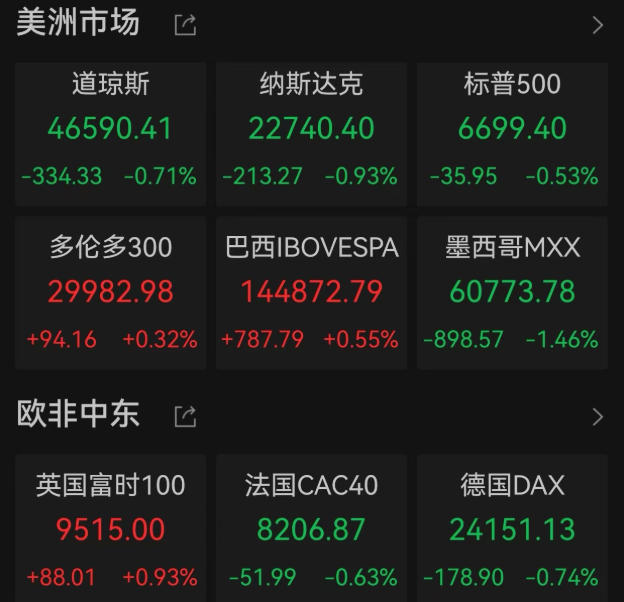
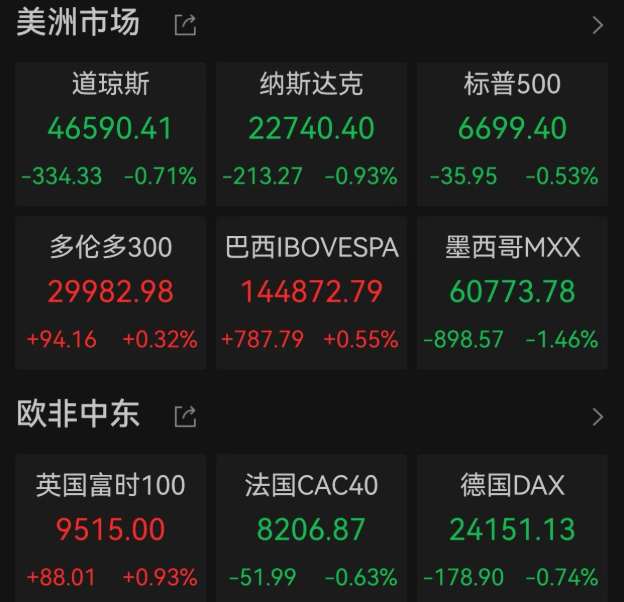
Market Overview - On October 22, US stock indices closed lower, with the Dow Jones Industrial Average dropping over 300 points, down 0.71% [2]. - The Nasdaq index fell 0.93%, and the S&P 500 index decreased by 0.53% [2]. - The US Tech Giants Index declined by 0.51%, with Amazon and Apple each falling over 1% [4]. Tesla Performance - Tesla's stock fell 0.82% and continued to decline in after-hours trading, dropping over 4% at one point [4]. - For Q3, Tesla reported revenue of $28.1 billion, exceeding the estimate of $26.36 billion, with an operating profit of $1.62 billion, slightly below the forecast of $1.65 billion [4]. - The company's gross margin for Q3 was reported at 18.0% [4]. Commodity Market - In the commodities market, international gold prices showed mixed trends, with London spot gold down 0.65% to $4,097.94 per ounce, while COMEX gold futures rose 0.18% to $4,116.60 per ounce [5]. - Oil prices surged, with Brent crude futures increasing over 4% and WTI crude futures rising more than 3% [8]. - Factors contributing to the rise in oil prices include changes in international trade dynamics, an unexpected decline in US crude oil inventories reported by the EIA, and plans by the US Energy Department to replenish the Strategic Petroleum Reserve [8]. Chinese Stocks - The Nasdaq Golden Dragon China Index fell by 0.93%, with notable declines in individual stocks such as Pony.ai dropping nearly 7% and Hesai Technology and JinkoSolar each falling over 5% [4]. European Market - European stock indices showed mixed results, with Germany's DAX down 0.74%, France's CAC40 down 0.63%, and the UK's FTSE 100 up 0.93% [4].


美股三大指数 全线下跌!原油跳涨
Zhong Guo Zheng Quan Bao· 2025-10-22 23:23
Market Overview - On October 22, US stock indices closed lower, with the Dow Jones Industrial Average dropping over 300 points, down 0.71% [2]. - The Nasdaq index fell 0.93%, and the S&P 500 index decreased by 0.53% [2]. - The major technology stocks showed mixed results, with the WenDe US Technology Seven Giants Index down 0.51% [4]. Company Performance - Tesla's stock fell 0.82% and continued to decline in after-hours trading, dropping over 4% at one point [4]. - Tesla reported third-quarter revenue of $28.1 billion, exceeding the estimate of $26.36 billion, with an operating profit of $1.62 billion, slightly below the forecast of $1.65 billion [4]. - The gross margin for Tesla in Q3 was reported at 18.0% [4]. Commodity Market - In the commodities market, international gold prices showed mixed trends, with London spot gold down 0.65% to $4,097.94 per ounce, while COMEX gold futures rose 0.18% to $4,116.6 per ounce [7][8]. - Oil prices surged, with Brent crude oil futures increasing by over 4% [9]. - Factors contributing to the rise in oil prices included unexpected declines in US crude oil inventories and plans by the US Energy Department to replenish the Strategic Petroleum Reserve [9]. International Market - The Nasdaq Golden Dragon China Index fell 0.93%, with individual stocks like Pony.ai dropping nearly 7% and Hesai Technology and JinkoSolar down over 5% [6]. - European stock indices showed mixed results, with Germany's DAX down 0.74% and France's CAC40 down 0.63%, while the UK's FTSE 100 rose by 0.93% [6].
偏多情绪回暖,能化震荡企稳
Bao Cheng Qi Huo· 2025-10-22 11:29
Report Overview - Report Date: October 22, 2025 [4] - Report Title: Rubber, Methanol, Crude Oil - Daily Report - Report Author: Chen Dong from Baocheng Futures Investment Consulting Department 1. Report Industry Investment Rating - No industry investment rating is provided in the report. 2. Core Viewpoints - **Rubber**: On Wednesday, the domestic Shanghai rubber futures contract 2601 showed a trend of shrinking volume, reducing positions, stabilizing in oscillation, and slightly rising. The price center moved up to around 15,100 yuan/ton. Benefiting from better-than-expected production and sales in the domestic auto market, the demand drive strengthened, which was conducive to the valuation repair of the Shanghai rubber futures contract 2601 [6]. - **Methanol**: On Wednesday, the domestic methanol futures contract 2601 showed a trend of shrinking volume, increasing positions, stabilizing in oscillation, and slightly rising. The price reached a maximum of 2,276 yuan/ton and a minimum of 2,257 yuan/ton. The 1 - 5 spread discount widened to 20 yuan/ton. Currently, the domestic methanol market is still in a stage of oversupply and weak demand, and the domestic methanol futures contract 2601 remains in a weak state [6]. - **Crude Oil**: On Wednesday, the domestic crude oil futures contract 2512 showed a trend of increasing volume, increasing positions, stabilizing in oscillation, and slightly rising. The price reached a maximum of 448.1 yuan/barrel and a minimum of 434.0 yuan/barrel. As the previous macro - negative sentiment was "gradually digested, the short - term macro - drive was corrected, and the "bullish" atmosphere recovered. It is expected that the prices of domestic and foreign crude oil futures will maintain a stable and oscillating trend in the future [6]. " 3. Summary by Directory 3.1 Industry Dynamics Rubber - As of October 19, 2025, the total inventory of natural rubber in bonded and general trade in Qingdao was 437,500 tons, a decrease of 18,600 tons or 4.07% from the previous period. The bonded area inventory was 69,600 tons, a decrease of 1.70%, and the general trade inventory was 367,900 tons, a decrease of 4.51%. The inbound rate of the sample bonded warehouses for natural rubber in Qingdao decreased by 2.14 percentage points, and the outbound rate increased by 1.01 percentage points; the inbound rate of general trade warehouses decreased by 1.97 percentage points, and the outbound rate increased by 2.21 percentage points [8]. - As of the week of October 17, 2025, the capacity utilization rate of China's semi - steel tire sample enterprises was 71.07%, a week - on - week increase of 28.92 percentage points and a year - on - year decrease of 8.57 percentage points; the capacity utilization rate of China's all - steel tire sample enterprises "was 63.96%, a week - on - week increase of 22.43 percentage points and a year - on - year increase of 4.98 percentage points. Most enterprises' "capacity utilization rates" have recovered "to pre - holiday levels, and the overall shipment performance within the cycle varies [8]. - In September 2025, China's logistics industry prosperity index was 51.2%, an increase of 0.3 percentage points from the previous month. The new order index showed stable " "expansion. " In September, "China's automobile "production and sales" were " "3.276 million "and 3.226 million "units respectively, a year - on - year increase of 17.1% and 14.9% respectively. In the first three quarters of 2025, China's cumulative automobile production and sales were 24.333 million and 24.363 million units respectively, a year - on - year increase of 13.3% and "12.9% respectively. In September 2025 " the sales volume of China's heavy - truck " "market was 105,00 " "units, a year - on - year increase of about "82% "and a month - on - month increase of 15%, " "ach "ieving " six consecutive months of growth [9]. " Methanol - As of the week of October 17, 2025 " "the average domestic "methanol " "operating rate "was maintained at 84.38%, a week - on - week "slight increase of 4 "%, a month - on - month " "significant increase of 4.99%, and a slight increase of 2.95% compared with the same period last year. The average weekly production of methanol in China reached 1.9837 million tons, a week - on - "week "slight decrease "of 49,3 " "tons, a month - on - month significant increase of 64,400 tons, and a significant increase of 118,600 tons compared with "1.86 "51 million tons in the same period last year [10]. - As of the week of October 17, 2025, the domestic formaldehyde operating rate was maintained at 30.95%, a week - on - week slight decrease of "0.03%. The operating rate of dimethyl ether was maintained at 6.68%, a week - on - week slight decrease of "1.52%. The operating rate " "of acetic acid was "maintained at 71.61%, a week - on - week significant "decline of 10.04%. The operating rate of MTBE was maintained at 54.89%, a week - on - week slight "de " " "crease of 3%. As of the week of " "October 17, 2025, the " "average operating load of domestic coal (methanol) to olefin " " "plants was " "88.36%, a week - on - week slight " " "increase of 0.39 percentage points and a month - on - month slight increase of 5.48 "%. As of October 17, 2025, the futures " " " " " " " " " " " " " " " " " " " " " " " " " " " " " " " " " " " " " " " " " " " " " " " " " " " " " " " " " " " " " " " " " " " " " " " " " " " " " " " " " " " " " " " " " " " " " " " " " " " " " " " " " " " " " " " " " " " " " " " " " " " " " " " " " " " " " " " " " " " " " " " " " " " " " " " " " " " " " " " " " " " " " " " " " " " " " " " " " " " " " " " " " " " " " " " " " " " " " " " " " " " " " " " " " " " " " " " " " " " " " " " " " " " " " " " " " " " " " " " " " " " " " " " " " " " " " " " " " " " " " " " " " " " " " " " " " " " " " " " " " " " " " " " " " " " " " " " " " " " " " " " " " " " " " " " " " " " " " " " " " " " " " " " " " " " " " " " " " " " " " " " " " " " " " " " " " " " " " " " " " " " " " " " " " " " " " " " " " " " " " " " " " " " " " " " " " " " " " " " " " " " " " " " " " " " " " " " " " " " " " " " " " " " " " " " " " " " " " " " " " " " " " " " " " " " " " " " " " " " " " " " " " " " " " " " " " " " " " " " " " " " " " " " " " " " " " " " " " " " " " " " " " " " " " " " " " " " " " " " " " " " " " " " " " " " " " " " " " " " " " " " " " " " " " " " " " " " " " " " " " " " " " " " " " " " " " " " " " " " " " " " " " " " " " " " " " " " " " " " " " " " " " " " " " " " " " " " " " " " " " " " " " " " " " " " " " " " " " " " " " " " " " " " " " " " " " " " " " " " " " " " " " " " " " " " " " " " " " " " " " " " " " " " " " " " " " " " " " " " " " " " " " " " " " " " " " " " " " " " " " " " " " " " " " " " " " " " " " " " " " " " " " " " " " " " " " " " " " " " " " " " " " " " " " " " " " " " " " " " " " " " " " " " " " " " " " " " " " " " " " " " " " " " " " " " " " " " " " " " " " " " " " " " " " " " " " " " " " " " " " " " " " " " " " " " " " " " " " " " " " " " " " " " " " " " " " " " " " " " " " " " " " " " " " " " " " " " " " " " " " " " " " " " " " " " " " " " " " " " " " " " " " " " " " " " " " " " " " " " " " " " " " " " " " " " " " " " " " " " " " " " " " " " " " " " " " " " " " " " " " " " " " " " " " " " " " " " " " " " " " " " " " " " " " " " " " " " " " " " " " " " " " " " " " " " " " " " " " " " " " " " " " " " " " " " " " " " " " " " " " " " " " " " " " " " " " " " " " " " " " " " " " " " " " " " " " " " " " " " " " " " " " " " " " " " " " " " " " " " " " " " " " " " " " " " " " " " " " " " " " " " " " " " " " " " " " " " " " " " " " " " " " " " " " " " " " " " " " " " " " " " " " " " " " " " " " " " " " " " " " " " " " " " " " " " " " " " " " " " " " " " " " " " " " " " " " " " " " " " " " " " " " " " " " " " " " " " " " " " " " " " " " " " " " " " " " " " " " " " " " " " " " " " " " " " " " " " " " " " " " " " " " " " " " " " " " " " " " " " " " " " " " " " " " " " " " " " " " " " " " " " " " " " " " " " " " " " " " " " " " " " " " " " " " " " " " " " " " " " " " " " " " " " " " " " " " " " " " " " " " " " " " " " " " " " " " " " " " " " " " " " " " " " " " " " " " " " " " " " " " " " " " " " " " " " " " " " " " " " " " " " " " " " " " " " " " " " " " " " " " " " " " " " " " " " " " " " " " " " " " " " " " " " " " " " " " " " " " " " " " " " " " " " " " " " " " " " " " " " " " " " " " " " " " " " " " " " " " " " " " " " " " " " " " " " " " " " " " " " " " " " " " " " " " " " " " " " " " " " " " " " " " " " " " " " " " " " " " " " " " " " " " " " " " " " " " " " " " " " " " " " " " " " " " " " " " " " " " " " " " " " " " " " " " " " " " " " " " " " " " " " " " " " " " " " " " " " " " " " " " " " " " " " " " " " " " " " " " " " " " " " " " " " " " " " " " " " " " " " " " " " " " " " " " " " " " " " " " " " " " " " " " " " " " " " " " " " " " " " " " " " " " " " " " " " " " " " " " " " " " " " " " " " " " " " " " " " " " " " " " " " " " " " " " " " " " " " " " " " " " " " " " " " " " " " " " " " " " " " " " " " " " " " " " " " " " " " " " " " " " " " " " " " " " " " " " " " " " " " " " " " " " " " " " " " " " " " " " " " " " " " " " " " " " " " " " " " " " " " " " " " " " " " " " " " " " " " " " " " " " " " " " " " " " " " " " " " " " " " " " " " " " " " " " " " " " " " " " " " " " " " " " " " " " " " " " " " " " " " " " " " " " " " " " " " " " " " " " " " " " " " " " " " " " " " " " " " " " " " " " " " " " " " " " " " " " " " " " " " " " " " " " " " " " " " " " " " " " " " " " " " " " " " " " " " " " " " " " " " " " " " " " " " " " " " " " " " " " " " " " " " " " " " " " " " " " " " " " " " " " " " " " " " " " " " " " " " " " " " " " " " " " " " " " " " " " " " " " " " " " " " " " " " " " " " " " " " " " " " " " " " " " " " " " " " " " " " " " " " " " " " " " " " " " " " " " " " " " " " " " " " " " " " " " " " " " " " " " " " " " " " " " " " " " " " " " " " " " " " " " " " " " " " " " " " " " " " " " " " " " " " " " " " " " " " " " " " " " " " " " " " " " " " " " " " " " " " " " " " " " " " " " " " " " " " " " " " " " " " " " " " " " " " " " " " " " " " " " " " " " " " " " " " " " " " " " " " " " " " " " " " " " " " " " " " " " " " " " " " " " " " " " " " " " " " " " " " " " " " " " " " " " " " " " " " " " " " " " " " " " " " " " " " " " " " " " " " " " " " " " " " " " " " " " " " " " " " " " " " " " " " " " " " " " " " " " " " " " " " " " " " " " " " " " " " " " " " " " " " " " " " " " " " " " " " " " " " " " " " " " " " " " " " " " " " " " " " " " " " " " " " " " " " " " " " " " " " " " " " " " " " "
贵金属价格大幅波动
Tebon Securities· 2025-10-22 11:24
Report Industry Investment Rating The document does not provide the report industry investment rating. Core Viewpoints of the Report - On October 22, 2025, the A-share market showed a shrinking and volatile trend, the bond market maintained a relatively strong trend, and the commodity market witnessed significant fluctuations in precious metal prices [2][3][7][8]. - It is recommended to maintain a balanced allocation strategy. With the upcoming conclusion of the Fourth Plenary Session of the 20th Central Committee, the focus of the "15th Five-Year Plan" policies may become the focus of the new market mainline. The technology sector and new sub - fields such as "deep - earth economy" may receive new catalysts, and the large - consumption sector is worthy of further attention [4][6]. - In the short term, for stocks, it is advisable to maintain a balanced allocation; for bonds, pay attention to policy signals; for commodities, the sharp adjustment of precious metal prices may bring new long - term layout opportunities [14]. Summary by Related Catalogs Market行情Analysis Stock Market - The A - share market was volatile and shrinking. The Shanghai Composite Index closed at 3913.76 points, down 0.07%; the Shenzhen Component Index fell 0.62% to 12996.61 points; the ChiNext Index dropped 0.79% to 3059.32 points; the STAR 50 closed at 1405.41 points, down 0.06%. The total trading volume was 1.69 trillion yuan, a 10.7% decrease from the previous day [3]. - The energy and banking sectors led the gains, while the precious metal sector tumbled. The energy equipment index rose 2.44%, the oil and gas index increased 1.37%, and the banking index rose 0.93%. The precious metal index dropped 2.49% [6]. - Due to the shift of funds from high - valuation technology stocks to low - valuation value stocks, it is recommended to maintain a balanced allocation. If the trading volume continues to decline, beware of the risk of insufficient market liquidity support [6]. Bond Market - The bond market maintained a relatively strong trend. The 30 - year main contract of treasury bond futures led the gains, and the short - end contracts were relatively weak. The central bank increased net investment, and the market sentiment was driven by the expectation of loose monetary policy and institutional duration - extension behavior [12]. - As the end of the month approaches, attention should be paid to macro - events such as the policy tone of the Fourth Plenary Session, the progress of Sino - US trade negotiations, and the impact of changes in capital fluctuations and policy expectations on subsequent trends [12]. Commodity Market - The domestic commodity futures market showed a sharply differentiated pattern. The energy and chemical sectors led the gains, while the precious metal sector was heavily hit. Crude - oil related varieties such as asphalt (2.95%), crude oil (2.52%), and low - sulfur fuel oil (2.32%) had significant increases, while Shanghai gold and Shanghai silver fell 3.92% and 3.86% respectively [11][12]. - The sharp decline in precious metal prices may be due to the expectation of the end of the Russia - Ukraine war and the market's concern that the CPI data to be released on October 24 may exceed expectations and weaken the Fed's rate - cut efforts [12]. Transaction Hotspot Tracking Recent Popular Varieties Combing - Precious metals: The central bank's continuous purchases and the Fed's expected rate cuts are the core logics. Follow - up concerns include the Fed's rate - cut situation and geopolitical risks [16]. - Dividend stocks: Market style switching is the core logic. Pay attention to the third - quarter report performance and corporate dividend situations [16]. - Artificial intelligence: The accelerating capital expenditure of global technology giants is the core logic. Focus on the capital expenditure and orders of US and domestic technology leaders [16]. - Nuclear fusion: The industrialization acceleration of the mid - upstream links is the core logic. Track project progress and industry bidding situations [16]. - Domestic chips: Technological breakthroughs and large domestic substitution space are the core logics. Watch for lithography machine technology breakthroughs and the progress of self - developed chips by Baidu, Alibaba, etc. [16]. - Robots: The accelerating industrialization trend is the core logic. Follow the order release rhythm of Tesla and the technological progress of domestic enterprises [16]. - Big consumption: RMB appreciation and market style switching are the core logics. Pay attention to the economic recovery situation and further stimulus policies [16]. - Securities firms: Active trading and deposit transfer are the core logics. Focus on the A - share market trading volume and possible changes in trading systems [16]. Recent Core Idea Summary - For equities, due to the lack of significant release of trading volume, it is recommended to maintain a balanced allocation in the short term. In the long - term, technology may still be dominant [14]. - For the bond market, the central bank's net investment and loose capital support the bond market. Pay attention to policy signals from the Financial Street Forum and the Fed's interest - rate meeting at the end of the month [14]. - For commodities, the sharp adjustment of precious metal prices may bring new long - term layout opportunities, and the prices of precious metals may reach new highs during the Fed's rate - cut cycle [14].
【UNforex财经事件】美元回升压制金价 日元与油价分化
Sou Hu Cai Jing· 2025-10-22 10:56
Group 1 - Gold prices are under pressure after testing the $4,380 level, dropping over 4% to around $4,100, influenced by reduced safe-haven demand due to trade optimism and a rebound in the dollar, which raises the opportunity cost of holding gold [1] - Despite short-term pressure, the medium to long-term fundamentals remain supportive for gold, including central bank purchases, de-dollarization trends, structural safe-haven demand, and geopolitical uncertainties [1] - The dollar index has rebounded to the 98.8–98.9 range, driven by improved risk appetite and a slight increase in yields, with market participants reassessing interest rate cut expectations following comments from Federal Reserve officials [1] Group 2 - Recent API and EIA data indicate a larger-than-expected increase in U.S. crude oil inventories, contributing to WTI prices remaining at low levels, with short-term oil prices influenced by inventory levels, drilling counts, and geopolitical news [2] - Key variables for the week include U.S. CPI/PCE inflation data and statements from Federal Reserve officials, which could significantly impact market volatility and asset correlations [2] - The market is exhibiting a "news-driven rapid switch" characteristic, with trade optimism boosting risk appetite, a stronger yen due to economic data and rate hike expectations, and oil prices pressured by inventory and supply forecasts [2]
能源化工期权策略早报:能源化工期权-20251022
Wu Kuang Qi Huo· 2025-10-22 02:03
1. Report Industry Investment Rating No relevant content provided. 2. Core Viewpoints of the Report - The energy and chemical sector is mainly divided into energy, alcohols, polyolefins, rubber, polyesters, alkalis, and others. For each sector, options strategies and suggestions are provided for selected varieties. Each option variety's strategy report includes underlying market analysis, option factor research, and option strategy suggestions [9]. - The overall strategy is to construct option portfolio strategies mainly based on sellers, as well as spot hedging or covered strategies to enhance returns [3]. 3. Summary by Related Catalogs 3.1 Futures Market Overview - **Data of Various Options**: The report provides the latest prices, price changes, price change rates, trading volumes, volume changes, open interest, and open interest changes of various energy and chemical option underlying futures contracts, such as crude oil, liquefied petroleum gas (LPG), methanol, etc. [4]. 3.2 Option Factors - Volume and Open Interest PCR - **Concept Explanation**: The PCR indicator includes volume PCR (put option volume / call option volume) and open interest PCR (put option open interest / call option open interest). Volume PCR is mainly used to describe whether the underlying market has a turning point, while open interest PCR is used to describe the strength of the underlying market [5]. - **Data of Various Options**: The report presents the volume, volume changes, open interest, open interest changes, volume PCR, volume PCR changes, open interest PCR, and open interest PCR changes of various options [5]. 3.3 Option Factors - Pressure and Support Levels - **Determination Method**: The pressure and support levels of the underlying are determined from the strike prices with the largest open interest of call and put options [6]. - **Data of Various Options**: The report provides the pressure points, pressure point offsets, support points, support point offsets, maximum call option open interest, and maximum put option open interest of various options [6]. 3.4 Option Factors - Implied Volatility - **Calculation Method**: The implied volatility includes at - the - money implied volatility (the arithmetic average of call and put at - the - money option implied volatilities) and weighted implied volatility (using volume - weighted average) [7]. - **Data of Various Options**: The report shows the at - the - money implied volatility, weighted implied volatility, weighted implied volatility changes, annual average implied volatility, call option implied volatility, put option implied volatility, historical 20 - day volatility, and the difference between implied and historical volatility of various options [7]. 3.5 Option Strategies and Suggestions for Different Varieties 3.5.1 Energy - related Options - **Crude Oil**: - **Underlying Market Analysis**: OPEC maintains a 137,000 - barrel - per - day increase. The US shale oil production has slightly increased, and refinery operations are seasonally declining but approaching a small demand peak. The crack spread of refined oil has declined, and the monthly spread of crude oil is stronger than the single - price performance. The market has shown a weak trend overall since July [8]. - **Option Factor Research**: The implied volatility of crude oil options has declined to near the average. The open interest PCR is around 0.60, indicating a weak market. The pressure level is 500, and the support level is 400 [8]. - **Option Strategy Suggestions**: Directional strategy: None. Volatility strategy: Construct a neutral - biased short call + put option combination strategy. Spot long - hedging strategy: Construct a long collar strategy [8]. - **LPG**: - **Underlying Market Analysis**: In September, the estimated domestic LPG commodity volume decreased. The market has shown a pattern of over - decline and rebound with pressure above [10]. - **Option Factor Research**: The implied volatility of LPG options has significantly declined to below the average. The open interest PCR is around 0.60, indicating a weak market. The pressure level is 4500, and the support level is 3600 [10]. - **Option Strategy Suggestions**: Directional strategy: None. Volatility strategy: Construct a neutral - biased short call + put option combination strategy. Spot long - hedging strategy: Construct a long collar strategy [10]. 3.5.2 Alcohol - related Options - **Methanol**: - **Underlying Market Analysis**: Port inventory has decreased, and enterprise inventory has increased. The market has shown a weak trend with pressure above [10]. - **Option Factor Research**: The implied volatility of methanol options fluctuates around the historical average. The open interest PCR is below 0.80, indicating a weak and volatile market. The pressure level is 2300, and the support level is 2250 [10]. - **Option Strategy Suggestions**: Directional strategy: None. Volatility strategy: Construct a short - biased short call + put option combination strategy. Spot long - hedging strategy: Construct a long collar strategy [10]. - **Ethylene Glycol**: - **Underlying Market Analysis**: Port inventory has increased, and the market has entered a inventory - building cycle. The market has shown a weak trend [11]. - **Option Factor Research**: The implied volatility of ethylene glycol options fluctuates below the average. The open interest PCR is around 0.60, indicating strong short - side power. The pressure level is 4500, and the support level is 4050 [11]. - **Option Strategy Suggestions**: Directional strategy: Construct a bear spread strategy using put options. Volatility strategy: Construct a short - volatility strategy. Spot long - hedging strategy: Hold a long spot position + buy a put option + sell an out - of - the - money call option [11]. 3.5.3 Polyolefin - related Options - **Polypropylene**: - **Underlying Market Analysis**: PP production enterprise inventory has decreased, and the market has shown a weak trend with downward pressure [11]. - **Option Factor Research**: The implied volatility of polypropylene options has declined to near the average. The open interest PCR is around 0.70, indicating a weak market. The pressure level is 7300, and the support level is 6300 [11]. - **Option Strategy Suggestions**: Directional strategy: None. Volatility strategy: None. Spot long - hedging strategy: Hold a long spot position + buy an at - the - money put option + sell an out - of - the - money call option [11]. 3.5.4 Rubber - related Options - **Rubber**: - **Underlying Market Analysis**: The social inventory of natural rubber in China has decreased. The market has shown a weak and volatile pattern with support below and pressure above [12]. - **Option Factor Research**: The implied volatility of rubber options has risen sharply and then declined to near the average. The open interest PCR is around 0.60. The pressure level has dropped significantly to 17000, and the support level is 14000 [12]. - **Option Strategy Suggestions**: Directional strategy: None. Volatility strategy: Construct a short - biased short call + put option combination strategy. Spot hedging strategy: None [12]. 3.5.5 Polyester - related Options - **PTA**: - **Underlying Market Analysis**: The overall social inventory of PTA has increased slightly, and the market has shown a weak and short - biased trend with pressure above [12]. - **Option Factor Research**: The implied volatility of PTA options fluctuates at a relatively high level. The open interest PCR is around 0.70, indicating a volatile market. The pressure level is 4600, and the support level is 4300 [12]. - **Option Strategy Suggestions**: Directional strategy: None. Volatility strategy: Construct a short - biased short call + put option combination strategy. Spot hedging strategy: None [12]. 3.5.6 Alkali - related Options - **Caustic Soda**: - **Underlying Market Analysis**: The average utilization rate of caustic soda production capacity has decreased. The market has shown a weak and short - biased trend recently [13]. - **Option Factor Research**: The implied volatility of caustic soda options fluctuates at a relatively high level. The open interest PCR is around 0.90, indicating a weak and volatile market. The pressure level is 2720, and the support level is 2280 [13]. - **Option Strategy Suggestions**: Directional strategy: Construct a bear spread strategy. Volatility strategy: None. Spot collar hedging strategy: Hold a long spot position + buy a put option + sell an out - of - the - money call option [13]. - **Soda Ash**: - **Underlying Market Analysis**: The in - plant inventory of soda ash has increased. The market has shown a low - level and weak - volatile pattern with support below [13]. - **Option Factor Research**: The implied volatility of soda ash options fluctuates at a relatively high historical level. The open interest PCR is below 0.60, indicating strong short - side pressure. The pressure level is 1400, and the support level is 1100 [13]. - **Option Strategy Suggestions**: Directional strategy: None. Volatility strategy: Construct a short - volatility combination strategy. Spot long - hedging strategy: Construct a long collar strategy [13]. 3.5.7 Urea Options - **Underlying Market Analysis**: The enterprise inventory of urea has increased, and the market has shown a low - level and weak - volatile pattern [14]. - **Option Factor Research**: The implied volatility of urea options fluctuates slightly around the historical average. The open interest PCR is below 0.60, indicating strong short - side pressure. The pressure level is 1800, and the support level is 1600 [14]. - **Option Strategy Suggestions**: Directional strategy: Construct a bear spread strategy using put options. Volatility strategy: Construct a short - biased short call + put option combination strategy. Spot hedging strategy: Hold a long spot position + buy an at - the - money put option + sell an out - of - the - money call option [14].
【财经早餐】2025.10.22星期三
Sou Hu Cai Jing· 2025-10-22 01:32
Macro Economy - The Ministry of Commerce held a video meeting discussing export controls and the EU's anti-subsidy case against Chinese electric vehicles, with both sides expressing a willingness to enhance communication on semiconductor issues [4] - China's GDP growth averaged 5.5% during the first four years of the 14th Five-Year Plan, showcasing resilience and potential despite external challenges [4] - Domestic tourism saw 4.998 billion trips in the first three quarters, a year-on-year increase of 18.0%, with total spending reaching 4.85 trillion yuan, up 11.5% [4] Real Estate Dynamics - The Guangzhou Real Estate Agency issued a statement urging real estate agents to improve service quality and resist commission-based practices that harm the industry's reputation [6] - In September, the real estate sector raised 56.1 billion yuan in bond financing, a 31% year-on-year increase, with credit bonds accounting for 57.4% of the total [6] - Shenzhen plans to launch 39 new residential projects in Q4, with a total supply area of approximately 1.6 million square meters, indicating a significant increase compared to Q3 [6] Stock Market Review - The Shanghai Composite Index rose 1.36% to 3916.33 points, with a total market turnover of 1.87 trillion yuan, reflecting a broad-based rally [7] - The Hang Seng Index increased by 0.65%, with significant gains in the insurance and technology sectors, while new consumption concepts showed signs of adjustment [7] - As of October 21, the total market capitalization of companies listed on the Beijing Stock Exchange was 863.865 billion yuan [8] Company News - Bubble Mart reported a 245%-250% year-on-year increase in overall revenue for Q3, with domestic revenue up 185%-190% and overseas revenue up 365%-370% [18] - CATL is accelerating the production of its 587Ah battery, aiming to increase its market share in the future [19] - Yushutech launched a four-legged robot training platform aimed at enhancing engineering practice capabilities for students [19]

宝城期货原油早报-20251022
Bao Cheng Qi Huo· 2025-10-22 01:08
1. Report Industry Investment Rating - There is no clear industry - wide investment rating provided in the report. 2. Report's Core View - The report believes that although the macro - bearish sentiment has weakened due to Trump's signal to ease tensions, the macro and industrial factors in the crude oil market remain weak. With OPEC+ increasing production and the "war premium" fading, the oil market supply pressure is increasing. However, the domestic crude oil futures 2512 contract may maintain a slightly stronger oscillation trend on Wednesday [5]. 3. Summary According to Relevant Contents Price and Trend - The domestic crude oil futures 2512 contract showed an oscillating and stabilizing trend on Tuesday night, with the futures price rising slightly by 0.64% to 439.0 yuan/barrel. It is expected to maintain an oscillating and slightly stronger trend on Wednesday [5]. Driving Factors - The macro - bearish sentiment has weakened as Trump released a signal to ease tensions. But the macro and industrial factors in the crude oil market are still in a weak pattern [5]. - Eight OPEC+ oil - producing countries decided to increase production by 137,000 barrels per day in November, increasing the supply pressure in the oil market [5]. - The geopolitical situation in the Middle East has shown signs of easing, and the "war premium" that previously supported oil prices has diminished [5].
国际油价或步入下行周期,化工行业板块分化明显
Sou Hu Cai Jing· 2025-10-21 22:47
Core Viewpoint - The international crude oil and chemical industry is expected to maintain a weak and volatile trend in the fourth quarter due to OPEC+'s continued production increase and the end of the peak oil consumption season [1] Oil Market Outlook - Oil prices are likely to remain weak and volatile in Q4 due to factors such as OPEC+ production increases and the conclusion of the peak consumption season [1] Chemical Industry Analysis - The chemical industry is currently in a cyclical low, transitioning from a late-stage recession to an early-stage recovery, with limited quarter-on-quarter improvement expected in Q4, although a slight year-on-year increase is anticipated [1] - Sub-industry performance is expected to diverge further, with segments like agrochemicals, fluorochemicals, and electronic chemicals benefiting from policy support and demand growth, showing potential for continued upward momentum [1] - Conversely, sectors such as titanium dioxide and vitamins are facing challenges due to capacity saturation and insufficient demand-side support [1]