Hua Er Jie Jian Wen

Search documents
国产AI算力里程碑时刻:中科曙光3套scaleX万卡超集群落地,国产最大AI算力池投入运营
Hua Er Jie Jian Wen· 2026-02-06 10:57
Core Insights - The National Supercomputing Internet Core Node has launched in Zhengzhou, marking the first operational deployment of a 30,000-card domestic AI computing pool in China [1] - The scaleX 10,000-card super cluster is a significant advancement in AI computing, achieving a 20-fold increase in cabinet-level computing density and a 30% to 40% performance improvement for MoE trillion-parameter model training and inference [1][2] - The scaleX640 super node, which supports multi-brand acceleration cards and is compatible with mainstream computing ecosystems, aims to lower the R&D threshold for AI clusters and avoid redundant investments [2] Technological Advancements - The scaleX640 super node features an "open architecture" that enhances communication speed and reduces latency, enabling the formation of thousand-card computing units [1][2] - The supercomputing pool supports various large-scale AI computing scenarios, including trillion-parameter model training, high-throughput inference, and AI for Science applications, significantly improving research efficiency in fields like protein studies [2] Future Developments - The company plans to establish an Advanced Computing Technology Research Institute in Zhengzhou, with a 160,000 square meter R&D space and an initial goal of gathering 1,000 researchers focused on AI and high-performance computing applications [3]

CPU供应短缺再升级,英特尔和AMD被曝告知中国客户交货延长
Hua Er Jie Jian Wen· 2026-02-06 10:38
风险提示及免责条款 市场有风险,投资需谨慎。本文不构成个人投资建议,也未考虑到个别用户特殊的投资目标、财务状况或需要。用户应考虑本文中的任何 意见、观点或结论是否符合其特定状况。据此投资,责任自负。 据外媒报道称,知情人士透露,英特尔和AMD已通知中国客户,其服务器用中央处理器(CPU)出现 供应短缺问题。英特尔还警告称,未来交货期最长可能达到六个月。 媒体援引一位知情人士的话表 示,供货紧张已导致英特尔服务器产品在中国市场的价格普遍上涨逾10%,不过具体价格因客户合同条 款可能会有些区别。还有两位知情人士表示,中国市场占英特尔总营收的20%以上,该公司第四代和第 五代至强(Xeon)CPU的供应尤为紧张,英特尔正实行定量交货制度。 记者向供应链求证,一位知情 人士表示,确实个别产品会供应紧张,需要提前提交市场需求预测。(澎湃) ...


软件崩盘的“蝴蝶效应”:BDC→私募信贷→金融板块?
Hua Er Jie Jian Wen· 2026-02-06 10:28
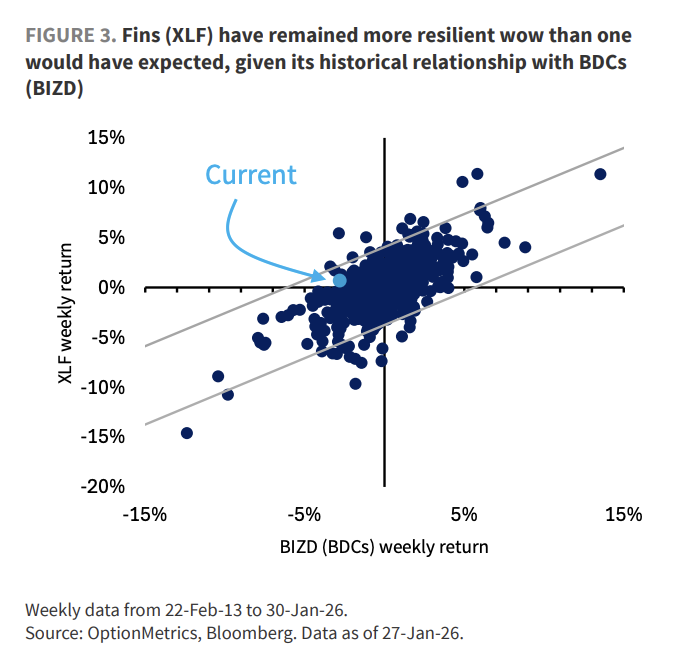
Group 1 - The core viewpoint of the report is that the significant decline in the software industry is transmitting risks to the private credit market through Business Development Companies (BDCs) [1][2] - BDCs have a high concentration of risk exposure in the software sector, accounting for approximately 20% of their portfolios, making them vulnerable to the recent downturn in software stock prices [2] - The software sector has experienced a cumulative decline of about 21% year-to-date, leading to a notable deterioration in the quality of underlying assets [1][2] Group 2 - Financial ETFs and high-yield bond ETFs show a persistent and significant statistical correlation with private credit returns, indicating that the financial sector has not fully priced in the potential risks from the software sector's decline [2] - Despite the weakening BDC index, financial ETFs remain relatively strong, suggesting a possible lag in market adjustments to the emerging risks [2] Group 3 - The report highlights a structural divergence in market volatility pricing, with commodity asset volatility at historically high levels, while fixed income and financial sector volatility remains at historically low levels [4] - The implied volatility for commodities like U.S. crude oil, silver, and gold ETFs is at the 99%-100% historical percentile, reflecting strong market pricing of geopolitical risks and currency devaluation expectations [4] Group 4 - Current market sentiment indicators show extreme polarization, with bearish sentiment concentrated in small-cap and technology sectors, while assets like gold and natural gas exhibit strong bullish expectations [5] - The skewness in options pricing indicates that the cost of downside protection for the Nasdaq 100 and materials sector is significantly high, while oil and gas options are priced more moderately [6] Group 5 - The report identifies high-quality hedging tools for different asset classes, suggesting that high-yield bonds and financial sector put options offer optimal risk-reward ratios for hedging against global equity market risks [7] - For large-cap tech stock downside risks, high-yield bonds and investment-grade corporate bonds provide effective protection, while for commodities, high-yield bonds and energy sector ETFs are recommended [7] Group 6 - The commodity sector is under significant pressure, with its volatility and term structure Z-scores notably above long-term averages, indicating that market pressures are far beyond normal levels [8] - Cross-asset correlations are currently at a high level of 73%, suggesting that the diversification effect of asset allocation is diminishing, while internal correlations within the U.S. stock market remain at a historical low of 2% [8]


华尔街评亚马逊财报:2000亿资本开支太吓人,将对利润造成压力
Hua Er Jie Jian Wen· 2026-02-06 09:34
Core Insights - Amazon's AWS business drove better-than-expected Q4 performance, but the weak Q1 operating profit guidance and a capital expenditure plan of up to $200 billion by 2026 are shifting market focus from growth to the sustainability of profits and free cash flow [1] Group 1: Q4 Performance - The company reported Q4 net sales of $213.4 billion, a 14% year-over-year increase, with a GAAP operating profit of $25 billion [1] - AWS revenue reached $35.6 billion, growing 24% year-over-year, marking the fastest growth rate in 13 quarters [1][2] - Adjusted operating profit for Q4 was $27.4 billion, a 29.2% increase year-over-year, exceeding market expectations by approximately 10% [2] Group 2: Q1 Guidance - For Q1, the company expects net sales between $173.5 billion and $178.5 billion, a year-over-year growth of 11% to 15%, with a midpoint of $176 billion, aligning with market expectations [3] - The operating profit guidance is significantly lower than market consensus, ranging from $16.5 billion to $21.5 billion, with a midpoint of $19 billion, about 15% below market expectations [3] Group 3: Capital Expenditure - The company anticipates capital expenditures to reach $200 billion by 2026, a 52% year-over-year increase, significantly higher than the market's previous expectation of $146 billion to $149 billion [4] - The increase in capital expenditure is attributed to growing demand for AWS and AI, with AWS order commitments rising 40% year-over-year to $240 billion [4] Group 4: Analyst Perspectives - Analysts have mixed views; HSBC lowered its target price from $300 to $280 due to Q1 guidance and Leo project costs, maintaining a Buy rating [5] - UBS also maintains a Buy rating with a target price of $311, indicating about 40% upside potential, while Citigroup believes AWS growth and retail efficiency justify a premium valuation, maintaining a Buy rating with a target price of $320 [5] Group 5: Market Focus - Investors are expected to focus on disclosures regarding performance obligations and AWS capacity utilization in upcoming communications [6] - The key question for Amazon will shift from "Can it grow?" to "At what cost can it grow?" and when the high levels of investment will translate into more certain profit and cash flow improvements [6]

第三次锂超期周期!瑞银:全面上调锂价预测,到2030年需求有望翻番
Hua Er Jie Jian Wen· 2026-02-06 09:06
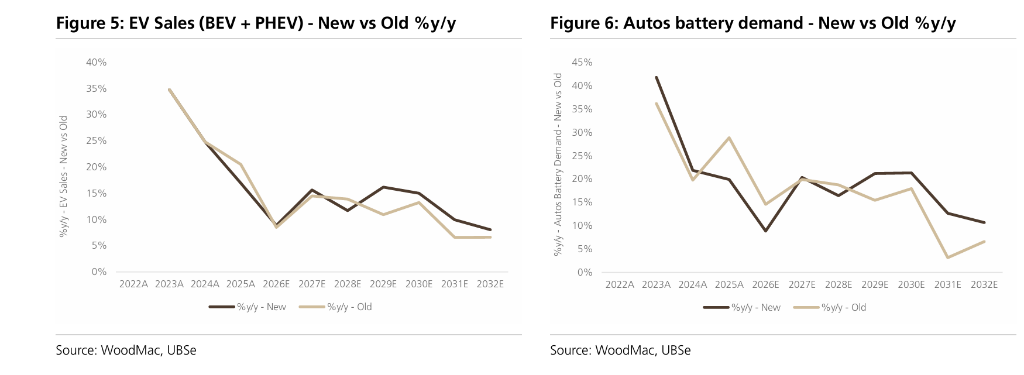
Core Viewpoint - UBS has significantly raised its lithium price forecasts, with increases up to 74%, and expects global lithium demand to double to 3.4 million tons by 2030 compared to 2025, marking the onset of a third lithium price supercycle [1]. Demand Side: Dual Drivers of Electric Vehicles and Energy Storage - UBS predicts a 14% increase in global lithium demand in 2026 and a 16% increase in 2027, with long-term demand expected to grow from 1.7 million tons in 2025 to 3.4 million tons by 2030, reflecting a compound annual growth rate of 13% before 2035 [2]. - Electric vehicle (EV) demand is projected to accelerate mid-term, with a forecasted global EV penetration rate of 58% by 2035, up from 23% in 2025 [2]. - The demand for energy storage systems is expected to surge, with UBS raising its 2026-2035 energy storage demand forecast by 30-53%, increasing its share of lithium consumption from 8% in 2020 to 42% by 2035 [2]. Supply Response: Growth but Still Insufficient to Meet Demand - Supply is responding but is lagging behind demand growth, with a projected 18% increase in primary supply in 2025, which is still below the 26% demand growth [5]. - UBS anticipates a 20% year-on-year increase in risk-weighted supply in 2027, with a 13% increase in 2028, but the market will remain tight due to strong demand growth [5]. - Recycled lithium supply is expected to account for 5.3% of battery demand by 2026, increasing to 6.7% by 2030, but remains limited [5]. Price Outlook: Significant Increases Yet Within Historical Ranges - UBS has raised its lithium spodumene and chemical price forecasts by up to 74%, with a 2026 spodumene price forecast of $3,131 per ton, significantly above market consensus [9]. - The 2027 price forecast indicates continued strength, with spodumene at $3,469 per ton and lithium carbonate and hydroxide at $28,525 per ton, reflecting UBS's aggressive stance on supply-demand dynamics [9]. - Long-term price forecasts are more moderate, with spodumene prices expected to decline from $2,750 per ton in 2028 to $1,750 per ton by 2030 [9]. Market Balance: Shortage Situation Supporting Prices - The market is experiencing increasing supply shortages, with a projected shortfall of approximately 15,000 tons in 2025 and 18,000 tons in 2026, which will support high prices [13]. - Inventory data shows a continuous decline in China's lithium carbonate inventory, indicating a tightening supply chain [13]. - A potential market surplus of about 61,000 tons is expected in 2027, but shortages are anticipated to return in 2029 and 2030, with deficits of 63,000 tons and 87,000 tons, respectively [13].
暴跌20%!Stellantis宣告“电车大撤退”,计提220亿巨额亏损
Hua Er Jie Jian Wen· 2026-02-06 08:40
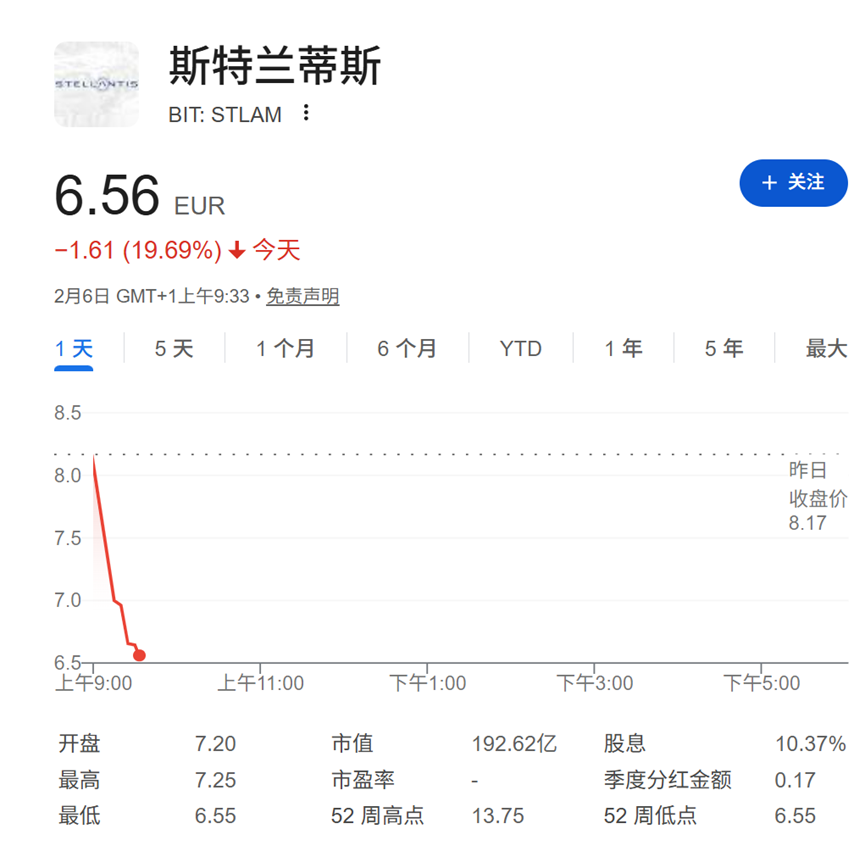
Core Viewpoint - Stellantis, the world's fourth-largest automaker, is acknowledging a strategic miscalculation with a massive write-down of approximately €22 billion, leading to a comprehensive adjustment of its operational strategy, including exiting battery joint ventures and halting production of electric pickup trucks [1] Group 1: Strategic Adjustments - Stellantis is systematically reducing its electric vehicle (EV) business footprint, including exiting a joint venture with LG Energy Solution in Canada, where it had planned to invest over CAD 5 billion (USD 3.7 billion) in a large EV battery plant [3] - The company has discontinued several electric vehicle models, including the RAM 1500 electric pickup in the U.S. market, and postponed Alfa Romeo's EV projects in Europe, contrasting sharply with the aggressive targets set by former CEO Carlos Tavares [4] - As part of the strategic overhaul, Stellantis has also decided to abandon certain investment projects, including a planned hydrogen joint venture [5] Group 2: Financial Outlook - Stellantis anticipates a net loss of up to €21 billion in the second half of 2025, with an expected full-year operating profit margin in the low single digits, which includes approximately €1.6 billion in tariff-related expenses [6] - To strengthen its balance sheet, Stellantis plans to issue up to €5 billion in bonds as a financial self-rescue measure following significant market share losses [6] - The company is set to release detailed annual financial results on February 26 and plans to present its strategic plan to investors in May [7] Group 3: Leadership and Market Strategy - Since taking over in June last year, CEO Antonio Filosa has been implementing comprehensive reforms aimed at regaining market share while scaling back EV ambitions and addressing U.S. tariff costs [7] - Filosa has committed to investing $13 billion in the U.S. market, reintroducing V8 engines, and delaying EV projects, alongside significant price reductions to capture market share [7]

涨价了你得补钱!三大存储巨头拟推“短期合同+后结算”模式
Hua Er Jie Jian Wen· 2026-02-06 08:40
Core Insights - The global memory chip market is undergoing a significant transformation in pricing rules, with major suppliers like Samsung, SK Hynix, and Micron adopting a new contract model that shortens contract durations and introduces "post-settlement" clauses [1][2] Group 1: Pricing Mechanism Changes - Traditional pricing models for memory products, such as DRAM and NAND, are being disrupted, moving from fixed prices determined at the start of contracts to dynamic pricing that allows adjustments based on market conditions even after delivery [2] - The introduction of "post-settlement" clauses enables suppliers to capture price increases, effectively transferring market risk entirely to buyers [2] - Contract durations have significantly shortened, with many agreements now lasting only a quarter or even a month, despite buyers seeking longer contracts for stable supply [2] Group 2: Impact on Major Tech Companies - Even large tech companies like Apple, which typically secure long-term supply agreements, are not immune to price increases, as current supply shortages limit their ability to lock in prices beyond mid-2026 [3] - In the first quarter, Samsung and SK Hynix raised the prices of LPDDR for iPhones, with Samsung's prices increasing by over 80% and SK Hynix's by approximately 100% [3] - Major memory manufacturers are tightening control over customer orders, requiring disclosure of end customers and order volumes to prevent stockpiling and overbooking, further solidifying the seller's market [3]


谁用电谁发电!美国拟立法终结数据中心“蹭电”时代,严禁推高民用电价
Hua Er Jie Jian Wen· 2026-02-06 08:40
Core Viewpoint - Senator Josh Hawley is advocating for a new bill that mandates data centers to self-supply their electricity when constructing new high-energy facilities, aiming to prevent cost transfer to consumers and protect households from rising electricity prices [1] Group 1: Legislative Proposal - The proposed legislation directly addresses the core issue of the U.S. electricity market, where large data centers consume power far exceeding the current grid capacity, leading to significant price increases for local residents [1] - The bill requires new data centers to implement a "behind-the-meter" power supply arrangement, meaning they must generate their own power and cannot pass energy costs onto consumers [1][2] - This legislative move could fundamentally alter the investment and operational models of the U.S. data center industry, especially as demand for AI and cloud computing surges [1] Group 2: Power Supply Models - The core demand from lawmakers is to establish a responsibility mechanism of "who uses electricity, who generates electricity" [2] - The "behind-the-meter" model is seen as a direct way to alleviate taxpayer burdens by physically isolating corporate electricity use from residential use, ensuring that data centers' energy consumption does not strain existing grid resources [2] - An alternative "front-of-the-meter" model allows data centers to self-generate power while still utilizing the local grid for transmission, which could shorten the operational timeline for facilities [3] Group 3: Market Context - The legislative initiative arises amid growing resistance to new data centers across the U.S., with increasing studies linking electricity price surges to data center construction [4] - The root of the problem lies in the mismatch between supply and demand, where a gigawatt-scale data center can consume power that far exceeds the grid's capacity, leading to local power shortages and price hikes [4] - Lawmakers aim to resolve the supply-demand imbalance by mandating data centers to either self-generate power or fund grid upgrades, ending the reliance on public grid resources that inflate residential electricity prices [4]
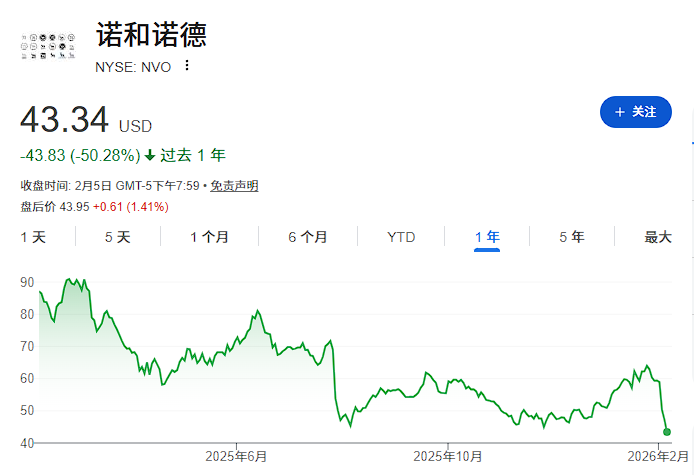
高盛:诺和诺德定价压力被市场过度定价,口服Wegovy将是扭转信心的关键
Hua Er Jie Jian Wen· 2026-02-06 08:23
Core Viewpoint - Novo Nordisk's stock price fell by 18% after disappointing guidance for fiscal year 2026, with Goldman Sachs suggesting that the market's reaction was excessive and that the current stock price reflects the lower end of the company's guidance range [1][4]. Group 1: Financial Guidance and Market Reaction - The company expects revenue for 2026 to decline by 5% to 13% at constant exchange rates, indicating significant pricing pressure and sales bottlenecks in the U.S. obesity drug market [3][5]. - Goldman Sachs noted that the lower end of the guidance implies approximately 13% and 14% downside risks to revenue and EBIT, respectively, aligning with the stock price drop [4]. - The guidance surprised the market, particularly regarding sales expectations, leading to a substantial adjustment in revenue and operating profit forecasts [4][5]. Group 2: U.S. Market Challenges - The decline in revenue is attributed to pricing pressures, slowing sales growth, and the impact of generics, contrasting with competitors like Eli Lilly, which provided a more optimistic sales outlook [5]. - Goldman Sachs significantly revised its forecast for U.S. Wegovy sales, reducing the expected growth from 20-25% to approximately 5%, with a projected 25% decline in sales revenue for 2026 [5]. Group 3: Oral Wegovy Performance - Despite the negative outlook, early performance of the oral version of Wegovy has been a bright spot, with around 50,000 prescriptions written in the U.S. market as of January 23, indicating strong demand [6][7]. - Approximately 45,000 of these prescriptions are self-pay, reflecting robust demand, and management expresses confidence in the product's competitive position [7]. Group 4: Key Catalysts and Pipeline Developments - 2026 is a critical year for Novo Nordisk's pipeline, with significant regulatory decisions expected [8]. - The FDA is anticipated to make a decision on high-dose semaglutide in Q1 2026, with ample production capacity ready for a swift U.S. launch upon approval [9]. - The regulatory decision for the combination drug CagriSema is expected by the end of 2026, with management indicating that initial trial results may not fully capture its weight loss potential [10].

比特币周四暴跌的元凶:巨额IBIT相关杠杆期权被强平?
Hua Er Jie Jian Wen· 2026-02-06 08:10
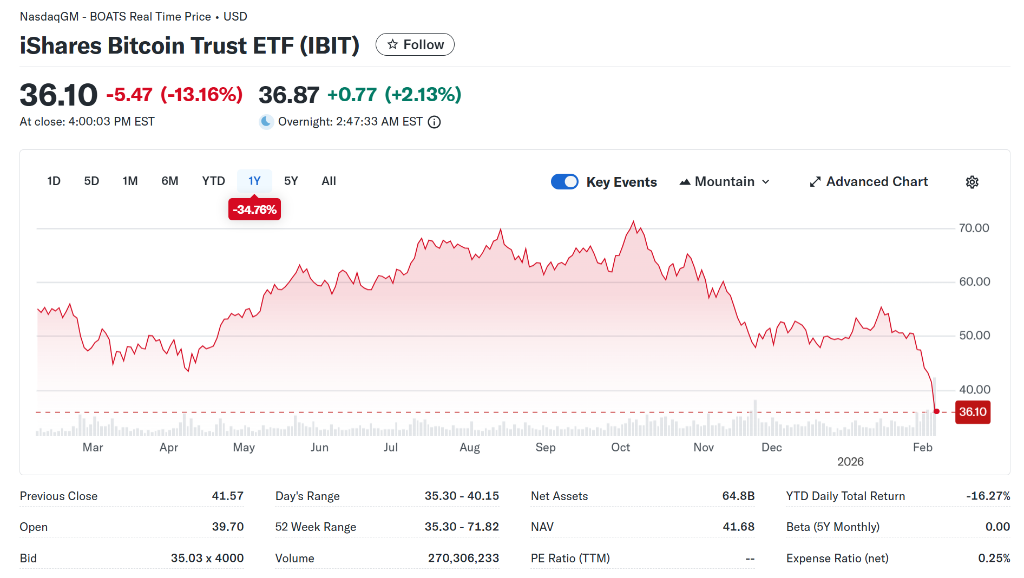
贝莱德旗下比特币现货ETF在周四创下交易量历史新高,市场人士怀疑这场剧烈波动可能源于对冲基金持有的IBIT的高杠杆头寸被强制平仓。 据Nasdaq数据,贝莱德比特币现货ETF产品IBIT周四交易量超过2.84亿股,名义价值突破100亿美元,较此前纪录暴增169%。与此同时,IBIT价 格暴跌13%至36美元左右,创2024年10月以来新低,年内跌幅扩大至27%。 价格方面,IBIT一度跌破35美元,为2024年10月11日以来最低水平。该基金价格曾在去年10月初触及71.82美元的峰值,此后持续下跌。作为全球 最大的公开上市比特币基金,IBIT持有实物比特币,旨在镜像追踪比特币现货价格。比特币周四一度跌至近6万美元。 创纪录交易量与价格暴跌的组合通常被视为投降式抛售的信号,即长期持有者认输并不惜亏损清算持仓。这标志着熊市进入最激烈的抛售阶段, 可能预示着漫长而痛苦的筑底过程开始。 期权市场数据进一步印证了恐慌情绪。据MarketChameleon数据,周四IBIT的长期看跌期权溢价超过看涨期权25个波动率点以上,创下历史新高。 看跌期权是投资者用于对冲下跌风险的合约。 Parker White指出,期权权利金 ...