
Qi Huo Ri Bao

Search documents
情绪退潮叠加基本面压力,氧化铝期价冲高回落
Qi Huo Ri Bao· 2025-08-15 02:53
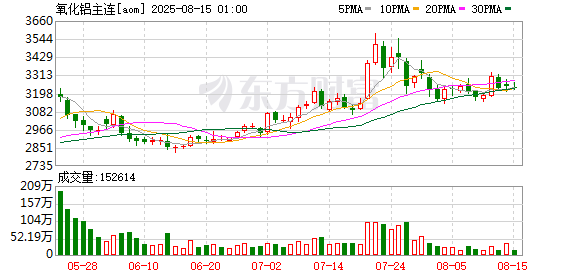
Core Viewpoint - The recent surge in alumina futures prices was driven by news from Shanxi Province regarding adjustments in mining rights, but the market has since cooled down, leading to a decline in prices as speculative sentiment wanes [1][2]. Supply Side - Shanxi's decision aims to enhance the protection of strategic mineral resources, including bauxite, by centralizing mining rights management [1]. - China's bauxite supply has been decreasing annually due to reduced mineral resources and stricter mining controls, leading to increased imports by local alumina companies to maintain production [1][2]. - Recent elections in Guinea have led to a relaxation of aluminum ore export policies, which is expected to increase overseas ore supply [2]. - Domestic alumina production capacity is growing, but there is a regional imbalance in output, with higher production in the north compared to the south [2][3]. - As of August 7, China's alumina production capacity was 114.8 million tons, with an operating capacity of 94.4 million tons, resulting in an operating rate of 82.23% [2]. Demand Side - The demand for alumina is expected to weaken as the replenishment of raw materials and inventory reduction slows down, coupled with limited growth in demand for casting aluminum alloys [2][3]. - Inventory levels for alumina are rising, with the Shanghai Futures Exchange's alumina delivery warehouse inventory increasing from under 5,000 tons to around 40,000 tons recently [3]. Market Outlook - Analysts suggest that the fundamentals for alumina are under pressure, leading to weak price performance [3]. - The increase in registered warehouse receipts for alumina in August may alleviate previous tightness in the market, but bearish sentiment persists due to expectations of weak future prices [3][4]. - Despite the bearish outlook, factors such as the Shanxi mining rights news and stable overseas ore prices may limit the downside for alumina futures in the short term [3][4]. - The market is expected to maintain a range-bound trading pattern, fluctuating around cost levels, influenced by seasonal demand and potential supply adjustments [4].
焦煤关注“反内卷”政策执行力度
Qi Huo Ri Bao· 2025-08-15 00:46
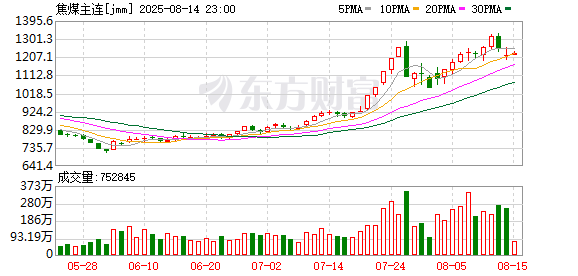
6月,全国安全生产月之初,煤矿事故引发主产区安监加码,加上彼时炼焦煤价格已处2017年以来的低 位,部分煤矿经营压力较大。成本支撑、安监预期,以及市场短期调整等因素叠加,推动焦煤期货于6 月3日见底后企稳走强。 整体来看,8月焦煤市场供应端仍存在多重支撑因素。虽然短期对国内实际供应影响有限,但行业积极 响应"反内卷"政策的态势已然显现。即便实质性产能退出规模尚待观察,但市场预期已明显改善,行业 协会召开专题会议,释放产量调控信号,以及煤企主动配合政策导向,通过调整生产节奏等方式维护市 场秩序。 焦煤产量边际收缩 从实际产量来看,7月底至8月上旬,国内炼焦煤矿开工率连续两周环比下滑,"反内卷"政策已通过超产 整治和企业自律等方式对焦煤供应产生一定压制。根据钢联的统计,截至8月14日,全国523家炼焦煤矿 开工率为83.7%,较7月25日当期累计下降3.2个百分点;原煤日均产量为187.9万吨,较7月25日当期累 计下降6.8万吨。 综上,当前市场关注的核心在于"反内卷"政策对焦煤供应端的实质性影响。这一影响主要体现在两个层 面:政策层面,煤炭行业具体调控措施的出台及执行力度将直接影响市场预期;实际层面,焦煤产量 ...
宝城期货:铁矿石高位整理
Qi Huo Ri Bao· 2025-08-15 00:43
Core Viewpoint - Iron ore prices have been steadily rising since August, with the 2601 contract increasing by 7.28% from its low, approaching previous highs. The spot price index for iron ore is reported at $103.30 per ton, with mainstream spot varieties at Qingdao Port showing increases between 14 to 39 yuan per ton [1] Group 1: Factors Supporting Price Increase - The recent rise in mineral prices is supported by two main factors: the ongoing "anti-involution" trading logic creating a warm atmosphere in the commodity market, particularly strong performance in the coking coal sector, and the implementation of strict production limits in Tangshan for rebar and rod mills [2] - Despite being in a traditional off-season, the overall decline in iron ore consumption is limited, with steel mills maintaining strong demand. As of the week ending August 8, the average daily pig iron output from 247 sample steel mills was 2.4032 million tons, and daily consumption of imported ore was 2.9814 million tons, both showing year-on-year increases [2][3] Group 2: Supply and Demand Dynamics - The supply of iron ore is currently tight, with a weekly arrival volume of 25.716 million tons at 47 domestic ports, a decrease of 508,000 tons week-on-week. Global shipments also fell by 1.507 million tons [4] - Domestic mining production is weakening, with the capacity utilization rate of 126 mining enterprises at 62.06%, and daily output of iron concentrate at 391,600 tons, both at year-to-date lows. This situation is expected to continue, supporting higher iron ore prices [4] Group 3: Market Outlook - The overall market remains stable with resilient demand, providing continued support for iron ore prices. However, the relative high valuation of iron ore and the unsustainable nature of supply contraction may lead to a period of high-level consolidation in the future [4]
多地尿素出厂价跌破1700元/吨,后期需重点关注两点变化
Qi Huo Ri Bao· 2025-08-15 00:41
Core Viewpoint - The domestic urea market is experiencing mixed performance with significant regional disparities, as prices for low-end urea have dropped below 1700 yuan/ton in major production areas, while some regions see slight rebounds [1][2]. Price Trends - As of August 13, urea futures prices fell, with the main contract closing at 1726 yuan/ton, a decrease of 1.76% [2]. - The price of urea in Xinjiang has decreased by 30 yuan/ton, reaching 1450 yuan/ton [1]. Supply and Demand Dynamics - Urea supply remains abundant, with daily production levels consistently high, leading to a situation where the market is not lacking in supply [3]. - Urea companies reported an increase in inventory, with stocks reaching 957,400 tons, up by 6,980 tons or 7.86% from the previous week [3]. - The agricultural demand for urea is currently weak due to seasonal factors, contributing to a lack of market confidence [2][3]. Future Outlook - There is an optimistic expectation for over 3 million tons of urea exports in the third quarter, primarily concentrated from July to September, coinciding with the peak season for autumn fertilizers [3]. - The production cost for urea is expected to provide strong support around the 1700 yuan/ton mark, limiting further price adjustments [4]. - Short-term price fluctuations are anticipated, with potential for a rebound in late August due to seasonal demand for autumn fertilizers [4].



焦煤后期走势需关注“反内卷”政策执行力度
Qi Huo Ri Bao· 2025-08-15 00:30
7月1日,中央财经委员会第六次会议明确提出"依法依规治理企业低价无序竞争,引导企业提升产品品 质,推动落后产能有序退出",旨在通过供给侧结构性改革遏制恶性价格战,优化行业集中度。供应过 剩的煤炭行业,成为市场关注焦点之一。 此后,国家能源局综合司、煤炭行业协会"反内卷"消息利好陆续兑现,焦煤中长期基本面预期好转,叠 加中美贸易关系缓和以及雅鲁藏布江超级水电工程开建等阶段性利多因素支撑,焦煤期货在7月加速上 行。8月14日,焦煤期货主力合约报收1204元/吨,较6月3日的低点累计上涨69.8%。 供应端存支撑因素 8月以来,焦煤供应端受消息面的影响不断。8月6日,钢联求证市场关注的"某煤业关于下发276工作日 生产组织方案试行通知"这一消息。据钢联调研了解,该集团内部有4家煤矿收到类似通知,合计产能 390万吨。"276工作日"是在上一轮煤炭行业供给侧改革中,国务院在《关于煤炭行业化解过剩产能实现 脱困发展的意见》中明确提出的,且在后续几年间引发行业广泛讨论。本次"276工作日"为个别企业响 应"反内卷"整治的自律行为,在行业内并未广泛执行,因而目前来看影响更多停留在消息层面。 6月,全国安全生产月之初,煤矿事 ...
情绪退潮叠加基本面压力 氧化铝期价冲高回落
Qi Huo Ri Bao· 2025-08-15 00:27
Group 1 - The core viewpoint of the news is that the recent fluctuations in alumina futures prices are primarily driven by market sentiment rather than fundamental supply and demand changes, following regulatory adjustments in Shanxi province [2][4] - Shanxi province has tightened the management of certain mineral resources, including bauxite, which may impact domestic supply, but analysts believe the actual effect on alumina production will be limited as companies can increase imports to meet demand [2][3] - The alumina market is experiencing regional supply-demand mismatches, with production capacity increasing in some areas while others face shortages, leading to a complex market dynamic [3][4] Group 2 - Analysts indicate that the recent increase in alumina production capacity in China has not translated into a proportional rise in output, with inventory levels rising significantly, suggesting a potential oversupply situation [3][5] - The outlook for alumina futures is cautious, with expectations of price corrections due to weakening fundamental support, although short-term factors may limit downside risks [4][5] - Long-term projections suggest that alumina capacity may face excess pressure, shifting the supply-demand balance towards a more relaxed state, which could suppress price increases [5]
多地尿素出厂价跌破1700元/吨 后期需重点关注两点变化
Qi Huo Ri Bao· 2025-08-15 00:27
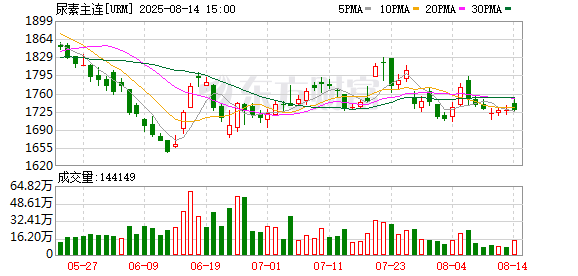
8月13日,国内尿素现货涨跌互现,区域分化明显。主流产区山东、河南、山西、河北、安徽等地低端 尿素出厂价跌破1700元/吨,并向1650元/吨逼近;新疆尿素报价再跌30元/吨,低至1450元/吨。而个别 地区小幅反弹10~30元/吨。 当日,尿素期货价格下跌,截至收盘,尿素期货主力2601合约报收于1726元/吨,跌幅1.76%。 业内人士表示,上游厂家收单不佳,纷纷降价吸单,市场低端尿素成交略有好转,但中间商出货价格更 低,导致成交价格与厂家出厂报价出现倒挂。 隆众资讯分析师吴苑丽向期货日报记者表示,进入7月后,因农业季节性需求转弱,尿素大多会有一波 下跌行情。今年市场存在出口的松动,因此市场参与者认为尿素价格下行空间并不大。不过,由于尿素 日产量一直偏高,价格又处于年内的中等位置,很难吸引下一波的农业需求,而且出口一直受政策管 控,短时市场有效支撑较弱,行情呈现震荡下行趋势,下游以逢低采购为主,追涨意愿不足。 方正中期期货研究院产业团队负责人夏聪聪表示,尿素货源供应及市场可流通货源充裕,而需求端则表 现疲弱,导致市场买气不足。现货市场参与者信心不足,尽管低价货源增加,但市场整体交投情况并未 有好转。市场买 ...
“塑料大王”的“防抖秘籍”——期货工具助力道恩集团稳住生意盘
Qi Huo Ri Bao· 2025-08-14 16:08
Core Viewpoint - Daon Group has established itself as a leading enterprise in the new materials sector in China, particularly in rubber, plastics, and chemical new materials, with a sales revenue of approximately 47.9 billion yuan in 2024 and a brand value exceeding 16 billion yuan [1] Group 1: Company Overview - Daon Group was founded in 1991 and is located in Longkou Economic Development Zone, Yantai City, Shandong Province [1] - The company has become a key player in the plastic industry, with its production and sales being a high-growth business segment [1] Group 2: Risk Management Strategies - The company has developed practical strategies to address price volatility in raw materials, including "cost locking," "pricing gauge," and "inventory slimming" [3] - "Cost locking" involves using futures contracts to hedge against price fluctuations in raw materials or products [3] - "Pricing gauge" allows the company to set reasonable procurement and sales prices based on futures market trends [3] - "Inventory slimming" helps manage stock levels and reduce capital occupation through various methods, including pre-sale pricing and futures hedging [3] Group 3: Response to Market Conditions - Daon Chemical, a subsidiary, has been responsible for the company's futures operations, managing risks associated with fluctuating raw material prices [2] - The company faced challenges in determining reasonable inventory levels due to the volatility of commodity prices, which can impact production costs and profit margins [2] Group 4: Case Study During the Pandemic - In 2020, Daon Group played a significant role in the supply chain for medical mask materials, particularly PP, during the pandemic [4] - The company implemented a pricing model that balanced the interests of upstream and downstream partners, ensuring stable supply and pricing [4][5] Group 5: Futures Market Participation - Daon Chemical has actively engaged in the futures market, providing risk management solutions to its partners through options trading [6][7] - In October 2021, the company executed multiple options trades to stabilize prices for upstream and downstream partners, enhancing their competitive positions [7][8] - The company has established a stable pricing model based on futures prices, integrating futures tools into its operational framework to mitigate price volatility risks [8]
四川盆地再添超千亿立方米深层整装页岩气田
Qi Huo Ri Bao· 2025-08-14 16:05
Core Viewpoint - China Petroleum & Chemical Corporation (Sinopec) announced the addition of 124.588 billion cubic meters of proven geological reserves at the Yongchuan shale gas field, marking the emergence of another large-scale deep shale gas field in the Sichuan Basin with total proven geological reserves reaching 148.041 billion cubic meters [1] Group 1 - The Yongchuan shale gas field is located in Chongqing's Yongchuan District and was discovered in 2016, characterized by significant exploration challenges due to its depth exceeding 3,500 meters in a complex structural area [1] - Sinopec has implemented multiple rounds of collaborative efforts and innovative oil and gas exploration and reservoir transformation technologies to overcome issues related to deep shale gas exploration, significantly improving exploration accuracy and development efficiency [1] - The average economic recoverable reserves per well have notably increased, indicating enhanced productivity and efficiency in the field [1] Group 2 - Liu Wei, Secretary of the Party Committee of Sinopec Southwest Petroleum Bureau, stated that the shale gas distribution in the complex structural area of southern Sichuan is extensive with substantial resource potential, indicating a promising outlook for exploration and development [1] - The Yongchuan shale gas field is situated in the core area for increasing reserves and production of shale gas in southern Sichuan, which is of great significance for ensuring national energy security [1]

期货日报:黄金重启涨势的决定性因素有哪些?
Qi Huo Ri Bao· 2025-08-14 01:00
Group 1: Gold Market Overview - International gold prices have maintained a high level of fluctuation after reaching a historical high, supported at $3200 per ounce, but require more positive factors for a new upward trend [1] - The marginal effects of previous positive factors such as central bank gold purchases and increased investment demand are diminishing, while the ongoing de-dollarization process and geopolitical crises provide some support against significant declines [1] - Future gold price increases largely depend on potential interest rate cuts by the Federal Reserve, with caution advised regarding the impact of U.S. Treasury issuance on dollar liquidity [1][6] Group 2: U.S. Economic Conditions - The risk of stagflation in the U.S. is increasing, with second-quarter economic growth seen as a correction of the first quarter's distortions rather than a strengthening of growth momentum [2] - Private domestic sales growth slowed to 1.2% in the second quarter, the slowest since Q4 2022, indicating weak domestic demand [2] - Employment data shows a significant drop in non-farm payrolls, with July's figures at 73,000, the lowest in nine months, raising concerns about the labor market [2] Group 3: Inflation and Consumer Prices - Tariff policies have contributed to inflation concerns, with July's Consumer Price Index (CPI) showing a 0.2% month-on-month increase and a year-on-year increase of 2.7%, slightly below expectations [3] - The core CPI, excluding food and energy, rose by 0.3% month-on-month and 3.1% year-on-year, indicating persistent inflationary pressures [3] - Historical evidence suggests that stagflation environments are favorable for gold, as seen in the 1970s when gold prices surged from $43 per ounce in 1970 to $666 per ounce in 1980 [3] Group 4: Federal Reserve Interest Rate Expectations - Following the release of July employment data, some Federal Reserve policymakers are leaning towards a dovish stance, with predictions of potential interest rate cuts [4] - Market expectations indicate a 94.1% probability of a 25 basis point cut in September, with significant probabilities for further cuts in October [4] - Increased demand for gold investments has been observed, with holdings in the SPDR Gold ETF rising to 964.2 tons, surpassing previous records [4] Group 5: Global Gold Demand - Global gold demand increased by 3% year-on-year in Q2, reaching 1248.8 tons, with investment demand remaining stable despite a decline in physical demand due to high prices [5] - Investment demand for gold in Q2 reached 477.2 tons, a 78% year-on-year increase, with significant growth in gold bars and coins [5] - The inflow of funds into gold ETFs increased by $3.2 billion in July, indicating strong investment interest [5] Group 6: Dollar Liquidity Risks - The U.S. Treasury has issued approximately $328 billion in short-term debt since raising the debt ceiling, which could strain liquidity in the financial system [6] - Predictions suggest that the cash balance in the Treasury General Account (TGA) will rise significantly, potentially impacting bank reserves and increasing the risk of liquidity issues [6] - The decline in the usage of the Federal Reserve's overnight reverse repurchase agreements (RRP) may lead to pressures in the financing market as Treasury cash balances grow [6]