Wen Hua Cai Jing

Search documents
美国铜关税将引发最后一轮抢运潮
Wen Hua Cai Jing· 2025-07-10 02:26
Group 1 - The U.S. is expected to accelerate copper imports ahead of the implementation of a new 50% tariff on all copper imports, as announced by President Trump [1] - The new tariff is anticipated to take effect around July 31 or August 1, according to U.S. Commerce Secretary [1] - Traders are moving copper from global warehouses to the U.S. to capitalize on the current price premium of approximately $2,600 per ton [1] Group 2 - Analysts predict that U.S. copper imports will decline in the months following the tariff implementation as users deplete their inventories [2] - Citigroup forecasts that copper prices outside the U.S. will drop to $8,800 per ton in the next three months, although any decline may be limited by ongoing global supply constraints [2] - A mining intelligence analyst suggests that while copper prices are under pressure, they may rebound after the tariff is finalized due to tight fundamentals in the short term [2]


美国铜进口关税生效前,智利、墨西哥寻找新市场
Wen Hua Cai Jing· 2025-07-10 02:26
7月9日(周三),智利和墨西哥政府高级官员表示,他们可能寻找其他市场,以躲避特朗普关税威胁,此前一天,美国总统特朗普威胁称将对铜进口征收 50%关税。 据新华社此前报道,美国总统特朗普7月8日表示,将对所有进口到美国的铜征收50%的新关税,但没有透露新关税生效具体时间。 据美国消费者新闻与商业频道报道,内阁会议结束后,美国商务部长卢特尼克说,商务部已完成对铜进口状况的调查,他预计新关税"可能在7月底或8月1日 实施"。 智利是美国最大的单一铜供应国,美国占到智利铜出口总量的约11%,但在其精炼铜出口中的比重不足7%。 智利总统博里奇表示,他正在等待美国政府的正式通知,包括关税是否会涵盖铜阴极这一内容,并质疑"这到底是否会真正得以实施呢?" 智利矿业部长Aurora Williams表示,现在还无法确定智利是否会提出豁免申请。 美国的铜进口量占其铜消费总量的近一半,该国政府正致力于提高国内铜产量。智利是美国最大的精炼铜供应国,而墨西哥则位居第五。 墨西哥总统辛鲍姆在新闻发布会上表示,墨西哥可能改变常规的对美出口路径,从而避免关税。 她表示,墨西哥官员将于周五抵达华盛顿,参加此前已安排好的有关贸易、安全和移民问题 ...
伯恩斯坦分析师认为对铜征收50%的关税不合逻辑 不会实施
Wen Hua Cai Jing· 2025-07-10 00:47
Core Viewpoint - Bernstein's commodity analysts argue against the implementation of a proposed 50% tariff on copper imports, labeling it as illogical and potentially destructive [1][2]. Group 1: Tariff Implications - The proposed 50% tariff on approximately 900,000 tons of copper, priced at $10,000 per ton, would result in an additional cost of $4.5 billion [2]. - The policy is expected to increase costs for U.S. manufacturers without incentivizing rational economic behavior [2]. - Bernstein highlights that the U.S. has only two major smelting plants, and building a new smelting facility typically takes five years and costs $6 billion, making it unlikely for domestic smelters to expand capacity due to tariffs [2]. Group 2: Trade Relationships - Bernstein suggests that imposing a 50% tariff on other countries while exempting friendly trade partners like Chile, Canada, and Peru could resolve the issue [3]. - The global smelting industry is currently facing severe economic challenges, with processing/refining fees being negative [2]. - Bernstein anticipates that logic will prevail in trade discussions, allowing for some leeway for friendly trade partners [2].
铅:多重利好共振,中长期期价有望走强
Wen Hua Cai Jing· 2025-07-09 09:29
Group 1 - The overall lead price has shown a trend of rising and then falling this year, primarily due to the seasonal transition between peak and off-peak demand periods [2] - Strong downstream demand during the lead-acid battery replacement peak season around the Spring Festival has supported lead prices, alongside fluctuating US tariff policies and environmental production restrictions [2] - After April, macroeconomic factors, including unexpected US tariff policies, have dampened market confidence, leading to a decline in lead prices as downstream demand enters the off-peak season [2] Group 2 - The recent downtrend in the US dollar is beneficial for the non-ferrous metal sector, as historical data indicates that metal prices tend to rise during dollar down cycles [3] - The current US government's policies, including repeated tariff changes and challenges to the Federal Reserve's independence, are increasing economic uncertainty and reducing international confidence in the dollar [3] Group 3 - Limited production capacity for primary lead is expected due to reduced overseas mining output from various mines affected by weather and operational delays [4][6] - Domestic lead concentrate production has increased significantly due to high profit margins, but the overall supply may not meet smelting demands in the medium term [6] Group 4 - The supply of recycled lead is expected to recover as seasonal demand for waste batteries increases, although supply shortages may persist due to seasonal fluctuations [7][9] - The production of recycled lead may face limitations from raw material supply constraints and environmental production restrictions, leading to a potential decrease in supply in the medium term [9] Group 5 - Demand for lead is expected to return seasonally, supported by policies promoting the replacement of old batteries, which have positively impacted sales in the automotive and electric bicycle sectors [11] - Despite a potential decline in exports due to domestic raw material supply limitations, domestic demand for lead-acid batteries is anticipated to remain strong [11] Group 6 - In the medium to long term, the balance of supply and demand for lead ingots is expected to tighten, which may support an upward trend in lead prices, aided by the opening of import channels to alleviate domestic supply constraints [14]

冶炼厂亏损扩大 6月中国和印尼镍铁产量下滑
Wen Hua Cai Jing· 2025-07-09 07:06
Group 1 - In June 2025, China's nickel pig iron production was 23,300 tons, with a month-on-month decrease of 2.87% and a year-on-year decrease of 7.35% [2] - The production of medium and high nickel pig iron was 16,700 tons, down 4.17% month-on-month and down 13.51% year-on-year, while low nickel pig iron production increased by 0.53% month-on-month to 6,700 tons, up 12.68% year-on-year [2] - From January to June 2025, China's total nickel pig iron production was 138,000 tons, a year-on-year decrease of 5.06%, with medium and high nickel pig iron accounting for 100,900 tons, down 9.04% year-on-year [2] Group 2 - In June 2025, the combined nickel pig iron production from China and Indonesia was 174,700 tons, reflecting a month-on-month decrease of 3.85% but a year-on-year increase of 22.21% [5] - The medium and high nickel pig iron production from both countries was 168,100 tons, down 4.01% month-on-month but up 22.62% year-on-year [5] - From January to June 2025, the total nickel pig iron production from China and Indonesia reached 1,040,700 tons, a year-on-year increase of 19.31%, with medium and high nickel pig iron production at 1,003,600 tons, up 20.27% year-on-year [5] Group 3 - As of June 30, 2025, Indonesia's nickel pig iron production was 151,400 tons, down 3.99% month-on-month but up 28.52% year-on-year [6] - From January to June 2025, Indonesia's total nickel pig iron production was 902,700 tons, a year-on-year increase of 24.77% [6] Group 4 - In Indonesia, the phenomenon of cost inversion among mainstream smelting plants has become common, with some production lines halting operations due to high cost pressures [8] - The production enthusiasm among smelting plants is low due to declining finished product prices, and some production lines may consider maintenance due to weak demand from downstream stainless steel [8] - It is expected that Indonesia's nickel pig iron production may further weaken in July due to ongoing high costs and reduced production capacity [8]
头号铜生产国智利关注美国关税政策最新进展
Wen Hua Cai Jing· 2025-07-09 01:08
Group 1 - The U.S. President Trump announced a 50% import tariff on all copper imports, catching Chile, the largest copper producer, off guard [1][2] - Chile's state-owned copper company, Codelco, is seeking clarification on which copper products are affected and whether the tariff applies to all countries [1] - Following the announcement, U.S. COMEX copper prices surged over 12%, reaching a record high [1] Group 2 - SONAMI President Jorge Riesco warned that the tariffs could lead to market uncertainty and price volatility, potentially impacting Chile and other suppliers [2] - Riesco noted that U.S. companies might stockpile copper ahead of the tariffs, which could temporarily inflate prices, but cautioned that the U.S. may struggle to expand its own supply [2]
Ivanhoe刚果矿山铜产量第二季度大幅增长
Wen Hua Cai Jing· 2025-07-09 01:01
Group 1 - Ivanhoe Mines reported a significant year-on-year increase of 11% in copper production at its Kamoa-Kakula mine, reaching 112,009 tons in Q2 [1] - Despite operational disruptions earlier this year due to an earthquake, production growth was achieved, and the company has lowered its 2025 production guidance by nearly 30% to between 370,000 and 420,000 tons [1] - The company has initiated mining in the low-grade Kakula West area, producing ore with a copper content of 3%-4%, and is implementing a two-phase drainage plan to access the flooded eastern region [1] Group 2 - The high-grade mining area in Kakula West, with a copper content of approximately 5%, is expected to resume operations by the end of the year [2] - Kamoa-Kakula is preparing to enhance its annual production capacity to 500,000 tons of copper concentrate by September, with the first production expected in October [2] - The Kamoa-Kakula mining area is one of the largest copper mines globally and is crucial for global supply amid increasing demand for energy transition metals [2]
下游需求偏弱 沪锡午后跳水【7月7日SHFE市场收盘评论】
Wen Hua Cai Jing· 2025-07-07 07:26
Group 1 - The core viewpoint indicates that the tin market is experiencing a downturn due to weak supply and demand dynamics, with prices falling by 2.03% to 263,520 yuan/ton [1] - Tin ore supply remains tight, with smelter operating rates at low levels, and downstream demand entering a seasonal lull, leading to cautious procurement by enterprises and a sluggish spot market [1] - Domestic social inventory continues to rise, putting pressure on tin prices, while the operating rate of refined tin smelting enterprises in Yunnan and Jiangxi has slightly increased to 53.97% [1] Group 2 - Downstream demand is weak, particularly in the photovoltaic and electronics sectors, with a decline in orders and production rates in East China and South China [2] - The high tin prices are suppressing downstream purchasing, with companies primarily maintaining just-in-time procurement [2] - Despite the weak demand, there is no significant pressure on the supply side, as tin ore supply shortages persist and smelter production is declining, leading to a potential high-level fluctuation in tin prices [2]
关税政策引发铜市巨震 未来走向是明是暗?【期市半年报】
Wen Hua Cai Jing· 2025-07-07 01:42
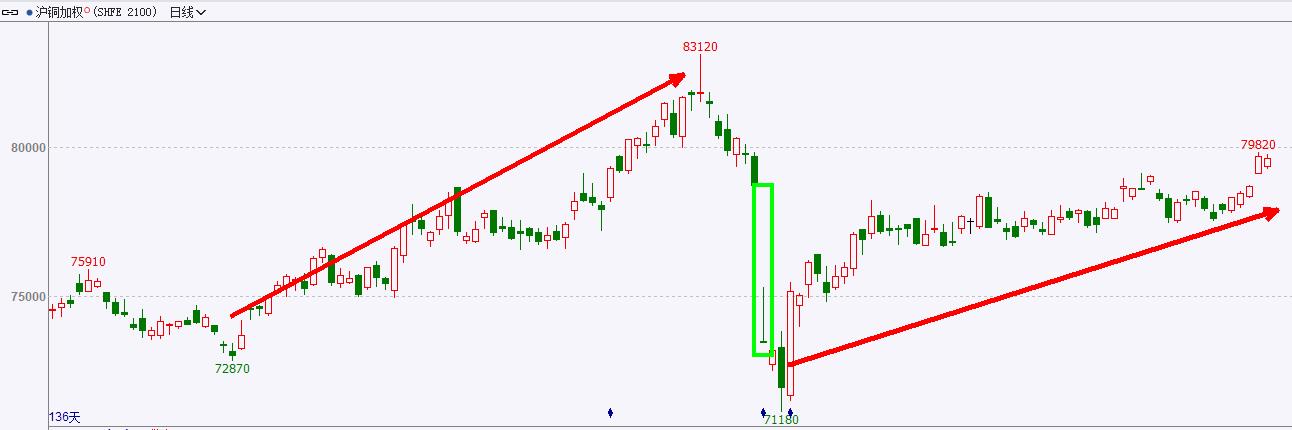
Core Viewpoint - The copper market experienced significant fluctuations in the first half of the year, primarily driven by U.S. tariff policies, which created both upward and downward pressures on copper prices [1] Group 1: Market Phases - **Phase 1 (Early January to Late March)**: Initial strength in copper prices was attributed to expectations of U.S. tariffs on imported copper, leading to a peak price of 83,000 yuan, the highest in over a year [3] - **Phase 2 (Late March to Early April)**: The implementation of unexpected reciprocal tariffs by the U.S. and retaliatory measures from other countries led to a sharp decline in copper prices, with the lowest point reaching 71,320 yuan, marking an eight-month low [4] - **Phase 3 (Mid-April to Late June)**: Negotiations between the U.S. and other countries created temporary optimism, but ongoing uncertainties kept copper prices in a narrow range, with a gradual recovery influenced by a dovish stance from the Federal Reserve [5] Group 2: Tariff Impact and Global Trade - The U.S. tariff policies have increased trade barriers and geopolitical tensions, leading to heightened uncertainty in the market, particularly after the implementation of reciprocal tariffs [6] - The expectation of tariffs on copper has created a "siphoning effect," where copper flows towards the U.S. due to higher prices, with COMEX copper inventories rising significantly while LME inventories declined [10][12] - The ongoing uncertainty regarding the timing and level of U.S. tariffs on copper continues to influence market dynamics, with traders remaining active in anticipation of policy changes [12] Group 3: Smelting and Processing Fees - The processing fees for copper have dropped to negative values, creating significant pressure on smelting operations, with the processing fee reaching -40 USD per dry ton [9] - Despite the challenges, smelting plants have maintained production through adjustments in raw material sourcing and the contribution of by-product revenues [9] - The long-term contracts for copper concentrate processing fees have been locked in at historical lows, raising concerns about the sustainability of smelting operations moving forward [9] Group 4: Future Outlook - The copper market is expected to remain influenced by macroeconomic factors, particularly U.S. tariff policies, which will continue to affect demand expectations and market sentiment [13] - The tightening supply of copper ore and the operational challenges faced by smelting plants may lead to potential production cuts, which could provide upward support for copper prices [13] - The timing and impact of U.S. tariff policies on copper will be critical to monitor, as the current window for copper flow to the U.S. remains open until definitive measures are enacted [13]
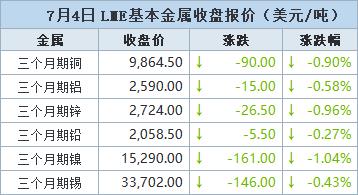
金属全线下跌 期铜收跌,市场关注美国关税最后期限临近【7月4日LME收盘】
Wen Hua Cai Jing· 2025-07-06 10:41
Group 1 - LME copper prices fell by $90, or 0.9%, closing at $9,864.5 per ton, after reaching a three-month high of $10,020.5 earlier in the week [1] - Other base metals also experienced declines, with LME three-month aluminum down $15 to $2,590.0, zinc down $26.5 to $2,724.0, lead down $5.5 to $2,058.5, nickel down $161 to $15,290.0, and tin down $146 to $33,702.0 [2][6][7][8][9][10] - Market sentiment is cautious as major trading partners, including the EU, Japan, and India, continue negotiations with the U.S. regarding trade agreements, with potential tariffs looming [3] Group 2 - The U.S. job report showed an increase of 147,000 non-farm jobs in June, exceeding economists' expectations, which may influence the Federal Reserve's interest rate decisions [4] - The market anticipates a 95.3% probability that the Federal Reserve will maintain interest rates during the July meeting, up from 76.2% earlier [4] - Guinea's bauxite exports are projected to increase by 36% year-on-year in the first half of 2025, reaching a record 99.8 million tons [5]