GEELY AUTO(00175)

Search documents
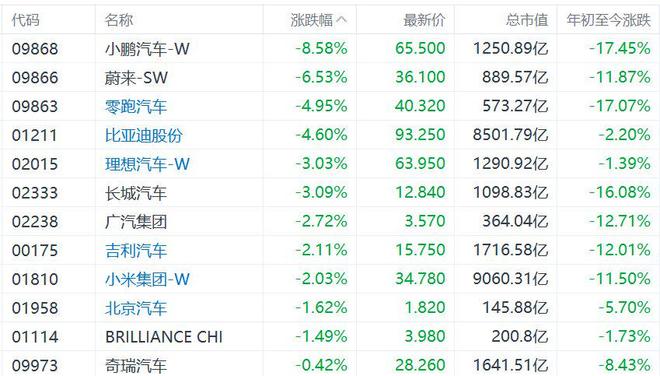
港股异动丨汽车股集体下挫,蔚来跌超6%
Ge Long Hui· 2026-02-02 02:07
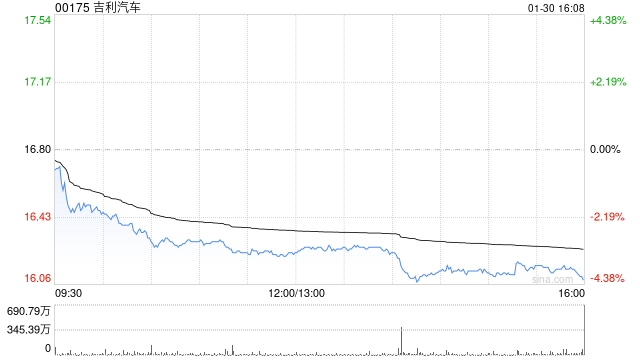
Group 1 - The Hong Kong stock market saw a collective decline in automotive stocks, with Xpeng Motors dropping over 8%, NIO down over 6%, and Li Auto, Great Wall Motors, and others also experiencing declines [1] - Major Chinese automakers reported January vehicle delivery data, with BYD's January new energy vehicle sales at 210,051 units, a year-on-year decrease of 30.11%, while Li Auto delivered 27,668 units, down 7.55%, and Xpeng delivered 20,011 units, a decline of 34.07% [1] Group 2 - Specific stock performance included Xpeng Motors at -8.58% with a latest price of 65.500 and a market cap of 125.09 billion, NIO at -6.53% with a price of 36.100 and a market cap of 88.96 billion, and BYD at -4.60% with a price of 93.250 and a market cap of 850.18 billion [2] - Other notable declines included Li Auto at -3.03%, Great Wall Motors at -3.09%, and Geely Auto at -2.11%, with respective market caps of 129.09 billion, 109.88 billion, and 171.66 billion [2]



车企金融促销战升级,7年低息贷款成标配
Jin Shi Shu Ju· 2026-02-02 01:58
Core Viewpoint - The automotive industry is shifting from direct price competition to financial incentives as companies respond to regulatory pressures against price wars, raising questions about the sustainability and risks of this strategy [2][6]. Group 1: Financial Promotions - Tesla initiated a financial promotion with a "7-year low-interest" plan, offering a minimum down payment of 79,900 yuan and monthly payments of 1,918 yuan for the Model 3 [2]. - Xiaomi, Li Auto, and other companies quickly followed suit with similar financing options, highlighting a trend towards extended loan terms and lower monthly payments to attract consumers [3]. - The trend of "7-year low-interest" financing has become a standard offering among major automakers, with various companies providing competitive down payment and monthly payment options [3]. Group 2: Consumer Behavior and Market Dynamics - There is a growing consumer demand for flexible payment options, particularly among younger buyers, which can lead to an "equivalent price reduction" effect [4]. - The automotive market is facing significant pressure, with retail sales of passenger vehicles dropping by 28% year-on-year in early January 2026, prompting companies to adopt financial promotions to stimulate demand [6]. - The impending reduction of tax incentives for electric vehicles is expected to increase consumer costs, further motivating companies to offer attractive financing solutions [6]. Group 3: Regulatory and Policy Environment - Recent policies from financial regulators have allowed for the extension of personal consumption loans to 7 years, making low-interest financing a compliant option for automakers [7]. - The government has introduced fiscal subsidies for qualifying personal consumption loans, which can help offset the costs of low-interest financing for consumers [8]. - The inclusion of the automotive sector in key fiscal subsidy areas indicates a supportive regulatory environment for financial promotions in the industry [7]. Group 4: Financing and Leasing Controversies - Many automakers are incorporating financing leasing services into their promotional strategies, which can create confusion among consumers regarding ownership and contractual obligations [9]. - The financing leasing model, while innovative, has faced criticism for potentially misleading consumers about ownership rights and responsibilities [10]. - The automotive financing leasing sector is undergoing regulatory improvements to enhance transparency and protect consumer interests [10][11].





吉利又有新高管任命
Xin Lang Cai Jing· 2026-02-02 01:04
Core Insights - Geely has established two new sales companies, Changchun Zeekr Automotive Sales Co., Ltd. and Linhai Zhike Jixing Automotive Sales Service Co., Ltd., both led by key sales figure Zhu Qiqian, attracting industry attention [2][5]. Company Overview - Changchun Zeekr is located in the Changchun Automotive Development Zone, with a registered capital of 10 million yuan, while Linhai Zhike is based in Taizhou, Zhejiang, with a registered capital of 5 million yuan. Both companies focus on automotive sales and retail of spare parts [4][7]. Leadership and Management - Zhu Qiqian serves as the director, manager, and legal representative of both new companies. He has extensive experience in the automotive sales sector, having held significant positions at Geely Holding and possesses rich channel management and after-sales operation expertise [4][7]. Sales Performance - Geely's overall sales growth aligns with this strategic expansion, with official data indicating that Geely's global cumulative sales are expected to exceed 3.02 million units by 2025, representing a substantial year-on-year increase of 39%, marking a historical high [4][7]. Brand Performance - The Zeekr brand has shown particularly strong performance, with monthly deliveries surpassing 30,000 units in December of the previous year. Analysts believe that the new leadership will enhance the sales service network, providing solid support for Geely, especially the Zeekr brand, to capture a larger market share [4][7].

吉利汽车1月汽车总销量为27.02万部 同比增长约1%
Xin Lang Cai Jing· 2026-02-02 00:54
Group 1 - Geely Automobile reported total vehicle sales of 270,200 units in January 2026, representing a year-on-year increase of approximately 1% [1][3] - Both export sales and sales of the Zeekr brand doubled compared to the same period last year [1][3] - Proton achieved vehicle sales of 16,106 units in January 2026, marking a year-on-year growth of approximately 36% [1][3]
汽车早报|多家车企公布1月销量 宝马大中华区换帅
Xin Lang Cai Jing· 2026-02-02 00:40
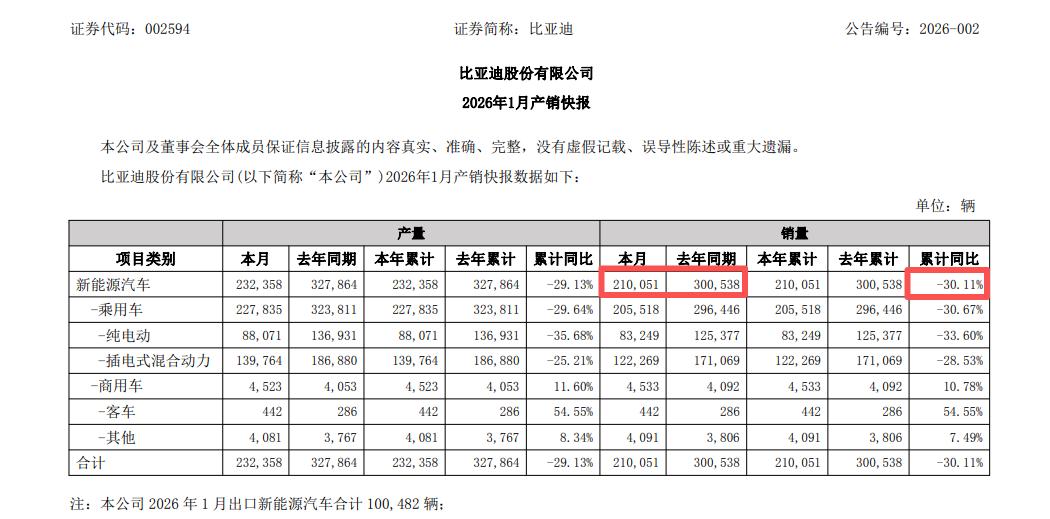
Group 1: Automotive Industry Overview - In January 2026, the Vehicle Inventory Alert Index for Chinese automotive dealers was reported at 59.4%, a year-on-year decrease of 2.9 percentage points and a month-on-month increase of 1.7 percentage points, indicating inventory levels above the threshold [1] - Various automotive companies reported their January delivery and sales figures, showcasing a mixed performance across the industry [2][3][4][5][6][7][8][9][10][11][12][13][14][15][16][17][18][19] Group 2: Company-Specific Performance - Xiaomi delivered over 39,000 vehicles in January 2026 [2] - Hongmeng Zhixing reported a total delivery of 57,915 vehicles in January, marking a year-on-year increase of 65.6% [3] - Aion (昊铂埃安) achieved sales of 23,591 vehicles in January, reflecting a growth of 63.9% [16] - NIO delivered 27,182 vehicles in January, up 96.1% year-on-year [7] - Li Auto reported deliveries of 27,668 vehicles in January [8] - Leap Motor achieved total deliveries of 32,059 vehicles, a year-on-year increase of 27% [9] - BYD's January sales of new energy vehicles were 210,051, a decline of 30.11% year-on-year [6] - Great Wall Motors sold 90,312 vehicles in January, an increase of 11.59% [11] - GAC Group reported sales of 116,622 vehicles in January, up 18.47% year-on-year [13] - Geely's total sales for January were 270,200 units, showing a growth of approximately 1% [13] - Chery's total sales across five brands in January decreased by 10.7% year-on-year [13] - SAIC-GM delivered approximately 51,005 vehicles in January, with a year-on-year increase of 8.2% [15] - A total of 40,016 vehicles were delivered by AITO in January, representing an 83% increase year-on-year [4] - Seres reported sales of 43,034 new energy vehicles in January, a significant increase of 140.33% [5] - GAC Trumpchi's terminal sales reached 26,937 vehicles in January, up 2.06% [14] - BAIC Blue Valley's subsidiary reported sales of 8,073 vehicles, an increase of 11.83% [19] Group 3: Leadership Changes - BMW Group announced that Christian Ach will succeed Sean Green as the President and CEO of BMW Group Greater China, effective April 1 [20]




“新王”诞生,比亚迪大跌,雷军大动作
3 6 Ke· 2026-02-02 00:16
Core Insights - The competitive landscape in the automotive industry has shifted in January, with Xiaomi emerging as the new leader among new energy vehicle manufacturers, surpassing Leap Motor for the first time [4][15] - BYD reported a significant decline in domestic sales, with January sales reaching 210,510 units, a year-on-year decrease of 30.11% and a month-on-month decrease of 50.04% [1][10] Sales Performance - BYD's January sales figures indicate a total of 210,510 units sold, down 30.11% year-on-year and 50.04% month-on-month [1][10] - In contrast, Xiaomi's deliveries exceeded 39,000 units, marking a significant lead over Leap Motor, which delivered approximately 32,059 units [4][15] - Other companies like Seres, NIO, and Lantu reported year-on-year growth in January deliveries of 104.85%, 96.08%, and 31.29% respectively [5] Market Dynamics - The reduction of the new energy vehicle purchase tax by half starting January 1 may have impacted BYD's sales negatively [2][11] - Unlike BYD, which has fully embraced new energy vehicles and ceased production of fuel vehicles, other brands like Geely continue to balance both fuel and electric vehicle sales, achieving growth in both segments [11][12] - Geely's January sales included 124,252 units of new energy vehicles and 145,900 units of fuel vehicles, both showing year-on-year growth [12] Financial Strategies - Several automakers, including Xiaomi and NIO, have introduced long-term low-interest financing options to stimulate sales amid declining subsidies [24] - Xiaomi's financing plan offers a starting down payment of 99,900 yuan with monthly payments as low as 1,931 yuan, aiming to attract more customers [21][24] - The introduction of these financing options is seen as a strategic move to mitigate the impact of subsidy reductions and enhance sales performance [24]
展望二〇二六驶向汽车产业提质增效新征程
Jing Ji Ri Bao· 2026-02-02 00:00
Core Insights - The Chinese automotive industry is transitioning from "scale expansion" to "quality improvement and efficiency enhancement" in 2026, driven by electrification and intelligent transformation [1] - The market competition is shifting from price wars to a "value war" focused on technological innovation, product iteration, quality enhancement, and experience optimization [1] Market Overview - In 2026, the total vehicle sales in China are projected to reach 34.75 million, a slight increase of 1%, while another estimate suggests around 28 million units, growing by 2% [2] - The industry is entering a phase characterized by high sales volume but low growth, with competition focusing on quality and efficiency rather than scale [2] - The central economic work conference emphasizes a policy direction of "stability while seeking progress" and "quality improvement and efficiency enhancement" for the automotive sector [2] New Energy Vehicles (NEVs) - NEVs are expected to achieve significant growth, with sales projected to exceed 20 million units in 2026, solidifying their market dominance [3] - Domestic automakers are leveraging technological innovation and supply chain advantages to produce competitively priced NEVs, shifting from policy-driven sales to market-driven sales as penetration rates exceed 50% [3] Competitive Landscape - Leading domestic automakers like Geely, BYD, and Chery are expected to benefit from product structure upgrades and global expansion, with Geely targeting over 4.5 million units in sales for 2026 [3] - New entrants in the automotive market are experiencing accelerated differentiation, with companies like Leap Motor and Xpeng doubling their sales, while others like NIO are focusing on operational efficiency [4] Internationalization and Global Expansion - The Chinese automotive industry is increasingly focusing on international markets, with exports projected to exceed 8 million units in 2026, primarily driven by NEVs [12] - Major automakers are establishing overseas production facilities to mitigate tariffs and trade barriers, enhancing local integration and responsiveness [13] Technological Innovation - Key areas of technological advancement include power batteries, chips, and software, with significant breakthroughs expected in 2026 [6] - The development of next-generation battery technologies, such as solid-state batteries, is progressing, with initial production expected to begin in 2026-2027 [6] - Intelligent driving technologies are advancing, with L2-level driving assistance features expected to penetrate over 70% of new passenger vehicles by 2026 [7] Emerging Trends - The automotive industry is evolving into a "super platform," integrating various technologies and services beyond traditional transportation [11] - Companies are exploring new growth avenues, including humanoid robots and low-altitude economy sectors, with significant developments anticipated in 2026 [9][10]


2026车圈反思开局:我们犯了大错误
汽车商业评论· 2026-02-01 23:07
Core Insights - The automotive industry is reflecting on past strategies and decisions as leaders express both criticism and optimism for the future [4][9][12]. Group 1: Leadership Reflections - Li Shufu, chairman of Geely, emphasizes the importance of perseverance and learning from past mistakes in the automotive sector [8]. - Oliver Blume, former CEO of Porsche, admits to strategic errors regarding the Macan model, which led to a significant gap in product offerings and shareholder losses [9][10][14]. - Blume acknowledges that the decision to fully electrify the Macan was overly optimistic and resulted in a two-year gap before new fuel models could be introduced [10][15]. Group 2: Company Strategies and Market Position - Lei Jun, founder of Xiaomi, addresses marketing controversies and emphasizes the need for transparency in communication with consumers [17][18]. - Li Bin, founder of NIO, celebrates the production of the one-millionth electric vehicle and outlines ambitious plans for expanding battery swap stations, aiming for profitability while focusing on growth quality [21][22][25]. - Elon Musk highlights China's rapid advancements in AI and energy infrastructure, predicting that China will surpass the U.S. in power generation by 2026 [28][30]. Group 3: Industry Trends and Future Outlook - François Provost, CEO of Renault, suggests that Chinese automakers should shift from a volume-driven strategy to a value-driven approach to avoid detrimental price wars [43]. - Li Xiang, CEO of Li Auto, announces a strategic pivot towards humanoid robotics and AI, indicating a significant transformation in the company's research and development focus [46][48]. - The automotive industry is witnessing a shift towards integrating AI and robotics, with companies like Li Auto aiming to enhance user experiences through innovative technologies [46][48].

开年即洗牌?1 月新能源销量出炉:分化加剧,谁在逆势突围?
电动车公社· 2026-02-01 16:41
Core Viewpoint - The article highlights the impact of policy adjustments and changes in consumer behavior on the Chinese new energy vehicle (NEV) market in January 2026, indicating a cautious outlook for February due to these factors [1]. Market Overview - The NEV market in January faced dual short-term pressures: adjustments in the purchase tax policy and promotional activities by car manufacturers to meet annual targets, which led to a preemptive consumption demand [1]. - The New Year holiday compressed the sales window, placing the market in a demand recovery phase [1]. - Key variables influencing the market include policy alignment and consumer expectations, with some local subsidy application details yet to be finalized, leading to a wait-and-see attitude among consumers [1]. Company Performance - **BYD**: Achieved a passenger car sales volume of 205,518 units in January, maintaining a significant lead in the NEV sector [2][5]. - **Geely**: Reported total sales of 270,167 units, with 124,252 units being NEVs, showing a strong performance across its brands [6][9]. - **Harmonious Intelligence**: Delivered 57,915 units, driven by strong demand for its models and successful technology integration [3][11]. - **Chery**: Sold 52,131 NEVs out of a total of 200,269 units, with a notable year-on-year growth exceeding 50% in the NEV segment [12][15]. - **Xiaomi**: Recorded over 39,000 units delivered, with upcoming models expected to boost sales further [16][18]. - **Leap Motor**: Achieved 32,059 units in deliveries, marking a 27% year-on-year growth despite the seasonal slowdown [6][20]. - **NIO**: Delivered 27,182 units, with the ES8 model showing significant sales momentum [7][23]. - **Li Auto**: Reported 27,668 units delivered, maintaining a positive outlook despite competitive pressures [8][25]. - **GAC Aion**: Sold 21,635 units, benefiting from brand integration and new model launches [9][27]. - **XPeng**: Delivered 20,011 units, with plans for new model releases enhancing its market presence [10][31]. - **Great Wall Motors**: Recorded 18,029 NEV sales, with a focus on high-end markets and international sales [11][34]. - **Lantu**: Achieved 10,515 units delivered, with ongoing product development and partnerships [12][36]. - **BAIC New Energy**: Sold 11,169 units, with a focus on high-end models and technological advancements [13][38]. - **Zhi Mi**: Delivered 5,017 units, expanding its product line with new models [14][39]. - **Extreme Stone**: Achieved 1,028 units delivered, with plans for global market expansion [15][42].

蔚来、极氪翻倍!造车新势力1月销量公布
DT新材料· 2026-02-01 16:05
【DT新材料】 获 悉 , 2月1日, 比亚迪 以及造车新势力零跑、理想、蔚来和小鹏先后发布1月交付量。主要的原因可能是年初是传统的市场淡季, 再叠加去年底免征车辆购置税政策的截止,提前透支了一部分需求,导致今年市场大盘下滑幅度整体比较大。当然也有逆势上涨的企业。 比亚迪 ,1月份新能源汽车销量210051辆,乘用车销量205518辆,1月出口新能源汽车合计100482辆。 | | | | 产量 | | | | | 销量 | | | | --- | --- | --- | --- | --- | --- | --- | --- | --- | --- | --- | | 项目类别 | 本月 | 去年同期 | 本年累计 | 去年累计 | 累计同比 | 本月 | 去年同期 | 本年累计 | 去年累计 | 累计同比 | | 新能源汽车 | 232, 358 | 327,864 | 232, 358 | 327.864 | -29. 13% | 210, 051 | 300, 538 | 210, 051 | 300, 538 | -30. 11% | | -乘用车 | 227.835 | 323,811 | 227 ...