GEELY AUTO(00175)

Search documents
9大车企要卖超1800万台,鸿蒙智行冲刺销量翻番,四家车企瞄准300万年销
3 6 Ke· 2026-01-13 03:03
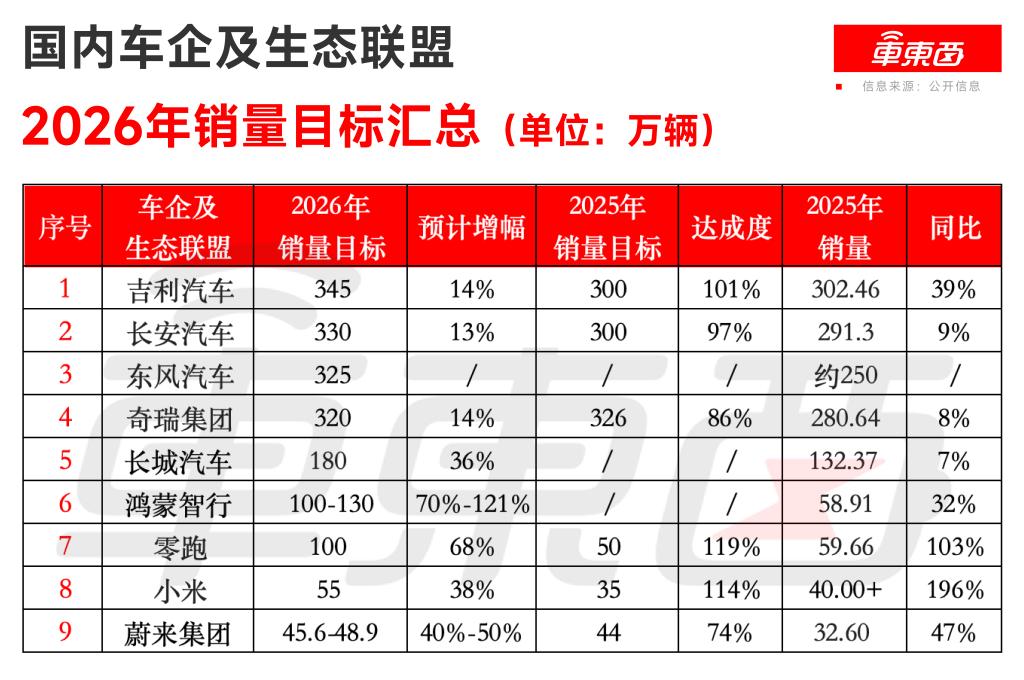
Core Viewpoint - The competition in the domestic automotive market is intensifying as major car manufacturers and alliances announce ambitious sales targets for 2026, totaling 18.339 million units, which exceeds the actual sales of 3.86 million units in 2025 [1] Group 1: New Energy Vehicle Manufacturers - New energy vehicle manufacturers such as Hongmeng Zhixing, Leap Motor, and NIO have set aggressive sales targets for 2026, with expected growth rates ranging from 40% to 121% [2][4] - Hongmeng Zhixing aims for sales between 1 to 1.3 million units, with a projected growth rate of 70%-121% [4] - Leap Motor targets 1 million units with a growth rate of 68%, while NIO's target is between 456,000 to 489,000 units, reflecting a growth of 40%-50% [2][12] - Xiaomi Auto plans to increase its sales target from 350,000 units in 2025 to 550,000 units in 2026, representing a growth of approximately 38% [8] Group 2: Traditional Automakers - Traditional automakers like Geely, Changan, and Chery have set more conservative targets, with Geely aiming for 3.45 million units, Changan for 3.3 million units, and Chery for 3.2 million units, reflecting growth rates of 14%, 13%, and 14% respectively [3][13] - Great Wall Motors plans to sell 1.8 million units in 2026, with a leading growth rate of 36% among traditional manufacturers [2][13] - Geely's target includes a significant focus on electric vehicles, aiming for 2.22 million units in 2026, up from 1.69 million in 2025, increasing its electric vehicle penetration from 56% to 64% [13][14] Group 3: Market Dynamics and Competition - The competition in the automotive market is shifting from mere scale expansion to a comprehensive contest involving technology, product offerings, and global strategies [18] - Market analysts predict that growth in the Chinese passenger car market may slow or even decline slightly in 2026, making every percentage point of growth critical and competitive [18] - The ability of companies to balance scale, profitability, and technological investment will determine their success in this increasingly fierce market [19]






港股大爆发!阿里巴巴涨超4%,自带哑铃策略的——香港大盘30ETF(520560)跳空大涨,盘中拉升2%!
Xin Lang Cai Jing· 2026-01-13 02:32
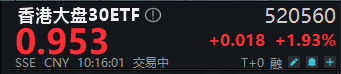
Core Viewpoint - The Hong Kong stock market experienced a significant surge, with major indices rising over 1%, driven by a "technology + dividend" strategy, particularly highlighted by the Hong Kong Large Cap 30 ETF (520560) which saw a jump of over 2.1% during trading [1][8]. Group 1: Market Performance - The Hong Kong Large Cap 30 ETF (520560) recorded a price increase of 1.93% after a peak of 2.1% during the day [1][8]. - Key stocks such as BYD, Alibaba, China Life, and China Ping An saw gains exceeding 4% and 3%, respectively, while other companies like CNOOC and Li Auto also experienced increases of over 2% [1][8]. Group 2: Technology Sector Insights - The AI application sector witnessed a surge, with companies like MiniMax and Zhiyu Huazhang entering the capital market, leading to a focus on AI applications across the industry [2][9]. - Domestic AI hardware companies are leveraging capital market support to accelerate business growth, making AI a focal point in the market [2][9]. Group 3: Dividend Sector Developments - Several banks have launched new "asset enhancement activities" at the beginning of the year, allowing users to earn points and discounts upon participation, involving major state-owned and city commercial banks [2][9]. Group 4: Investment Rationale for Hong Kong Stocks - Global interest rate cuts are a prevailing trend, leading to increased liquidity in capital markets, which is expected to favor RMB assets, including A-shares and Hong Kong stocks [3][10]. - The net inflow of funds through the Hong Kong Stock Connect reached historical highs last year, indicating strong interest from mainland investors in Hong Kong stocks [3][10]. - Valuations for monopolistic or leading global stocks in Hong Kong are gradually increasing, as evidenced by significant premium rates for companies like CATL and MiniMax [3][10]. - The Hong Kong market is experiencing structural differentiation, with the Hang Seng Index projected to rise by 28% by 2025, driven by technology and high-dividend sectors [3][10]. Group 5: Investment Strategy - GF Securities recommends a "barbell strategy" for investing in Hong Kong stocks, suggesting a long-term allocation to stable value assets while also focusing on growth sectors with solid industrial logic [3][10]. - The Hong Kong Large Cap 30 ETF (520560) is highlighted as an ideal tool for long-term allocation, combining high-growth technology stocks with stable dividend-paying companies [4][11].



43家港股公司出手回购(1月12日)
Zheng Quan Shi Bao Wang· 2026-01-13 01:51
| 代码 | 简称 | 回购股数 | 回购金额(万 | 回购最高价 | 回购最低价 | 年内累计回购金额 | | --- | --- | --- | --- | --- | --- | --- | | | | (万股) | 港元) | (港元) | (港元) | (万港元) | | 00700 | 腾讯控股 | 102.40 | 63568.82 | 627.000 | 614.000 | 445012.55 | | 00175 | 吉利汽车 | 900.70 | 15128.33 | 17.150 | 16.630 | 37249.70 | | 02382 | 舜宇光学科 技 | 124.00 | 7934.07 | 64.850 | 63.150 | 18722.08 | | 02096 | 先声药业 | 367.20 | 4194.53 | 11.600 | 11.198 | 4194.53 | | 02367 | 巨子生物 | 40.00 | 1400.29 | 35.500 | 34.500 | 8250.74 | | 06098 | 碧桂园服务 | 170.00 | 1061.50 | 6.280 ...


汽车早餐 | 比亚迪推出子品牌“领汇”;岚图将与引望联合开发智驾、智舱;抖音App新增“租车”功能
Zhong Guo Qi Che Bao Wang· 2026-01-13 01:17
Group 1: Government Initiatives - The Ministry of Industry and Information Technology emphasizes the implementation of a new round of growth stabilization work plan focusing on ten key industries, including steel and petrochemicals, by 2026 [2] - The National Development and Reform Commission, along with other ministries, has released guidelines to support government investment funds in emerging industries, including new energy vehicles and digital economy [3] Group 2: Market Developments - The State Administration for Market Regulation has unconditionally approved several mergers and acquisitions, including the acquisition of the Changchun Automotive Testing Center by the China Automotive Technology Research Center [4] - The Ministry of Commerce reported on the progress of negotiations regarding the EU-China electric vehicle case, indicating a mutual agreement to provide guidance for Chinese exporters on price commitments [5] Group 3: Automotive Industry News - Stellantis has announced the cancellation of its plug-in hybrid vehicle sales plan in the U.S. due to weak market demand, shifting focus to more competitive electrification solutions [7] - Maruti Suzuki plans to increase its production capacity by 1 million units in Gujarat, with a total budget of approximately 49.6 billion rupees (about 5.5 billion USD) [7] - BYD has launched a new sub-brand "Linghui," with multiple electric and plug-in hybrid models submitted for approval [8] - Lantu Automotive and Yiwang have signed a strategic cooperation agreement to jointly develop intelligent driving and cockpit technologies [9] - Geely Auto has repurchased approximately 9.07 million shares for about 151 million HKD as part of its share buyback plan [10] - Zhaoyi Innovation has signed a strategic cooperation agreement with Chery Automobile to focus on vehicle-grade chips and next-generation electronic architectures [11] Group 4: Technology and Services - Douyin App has introduced a car rental feature, expanding its travel service offerings [12] - Zhiyu and Didi have reached a strategic cooperation to explore the application of general artificial intelligence in the transportation sector [13][14]


智通港股回购统计|1月13日
智通财经网· 2026-01-13 01:12
Group 1 - The article reports on share buybacks conducted by various companies on January 12, 2026, with Tencent Holdings (00700) having the largest buyback amount of 636 million yuan for 1.024 million shares [1][2] - Other notable companies involved in the buyback include Geely Automobile (00175) with 9.007 million shares repurchased for 151 million yuan, and Sunny Optical Technology (02382) with 1.24 million shares for 79.34 million yuan [1][2] - The total number of shares repurchased by Tencent represents 1.188% of its total share capital, while Geely's buyback accounts for 0.438% of its total share capital [2] Group 2 - The buyback activities reflect a trend among companies to return capital to shareholders, with some companies like Antong Oilfield Services (03337) and Weigao Group (01066) showing significant percentages of their total share capital being repurchased, at 2.460% and 6.459% respectively [2][3] - Companies such as Vitasoy International (00345) and Keep (03650) also participated in the buyback, with their repurchase amounts being 432,600 yuan and 28,900 yuan respectively, indicating a diverse range of companies engaging in this practice [3] - The data suggests a strategic move by these companies to enhance shareholder value and potentially stabilize their stock prices amid market fluctuations [1][2]
乘用车2026 | 2025政策促需 2026高端发力+智能平权+出海提速
汽车琰究· 2026-01-13 00:05
Group 1 - The core viewpoint of the article emphasizes that the demand for automobiles is driven by the continuation of the trade-in policy, leading to an unexpected penetration of new energy vehicles (NEVs) and improved profitability through high-end products and overseas expansion [3][4][5][6][7][8] Group 2 - In 2025, the cumulative wholesale sales of passenger cars reached 24.119 million units, a year-on-year increase of 12.6%, with NEVs growing by 30.7% [3][8] - The penetration rate of NEVs in wholesale sales was 50.4%, up by 7.0 percentage points year-on-year, while the penetration rate for insurance reached 53.3%, an increase of 6.6 percentage points [3][46] - The share of domestic passenger cars in wholesale sales reached 69.3%, a year-on-year increase of 4.9 percentage points, with brands like Geely, Xiaomi, and Leap Motor showing significant growth [3][50] Group 3 - Looking ahead to 2026, the trade-in policy is expected to continue, supporting demand, with projected insurance sales of 22.32 million units, a decrease of 5.0% year-on-year, and wholesale sales of 30.10 million units, an increase of 1.0% [4][5] - The NEV insurance sales are expected to reach 13.8 million units, a year-on-year increase of 6.2%, while wholesale sales are projected to be 17.3 million units, up by 13.4% [4][15] Group 4 - The competitive landscape is shifting, with joint ventures declining and domestic brands accelerating their rise in the mid-to-high-end market [5][10] - In the 5-15 million price range, price-sensitive consumers are expected to drive competition, while brands like Geely, BYD, and Leap Motor are anticipated to gain higher sales growth due to their advantages in intelligence and cost-effectiveness [5][10] Group 5 - The article highlights the acceleration of intelligent driving technology, with major players like Huawei and BYD pushing for the democratization of advanced driving features [6][10] - The L3 commercial deployment is expected to gain momentum in 2026-2027, with various automakers launching new high-level driving systems and models [6][10] Group 6 - The export of passenger cars is projected to reach 6.64 million units in 2026, a year-on-year increase of 15.5%, driven by the technological advantages of domestic NEVs and the expansion of overseas manufacturing [7][11] - Companies like BYD and Geely are expected to increase their export efforts, with BYD establishing overseas factories and Geely accelerating NEV exports [7][11]



【环球财经】抑价提质 中国品牌改写埃及汽车市场格局
Xin Hua She· 2026-01-12 12:53
Core Viewpoint - The Egyptian automotive market is experiencing significant changes, with improved supply and more affordable prices, largely due to the influence of Chinese automotive brands [1][6]. Group 1: Market Dynamics - The supply of vehicles in Egypt is increasing, leading to more reasonable pricing, making new cars accessible to ordinary families [1]. - In 2024, sales of Chinese brand vehicles in Egypt reached 30,441 units, marking a year-on-year increase of 37.3% [3]. - The introduction of 18 new models by various Chinese automakers in July 2025, primarily priced below 1.5 million EGP (approximately 230,000 RMB), caters to the Egyptian consumer market [3]. Group 2: Local Production and Economic Factors - The Egyptian automotive market is transitioning to a phase characterized by local manufacturing and healthy competition, which is beneficial for consumers and the economy [6][7]. - The local assembly of vehicles is increasing, with a reported 31.7% year-on-year growth in CKD (Completely Knocked Down) vehicles in 2024, while CBU (Completely Built Up) vehicles only grew by 5.2% [10]. - The Egyptian government has implemented a national automotive industry development plan to promote local assembly and reduce import tariffs, which can lower costs significantly [11]. Group 3: Future Outlook - The strengthening of the Egyptian pound, increased local production, and reduced shipping costs are contributing to a downward trend in car prices, expected to continue at least until 2026 [7]. - The potential for growth in the Egyptian automotive market is substantial, driven by a young population and low car ownership rates [4]. - Chinese automotive brands are encouraged to invest in brand building, after-sales service, and customer-centric experiences to achieve greater market penetration in Egypt [13].

连续9年登顶中国品牌燃油车销冠!吉利中国星重塑燃油车价值新标杆
Xin Lang Cai Jing· 2026-01-12 12:28
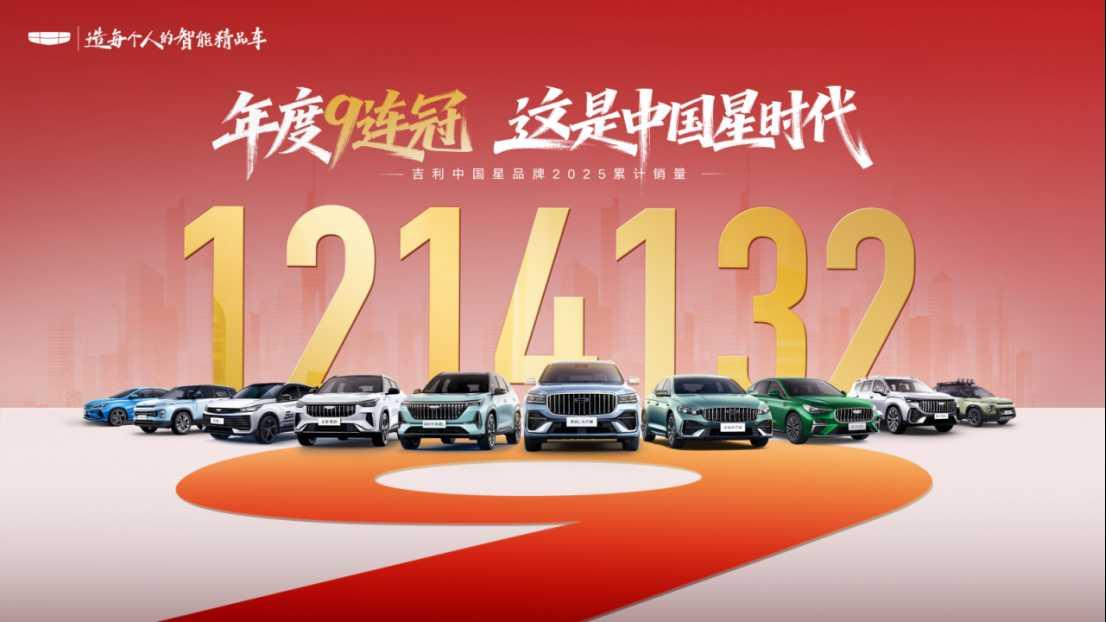
Core Insights - In 2025, Geely Auto achieved an annual total sales of over 3,024,567 vehicles, marking a 39% year-on-year increase and exceeding the adjusted target of 3 million vehicles [1][23]. - The Geely China Star matrix, consisting of popular models like Xingrui, Xingyue L, Boyue, Emgrand, and Bin Yue, sold a total of 1,214,132 units, securing the title of the best-selling Chinese brand fuel passenger car for nine consecutive years [1][23]. - Geely's strong performance in the fuel vehicle market sets a new benchmark for the development of Chinese brand fuel vehicles amidst the accelerating penetration of new energy vehicles [1][23]. Sales Performance - The high-end series of the Geely China Star sold over 420,000 units in 2025, becoming the core engine for the high-end fuel vehicle market [4][25]. - The flagship SUV, Xingyue L, was the best-selling fuel SUV of 2025, while the flagship sedan, Xingrui, led the A-class fuel sedan segment for Chinese brands [4][25]. - The Boyue model achieved annual sales of 300,000 units, driven by continuous product expansion and iteration [6][29]. Product Innovations - The Boyue underwent a dual-car renewal with the launch of the fourth-generation Boyue L and the new Boyue, enhancing its market value standards for family SUVs [8][28]. - The Emgrand sedan sold 180,000 units in 2025, becoming the first and only Chinese brand sedan to surpass cumulative global sales of 4.15 million units [10][30]. - The fifth-generation Emgrand, built on the new BMA Evo global modular architecture, underwent a comprehensive upgrade across five dimensions: aesthetics, comfort, safety, driving control, and intelligence [10][30]. Safety and Technology - Geely emphasizes safety as its top priority, with over 250 billion invested in R&D over the past 11 years and 1,562 safety patents, leading the industry [12][33]. - The global safety center was launched in 2025, achieving five Guinness World Records, and introduced the "Full Domain Safety 2.0" technology system to enhance safety standards [12][33]. - The Geely China Star models are designed with a focus on comprehensive safety, adhering to C-NCAP five-star standards and incorporating advanced safety features [14][36]. Intelligent Features - Geely's "Smart Geely 2025" strategy, initiated in 2021, aims to create a smart technology ecosystem through advanced computing and data capabilities [17][38]. - The introduction of the "Full Domain AI" technology system in 2025 positions Geely as the only automaker with a complete AI intelligent layout, enhancing both fuel and new energy vehicles [17][38]. - The new models feature the industry-leading "Qianli Haohang" advanced driving assistance system, providing a comprehensive perception capability [18][39]. Future Outlook - Geely aims to continue leveraging its core advantages in full-domain AI and safety to meet user demands and drive technological innovation [21][41]. - The company is committed to redefining the value standards of fuel vehicles through continuous technological iterations in safety, intelligence, energy efficiency, and comfort [21][41].
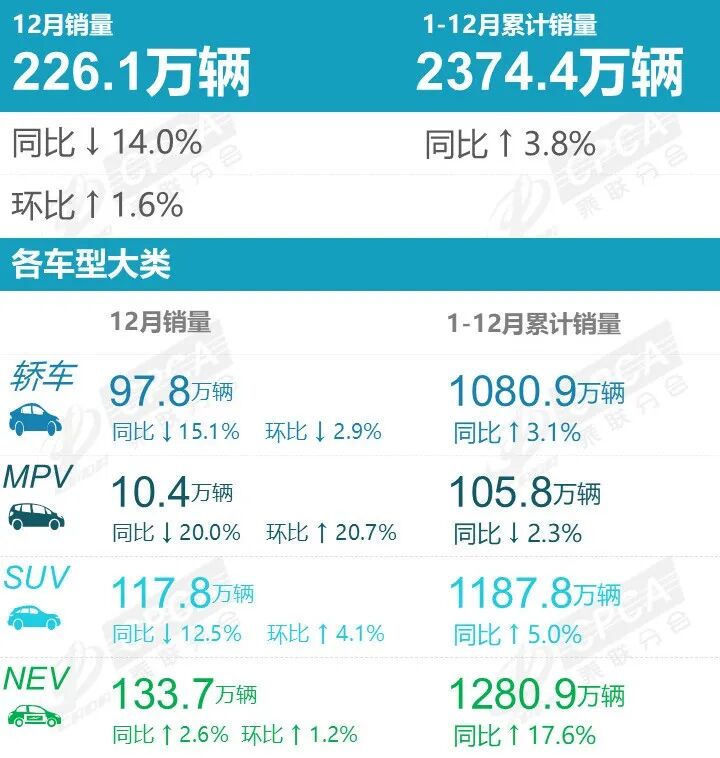
中国汽车流通协会:2025年12月国内狭义乘用车市场零售销量达226.1万辆 同比下降14.0%
Zhi Tong Cai Jing· 2026-01-12 12:11
Core Insights - The domestic narrow passenger car market in China saw a retail sales volume of 2.261 million units in December 2025, representing a year-on-year decline of 14.0% but a month-on-month increase of 1.6%. Cumulatively, the sales for the year reached 23.744 million units, marking a year-on-year growth of 3.8% [1]. Market Overview - December 2025 successfully achieved the growth expectations set for the "14th Five-Year Plan" in the automotive market. Despite a challenging environment with significant regulatory measures, the highlights were observed in the new energy vehicle (NEV) market and export market. The expiration of the tax exemption policy for NEVs at the end of December was expected to stimulate demand, although the depletion of subsidy funds across provinces limited the purchasing momentum [2]. Manufacturer Performance - December 2025 - BYD Auto led the sales with 414,784 units, experiencing a month-on-month decrease of 12.7% and a year-on-year decline of 18.6%, holding a market share of 14.9% [4]. - Geely Auto sold 236,817 units, down 23.7% month-on-month but up 12.7% year-on-year, with a market share of 8.5% [4]. - Chery Auto reported sales of 234,736 units, a month-on-month decrease of 10.6% and a year-on-year decline of 19.1%, capturing 8.4% of the market [4]. - Tesla China saw an increase in sales to 97,171 units, up 12.1% month-on-month and 3.6% year-on-year, with a market share of 3.5% [4]. Annual Manufacturer Performance - 2025 - For the entire year of 2025, BYD Auto sold 4.545 million units, a year-on-year increase of 6.9%, securing a market share of 15.4% [5]. - Geely Auto's sales reached 3.025 million units, reflecting a significant year-on-year growth of 39.0% and a market share of 10.2% [5]. - Chery Auto achieved sales of 2.698 million units, up 7.3% year-on-year, with a market share of 9.1% [5]. - Tesla China sold 851,732 units, down 7.1% year-on-year, holding a market share of 2.9% [5]. NEV Market Performance - December 2025 - In December 2025, BYD Auto led the NEV wholesale sales with 414,784 units, down 12.7% month-on-month and 18.6% year-on-year, capturing 26.5% of the market [8]. - Geely Auto followed with 154,264 units, a month-on-month decrease of 17.9% but a year-on-year increase of 38.7%, holding 9.9% market share [8]. - Tesla China sold 97,171 units, marking a month-on-month increase of 12.1% and a year-on-year increase of 3.6%, with a market share of 6.2% [8]. NEV Annual Performance - 2025 - For the year 2025, BYD Auto sold 4.545 million NEVs, a year-on-year increase of 6.9%, with a market share of 29.7% [9]. - Geely Auto's NEV sales reached 1.688 million units, reflecting a remarkable year-on-year growth of 90.0% and a market share of 11.0% [9]. - Changan Auto sold 937,460 NEVs, up 40.7% year-on-year, with a market share of 6.1% [9].
【招商电子】CES 2026跟踪报告:AI赋能依旧是主旋律,聚焦穿戴/IoT、智能车、机器人等新品创新
招商电子· 2026-01-12 12:03
Core Viewpoint - CES 2026 showcased significant advancements in AI-driven consumer electronics, with a focus on wearable devices, automotive technology, robotics, and IoT innovations, highlighting the integration of AI across various sectors [2][5][6]. Group 1: Wearable/IOT - AI glasses and camera headphones remain focal points in wearable technology, with over 50 companies participating, primarily from mainland China, emphasizing design improvements and multi-modal interactions [2][10]. - Headphone innovations shifted from audio performance to a combination of sound quality, AI integration, and multi-modal capabilities, with products featuring cameras and environmental awareness [2][13]. - New IoT categories, including smart imaging devices and AI home products, are gaining traction, with many startups entering the market [2][16]. Group 2: Automotive - AI is driving a comprehensive upgrade in automotive technology, with high-level autonomous driving expected to scale commercially [3][19]. - NVIDIA introduced the Alpamayo series of open-source AI models, enhancing the development of autonomous driving capabilities [3][19]. - Major automotive companies like Geely and Great Wall showcased their AI systems, while international brands are partnering with AI giants to enhance their offerings [3][24][26]. Group 3: Robotics - The robotics sector is evolving from household and service robots to humanoid collaboration, with significant participation from electronic companies [4][34]. - Innovations in household robots include advanced cleaning capabilities and a broader range of applications, while humanoid robots are becoming more sophisticated in interaction and movement [4][34]. - Chinese electronic companies are increasingly showcasing key components and technologies in robotics at CES 2026 [4][34]. Group 4: PC/Smartphone - Lenovo launched its first personal super intelligent system, Lenovo Qira, and announced a partnership with NVIDIA for AI infrastructure [4][36]. - Chip manufacturers like Intel, Qualcomm, and AMD are upgrading their products to enhance AI performance and user experience in PCs [4][39]. - The focus on AI integration in smartphones and PCs is expected to drive innovation and market growth in the coming years [4][39].