
LI AUTO-W(02015)

Search documents
理想汽车业绩“翻车”少卖9.4万辆净利锐减69亿 现金储备超千亿研发113亿一半投向AI
Chang Jiang Shang Bao· 2026-03-15 23:19
Core Viewpoint - Li Auto, once a leading player in the new energy vehicle sector, reported disappointing financial results for 2025, with significant declines in both revenue and net profit [2][5][10]. Financial Performance - In 2025, Li Auto achieved a revenue of 112.3 billion yuan, a year-on-year decrease of approximately 22% [5][11]. - The net profit for 2025 was around 1.1 billion yuan, down from a profit of 6.9 billion yuan the previous year, marking an 86% decline [5][11]. - Vehicle sales revenue fell to 106.7 billion yuan, a 23% decrease compared to the previous year [2][5]. Vehicle Delivery and Sales - The total new vehicle deliveries for 2025 were 406,300 units, a drop of about 94,200 units or 18.8% from 2024 [3][13]. - The flagship MPV MEGA delivered only 18,500 units, less than 30% of its annual target [13]. - The sales performance of the Li Auto i6 and i8 models was hindered by various challenges, including policy changes and production capacity issues [13][14]. Market Competition and Strategy - The decline in net profit is attributed to increased market competition and the need for greater sales incentives, which led to a decrease in gross margin [14][15]. - The overall gross margin for 2025 was 18.68%, down 1.85 percentage points from 2024, with vehicle gross margin at 17.9%, a decline of 1.9 percentage points [16][17]. Future Outlook - For 2026, Li Auto aims to deliver approximately 487,600 vehicles, representing a 20% increase from 2025 [19][20]. - The company plans to launch a new pure electric flagship SUV, the Li Auto i9, in the second half of 2026 [21]. - Li Auto is also focusing on humanoid robots and AI technologies as part of its strategy to enhance its competitive edge in the market [23][24]. Research and Development - In 2025, Li Auto invested 11.3 billion yuan in R&D, with 50% allocated to AI-related projects [3][26]. - The planned R&D investment for 2026 is around 12 billion yuan, maintaining a similar focus on AI technologies [26].

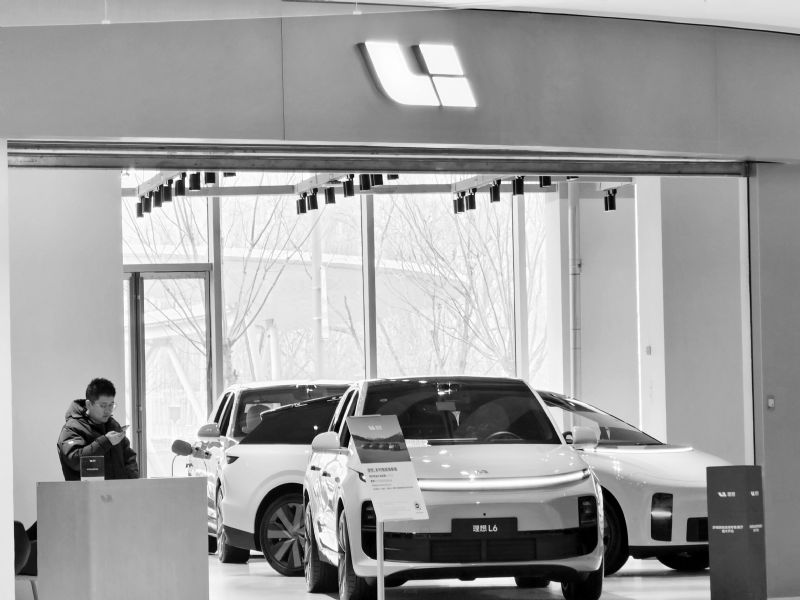
理想汽车常州基地
Zhong Guo Zheng Quan Bao - Zhong Zheng Wang· 2026-03-15 23:11
Core Insights - The article discusses significant developments in the investment banking sector, highlighting trends and shifts in market dynamics [1] Group 1: Market Trends - Investment banks are experiencing increased competition due to the rise of fintech companies, which are offering innovative financial solutions [1] - There is a noticeable shift towards digital transformation within traditional investment banks, aiming to enhance operational efficiency and client engagement [1] Group 2: Financial Performance - Recent financial reports indicate a mixed performance among major investment banks, with some reporting a decline in revenue while others show growth in specific segments [1] - The overall market for mergers and acquisitions (M&A) has seen fluctuations, with a notable decrease in deal volume compared to previous years [1] Group 3: Regulatory Environment - Regulatory changes are impacting the investment banking landscape, with new compliance requirements being introduced that could affect profitability [1] - The article emphasizes the importance of adapting to these regulatory changes to maintain competitive advantage [1]
蔚来、理想、保时捷、宁德时代公布全年财报!尚界Z7等多款新车登陆工信部!iCAR V27、钛3闪充版等新车上市!丨一周大事件
电动车公社· 2026-03-15 16:06
New Car Launches - New model Yuedi 03 launched with a price range of 7.98-11.99 million yuan, featuring a compact SUV design and a range of over 400 km [3][11] - Lantu Dreamer Champion Edition launched at 30.99 million yuan, offering advanced features like Huawei ADS 4 and a comprehensive range of luxury amenities [12][19] - iCAR V27 launched with a price range of 16.98-19.68 million yuan, designed as a mid-size SUV with a focus on rugged aesthetics and advanced driver assistance systems [13][29] - Wuling Bingguo S 525km flagship version launched at 8.98 million yuan, enhancing its range to 525 km, making it suitable for daily use [30][34] - Fangcheng Leopard Titanium 3 fast-charging version launched with a price range of 15.38-16.98 million yuan, featuring advanced battery technology and improved charging speed [35][43] - Chery QQ3 EV pre-sale started with a price range of 6.892-8.9985 million yuan, targeting the compact electric vehicle market [44][51] - Lotus For Me pre-sale started with a price range of 52.8-58.8 million yuan, showcasing advanced design and technology features [57][59] Company Dynamics - NIO reported a revenue of 87.49 billion yuan for 2025, achieving a 33.1% year-on-year growth, with a significant milestone of quarterly profitability in Q4 [104][105][107] - Tesla delivered over 38,000 vehicles in February, maintaining strong sales performance despite increasing competition [108][109] - BYD is evaluating participation in F1 racing to enhance its global brand presence, amidst a growing overseas market [110][114] - Porsche's revenue for 2025 was 36.27 billion euros, down 9.5% year-on-year, with a dramatic 93% drop in profit due to various challenges [115][117] - CATL reported a revenue of 423.7 billion yuan for 2025, with a net profit of 72.2 billion yuan, reflecting strong market leadership in battery technology [117][119] - Li Auto achieved a net profit of 1.1 billion yuan in 2025, with significant investments in AI and technology development [120][122] - Honda projected its first annual loss, estimating a net loss of 420-690 billion yen, prompting a strategic shift in its electric vehicle plans [123][126] - BYD officially joined the International Automotive Task Force, enhancing its influence in global automotive standards [127][132] - BMW announced a temporary halt to L3 autonomous driving development due to commercial challenges, indicating a shift in focus towards more viable technologies [133][136] - Volkswagen and Xpeng's first collaborative model, the Weizhong 08, has begun production, marking a significant step in their partnership [137][139] Industry News - The coverage rate of charging facilities in national highway service areas reached 98.8%, indicating significant infrastructure development for electric vehicles [2][140]





理想汽车-W(02015):——产品结构调整影响25Q4业绩,新车加持下26年销量目标实现20%以上增长:理想汽车-W(02015.HK)
Hua Yuan Zheng Quan· 2026-03-15 13:44
Investment Rating - The investment rating for the company is "Buy" (maintained) [5] Core Views - The report highlights that the product structure adjustment will impact the performance in Q4 2025, but the company aims for over 20% growth in sales volume in 2026, supported by new vehicle launches [5][7] - The company is expected to launch the new generation L9 series and i9 models in 2026, which will enhance its competitive edge through advanced technology and improved sales management [7][8] - The company plans to maintain its R&D investment strategy, with a focus on AI-related projects, to enhance long-term competitiveness [8] Summary by Relevant Sections Financial Performance - In Q4 2025, the company's revenue was 28.78 billion yuan, down 35% year-on-year, with vehicle sales revenue at 27.25 billion yuan, also down 36% year-on-year [6] - The gross margin for Q4 2025 was 17.8%, a decrease of 2.4 percentage points year-on-year, while the net profit attributable to shareholders was 0.1 billion yuan [6] - For Q1 2026, the company expects vehicle deliveries of 85,000 to 90,000 units, with total revenue projected between 20.4 billion to 21.6 billion yuan [6] Sales and Product Strategy - The company aims to achieve a sales target of at least 480,000 units in 2026, representing over 20% growth compared to 2025, driven by the new L9 series and i9 models [7] - The new L9 series is set to launch in Q2 2026, featuring advanced technologies such as 800V ultra-fast charging and AI-driven maintenance systems [7] - A new sales management system has been implemented to enhance operational efficiency and accountability at the store level [7] R&D and Organizational Changes - The company invested 11.3 billion yuan in R&D in 2025, with 50% allocated to AI-related projects, and plans to maintain a similar investment level in 2026 [8] - A significant organizational restructuring occurred in January 2026, shifting the R&D team management to improve efficiency and collaboration [9] Profit Forecast and Valuation - The forecast for non-GAAP net profit for 2026-2028 is 2.24 billion, 4.72 billion, and 5.89 billion yuan, with respective growth rates of -79%, +111%, and +25% [9] - The current stock price corresponds to a PE ratio of 58 for 2026, decreasing to 27 and 22 for 2027 and 2028, respectively [9]
理想汽车-W(02015):盈利性短期承压,关注新车和战略调整
GOLDEN SUN SECURITIES· 2026-03-15 11:02
Investment Rating - The report maintains a "Buy" rating for the company, with a target market value of 150.9 billion RMB and a target price of approximately 79.45 HKD or 20.21 USD, corresponding to 1.1x 2026 P/S and 48x 2026 P/E [4][6]. Core Insights - The company is expected to face short-term profitability pressure due to factors such as the vehicle purchase tax policy and inventory clearance of the L9 model. The projected Q1 2026 vehicle delivery volume is between 85,000 and 90,000 units, representing a year-on-year decrease of 3.1% to 8.5% [2][4]. - The company plans to launch a new generation of the L9 model in Q2 2026, featuring advanced technology and cost-reduction strategies through in-house development [2][4]. - A sales adjustment strategy is being implemented, including a store partner program to enhance operational efficiency and decision-making authority at the store level [3][4]. Financial Summary - For Q4 2025, the company reported a net profit attributable to shareholders of 6.52 million RMB, with a Non-GAAP net profit of 26 million RMB, reflecting a Non-GAAP net profit margin of 0.9%, down 8.2 percentage points year-on-year but up 2.2 percentage points quarter-on-quarter [1][4]. - The projected sales volume for 2026-2028 is approximately 520,000, 580,000, and 640,000 units, with total revenues expected to reach 137.2 billion, 159 billion, and 177.5 billion RMB respectively [4][5]. - The company's GAAP net profit for 2026 is estimated at 1.4 billion RMB, with a GAAP net profit margin of 1.0%, and Non-GAAP net profit expected to be 3.1 billion RMB, with a Non-GAAP net profit margin of 2.3% [4][5].
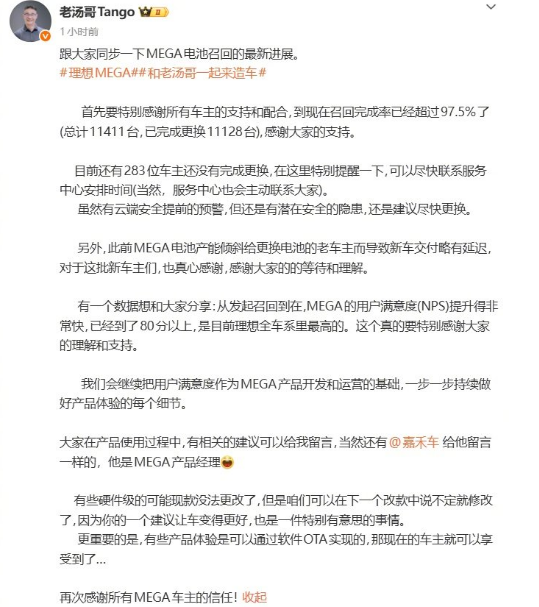
理想汽车:MEGA电池召回完成率超97.5%
Xin Lang Cai Jing· 2026-03-15 10:55
(来源:一览众车) 3月15日,理想汽车产品线负责人汤靖公布MEGA电池召回的最新进展。到现在召回完成率已经超过 97.5%(总计11411台,已完成更换11128台),目前还有283位车主还没有完成更换。 "虽然有云端安全提前的预警,但还是有潜在安全的隐患,还是建议尽快更换。"汤靖表示。 电话:18676695257 2025年10月31日,理想汽车宣布主动召回部分理想MEGA 2024款电动汽车,共计11411辆。本次召回范 围内的车辆,由于该批次冷却液防腐性能不足,特定条件下会导致冷却回路中动力电池和前电机控制器 的冷却铝板腐蚀渗漏,导致车辆出现故障灯点亮、动力受限及无法上电的情形,极端情况下会造成动力 电池热失控,存在安全隐患。公司将为召回范围内车辆免费更换冷却液、动力电池和前电机控制器。 邮件:service@yilanzhong.com 一览众电动零部件报告(2026) 《2025-2030年电动汽车高压连接器市场及企业调研报告》 《2025-2030年电动汽车高压继电器市场及企业调研报告》 《2025-2030年电动汽车高压熔断器市场及企业调研报告》 《2025-2030年电动汽车高压线束市场及 ...
理想汽车-W:盈利性短期承压,关注新车和战略调整-20260315
GOLDEN SUN SECURITIES· 2026-03-15 10:24
Investment Rating - The report maintains a "Buy" rating for the company, with a target market value of 150.9 billion RMB and a target price of approximately 79.45 HKD or 20.21 USD, corresponding to 1.1x 2026 P/S and 48x 2026 P/E [4][6]. Core Insights - The company is expected to face short-term profitability pressure due to factors such as the vehicle purchase tax policy and inventory clearance of the L9 model. The projected Q1 2026 vehicle delivery volume is between 85,000 and 90,000 units, representing a year-on-year decrease of 8.5% to 3.1% [2][4]. - The company plans to launch a new generation of the L9 model in Q2 2026, featuring advanced technology and cost-reduction strategies through in-house development [2][3]. - A sales adjustment strategy is being implemented, including a store partner program to enhance operational efficiency and decision-making authority at the store level [3]. Financial Performance Summary - For Q4 2025, the company reported a net profit attributable to shareholders of 6.52 million RMB, with a Non-GAAP net profit of 26 million RMB, reflecting a Non-GAAP net profit margin of 0.9%, down 8.2 percentage points year-on-year but up 2.2 percentage points quarter-on-quarter [1]. - The projected revenue for 2026 is estimated to be between 137.2 billion and 159.0 billion RMB, with a Non-GAAP net profit forecast of 31 billion RMB for 2026, increasing to 72 billion RMB by 2028 [4][5]. - The company anticipates a gross margin of approximately 5% for Q1 2026, significantly impacted by the aforementioned factors [2]. Sales and Production Outlook - The company expects total sales volumes of approximately 520,000, 580,000, and 640,000 units for the years 2026, 2027, and 2028, respectively [4]. - The sales strategy includes focusing on more promising markets and enhancing store efficiency through the store partner program [3]. Research and Development - The company is actively working on cost reduction across the entire product development and manufacturing chain, including in-house production of key components such as range extenders and power modules [2]. - The new L9 model will incorporate advanced features such as an 800V full active suspension system and a powerful computing platform [2]. Market Position and Competitive Landscape - The company is adjusting its profitability forecasts in light of competitive pressures, with a focus on enhancing product competitiveness through strategic cost management and technological advancements [4]. - The report highlights the importance of the upcoming new model launches in maintaining market relevance and driving future sales growth [2][4].
汽车行业周报(20260309-20260315):整车情绪已至拐点,AIDC仍是重点投资方向-20260315
Huachuang Securities· 2026-03-15 09:42
Investment Rating - The report maintains a recommendation for the automotive industry, indicating that the sentiment has reached an inflection point and AIDC remains a key investment direction [3][4]. Core Insights - The report highlights that the terminal sales of passenger vehicles and the complete vehicle sector have shown signs of recovery, with new car price increases being recognized by some investors as a counter to rising raw material costs. Additionally, the increase in oil and gas prices has contributed to a positive shift in investment sentiment [3][4]. - The report suggests that the automotive sector is expected to see improved sales, profitability, and exports in March and April, with specific recommendations for companies such as Geely, BYD, and Jianghuai Automotive [6][10]. Data Tracking - In February, new energy vehicle deliveries showed varied performance, with BYD delivering 190,190 units (down 41.1% year-on-year), while NIO saw a significant increase of 57.6% year-on-year with 20,797 units delivered [5][20]. - Traditional automakers also reported significant sales changes, with SAIC Motor leading with 269,000 units sold (down 8.6% year-on-year) [5][21]. - The average discount rate in the industry increased to 9.3%, with a discount amount of 20,940 yuan, reflecting a slight year-on-year decrease [5][7]. Industry News - The report notes that the average price of lithium carbonate in Q1 2026 reached 154,227 yuan per ton, marking a 103% year-on-year increase [9]. - The automotive export figures for February showed a significant growth of 52.4% year-on-year, with a total of 672,000 vehicles exported [10][26]. - The report mentions that the capital restructuring plan of Dongfeng Motor Corporation was approved, allowing it to privatize and list its high-end electric vehicle brand, Lantu, on the Hong Kong Stock Exchange [26].




理想汽车(LI):跟踪报告:4Q25业绩持续承压,淡季+新老交替影响1Q26E基本面
EBSCN· 2026-03-15 09:35
Investment Rating - The report maintains a "Buy" rating for the company, indicating a positive outlook despite market volatility and increased competition [4]. Core Insights - The company reported a total revenue of 112.3 billion RMB for 2025, a year-on-year decrease of 22.3%, with a gross margin of 18.7%, down 1.8 percentage points [1]. - The Non-GAAP net profit for 2025 was 2.4 billion RMB, reflecting a significant decline of 77.7% year-on-year [1]. - In Q4 2025, total revenue was 28.78 billion RMB, a 35.0% year-on-year decrease, but a 5.2% increase quarter-on-quarter [1]. - The company expects Q1 2026 delivery volumes to be between 85,000 and 90,000 units, but anticipates significant pressure on gross margins due to various factors [2]. Summary by Relevant Sections Financial Performance - The company’s total revenue for 2025 was 112.3 billion RMB, with a gross margin of 18.7% and a Non-GAAP net profit of 2.4 billion RMB [1][5]. - Q4 2025 saw a total revenue of 28.78 billion RMB, with a gross margin of 17.8% [1][2]. - The forecast for 2026 estimates total revenue to increase to 124.4 billion RMB, with a Non-GAAP net profit projected at 84 million RMB [5][9]. Cost Management and Operational Efficiency - The company is focusing on cost control and organizational optimization to strengthen its operational foundation, including long-term price locking and self-research of core components [3]. - R&D expenses for Q4 2025 were 10.5% of revenue, indicating a strategic investment in innovation despite current financial pressures [2]. Product Development and Market Strategy - The new L9 model is expected to launch in Q2 2026, which is anticipated to enhance sales and gross margins [3]. - The company is also exploring international markets, with plans to enter Egypt and Kazakhstan, which could serve as new growth engines [3].
理想汽车现金储备大幅领先新势力车企 多年研发成果将集中兑现
Zhong Guo Jin Rong Xin Xi Wang· 2026-03-15 08:07
Core Insights - Li Auto achieved a revenue of 112.31 billion yuan and a net profit of 1.139 billion yuan in 2025, becoming the only new force car company in China to achieve over 100 billion yuan in revenue and profitability for three consecutive years [1][2] - The company plans to focus on "embodied intelligence" in 2026, with significant R&D investments expected to yield results this year, including the mass production of its self-developed chip, the Mach 100 [1][3] Financial Performance - In Q4 2025, Li Auto reported a revenue of 28.775 billion yuan and a net profit of 20.2 million yuan [2] - The company has a cash reserve of 101.2 billion yuan, significantly higher than competitors like NIO and Xpeng, which had cash reserves of 45.9 billion yuan and 48.33 billion yuan respectively [2][3] - Li Auto's total R&D investment reached a historical high of 11.3 billion yuan in 2025, with 50% allocated to AI-related projects [2][4] Sales and Market Strategy - Li Auto sold 406,300 vehicles in 2025 and aims for over 20% year-on-year growth in 2026 [3][6] - The company has adopted a "3+2" strategy focusing on sales management, successful model upgrades, and stable growth in electric vehicle sales, alongside investments in smart technology and overseas market expansion [3][6] Technological Advancements - The new generation Li Auto L9, set to launch in Q2 2026, will feature the Mach 100 chip, which offers 5-6 times the effective computing power of NVIDIA's Thor-U [5][6] - Li Auto's self-developed third-generation range extender will enhance user experience and reduce operating costs through innovative technologies [6] - The company has established a comprehensive R&D organization that integrates software and hardware development, significantly improving efficiency [4][5]