
MEITUAN(03690)

Search documents
李亚鹏6小时直播销售额达1.6亿;月之暗面公开喊话百度;黄仁勋否认对OpenAI不满,透露将巨额投资;国际巨头被曝拟裁员3万人...
Sou Hu Cai Jing· 2026-02-02 01:26
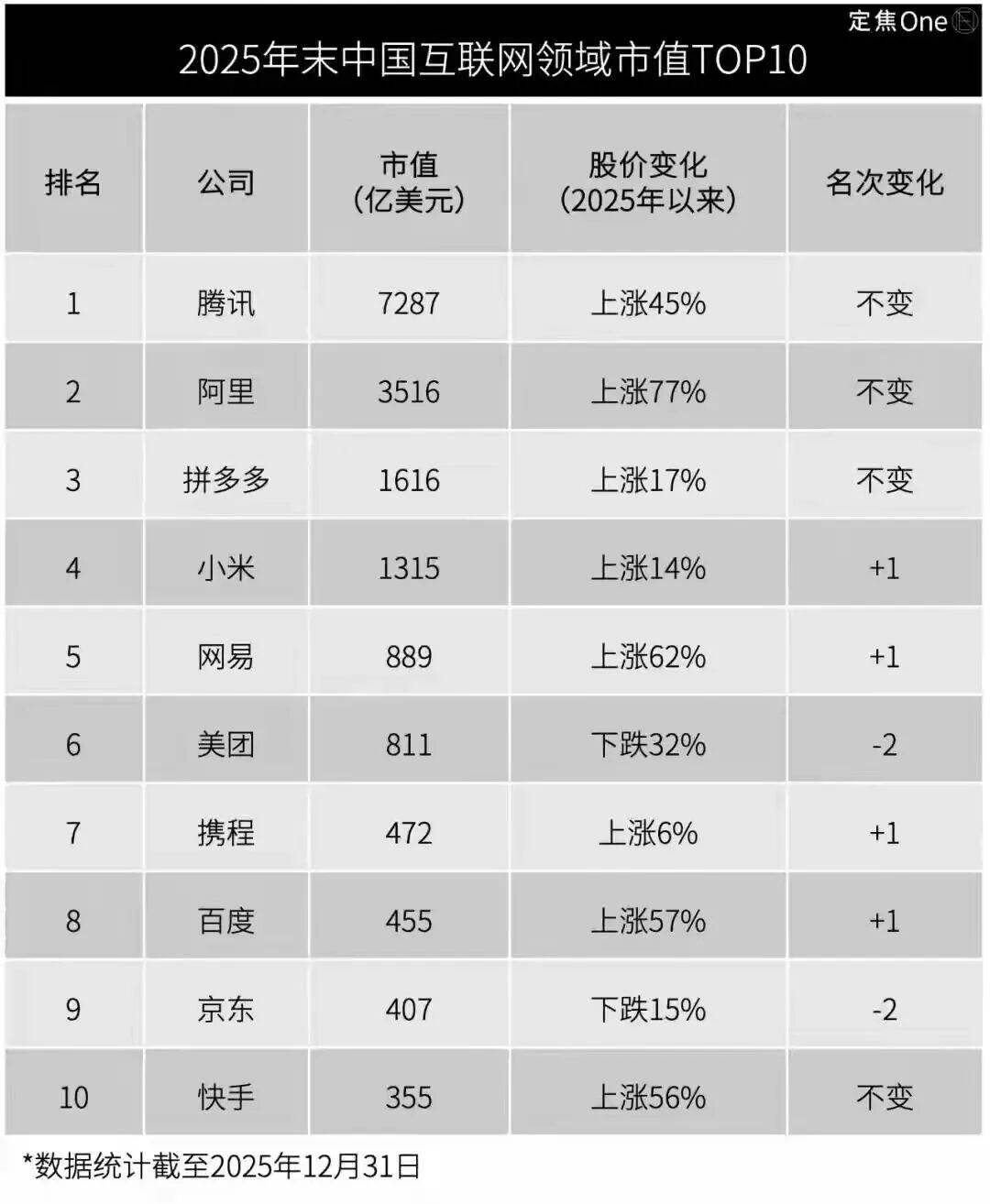
Group 1: Market Capitalization of Chinese Internet Companies - Tencent leads the market with a valuation of $72.87 billion, experiencing a 45% increase since the beginning of 2025 [1] - Alibaba follows with a market cap of $35.16 billion, showing a 77% rise [1] - Pinduoduo ranks third with a valuation of $16.16 billion, up by 17% [1] - Xiaomi's market cap is $13.15 billion, increasing by 14% [1] - NetEase has a valuation of $8.89 billion, with a significant 62% increase [1] - Meituan's market cap is $8.11 billion, but it has seen a decline of 32% [1] - Ctrip's valuation stands at $4.72 billion, with a modest increase of 6% [1] - Baidu's market cap is $4.55 billion, reflecting a 57% rise [1] - JD.com has a valuation of $4.07 billion, down by 15% [1] - Zhongren ranks last with a market cap of $3.55 billion, with a drastic drop of 245,606% [1] Group 2: Tax Policy Changes - The Ministry of Finance and the State Administration of Taxation announced a new VAT exemption policy for small-scale taxpayers, effective from January 1, 2026 [3] - The new threshold for monthly sales is set at 100,000 yuan, and for quarterly sales at 300,000 yuan [3] - For single transactions, the threshold is 1,000 yuan, applicable on a daily basis for multiple transactions [3] Group 3: AI and Technology Developments - Nvidia's CEO Jensen Huang denied any dissatisfaction with OpenAI and announced plans for a significant investment in the company [5] - Apple is reported to have acquired the Israeli company Q.ai for approximately $2 billion, marking its second-largest acquisition in history [5] - Waymo is seeking to raise about $16 billion at a valuation close to $110 billion, with Alphabet expected to contribute $13 billion [18] Group 4: Corporate Actions and Market Reactions - Oracle is reportedly considering laying off 30,000 employees due to financial pressures from AI infrastructure investments [11] - The company is also evaluating the sale of its healthcare software division, Cerner, acquired for $28.3 billion [11] - Recent fluctuations in gold prices have led to increased consumer activity in gold purchases in Shenzhen [3]


智通港股通资金流向统计(T+2)|2月2日
智通财经网· 2026-02-01 23:35
Core Insights - Tencent Holdings (00700), Pop Mart (09992), and China Life (02628) ranked as the top three stocks for net inflow of southbound funds, with net inflows of 1.207 billion, 742 million, and 566 million respectively [1] - The top three stocks for net outflow of southbound funds were the Yingfu Fund (02800), Alibaba-W (09988), and Zijin Mining (02899), with net outflows of -2.595 billion, -950 million, and -858 million respectively [1] - In terms of net inflow ratio, Southern East Selection (03441), China Traditional Chinese Medicine (00570), and Baiaosaitu-B (02315) led the market with ratios of 51.51%, 44.99%, and 44.77% respectively [1] Net Inflow Rankings - Tencent Holdings (00700) had a net inflow of 1.207 billion, representing a 7.63% increase, closing at 621.000 (+2.31%) [2] - Pop Mart (09992) saw a net inflow of 742 million, with a net inflow ratio of 14.21%, closing at 231.400 (+7.03%) [2] - China Life (02628) recorded a net inflow of 566 million, with a net inflow ratio of 16.39%, closing at 35.180 (+3.17%) [2] Net Outflow Rankings - Yingfu Fund (02800) experienced the highest net outflow of -2.595 billion, with a net outflow ratio of -7.92%, closing at 28.040 (+2.64%) [2] - Alibaba-W (09988) had a net outflow of -950 million, with a net outflow ratio of -5.41%, closing at 173.500 (+2.12%) [2] - Zijin Mining (02899) faced a net outflow of -858 million, with a net outflow ratio of -12.94%, closing at 44.760 (+3.13%) [2] Net Inflow Ratio Rankings - Southern East Selection (03441) led with a net inflow ratio of 51.51%, with a net inflow of 6.9271 million, closing at 11.410 (+1.42%) [3] - China Traditional Chinese Medicine (00570) followed with a net inflow ratio of 44.99%, with a net inflow of 42.7833 million, closing at 2.090 (-4.57%) [3] - Baiaosaitu-B (02315) had a net inflow ratio of 44.77%, with a net inflow of 44.5882 million, closing at 47.000 (+9.35%) [3] Net Outflow Ratio Rankings - Guangshen Railway (00525) had the highest net outflow ratio of -57.47%, with a net outflow of -8.3198 million, closing at 2.250 (+1.35%) [3] - Huaxin Building Materials (06655) followed with a net outflow ratio of -54.93%, with a net outflow of -26.9041 million, closing at 20.020 (+1.16%) [3] - Kunlun Energy (00135) recorded a net outflow ratio of -53.60%, with a net outflow of -100 million, closing at 8.020 (+0.88%) [3]




指数研究|全球主要指数估值跟踪0201(实战版)
Xin Lang Cai Jing· 2026-02-01 15:13
Group 1: Nasdaq 100 - The Nasdaq 100 is seen as a high-value investment due to its representation of the highest level of total factor productivity (TFP) in the current economy, driven by technology replacing labor and algorithm-driven growth [2] - The index consists mainly of monopolistic tech giants with strong free cash flow, which are engaging in significant share buybacks, thereby increasing earnings per share (EPS) even if market valuations remain stable [2] - The Nasdaq 100 serves as a hedge against Chinese assets, reflecting global technology innovation cycles, contrasting with A-shares that are more influenced by global manufacturing cycles and domestic fiscal leverage [2] Group 2: Market Trends and Outlook - The current U.S. stock market presents both opportunities and risks, with an overall increase in risk compared to previous periods, but the core investment logic remains intact [3] - The AI industry transformation continues to be a central theme, with a focus on companies with high technological barriers, stable cash flows, and clear earnings visibility, such as large cloud service providers and core chip manufacturers [3] - Defensive sectors like consumer staples and healthcare are expected to perform well during market volatility, while cyclical sectors such as energy and military may also present opportunities due to expectations of manufacturing resurgence and potential fiscal expansion [3] Group 3: Valuation Tracking - The current PE-TTM for the Nasdaq 100 is 35.79, slightly down from 35.92 the previous week, placing it in the 86.72 percentile over the past decade, indicating a relatively high valuation [3] - The index has experienced a maximum drawdown of 35.56% over the past five years, with an average maximum drawdown of 15%, suggesting recent stability [5] Group 4: S&P 500 - The S&P 500 index currently has a PE-TTM of 29.10, with a historical percentile of 87.27, indicating a relatively high valuation compared to the past decade [12] - The top holdings in the S&P 500 include major companies like Nvidia, Microsoft, and Apple, reflecting a balanced industry representation [14] - The current market conditions suggest that it is not an ideal time for heavy investment, although small-scale dollar-cost averaging is considered acceptable [15] Group 5: Hang Seng Technology Index - The Hang Seng Technology Index has a current PE-TTM of 23.26, with a historical percentile of 39.29, indicating a moderate valuation [18] - The index is currently in a position suitable for dollar-cost averaging, despite recent declines [21] Group 6: Hang Seng Internet Technology - The Hang Seng Internet Technology Index has a PE-TTM of 23.61, with a historical percentile of 49.03, suggesting a reasonable valuation [23] - Recent performance indicates a decline in earnings, which requires monitoring for sustained trends [23]



同比增长超15%!春节前医美市场迎小高峰 美团推出专项活动助力用户“美美过新年”
Bei Jing Shang Bao· 2026-01-31 05:50
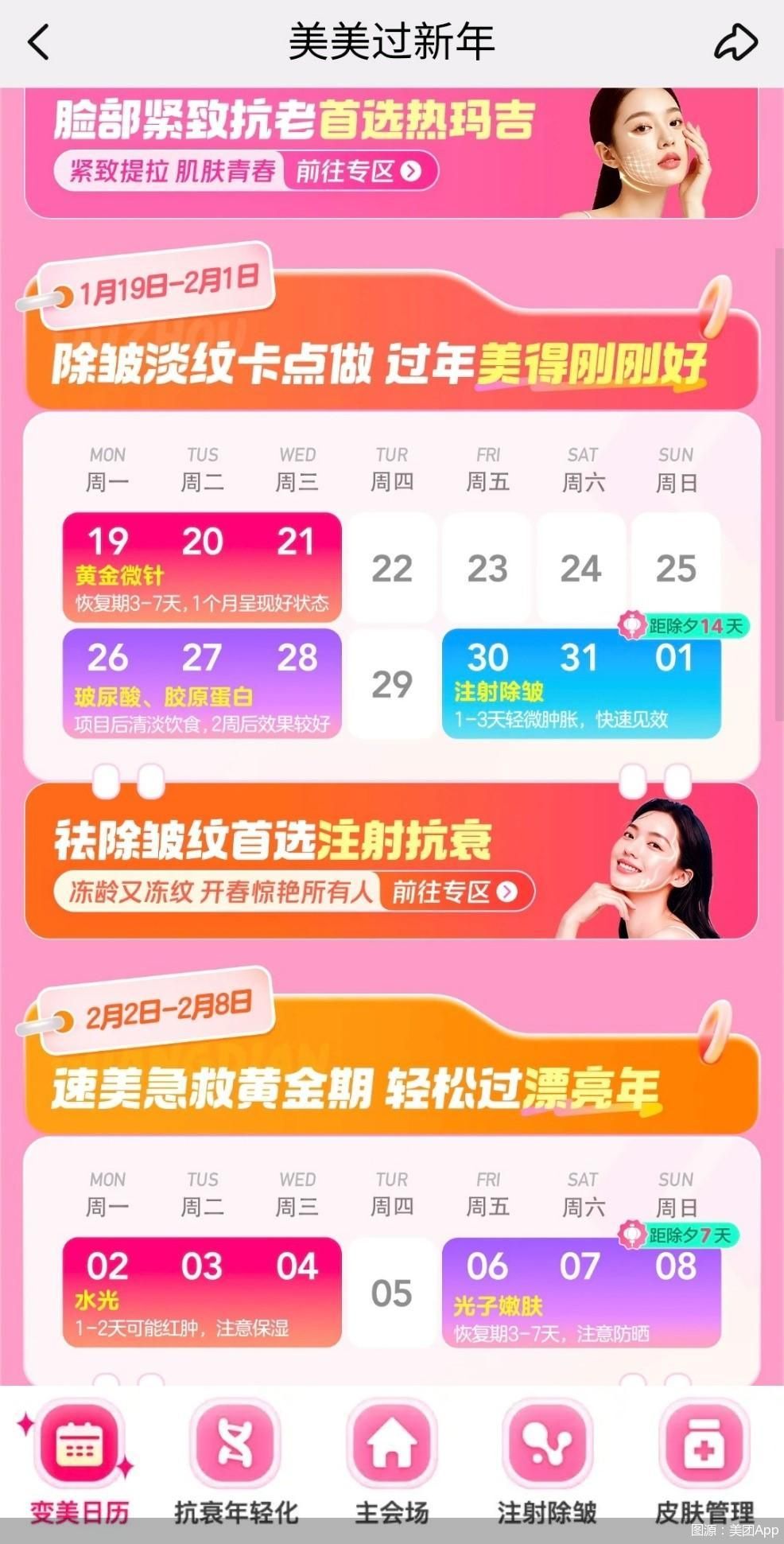
Core Insights - The medical beauty market is experiencing a surge in demand as consumers prepare for the upcoming Spring Festival, with many opting for aesthetic treatments to enhance their appearance [1][3]. Group 1: Market Trends - There has been a significant increase in user visits to medical beauty services, with Meituan reporting over a 15% year-on-year growth and nearly a 10% week-on-week increase [3]. - The demand for aesthetic treatments is primarily focused on anti-aging, wrinkle removal, and urgent skin condition improvement, with varying recovery periods influencing consumer choices [3]. - Popular treatments have shifted from longer recovery options like Thermage and Ultherapy to shorter recovery options such as hyaluronic acid injections and photorejuvenation [3]. Group 2: Company Initiatives - Meituan has launched a "Beautiful New Year" campaign, offering a 3000 yuan medical beauty voucher package and a beauty calendar to help users select appropriate treatments based on recovery times [3]. - During the Spring Festival, at least 30% of medical beauty institutions on the Meituan platform will remain open, which is a 5% increase compared to the previous year, providing convenience for users seeking urgent skin treatments [3]. - The company promotes the "Safe Beauty" initiative to ensure compliance and safety in the industry, aiming to verify over 12 million treatment instances by the end of 2025 across 2500 institutions in 140 cities [4].

【展望二〇二六】满足人民群众消费新期待
Jing Ji Ri Bao· 2026-01-31 05:13
Core Viewpoint - The Chinese market is undergoing significant regulatory changes in 2026, impacting competition in the food delivery and retail sectors, with a shift from aggressive price wars to a focus on service quality and consumer trust [1][2][3]. Group 1: Regulatory Changes - The State Council's Anti-Monopoly Committee announced investigations into the food delivery platform market and the alleged monopolistic behavior of Ctrip, indicating increased regulatory scrutiny [1][2]. - The Ministry of Finance and the State Taxation Administration will eliminate VAT export rebates for solar products starting April 1, 2026, reflecting a broader regulatory tightening [1]. - The market supervision authority released a list of major cases related to "involution" competition, highlighting ongoing efforts to address unfair practices in various industries [1][2]. Group 2: Market Dynamics - The competitive landscape in the food delivery sector is shifting from a "burning money" model to a focus on optimizing user experience and sustainable business practices [2][3]. - Major platforms are transitioning from merely delivering food to providing a broader range of retail services, indicating a strategic pivot towards becoming comprehensive retail infrastructures [4][5]. - The competition is expected to evolve into a "full-scenario retail war," integrating offline experiences, supply chain efficiency, and product quality [4][5]. Group 3: Consumer Behavior - Consumers are increasingly rejecting "involution" products characterized by extreme price cuts, signaling a demand for better quality and service [6][7]. - The market is anticipated to segment into two layers: one focused on efficiency and cost-effectiveness, and another on emotional and personalized experiences [8][12]. - The rise of local and individual creators is fostering a diverse ecosystem, enhancing consumer engagement and satisfaction [12][14]. Group 4: Food Safety and Transparency - Regulatory efforts are shifting from reactive measures to proactive prevention in food safety, aiming for a comprehensive regulatory framework to ensure consumer trust [9][10]. - New standards and regulations are being developed for pre-packaged food, emphasizing transparency and accountability in the food supply chain [9][10]. - The implementation of traceability systems and enhanced monitoring is expected to improve food safety and consumer confidence [10][11].

智通ADR统计 | 1月31日





智通财经网· 2026-01-30 23:36
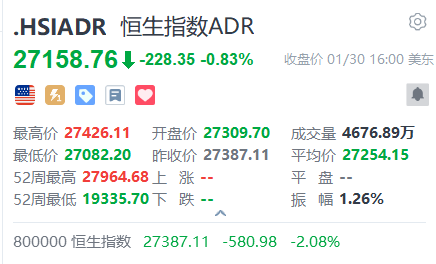
Market Overview - The Hang Seng Index (HSI) closed at 27,158.76, down by 228.35 points or 0.83% [1] - The index reached a high of 27,426.11 and a low of 27,082.20 during the trading session, with a trading volume of 46.7689 million [1] Major Blue-Chip Stocks Performance - Most large-cap stocks experienced declines, with notable movements including: - Tencent Holdings closed at HKD 606.00, down by HKD 16.00 or 2.57% [3] - Alibaba Group (ADR) fell to HKD 169.20, down by HKD 4.10 or 2.37% [3] - HSBC Holdings reported a slight decrease to HKD 136.60, down by HKD 1.00 or 0.73% [3] - Other significant declines included: - China Mobile down by 9.29% to HKD 36.12 [3] - BYD Company down by 3.98% to HKD 97.75 [3] - Meituan down by 1.42% to HKD 97.20 [3] Stock Price Movements - The following stocks showed notable price changes: - AIA Group down by 0.66% to HKD 90.35 [3] - Xiaomi Corporation down by 3.06% to HKD 35.50 [3] - JD.com down by 1.92% to HKD 112.40 [3] - Some stocks remained stable or showed minor gains, such as: - New World Development up by 0.88% to HKD 125.70 [3] - Bank of China up by 0.19% to HKD 41.24 [3]
满足人民群众消费新期待
Jing Ji Ri Bao· 2026-01-30 22:19
Core Viewpoint - The competitive landscape in the food delivery and retail sectors is shifting towards a focus on service quality and sustainable practices, driven by regulatory interventions and changing consumer expectations [1][2][3]. Group 1: Regulatory Changes and Market Dynamics - The State Council's Antitrust Committee announced investigations into the food delivery platform market and other sectors to assess competition [1]. - The Ministry of Finance and the State Taxation Administration will eliminate VAT export rebates for solar products starting April 1, 2026 [1]. - The market is witnessing a transition from aggressive price competition to a focus on service quality and user experience, as exemplified by the decline of "zero-yuan milk tea" promotions [2][3]. Group 2: Industry Evolution and Strategic Shifts - Major platforms are moving from a "burning money" strategy to a dual strategy of consolidating core businesses while exploring new retail avenues [4][5]. - The competition is evolving from food delivery to instant retail, with companies like Alibaba aiming to dominate the instant retail market by investing heavily [3][4]. - The focus is shifting towards optimizing user experience and ensuring sustainable business practices, moving away from mere scale expansion [2][3]. Group 3: Consumer Behavior and Market Trends - Consumers are increasingly rejecting "involution" products that prioritize low prices over quality, indicating a demand for better service and product standards [6][7]. - The market is expected to segment into efficiency-driven and experience-driven categories, reflecting diverse consumer needs [8][12]. - The rise of local brands and unique experiences is fostering a more vibrant consumer ecosystem, as seen in the popularity of cultural and experiential offerings [12][13]. Group 4: Food Safety and Transparency - Regulatory efforts are shifting towards proactive measures in food safety, aiming for a comprehensive oversight system to prevent risks [9][10]. - Initiatives are being implemented to enhance transparency in food sourcing and processing, which is crucial for rebuilding consumer trust [10][11]. - The food safety environment is anticipated to improve through ongoing regulatory adjustments and market responses to consumer concerns [11].
云平台异业联盟:重构商业生态,开启线上线下融合新篇章
Sou Hu Cai Jing· 2026-01-30 14:19
Core Viewpoint - The O2O (Online to Offline) model is becoming a crucial pathway for digital transformation across various industries, driven by the rise of mobile internet and the emergence of new players in the market [1][3]. Group 1: O2O Model Development - The O2O platform is experiencing unprecedented growth opportunities due to the widespread adoption of mobile devices and technological advancements [3]. - Various operational models within O2O, such as full-channel integration and social group buying, are meeting the diverse needs of consumers [3]. - The rise of new retail is deeply integrating online services with offline experiences, reshaping industry structures and ecosystems [3]. Group 2: Cross-Industry Alliance - The cross-industry alliance within cloud platforms is becoming a significant force in reconstructing the business ecosystem by integrating resources across industries [3][5]. - This alliance allows businesses to conduct joint marketing, service, or product innovation, achieving mutual benefits [3][5]. Group 3: Consumer Benefits - Consumers can enjoy discounts and services across various merchants within the alliance, enhancing their shopping experience and satisfaction [5][16]. - The alliance provides value-added services through incentives like points and coupons, increasing user loyalty [5][16]. - The shared traffic among merchants maximizes flow utilization, boosting sales and market share [5][16]. Group 4: Operational Model - The core of the alliance's operational model lies in the integration of online and offline resources, utilizing shared industry resources and joint marketing strategies [5][6]. - The alliance breaks down industry barriers, allowing merchants to share customer information and marketing channels, thus reducing operational costs and enhancing competitiveness [6]. Group 5: Marketing and Data Utilization - The alliance leverages cloud platform technology to provide online marketing tools, helping merchants expand brand influence and attract potential customers [8]. - By collecting and analyzing consumer data, the alliance offers precise market insights and decision support for merchants [8]. Group 6: Future Outlook - The cloud platform cross-industry alliance is expected to play a vital role in creating more value for businesses and consumers as technology advances and the market matures [17].


医美加入“春节变美三件套”,美团医美节前迎消费高峰
Nan Fang Du Shi Bao· 2026-01-30 08:33
Core Insights - The medical beauty market is experiencing a surge in demand as consumers prepare for the upcoming Spring Festival, with many opting for aesthetic treatments to enhance their appearance [1][2]. Group 1: Market Trends - There is a notable shift in consumer behavior, with traditional beauty treatments being supplemented by light medical beauty procedures, forming a new "Spring Festival beauty package" [1]. - Meituan's data indicates a more than 15% year-on-year increase in user visits to medical beauty services, with a nearly 10% week-on-week growth, reflecting heightened market activity [1]. - The demand is primarily focused on anti-aging, wrinkle removal, and skin emergency treatments, with varying popularity based on recovery times [1]. Group 2: Treatment Popularity - Treatments like Thermage and Ultherapy peaked in early January but have seen a gradual decline, while hyaluronic acid, Botox, and photorejuvenation have been on the rise recently [1]. - Meituan has launched a "Beautiful New Year" campaign, offering a 3000 yuan medical beauty voucher package and a beauty calendar to help users choose suitable treatments [1]. Group 3: Operational Insights - During the Spring Festival, at least 30% of medical beauty institutions on the Meituan platform will remain open, an increase of about 5 percentage points from the previous year, providing convenience for users seeking treatments [2]. - Meituan is promoting the "Safe Beauty" initiative to ensure compliance and safety in the industry, aiming to have over 12 million verified treatments by the end of 2025, covering 2500 institutions across 140 cities [3].
9天假期催热“反向过年”北上成渝广深跻身“反向过年”热门地
Zhong Guo Jing Ji Wang· 2026-01-30 07:01
Group 1 - The traditional "return home for the New Year" pattern is being disrupted, with more families opting for diverse experiences during the Spring Festival, such as bringing elders to cities or traveling to different locations [1] - The trend of "reverse New Year" is on the rise, with a significant increase in ticket bookings for this travel style, showing an 84% year-on-year growth in flight bookings during the Spring Festival period [1][2] - Popular destinations for "reverse New Year" travel include major cities like Beijing, Shanghai, and Chengdu, reflecting a shift in travel preferences [1] Group 2 - The price advantage of "reverse New Year" travel is notable, with significant price differences in flight tickets, such as a fare of 399 yuan from Wuhan to Beijing compared to 1479 yuan for the reverse route [2] - The booking volume for flights to destinations like Jieyang has surged by 166% year-on-year, driven by interest in cultural heritage experiences [2] - The trend of short-distance trips is also gaining popularity, with families opting for local experiences, such as visiting nearby cities for cultural events [3] Group 3 - The Spring Festival travel peak is expected around February 14, with a notable difference in travel patterns between those flying and those taking trains, as air travelers tend to depart a day later [4] - New high-speed rail lines have significantly reduced travel times, leading to a 175% increase in bookings for routes like Shenyang to Baishan [4] - The overall travel period for the Spring Festival in 2026 is extended to 40 days, allowing for a more relaxed travel experience [4]