ZJLD(06979)

Search documents
国盛证券食品饮料行业周报-20250608
GOLDEN SUN SECURITIES· 2025-06-08 10:57
Investment Rating - The report maintains an "Increase" rating for the food and beverage industry, indicating a positive outlook for the sector [5]. Core Insights - The beer and beverage sector is entering a peak season, with a focus on new product launches in mass-market segments. The report highlights three main lines for investment in liquor: leading brands, high-certainty regional brands, and flexible targets benefiting from recovery and risk appetite [1][2]. - The report emphasizes the importance of product innovation and quality in driving growth for companies like Yanjing Beer and Nongfu Spring, particularly in the beverage segment [3][4]. Summary by Sections Liquor Industry - Guizhou Moutai has launched a new product series, enhancing its cultural product structure and international expansion. The liquor market is stabilizing as inventory adjustments continue, providing long-term investment opportunities in leading stocks [2]. Beer and Beverage Sector - Yanjing Beer is implementing multiple strategies to drive U8 growth, including product quality differentiation and market penetration. Nongfu Spring has introduced a new carbonated drink, indicating ongoing competition in the beverage industry, which is expected to maintain high growth due to improved consumer scenarios [3]. Mass-Market Products - The report notes that Sam's Club is accelerating new product launches, which benefits companies that maintain high quality and innovation. The change in accounting for a subsidiary by Haoxiangni may lead to short-term profit fluctuations but could enhance asset value in the long run [4].





湖南本土白酒销冠“易主”:年收入超过10亿元,领先酒鬼酒、湘窖
Sou Hu Cai Jing· 2025-05-28 10:53
Core Insights - Hunan is a major liquor consumption province, with per capita liquor consumption nearly double the national average, and an annual sales scale of nearly 300 billion yuan [1] - The market share of local Hunan liquor brands is less than 30%, with only about 70 billion yuan in sales, which is inconsistent with its status as a major consumption province [1] - The "Three Flowers" of Hunan liquor, which were popular in the 1950s and 60s, have seen a decline in market presence [1] Industry Overview - As of 2024, Hunan has over 170 licensed liquor production companies, including 110 white liquor producers, with an annual production of approximately 50,000 to 60,000 kiloliters, ranking 13th to 15th nationally [3] - The major production areas for white liquor in Hunan are Xiangxi, Shaoyang, and Changde [3] Company Performance - Jiu Gui Jiu (酒鬼酒) reported a revenue of 1.423 billion yuan in the last year, with a net profit of 12.49 million yuan, marking a year-on-year decline of 49.70% and 97.72% respectively [3] - Jiu Gui Jiu's revenue from Hunan was 642 million yuan, accounting for 45.11% of total revenue, while revenue from outside the province was 781 million yuan, making up 54.89% [3] - The high-end "Nei Can" series of Jiu Gui Jiu saw a revenue drop of 67.06%, with inventory reaching 1,395 tons, an increase of nearly 20% year-on-year [4] Competitive Landscape - Xiang Jiao Jiu (湘窖酒业) achieved a revenue of 7.07 billion yuan, a slight increase of 0.5%, with a net profit of 1.68 billion yuan, up 3.3% [6] - Wu Ling Jiu (武陵酒) reported a revenue of 1.098 billion yuan, a year-on-year increase of 13.30%, making it the top brand in Hunan [9] - The overall market dynamics show a "three-legged" competition among Jiu Gui Jiu, Xiang Jiao Jiu, and Wu Ling Jiu, with other brands like Bai Sha Jiu Ye and De Shan Da Qu also gaining recognition [10]


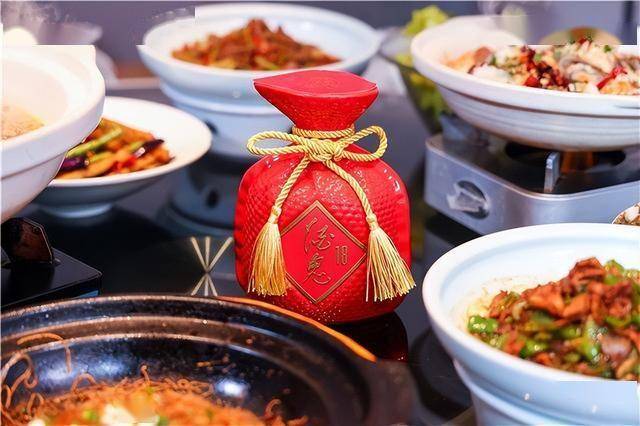
吴向东30年“卖真酒”打造两家上市酒企 华致酒行净利三连降吴其融临危受命
Chang Jiang Shang Bao· 2025-05-26 00:57
Core Viewpoint - The article discusses the transition of power within the white liquor empire built by Wu Xiangdong, who is facing challenges in the industry due to high inventory and price inversion, while his son Wu Qirong is gradually taking over leadership roles in the family business [1][14]. Company Overview - Wu Xiangdong, known as the "Father of Liquor," has established a significant presence in the Chinese liquor industry over nearly 30 years, starting with the founding of Changsha Haida Liquor Food Wholesale Co., Ltd. in 1996 and later creating the Jin Liufu brand [4][5]. - The company has expanded through acquisitions, including over ten local distilleries, and has successfully launched two publicly listed companies: Huazhi Liquor and Zhenjiu Lidu [8][9]. Financial Performance - In 2024, Zhenjiu Lidu reported a slight revenue increase to 7.067 billion yuan, but net profit fell by over 40% to 1.324 billion yuan, primarily due to non-operating financial instrument valuation changes [15]. - Huazhi Liquor's performance has been declining, with 2024 revenues of 9.464 billion yuan and a net profit of only 44 million yuan, marking an 81.11% drop [16]. - The first quarter of 2024 saw Huazhi Liquor's revenue and net profit continue to decline, with year-on-year decreases of 31.01% and 34.19%, respectively [16]. Market Challenges - The white liquor industry is experiencing a downturn characterized by high inventory levels, price inversions, and intensified competition, leading to a challenging environment for companies like Huazhi Liquor and Zhenjiu Lidu [20]. - The shift towards direct sales by major liquor companies has diminished the advantages of intermediaries like Huazhi Liquor, which is struggling to adapt to the new market dynamics [17]. Leadership Transition - Wu Qirong, Wu Xiangdong's son, has been gradually taking on more responsibilities, including becoming a director at both Huazhi Liquor and Zhenjiu Lidu, indicating a transitional phase in leadership [10][12]. - Wu Qirong has focused on digital marketing and e-commerce, with Huazhi Liquor's e-commerce revenue growing by 72.87% in 2024, becoming the company's second-largest revenue source [18]. Future Outlook - The transition of leadership and the focus on e-commerce may provide opportunities for the company to navigate the current market challenges, but the overall industry environment remains tough [20].
食品饮料周观点:白酒行业逐步施压,餐供龙头边际修复-20250525
GOLDEN SUN SECURITIES· 2025-05-25 06:18
Investment Rating - The report maintains an "Increase" rating for the food and beverage industry, indicating a positive outlook for key players in the sector [5]. Core Insights - The white liquor industry is experiencing gradual pressure, with a focus on rational growth targets for 2025. Key players are emphasizing market share enhancement and strategic execution efficiency. Innovations, market penetration, international expansion, and youth-oriented strategies are highlighted as core directions for liquor companies [2]. - The beer sector shows a slight decline in production, with a 0.6% year-on-year decrease in output from January to April 2025. However, there is potential for recovery in the upcoming peak season, suggesting a favorable investment window [3]. - The beverage sector is characterized by intense competition, but there are opportunities for growth driven by extended holiday periods and improved travel scenarios. Companies with strong channel networks and high-potential products are recommended for investment [3]. Summary by Sections White Liquor - The industry consensus is shifting towards stable, quality growth with a focus on market share rather than aggressive quantitative targets. Major companies like Guizhou Moutai and Shanxi Fenjiu are implementing strategies to enhance brand resilience and market stability [2]. - Guizhou Moutai aims for a revenue target of 7.6 billion yuan (approximately $1.1 billion) for 2025, reflecting a 3.49% year-on-year increase, while net profit is targeted at 2.62 billion yuan (approximately $380 million), a 1% increase [2]. Beer and Beverage - The beer production for the first four months of 2025 totaled 11.44 million kiloliters, with April showing a 4.8% increase compared to the previous year. The sector is expected to benefit from low comparative bases in the upcoming quarters [3]. - The beverage market is witnessing the launch of innovative products, such as the new electrolyte water brand targeting health-conscious consumers. Despite fierce competition, the beverage sector is projected to maintain high growth due to favorable market conditions [3]. Food Supply - The food supply sector is seeing recovery among leading companies, with a focus on expanding product lines and enhancing distribution channels. Companies like Three Squirrels are diversifying into new categories and exploring innovative retail strategies [7].

珍酒李渡:转变思路积极应对,厚积薄发砥砺前行-20250519
Soochow Securities· 2025-05-19 03:50
Investment Rating - The investment rating for the company is "Buy" (maintained) [1] Core Views - The company is actively responding to industry adjustments by transforming its strategies, focusing on nurturing enterprise customer structures and launching new products in the mid-to-high price range to create incremental growth [8] - The company aims to maintain price stability for existing products while introducing high-quality new products priced between 500-600 RMB to attract consumers [8] - The company is implementing a dual-driven strategy for national expansion and price range diversification, with a focus on experiential marketing to drive steady revenue growth [8] - The financial forecasts for the company indicate a stable performance in 2025, with slight adjustments to the non-IFRS net profit predictions for 2025-2027 [8] Financial Summary - Total revenue forecast for 2023A is 7,060 million RMB, with a projected growth of 20.56% [1] - The net profit attributable to the parent company for 2023A is 2,327 million RMB, showing a significant increase of 125.96% year-on-year [1] - Non-IFRS net profit for 2023A is 1,623 million RMB, reflecting a year-on-year growth of 35.52% [1] - The earnings per share (EPS) for 2023A is 0.69 RMB, with a projected P/E ratio of 9.03 [1] - The company expects to achieve a non-IFRS net profit of 1,431 million RMB in 2025E, with a corresponding P/E ratio of 14.69 [1]
珍酒李渡(06979):转变思路积极应对,厚积薄发砥砺前行
Soochow Securities· 2025-05-19 02:20
Investment Rating - The investment rating for the company is "Buy" (maintained) [1] Core Views - The company is actively responding to industry adjustments by transforming its strategies, focusing on nurturing enterprise customer structures and launching new products in the mid-to-high price range to create incremental growth [8] - The company aims to maintain price stability for existing products while introducing high-quality new products priced between 500-600 RMB to attract consumers [8] - The company is implementing a dual-driven strategy for national expansion and price range diversification, with a focus on experiential marketing to drive steady revenue growth [8] - The financial forecasts for the company indicate a stable performance in 2025, with slight adjustments to the non-IFRS net profit predictions for 2025-2027 [8] Financial Summary - Total revenue for 2023 is projected at 7,060 million RMB, with a growth rate of 20.56%. By 2027, revenue is expected to reach 8,929 million RMB, reflecting a growth rate of 14.54% [1] - The net profit attributable to the parent company for 2023 is estimated at 2,327 million RMB, with a significant increase of 125.96%. By 2027, it is projected to be 2,106 million RMB, with a growth rate of 22.98% [1] - The latest diluted EPS for 2023 is 0.69 RMB, expected to rise to 0.62 RMB by 2027 [1] - The company’s P/E ratio is projected to decrease from 15.88 in 2024 to 9.98 in 2027, indicating an improving valuation over time [1]
胖东来官网已恢复,本月销售额已接近10亿元;小米高管辟谣“退订会造成小米汽车崩塌”传闻;今麦郎董事长回应为娃哈哈代工丨邦早报
创业邦· 2025-05-17 00:55
Group 1 - Xiaomi's vice president refuted rumors that cancellations would lead to the collapse of Xiaomi Auto, stating that such claims are false [3] - The European Commission indicated that TikTok may have violated the Digital Services Act regarding advertising transparency, which could result in fines up to 6% of its global annual revenue if confirmed [4] - Jinmailang's chairman revealed that they produced 1.2 billion bottles of water for Wahaha in a year, highlighting their production capacity and efficiency [4] Group 2 - Xiaopeng Motors' CEO criticized competitors for offering triple salaries to poach talent, suggesting it stifles innovation, though his public relations team clarified he was not specifically targeting the automotive industry [6] - Pang Donglai announced its commitment to transparency, stating that all company information is available for legal scrutiny and that they will continue to share operational data with the public [8] - Pang Donglai's sales reached nearly 1 billion yuan in May, recovering from a previous website shutdown [12] Group 3 - OpenAI launched Codex, an AI agent focused on automating software development, which is currently available for select users on the ChatGPT platform [9] - Nissan denied reports about potential factory closures, labeling them as speculation without official basis [9] - Xiaomi's SU7 model faced complaints regarding design flaws, with experts noting manufacturing experience issues [10] Group 4 - Zeekr Technology reported a total revenue of 22 billion yuan for Q1 2025, with vehicle sales revenue of 19.1 billion yuan, marking a 16.1% year-on-year increase [18] - The Chinese film market saw a total box office of 26.6 billion yuan in the first five months of 2025, with a significant increase in domestic film revenue [26] - Green Tea Group's stock fell by 12.52% on its first day of trading, with a market capitalization of 4.236 billion HKD [21]




头部酒企集中度加剧,中腰部酒企“卡位战”升级,破局密码是什么?丨年报“显微镜”
Mei Ri Jing Ji Xin Wen· 2025-05-14 12:57
Core Insights - The overall performance of listed liquor companies in 2024 showed steady growth despite industry pressures, with 22 companies reporting a total revenue of 446.22 billion yuan and a net profit of 167.82 billion yuan, reflecting a slowdown in growth rates compared to previous years [1][4] Industry Overview - The liquor sector experienced increased differentiation in 2024, with six leading companies accounting for 80% of total revenue and 90% of net profit, even showing slight increases from 2023 [1][4] - The top six liquor companies, including Guizhou Moutai, Wuliangye, and Shanxi Fenjiu, achieved a combined revenue of 379.74 billion yuan, marking a significant increase of 164.96 billion yuan since 2020 [5][6] Competitive Landscape - Shanxi Fenjiu entered the top three with a revenue of 36 billion yuan, indicating a shift in rankings among leading companies [4][5] - The competition among mid-tier liquor companies intensified, with companies like Shunxin Agriculture and Shede Liquor facing significant revenue declines, highlighting the challenges in maintaining market positions [4][9] Market Trends - The industry is undergoing a transition towards high-end and youth-oriented products, with companies needing to focus on national expansion to succeed in a competitive market [4][11] - Regional market reliance remains high among many companies, with some struggling to increase their contributions from outside their home markets [10][11] Future Outlook - Companies are expected to balance expansion with cost control, with a focus on refining distribution channels as a new competitive dimension [11][13] - Emerging markets, particularly in the northwest, are becoming battlegrounds for companies seeking to increase their market share [11][13]



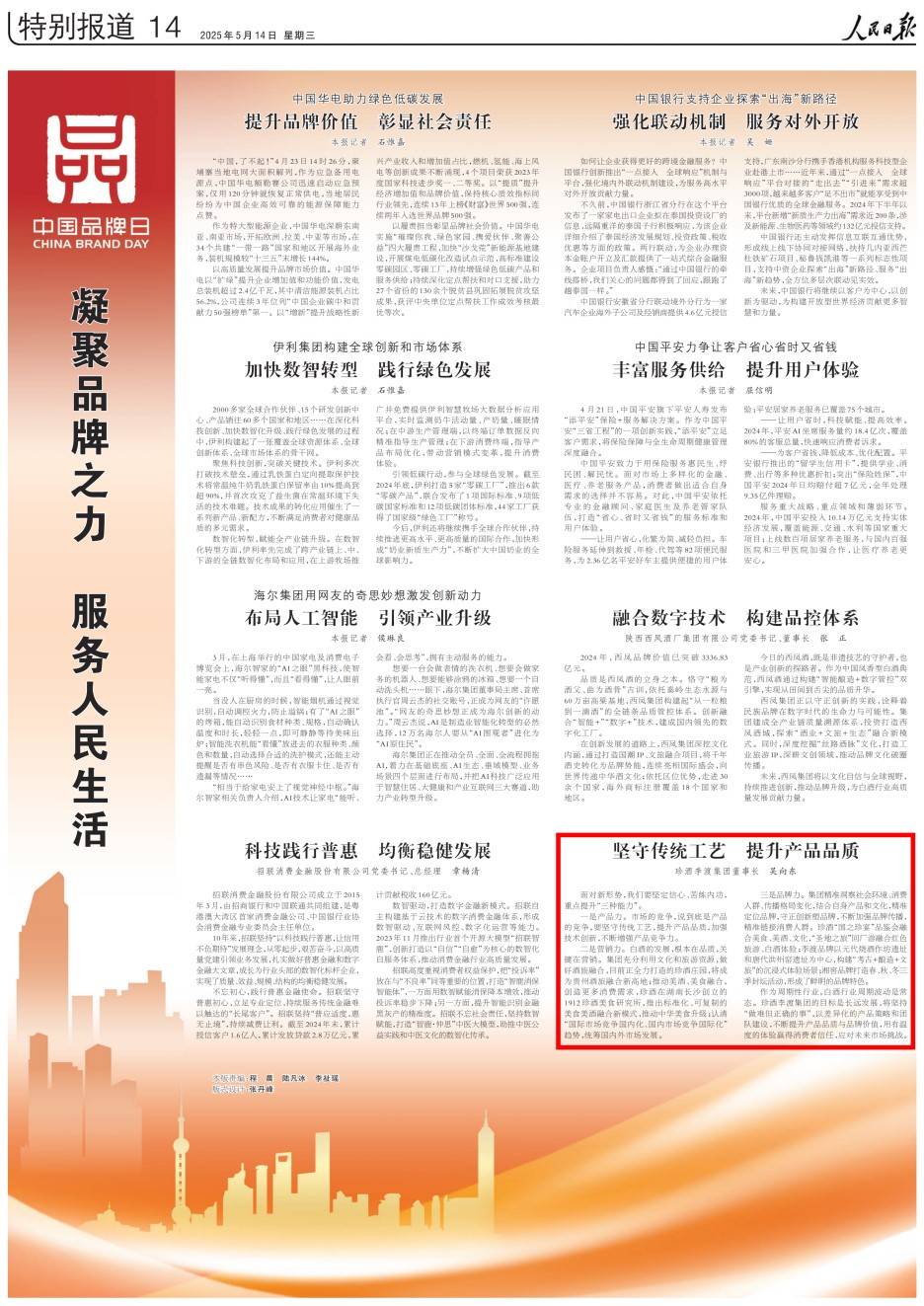
《人民日报》刊发珍酒李渡集团董事长吴向东署名文章
Sou Hu Cai Jing· 2025-05-14 11:54
Group 1 - The core viewpoint of the article emphasizes the importance of adhering to traditional craftsmanship and enhancing product quality in the liquor industry, which is characterized by cyclical fluctuations [1][14] - The company aims for long-term development by focusing on differentiated product strategies and team building to continuously improve product quality and brand value [14] - The article highlights the significance of cultural and tourism resources in marketing, with initiatives like the establishment of the 1912 Zhenjiu Culinary Research Institute to create standardized and replicable food and liquor fusion models [13][14] Group 2 - The liquor industry is described as a cyclical sector where market fluctuations are normal, and the company is committed to "doing difficult but correct things" to win consumer trust through warm experiences [14] - The company is actively developing a wine tourism integration model, positioning itself as a new highland for wine tourism in Guizhou [13] - The brand strategy includes precise insights into social environments, consumer demographics, and communication patterns to enhance brand awareness and connect with target consumers [13]
珍酒李渡“酒二代”吴其融接棒执行董事 数字化转型能否破局增长瓶颈?
Xi Niu Cai Jing· 2025-05-14 05:37
Core Viewpoint - The appointment of 28-year-old Wu Qirong as the youngest executive director of Zhenjiu Lidu (06979.HK) signals both family succession and strategic transformation within the company [2][3]. Company Overview - Wu Qirong, son of Chairman Wu Xiangdong, has a background in digital marketing and has been involved in various roles within the company since graduating from the University of Birmingham in 2019 [2]. - The company has faced significant challenges, with 2024 revenue reported at 7.067 billion yuan, showing nearly zero growth, and net profit plummeting by 43.1% to 1.324 billion yuan [2][3]. Market Challenges - Zhenjiu Lidu's core products are experiencing severe price declines, with the high-end "Zhen 30" retail price dropping over 60% from the suggested price, and the mid-range "Zhen 15" only achieving 40% of its suggested price [3]. - The company is struggling to compete with high-end brands like Moutai and Wuliangye while facing inventory buildup and shrinking channel profits [3]. Strategic Initiatives - Wu Qirong's leadership is seen as a potential turning point, leveraging his dual background in computer science and business management to align with the industry's trend towards digitalization and youth engagement [3]. - The company needs to activate the differentiated advantages of its sub-brands and innovate in brand image and product offerings to meet new consumer demands [3]. Governance and Management Issues - The governance dynamics between family-owned enterprises and professional managers, along with the contrast between high executive salaries and declining performance, will test Wu Qirong's management acumen [4].