
NIO(09866)

Search documents
港股汽车股走低,蔚来跌超6%
Di Yi Cai Jing Zi Xun· 2026-01-05 07:48
Group 1 - The core viewpoint of the articles indicates a significant decline in Hong Kong automotive stocks, particularly among electric vehicle manufacturers, due to a decrease in consumer traffic during the 2026 New Year holiday compared to 2025 [1][2] - NIO, Great Wall Motors, and XPeng Motors saw stock declines of over 6%, nearly 6%, and over 5% respectively, marking new lows since their listings in September 2025 [1] - The decline in consumer traffic is attributed to increased purchasing costs from changes in the new energy vehicle purchase tax policy, leading to a cautious consumer sentiment [1][2] Group 2 - In 2026, the new energy vehicle industry faces two major policy changes: the reduction of the vehicle purchase tax exemption from full exemption to a 5% tax rate, and a shift in subsidy policies from fixed amounts to percentage-based subsidies [2] - Although many automakers have implemented "safety net" measures, these do not fully offset the increased costs from the purchase tax [2] - For example, a consumer purchasing a NIO model priced at 119,800 yuan will incur nearly 6,000 yuan in purchase tax in 2026, while NIO only offers a 2,000 yuan subsidy, resulting in a higher overall cost compared to 2025 [2]

港股异动丨汽车集体走低,长城汽车跌近7%,“蔚小理”齐跌
Ge Long Hui· 2026-01-05 02:39
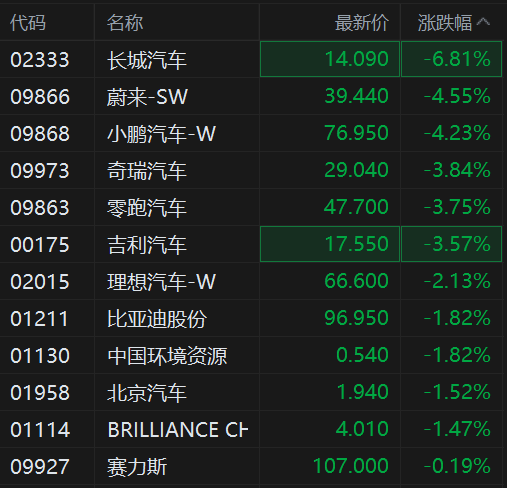
Group 1 - The Hong Kong automotive stocks collectively declined, with Great Wall Motors falling nearly 7%, NIO and Xpeng down over 4.2%, and other companies like Chery, Leap Motor, and Geely dropping close to 4% [1] - A report from CICC indicates that by 2026, the domestic automotive industry in China will face certain challenges in internal demand, while overseas sales are expected to grow steadily. The investment strategy favors auto parts over complete vehicles, focusing on opportunities in AI-related sectors such as robotics, intelligent driving, and data center liquid cooling [1] - A separate report forecasts that global electric vehicle sales growth will reach its lowest level since the pandemic began in 2020, with an expected increase of only 13% to 24 million units by 2026, significantly lower than the 22% growth anticipated for 2025 due to a slowdown in the European market and a rapid decline in the U.S. market [1] Group 2 - The latest stock prices and changes for major automotive companies are as follows: Great Wall Motors at 14.090 (-6.81%), NIO at 39.440 (-4.55%), Xpeng at 76.950 (-4.23%), Chery at 29.040 (-3.84%), Leap Motor at 47.700 (-3.75%), Geely at 17.550 (-3.57%), Li Auto at 66.600 (-2.13%), BYD at 96.950 (-1.82%), and others showing minor declines [2]


车企2025年产销量放榜 突破多个“里程碑”
Zheng Quan Shi Bao Wang· 2026-01-04 14:38
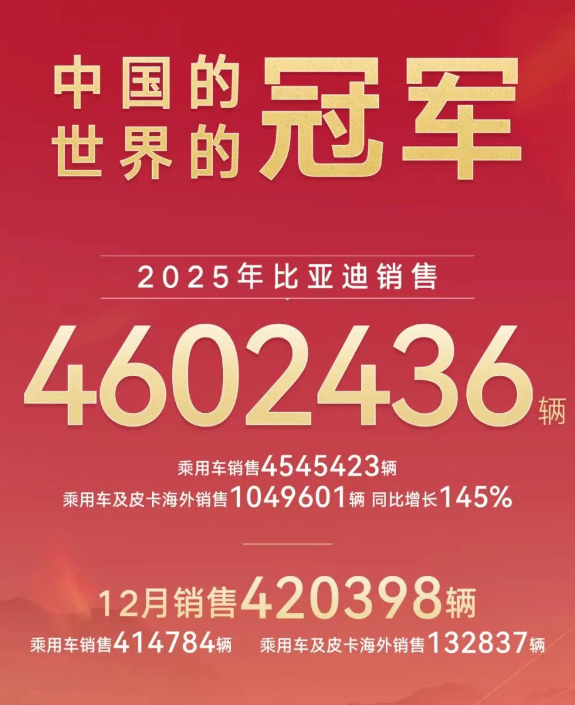
Core Insights - Major automotive companies in China, including BYD, Changan Automobile, and Geely, reported significant sales growth for 2025, with a notable increase in overseas sales and milestones achieved by new energy vehicle manufacturers [1][2][5][7]. BYD - BYD's total sales for 2025 reached 4.6024 million units, a year-on-year increase of 7.73%, with pure electric vehicle sales growing nearly 28% and commercial vehicle sales increasing by approximately 162% [2]. - BYD's overseas exports of new energy vehicles totaled 133,200 units in December 2025, with annual overseas sales surpassing 1 million units, reflecting a 145% year-on-year growth [4]. - The total installed capacity of BYD's power batteries and energy storage batteries was approximately 285.634 GWh, marking a nearly 47% increase from the previous year [4]. Changan Automobile - Changan's total sales for 2025 reached 2.913 million units, a year-on-year growth of 8.54%, with self-owned brand sales increasing by 10.86% and new energy vehicle sales growing by about 50% [5]. BAIC Blue Valley - BAIC Blue Valley achieved significant production and sales growth, with total production reaching 206,300 units, a year-on-year increase of 127.17%, and total sales of 209,600 units, up 84.06% [6]. Geely Automobile - Geely's total vehicle sales for 2025 were 3.0246 million units, a 39% increase compared to the previous year, exceeding its annual sales target [7]. - Geely set a sales target of 3.45 million units for 2026, representing a growth of approximately 14% from 2025, with a new energy vehicle sales target of 2.22 million units, up 32% [7]. NIO - NIO reported a delivery of 48,100 units in December 2025, a year-on-year increase of 54.6%, with total deliveries for the year reaching 326,000 units, up 46.9% [8]. Li Auto - Li Auto delivered 44,200 new vehicles in December 2025, with a historical cumulative delivery surpassing 1.5 million units, expanding its market presence in Central Asia and Africa [9]. XPeng - XPeng delivered 37,500 smart electric vehicles in December 2025, with total annual deliveries of 429,400 units, reflecting a year-on-year growth of 126% [10]. - The company expanded its overseas market presence with 45,000 units delivered abroad, a 96% increase, and established 1,100 new charging stations, bringing the total to 3,000 [10].




车企2025“年终考”成绩单出炉
Mei Ri Jing Ji Xin Wen· 2026-01-04 14:21
Core Insights - The 2025 Chinese automotive market showcased a "stronger getting stronger, increasing differentiation" trend amid deepening new energy transitions and intense industry competition [1] Group 1: Performance of Leading Companies - BYD achieved sales of 4.6024 million vehicles in 2025, with overseas sales surpassing 1 million for the first time, marking a 145% year-on-year increase in passenger and pickup truck sales [2] - BYD's pure electric vehicle sales reached 2.2567 million units, a nearly 28% increase, surpassing Tesla's 1.636 million units, making BYD the global leader in annual electric vehicle sales [2] - Geely also exceeded its annual sales target, achieving 3.0246 million units sold, a 39% year-on-year increase, with new energy vehicle sales reaching 1.6878 million units, up 90% [2] Group 2: Performance of Other Companies - Dongfeng Motor achieved its dual target of over 1 million new energy vehicles and 1.5 million total vehicle sales, with new energy vehicle sales reaching 1.04 million, a 21% increase [3] - Changan Automobile reported sales of 2.913 million vehicles, a growth of 8.5%, with new energy vehicle sales of 1.109 million, up 51% [5] - Chery Group sold 2.8064 million vehicles, a 7.8% increase, with new energy vehicle sales reaching 903,800 units, a 54.9% increase [5] Group 3: Underperformance of Certain Companies - China FAW achieved a total vehicle sales of 3.302 million, a 3.2% increase, but fell short of its target of 3.45 million [4] - Great Wall Motors reported sales of 1.3237 million vehicles, a 7.33% increase, but only achieved 33.09% of its 4 million target [5][6] - New energy vehicle sales for Great Wall reached 403,700 units, a 25.44% increase, but the overall performance was below expectations [5][6] Group 4: New Forces in the Market - Among new forces, Leap Motor, Xiaomi, and Xpeng all exceeded their annual sales targets, with Leap Motor achieving 596,600 units sold, marking a 119.3% target completion rate [7] - Xiaomi's vehicle deliveries surpassed 50,000 in December 2025, exceeding its annual target of 350,000 [7] - NIO and Li Auto, however, did not meet their targets, with NIO selling 326,000 units and Li Auto selling 406,300 units, both falling short of their respective goals [8][9]

12月国内销量跟踪
数说新能源· 2026-01-04 03:59
Sales Performance - BYD sold 420,398 vehicles, a year-on-year decrease of 18.3% and a month-on-month decrease of 11.5% [1] - NIO delivered 48,135 vehicles, a year-on-year increase of 54.6% and a month-on-month increase of 32.7% [1] - Li Auto delivered 44,246 vehicles, a year-on-year decrease of 24.4% but a month-on-month increase of 33.3% [1] - Xpeng delivered 37,508 vehicles, a year-on-year increase of 2.2% and a month-on-month increase of 2.1% [1] - Leap Motor delivered 60,423 vehicles, a year-on-year increase of 42.1% but a month-on-month decrease of 14.1% [1] - Lantu delivered 15,954 vehicles, a year-on-year increase of 31.5% but a month-on-month decrease of 20.2% [1] - Seres sold 57,000 vehicles, a year-on-year increase of 88.7% and a month-on-month increase of 4.9% [1] - Avita delivered 10,470 vehicles, a year-on-year decrease of 5.4% and a month-on-month decrease of 25.5% [1] - Geely sold 154,264 vehicles, a year-on-year increase of 38.7% but a month-on-month decrease of 17.9% [1] - SAIC-GM sold 11,307 vehicles, a year-on-year increase of 89.9% and a month-on-month increase of 6% [1] - Wuling sold 122,838 vehicles, a year-on-year increase of 31.2% and a month-on-month increase of 11.2% [1] - It is expected that 1.92 million electric vehicles (including commercial vehicles) will be sold in December in China, a year-on-year increase of 20.3% and a month-on-month increase of 5.32% [1] Industry Trends - The procurement of battery cells by manufacturers is focusing on balancing performance and cost [5] - BYD is expanding its presence in Southeast Asia [5] - CATL indicates that the growth in the energy storage market is outpacing that of the power market [9]


晚点独家丨李斌定调2026:继续“结硬寨,打呆仗”,没有片刻放松的资格
Xin Lang Cai Jing· 2026-01-04 01:29
Core Insights - The company achieved a record high delivery of over 326,000 new vehicles in 2025, despite not meeting the target of over 50,000 monthly deliveries in Q4 [2][15][16] - The CEO expressed optimism about the future, predicting that by 2030, the penetration rate of new energy vehicles in China will exceed 90%, with pure electric vehicles accounting for over 80% of that market [2][7][20] Company Performance - In 2025, the company delivered 67,433 vehicles in Q4, a year-on-year increase of 27.8%, with the new brand "firefly" achieving a 92.1% increase in deliveries [15][16] - The company has built 3,737 battery swap stations globally, providing over 96 million swap services, which enhances user convenience and supports vehicle sales [6][17] Strategic Focus - The CEO emphasized the need for strategic focus and operational efficiency in a highly competitive automotive market, where small efficiency differences can determine survival [4][14] - The company plans to continue investing in its 12 core technologies for smart electric vehicles and aims to launch three new models in 2026 to strengthen its market position [21] Market Trends - As of the first 11 months of 2025, pure electric vehicles accounted for 61.9% of the new energy vehicle market, significantly outpacing hybrid and plug-in models [7][20] - The company believes that the "golden age" of pure electric vehicles is approaching, driven by technological advancements and improved infrastructure [2][20]

2025年杀青汽车渠道瘦身进行时
Xin Lang Cai Jing· 2026-01-04 01:19
Core Viewpoint - In 2025, the Chinese automotive industry is at a historic turning point, with the penetration rate of new energy vehicles exceeding 50%, marking a shift towards a high-quality development phase characterized by a balance between traditional and electric vehicles [2][16]. Group 1: Industry Transformation - The automotive channel system is undergoing unprecedented restructuring, shifting from scale expansion to integration optimization, model innovation, and deepening market penetration [2][16]. - The era of merely pursuing the number of outlets has ended, with a focus on quality improvement and efficiency optimization becoming the core issues [2][3]. - The automotive channel transformation is clearly presenting three major trends: lightweight, hybrid, and downward expansion, aimed at addressing high costs and low efficiency in the industry [2][3][11]. Group 2: Lightweight Trend - The traditional heavy asset 4S stores are facing high rent and inventory pressures, prompting automakers to explore lightweight outlet models [4][19]. - Lincoln China's "Spark Plan" serves as a benchmark for lightweight transformation, significantly reducing single-store investment from 20-30 million yuan to 4 million yuan, leading to a 40% decrease in dealer operating costs [4][18]. - The optimization of profit structure in lightweight stores allows after-sales profits to fully cover operating costs, enhancing profitability [4][18]. Group 3: Hybrid Trend - The trend of channel hybridization, which began in 2024, continues to deepen in 2025, with brands exploring flexible combinations of direct sales, agency, and authorization models [7][21]. - NIO is cautiously adopting a hybrid approach, allowing local agents to manage market operations while maintaining brand control [7][21]. - BYD's Tengshi and Fangchengbao brands are implementing a dual-track system of direct sales and authorization to enhance channel efficiency [8][22]. Group 4: Downward Expansion Trend - The trend of channel downward expansion is accelerating, with significant sales growth in lower-tier cities, reflecting a clear shift in the automotive consumption market [11][25]. - Leap Motor's strategy of lowering the price of main models to the 150,000 yuan range has led to a 113.42% year-on-year increase in deliveries, with over 60% of sales coming from lower-tier markets [11][25]. - Third-party involvement, such as JD Auto's collaboration with GAC and CATL, is creating new models for the lower-tier market, significantly reducing the purchase threshold [12][26]. Group 5: Efficiency Revolution - The core of channel transformation is an efficiency revolution, focusing on serving more users at lower costs [12][26]. - The automotive channel is undergoing structural reshaping through lightweight, hybrid, and downward expansion trends, but the evolution of channels is far from over [12][26].


智驾的2025:辞旧迎新的一年
自动驾驶之心· 2026-01-04 01:04
Core Viewpoint - The article discusses the evolution of the autonomous driving industry in 2025, highlighting the dual focus on technology proliferation and technical challenges, with traditional automakers pushing for accessibility and new players striving for technological advancements [4][5]. Group 1: Industry Trends - In 2025, traditional automakers like BYD, Geely, and Chery are leading the charge in making autonomous driving technology more accessible by integrating mid-level highway NOA features into vehicles priced over 100,000 yuan [4]. - New entrants and leading autonomous driving suppliers are focused on pushing the limits of technology, adhering to a model of annual technological iteration [4][5]. - The industry is witnessing a bifurcation, with one camp focused on accessibility and the other on technological challenges, particularly in the realm of algorithm development [4]. Group 2: Technological Advancements - The transition from "passive perception" to "active cognition" is marked by the introduction of world models, which represent a significant paradigm shift in autonomous driving technology [5][6]. - 2025 is characterized as a year of significant technological transition, with the widespread adoption of end-to-end systems and the emergence of world models and VLA (Vision-Language-Action) technologies [6][9]. - NIO is highlighted as a pioneer in the world model space, having launched its world model in 2024, transitioning from "perception-driven" to "cognition-driven" systems [5][6]. Group 3: Data Infrastructure and Chip Development - The importance of data infrastructure is emphasized, with companies like NIO benefiting from early investments in data collection and model training capabilities [7][8]. - The year 2025 is noted as a pivotal year for integrated hardware and software solutions, with companies like NIO and XPeng achieving self-developed chip integration [7][8]. - The article warns of the risks associated with outsourced chip development, contrasting it with NIO's genuine self-development efforts, which involve significant technical team investments [8]. Group 4: Regulatory and Market Dynamics - The issuance of L3 licenses is seen as a significant step towards the next phase of autonomous driving, indicating a shift from L2+ mass production to L3 and L4 capabilities [8][9]. - While traditional automakers have secured initial L3 licenses, their capabilities are questioned, suggesting that true advancements will come from new players and those with strong model capabilities [9][10]. - The ultimate value of autonomous driving technology is framed around enhancing driver convenience and significantly reducing traffic accidents, with a focus on safety as a primary goal [9].

8点1氪丨小米辟谣“17 Ultra徕卡版变焦环造假”;最高降30万,宝马中国回应30多款车型降价;Netflix收购华纳后拟将上映期缩至17天
3 6 Ke· 2026-01-04 00:02
Group 1 - Trump announced the capture of Venezuelan President Maduro by U.S. military forces, stating that the U.S. will "manage" Venezuela until a "safe" transition is implemented [2] - The military operation involved over 150 aircraft and lasted approximately 2 hours and 20 minutes, with no U.S. casualties or equipment losses reported [2] - Maduro and his wife are to be sent to New York for judicial proceedings, facing charges related to "deadly drug terrorism" against the U.S. [2] Group 2 - BMW China announced a price adjustment for 31 key models starting January 1, 2026, with 24 models seeing price cuts exceeding 10% and some up to 30.1 million yuan [3][4] - The price adjustment aims to reflect changes in the official guidance price, with the lowest model now priced at 20.8 million yuan, making it competitive with domestic SUVs [3][4] Group 3 - NIO's CEO Li Bin announced in a company-wide letter that three new models will be launched in 2026, aiming to increase market share in the high-end vehicle segment [6] - NIO reported a record delivery of 48,135 vehicles in December 2025, marking a 46.9% year-on-year increase [6] Group 4 - The wholesale reference price for 25-year-old Flying Moutai has dropped to 1,495 yuan per bottle, reflecting a decrease of 15 yuan from the previous day [7] - The price for a full box of the same product is now reported at 1,505 yuan per bottle, down 20 yuan [7] Group 5 - Tesla reported a global delivery of 1.636 million vehicles in 2025, a decline of approximately 8.6%, marking the first time it has been surpassed in annual electric vehicle sales by BYD [8] Group 6 - Netflix plans to shorten the theatrical release window for Warner Bros. films to 17 days post-acquisition, raising concerns among traditional cinemas and Hollywood creators [11] - The current standard release window is around 45 days, and negotiations are expected to be contentious [11] Group 7 - Baidu announced plans to spin off Kunlun Chip and seek independent listing on the Hong Kong Stock Exchange, with the application already submitted [12]



比亚迪首夺全球纯电车年度销冠;2025年全国汽车以旧换新超1150万辆 | 汽车早参
Mei Ri Jing Ji Xin Wen· 2026-01-03 22:42
Group 1 - BYD has become the world's top seller of pure electric vehicles for the first time, surpassing Tesla's annual electric vehicle sales, which declined by approximately 8.6% to 1.636 million units in 2025 [1] - BYD's total new car sales exceeded 4.6 million units in 2025, marking a year-on-year growth of about 8%, with pure electric vehicle sales reaching over 2.25 million units, a 28% increase [1] - This shift in the electric vehicle market indicates a significant change in competitive dynamics, highlighting BYD's advantages in technological innovation and market expansion, and signaling the rise of China's new energy vehicle industry [1] Group 2 - In 2025, over 11.5 million vehicles were replaced through the trade-in program in China, with nearly 60% being new energy vehicles, contributing to a retail market share of over 50% for new energy passenger cars for nine consecutive months [2] - The recycling of scrapped vehicles is expected to grow by 24.5%, resulting in the recycling of approximately 9.6 million tons of steel and 1.3 million tons of non-ferrous metals, while reducing carbon emissions by about 24.5 million tons [2] - The trade-in program is driving market demand growth in the automotive sector, enhancing the overall vitality of the industry and reinforcing the market dominance of new energy passenger vehicles [2] Group 3 - From December 1 to 28, 2025, retail sales of passenger vehicles in China fell by 17% year-on-year, totaling approximately 1.928 million units, while wholesale sales dropped by 19% to 2.134 million units [3] - The significant decline in both retail and wholesale sales reflects weak market demand, which may negatively impact profitability expectations for the automotive manufacturing industry [3] - The overall market sentiment may become more cautious in light of consumer fatigue, potentially affecting stock market performance [3] Group 4 - NIO is set to celebrate the production of its one millionth vehicle on January 6, 2026, with cumulative deliveries reaching 997,592 units by the end of December 2025 [4] - The completion of the battery swap route from Kunming, Yunnan, to Tibet, spanning over 2,700 kilometers and featuring 19 battery swap stations, demonstrates NIO's expansion in battery swap service networks [4] - This milestone and service expansion may enhance investor sentiment towards the electric vehicle sector and strengthen NIO's market position [4]