
YTCO(600066)

Search documents
中国工业 - 走向全球:“中国 + 1” 投资计划追踪(2025 年第三季度)-China Industrials-Going global 'China+1' investment plan tracker (Q325)
2025-10-20 01:19
Summary of Key Points from the Conference Call Industry Overview - **Industry**: Chinese Corporates' Global Investment Strategy - **Focus**: 'China+1' investment plan tracker, particularly in ASEAN and Latin America (LatAm) regions Core Insights 1. **ASEAN Investment Plans**: - The number of investment plans in ASEAN increased by **32% YoY** in Q325, driven by sectors such as consumer, materials, and machinery [3] - Despite the increase in the number of plans, the investment value decreased by **8% YoY** due to fewer large investments compared to the previous year [3] - Thailand and Vietnam emerged as the primary destinations, with Thailand capturing **52%** of the total investment value [3] 2. **LatAm Investment Plans**: - Investment plans in LatAm diversified, with the number of plans rising from **three in Q324 to four in Q325** [4] - Notably, there was a **525% YoY increase** in total investment value in LatAm during Q325, marking a significant growth in investment activity [4] - The sectors involved included consumer goods, machinery, materials, and auto parts, with investments in consumer goods being a first for the region [4] 3. **China's Export Performance**: - In August 2025, exports of aluminium ore, hydrogen, and beef saw the highest YoY growth rates of **21,975%**, **304%**, and **174%**, respectively [5] - Key sectors contributing to incremental exports included semiconductors (+28% YoY), low-value simplified exports/imports (+20% YoY), and passenger vehicles (+19% YoY) [5] - Africa and ASEAN regions exhibited the highest growth in exports during this period [5] 4. **Investment Focus and Trends**: - The report indicates a continued expectation for the 'going global' strategy to be a major investment theme for China over the next **five to ten years** [2] - The focus on materials, electronic components, and consumer sectors reflects a strategic shift in investment priorities [3][4] Additional Important Insights - **Investment Value Trends**: - The overall investment amounts in ASEAN decreased by **8% YoY** in Q325, despite the increase in the number of plans [39] - Thailand's investment amounts saw a significant increase, particularly in electronic components and materials [41][43] - **Geographical Investment Distribution**: - Thailand and Vietnam attracted the most investment interest, with Thailand's investment amounts significantly up in Q325 [41][43] - **Future Outlook**: - The report emphasizes the potential for continued growth in overseas investments by Chinese corporates, particularly in emerging markets [2][4] This summary encapsulates the key points from the conference call, highlighting the trends and insights related to China's global investment strategy and export performance.


前三季度我国客车出口强劲增长
Zheng Quan Ri Bao· 2025-10-17 15:26
Core Insights - The export scale of China's bus products has been continuously growing this year, with September exports reaching 7,228 units, a year-on-year increase of 37.36%, and cumulative exports for the first nine months totaling 55,598 units, up 31.77% [1][2] Group 1: Industry Growth and Trends - The growth in bus exports signifies a shift from "price competition" to "value competition" in the Chinese bus industry, driven by policy support, technological breakthroughs, and a deep understanding of the global market [1][2] - The demand for buses in various segments such as public transport, tourism, and passenger transport has been steadily increasing, particularly in Europe and the Americas, which is accelerating the electrification process and boosting export volumes [2][3] - The export of new energy buses has become a significant growth point, with cumulative exports reaching 12,588 units in the first nine months, reflecting a year-on-year increase of 35.04% [2] Group 2: Company Performance - Yutong Bus has maintained its position as the industry leader with exports of 10,742 units in the first three quarters, marking an 18.17% increase and being the only company to exceed 10,000 units in exports [4] - Yutong Bus has leveraged its technological and industrial chain advantages to establish localized cooperation in over ten countries through KD assembly, transitioning from "product output" to "technology output and brand authorization" [4] Group 3: Future Outlook - The Chinese bus industry is expected to achieve a 40% share of the global market by 2030, becoming a core driver of the global green transportation revolution, supported by the establishment of KD factories in Southeast Asia and the implementation of carbon tariff response plans in Europe [4] - The overseas market is projected to generate a significant incremental market worth hundreds of billions, with a compound annual growth rate of 19% driven by accelerated penetration of new energy buses [4]
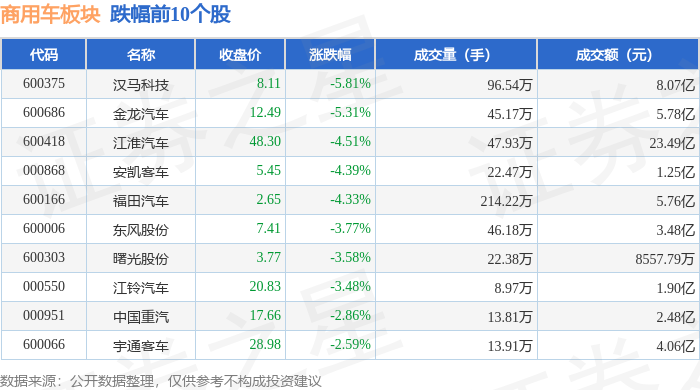
商用车板块10月17日跌3.52%,汉马科技领跌,主力资金净流出8.7亿元
Zheng Xing Xing Ye Ri Bao· 2025-10-17 08:31
Market Overview - The commercial vehicle sector experienced a decline of 3.52% on October 17, with Hanma Technology leading the drop [1] - The Shanghai Composite Index closed at 3839.76, down 1.95%, while the Shenzhen Component Index closed at 12688.94, down 3.04% [1] Individual Stock Performance - Hanma Technology (600375) closed at 8.11, down 5.81% with a trading volume of 965,400 shares and a turnover of 807 million yuan [1] - King Long Motor (600686) closed at 12.49, down 5.31% with a trading volume of 451,700 shares and a turnover of 578 million yuan [1] - JAC Motors (600418) closed at 48.30, down 4.51% with a trading volume of 479,300 shares and a turnover of 2.349 billion yuan [1] - Ankai Bus (000868) closed at 5.45, down 4.39% with a trading volume of 224,700 shares and a turnover of 12.5 million yuan [1] - Foton Motor (600166) closed at 2.65, down 4.33% with a trading volume of 2.1422 million shares and a turnover of 576 million yuan [1] Capital Flow Analysis - The commercial vehicle sector saw a net outflow of 870 million yuan from institutional investors, while retail investors contributed a net inflow of 697 million yuan [1] - The following stocks had notable capital flows: - JMC (000550) had a net inflow of 2.8502 million yuan from institutional investors but a net outflow of 3.2894 million yuan from retail investors [2] - Yutong Bus (600066) experienced a net outflow of 9.3627 million yuan from institutional investors but a net inflow of 29.0770 million yuan from retail investors [2] - Ankai Bus (000868) had a significant net outflow of 22.1866 million yuan from institutional investors, while retail investors contributed a net inflow of 25.24 million yuan [2]




宇通中标超1.6亿元公交车大单!
第一商用车网· 2025-10-17 07:00
Core Points - The core viewpoint of the article highlights the successful bid of Yutong Bus Co., Ltd. for the procurement of operational buses in Chongqing, with a bid amount of 161.2032 million yuan [1][3]. Group 1: Project Details - The project is titled "2025 Operational Bus Procurement (Second Batch) Segment Three" [3]. - The winning candidate for the bid is Yutong Bus Co., Ltd., with a bid amount of 161.2032 million yuan [1][3]. - Other candidates included Beiqi Foton Motor Co., Ltd. and Chongqing Hengtong Bus Co., Ltd., ranking second and third respectively [3]. Group 2: Industry Context - In September, the sales of tractors reached 56,000 units, marking a significant increase of 95%, with major players like Heavy Truck and Jiefang each selling over 10,000 units [7]. - The sales of new energy heavy trucks in September hit a record high of 24,000 units, with competition among Jiefang, Xugong, and Sany intensifying [7].
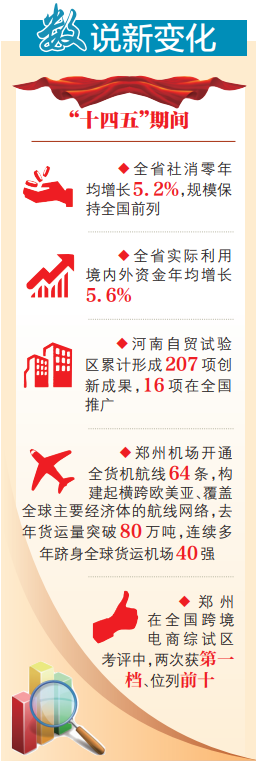
开放的河南豫加出彩
Zheng Zhou Ri Bao· 2025-10-17 00:59
Core Insights - The report highlights the achievements of Henan Province in promoting high-quality business development during the "14th Five-Year Plan" period, focusing on expanding consumption, stabilizing foreign trade and investment, and enhancing overall openness [2] Consumption Growth - Henan Province has implemented multiple measures to expand the consumption market, achieving an average annual growth of 5.2% in total retail sales of consumer goods over the past four years, maintaining a leading position nationally [3] - The government has introduced various policies to boost consumption, including special action plans and subsidies for key products, resulting in over 40 billion yuan in consumer vouchers that stimulated consumption by more than 500 billion yuan [4] - New consumption trends have emerged, such as "IP + consumption," digital consumption, and live e-commerce, with online participation in the 2025 Henan online New Year goods festival exceeding 200 million [4] Foreign Trade Enhancement - Henan Province has focused on expanding and improving the quality of foreign trade, maintaining a trade volume exceeding 800 billion yuan over the past four years, ranking among the top ten in the country [5] - The proportion of general trade has increased from 32.9% in 2020 to 40.4% in 2024, with exports of mobile phones exceeding 200 billion yuan annually and a significant growth in automobile exports [5] - The number of import and export enterprises has increased by 3,600 since 2020, with private enterprises' share of total exports rising from 31.2% to 70.5% by 2024 [5] Investment Expansion - The province has combined high-quality "inward" and high-level "outward" investment strategies, achieving an average annual growth of 5.6% in actual utilization of domestic and foreign funds over the past four years [6] - Key projects have been attracted, such as the Singapore Yihai Kerry investment of nearly 7 billion yuan and the establishment of a new energy vehicle production base by BYD [6] - Over 300 Henan enterprises have invested in more than 50 countries, with total investments reaching 47 billion yuan, enhancing international competitiveness [6] Open Economy Development - Henan has deepened its free trade zone strategy, expanding institutional openness and enhancing trade connectivity through various initiatives [7] - The province has achieved 207 innovative results in its free trade zone, with 16 being promoted nationwide, and has established a leading air transport safety control model for cross-border e-commerce [7] - The Zhengzhou Airport has opened 64 all-cargo routes, significantly increasing its cargo volume and establishing itself as a key trade corridor connecting Europe and ASEAN [8]

从“产品出海”到“智造出海” 宇通客车全球化布局再进阶
Shang Hai Zheng Quan Bao· 2025-10-16 18:52
Core Viewpoint - Yutong Bus has established itself as a global leader in the bus industry, showcasing its strengths in vehicle performance, safety, and environmental protection, as evidenced by winning seven awards at the Bus World Expo in Belgium [2]. Group 1: Product Performance and Safety - Yutong Bus conducts rigorous testing for each vehicle, including high-speed stability tests and water resistance tests, ensuring vehicles can withstand extreme conditions [3]. - The company has invested nearly 100 million yuan to build an EMC testing laboratory, creating an "electromagnetic immunity system" to enhance vehicle performance and passenger safety [4]. - Yutong's core technologies in new energy, including battery, motor, and control systems, have reached industry-leading levels, with the YEA intelligent control platform being the first of its kind in the commercial vehicle sector [4]. Group 2: Global Market Expansion - As of mid-October, Yutong has exported over 110,000 buses to more than 60 countries and regions, demonstrating its global footprint [5]. - The company has secured significant contracts, including 165 customized buses for Saudi Arabia and 723 high-end buses for the Africa Cup, setting records for Chinese brands in these markets [6]. - Yutong's overseas strategy has evolved beyond merely selling products; it has established KD assembly plants in over ten countries and is set to open its first overseas new energy commercial vehicle factory in Qatar by the end of the year [6]. Group 3: Shareholder Returns - Yutong Bus announced a cash dividend of 1.107 billion yuan in August, with a payout ratio of 57.19% of its net profit for the first half of 2025 [7]. - Over its 28 years as a listed company, Yutong has distributed a total of 27.13 billion yuan in dividends, significantly exceeding its total capital market financing of 2.91 billion yuan [7]. - The company emphasizes shareholder returns and aims to maintain stable cash dividends as long as there are no significant capital expenditures affecting normal operations [7].
郑州资本市场并购重组大会举行 解码并购重组赋能产业升级新路径
Zheng Quan Ri Bao Wang· 2025-10-16 12:51
Group 1 - The event in Zhengzhou focused on stimulating mergers and acquisitions (M&A) to promote high-quality industrial development, with participation from experts, financial institutions, and industry leaders [1] - Zhengzhou has a robust financial ecosystem with 421 financial institutions, over 60 listed companies, a fund scale exceeding 90 billion, and a bond market exceeding 400 billion [1] - Key industries in Zhengzhou include equipment manufacturing, biomedicine, modern food, and digital economy, with leading companies like Yutong Bus, China Railway Equipment, and Hanwei Technology [1] Group 2 - The implementation of the "Six M&A Guidelines" has led to significant activity in the M&A market, with 10 listed companies initiating 12 M&A transactions, of which 5 have been completed, resulting in substantial revenue and profit growth [2] - The Shenzhen Stock Exchange has seen increased activity in the restructuring market, particularly among private listed companies, with a trend towards industry consolidation and a focus on new productive forces [2] - Experts predict that M&A will surpass IPOs as the main avenue for capital market activity, driven by new regulations and the current pressures on the IPO market [2] Group 3 - M&A carries significant opportunities but also risks, with a noted 70% failure rate in M&A cases, primarily due to integration issues and cultural mismatches [3] - Strategic alignment, cultural compatibility, and valuation premiums are critical considerations in successful M&A transactions [3] - The event included presentations from seven quality projects in strategic emerging fields such as biotechnology, semiconductors, new materials, and intelligent manufacturing [3]


智造先行,郑州品牌闪耀世界舞台
Zheng Zhou Ri Bao· 2025-10-16 02:45
Core Insights - Zhengzhou is at a pivotal point between the "14th Five-Year Plan" and the upcoming "15th Five-Year Plan," showcasing significant advancements in various industries over the past five years [1] - The city aims to build a modern industrial system supported by advanced manufacturing, with over 100 billion-level enterprises and several trillion-level industrial clusters by 2025 [4] Industry Developments - The emergence of new industries in Zhengzhou includes sectors such as energy conservation, new generation information technology, biomedicine, high-end equipment manufacturing, new materials, and smart connected vehicles [1] - Zhengzhou has cultivated seven trillion-level industrial clusters, including electronic information and automotive manufacturing, contributing to a stable industrial output value ranking among the top in the country [4][10] Technological Advancements - Yutong Bus has achieved global recognition, winning multiple awards at the World Bus Expo, supported by its core technology and innovations like the "vehicle-battery co-life" technology [5] - The automation rate in BYD's Zhengzhou base has reached over 97%, reflecting the efficiency of smart manufacturing in the production of electric vehicles [6] Manufacturing Excellence - China Railway Engineering Equipment Group has developed world-leading technology for shield machines, exporting to over 30 countries, and emphasizes the importance of digitalization in manufacturing [7] - Zhengzhou's industrial scale has shown consistent growth, with an average annual increase of 9.55% in industrial added value from 2021 to 2024 [10] Future Outlook - Zhengzhou is strategically planning for future industries, focusing on six major directions and laying out 15 new tracks, with the future industry scale exceeding 150 billion [12] - The city aims to drive digital empowerment and transformation towards high-end, intelligent, and green manufacturing, aligning with national strategies and technological advancements [12]
小红日报|标普红利ETF(562060)标的指数收涨0.92%,水星家纺大涨9.41%
Xin Lang Ji Jin· 2025-10-16 02:06
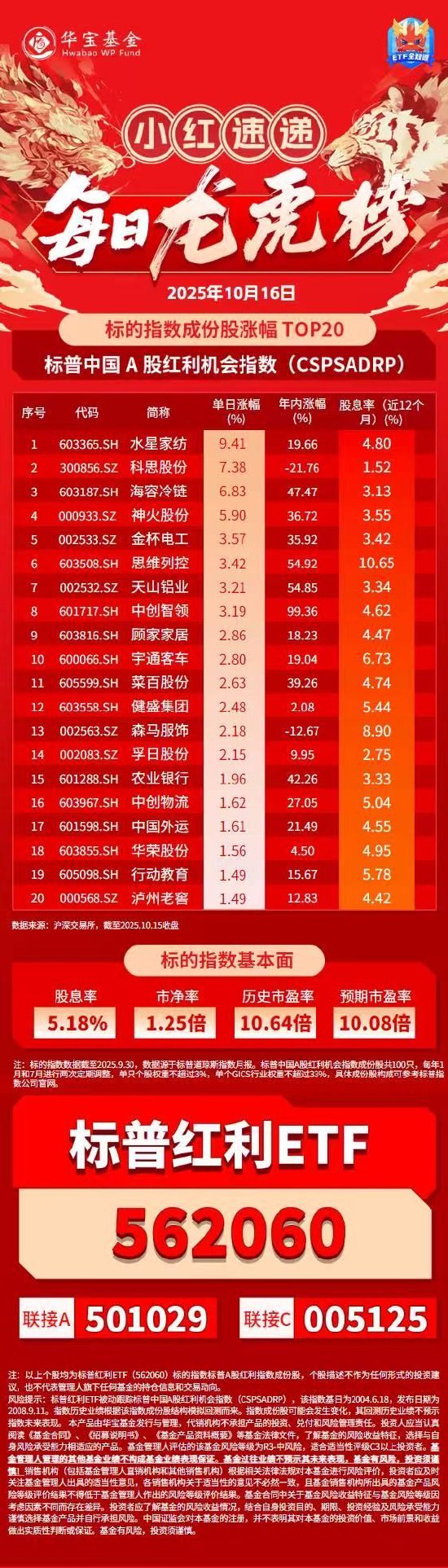
Core Insights - The article highlights the top-performing stocks in the S&P China A-Share Dividend Opportunity Index, showcasing significant price increases and dividend yields for various companies [1] Group 1: Stock Performance - Mercury Home Textiles (603365.SH) leads with a year-to-date increase of 19.66% and a recent increase of 9.41%, along with a dividend yield of 4.80% [1] - Other notable performers include: - Hailong Cold Chain (603187.SH) with a year-to-date increase of 47.47% and a recent increase of 6.83% [1] - Shenhuo Co., Ltd. (000933.SZ) showing a year-to-date increase of 36.72% and a recent increase of 5.90% [1] - Siwei Liekong (603508.SH) with a remarkable year-to-date increase of 54.92% and a recent increase of 3.42%, boasting a high dividend yield of 10.65% [1] Group 2: Dividend Yields - The article lists companies with attractive dividend yields, such as: - Siwei Liekong (603508.SH) at 10.65% [1] - Semir Apparel (002563.SZ) at 8.90% [1] - Yutong Bus (600066.SH) at 6.73% [1] - The dividend yields reflect the companies' commitment to returning value to shareholders, which may attract income-focused investors [1]




智造先行 郑州品牌闪耀世界舞台
Zheng Zhou Ri Bao· 2025-10-16 01:03
Core Insights - Zhengzhou is transitioning from the "14th Five-Year Plan" to the "15th Five-Year Plan," focusing on high-quality development and modern industrial systems [1][2] - The city aims to establish several trillion-yuan industrial clusters, with a strong emphasis on advanced manufacturing and emerging industries [2][7] Industry Developments - Zhengzhou's industrial landscape features significant players like Yutong in 5G autonomous buses and Hanwei Technology with over 70% market share in gas sensors [2] - The city is home to over 210 million business entities and aims to cultivate seven trillion-yuan industrial clusters, including electronics and automotive manufacturing [2][7] Technological Advancements - Yutong's recent accolades at the World Bus Expo highlight its commitment to innovation, with a focus on electric vehicle technology and automation [3] - The automation rate in BYD's Zhengzhou base has reached over 97%, showcasing advancements in smart manufacturing [3] Digital Transformation - Zhengzhou Coal Machine has rebranded to Zhongchuang Zhiling, emphasizing its shift towards digital and intelligent mining solutions [4] - The establishment of a digital lighthouse factory has significantly improved production efficiency and reduced costs [4] Equipment Manufacturing - China Railway Engineering Equipment Group is leading in shield machine production, with exports to over 30 countries [5] - The company collaborates with Tsinghua University to overcome material challenges, enhancing its competitive edge in the global market [5] Industrial Growth Metrics - Zhengzhou's industrial output has shown a steady annual growth rate of 9.55% from 2021 to 2024, with strategic emerging industries accounting for 50.9% of the industrial value added by 2024 [7][8] - The city has implemented policies to upgrade traditional industries and promote digital transformation, resulting in significant increases in production capacities across various sectors [7][8] Future Outlook - Zhengzhou is positioning itself to leverage national strategies and technological advancements, focusing on a balanced development of traditional, emerging, and future industries [8] - The city plans to expand its future industry scale to over 150 billion yuan, targeting six key directions for growth [8]
