
wanhua(600309)

Search documents
化工周报:爆炸事件导致康宽及K胺供需趋紧,有望推动农药行业景气加速修复,硝化棉价格或继续上行-20250602
Shenwan Hongyuan Securities· 2025-06-02 12:11
Investment Rating - The report maintains a "Buy" rating for specific companies in the agricultural chemicals sector, including Yangnong Chemical and Runfeng Co., while recommending "Hold" for others like Haier and Guangxin Co. [20] Core Insights - The recent explosion incident has tightened the supply-demand dynamics for K-amine and other intermediates, which is expected to accelerate the recovery of the pesticide industry and potentially drive up nitrocellulose prices [5][12] - The agricultural chemicals sector is gradually returning to rationality, with high-priced inventories being depleted and procurement demand recovering, although supply-side pressures remain [5][12] - The report highlights the potential for stricter safety and environmental regulations following the recent incidents, which could further enhance the agricultural chemicals industry's cyclical recovery [5][12] Industry Dynamics - Current macroeconomic judgments indicate that oil prices are under pressure due to geopolitical factors and OPEC+ production increases, while coal prices are expected to decline in the medium to long term [6] - The chemical industry is experiencing a gradual recovery in PPI, with April's chemical industry PPI showing a year-on-year decline of 3.2% [8] - The report notes that the recent explosion at a chemical facility has led to increased prices for K-amine and related products, with recommendations to focus on companies like Hongyang and Lier Chemical [5][12] Chemical Product Prices and Trends - The report provides detailed pricing trends for various chemical products, including a stable price for urea at 1830 RMB/ton and fluctuations in pesticide prices, with some herbicides seeing price increases [12][22] - The report indicates that the price of nitrocellulose has risen significantly, with export prices increasing from 2.06 USD/kg in October 2021 to 4.75 USD/kg in April 2025 [5][12] Company Recommendations - Specific companies are highlighted for investment based on their market positions and growth potential, including Yangnong Chemical, Runfeng Co., and others in the agricultural chemicals sector [20] - The report suggests monitoring companies with mature nitrochemical processes, such as Yangnong Chemical and Guangxin Co., due to expected regulatory changes [5][12]



每周股票复盘:XD万华化(600309)万华化学每股派发现金红利0.73元,回购价格上限调整至98.63元
Sou Hu Cai Jing· 2025-05-30 21:05
Group 1 - The stock price of XD Wanhua Chemical (600309) closed at 54.14 yuan on May 30, 2025, down 3.46% from the previous week's closing price of 56.08 yuan [1] - The highest intraday price for XD Wanhua Chemical on May 26 was 56.19 yuan, while the lowest intraday price on May 30 was 53.92 yuan [1] - The current total market capitalization of XD Wanhua Chemical is 169.986 billion yuan, ranking 1st in the chemical products sector and 71st among 5146 A-shares [1] Group 2 - The company announced a cash dividend of 0.73 yuan per share, totaling 2,292,015,036.98 yuan [3] - The repurchase price ceiling has been adjusted to not exceed 98.63 yuan per share, down from the previous ceiling of 99.36 yuan per share, effective from May 30, 2025 [3] - The company successfully issued the fourth phase of its 2025 technology innovation bonds, with a total issuance amount of 600 million yuan and an interest rate of 1.88%, maturing in three years [3]

十年之后,复盘“中国制造2025”
Guan Cha Zhe Wang· 2025-05-30 11:10
Group 1 - "Made in China 2025" aims to transform China from a "world factory" to a global high-tech manufacturing leader by 2025, with a target of 70% self-sufficiency in core components and key materials [3][4] - The initiative focuses on ten high-tech sectors, including semiconductors, robotics, new energy vehicles, aerospace, and biomedicine, supported by significant government funding and policy incentives [3][4] - From 2015 to 2022, over $1.3 trillion was invested in priority industries, with nearly 60% allocated to semiconductors and new energy vehicles, indicating a concentrated policy approach [4] Group 2 - The new energy vehicle (NEV) sector has seen remarkable success, with domestic NEVs capturing 80% of the market share in 2022, and companies like BYD ranking second globally in NEV sales [5][6] - High-speed rail has become a textbook success story, with Chinese companies now dominating the market, achieving a 90% share in high-speed rail signaling equipment [6][7] - In the new materials sector, China has significantly increased its production capacity, with a global share of 80% in petrochemical products from 2019 to 2022, and companies like Wanhua Chemical leading in the polyurethane market [7][8] Group 3 - Despite achievements, challenges remain in high-end manufacturing, particularly in semiconductors, where China's market share is only 1.9%, and reliance on imported equipment is high [8][9] - The aerospace sector faces similar issues, with the domestically produced C919 aircraft having only a 60% local content rate, heavily dependent on foreign suppliers for critical components [9][10] - The marine engineering and high-tech shipbuilding sectors also struggle, with less than 30% localization in high-tech ship equipment [10] Group 4 - The rapid advancements have led to some negative consequences, including resource wastage due to excessive government spending, with 30% of semiconductor project funds wasted on inefficient projects [11][12] - Overemphasis on industrial policy has resulted in production capacity outpacing consumer demand, leading to price wars and declining industrial profits [11][12] - In 2022, China's power battery production capacity reached 900 GWh, but actual demand was only 450 GWh, resulting in a 50% surplus [12][13] Group 5 - While China excels in low-end and mid-range markets, it still lags behind international giants in high-end sectors, with R&D investment significantly lower than that of the U.S. [13][14] - Foreign enterprises believe that Chinese competitors will take 5 to 10 years to catch up in technology, particularly in advanced fields like semiconductors and aerospace engines [14][15] - The decline in international scientific collaboration and increased trade tensions pose additional challenges for Chinese companies in sensitive technology areas [15]



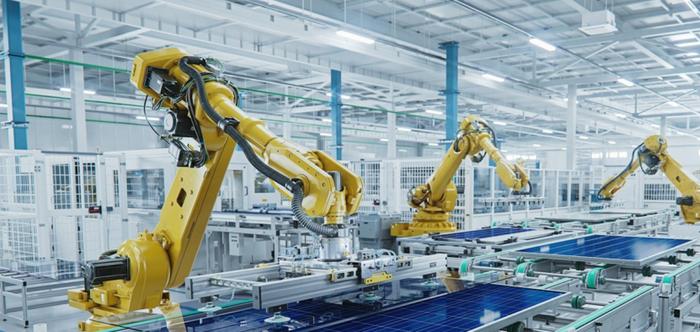
研判2025!中国阻燃ABS原料行业产业链、发展现状、竞争格局及发展趋势分析:以旧换新推动行业规模增长,环保化是其未来发展的重要趋势[图]
Chan Ye Xin Xi Wang· 2025-05-30 01:43
Core Viewpoint - The demand for flame-retardant ABS materials is increasing due to government policies promoting the replacement of old appliances and vehicles, leading to a projected market size of 6.75 billion yuan in China by 2024, a year-on-year increase of 5.63% [1][16]. Industry Overview - Flame-retardant ABS materials are engineered plastics with excellent flame-retardant properties, widely used in electronics, automotive, and construction industries [1][16]. - The market for flame-retardant ABS materials in China has shown a continuous upward trend, with a market size expected to reach 6.75 billion yuan in 2024 [1][16]. - The production process of flame-retardant ABS involves adding flame retardants to ABS resin, which is derived from styrene, acrylonitrile, and butadiene [3][12]. Industry Chain - The upstream of the flame-retardant ABS industry includes the production of ABS resin and various flame retardants [7]. - The midstream involves the manufacturing of flame-retardant ABS materials, while the downstream applications span electronics, automotive, construction, and medical sectors [7]. Market Dynamics - The automotive sector is a significant consumer of flame-retardant ABS, used in interior components to enhance safety [9]. - Government policies, such as the promotion of vehicle replacement, have led to increased production and sales in the automotive industry, with a reported 14.5% and 11.2% year-on-year growth in production and sales in early 2025 [9]. Competitive Landscape - The flame-retardant ABS market features competition among various brands and specifications, with both international and domestic players [18]. - Key domestic companies include Kingfa Technology, Shanghai Pulite, and Guangzhou Jusa Long, which have established significant market shares [19][21]. Development Trends - The industry is moving towards greener practices, with an increasing use of halogen-free and lead-free flame retardants [23]. - There is a growing demand for high-performance materials in electronics and automotive sectors, necessitating improvements in flame-retardant properties and other material characteristics [24]. - The adoption of smart manufacturing technologies is expected to enhance production efficiency and customization in response to diverse customer needs [25].



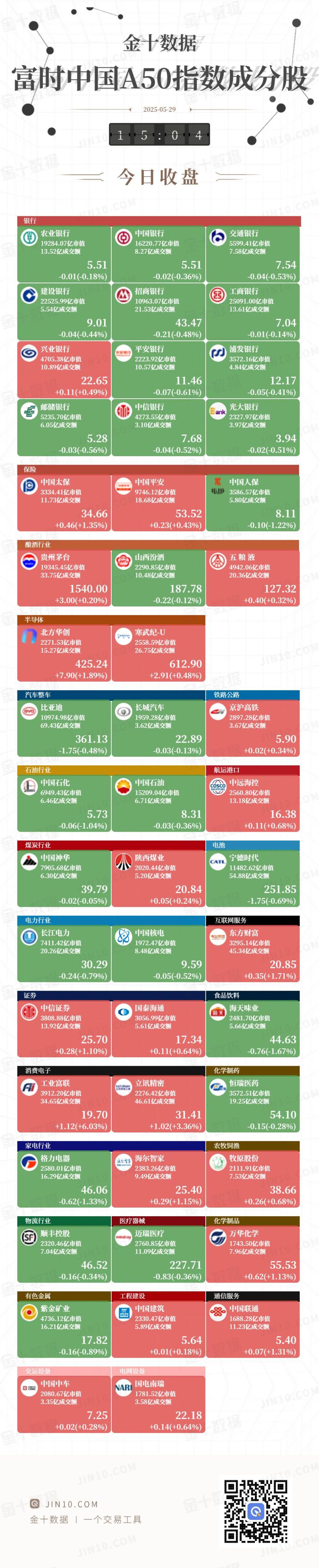
金十图示:2025年05月29日(周四)富时中国A50指数成分股今日收盘行情一览:半导体板块全天走高,汽车板块午后飘绿
news flash· 2025-05-29 07:08
Market Overview - The FTSE China A50 Index component stocks showed a mixed performance with the semiconductor sector rising throughout the day while the automotive sector turned negative in the afternoon [1] Insurance Sector - China Life Insurance had a market capitalization of 358.657 billion with a trading volume of 1.868 billion, increasing by 1.35% - China Pacific Insurance had a market capitalization of 333.441 billion with a trading volume of 0.580 billion, increasing by 0.43% - Ping An Insurance had a market capitalization of 974.612 billion with a trading volume of 1.173 billion, decreasing by 1.22% [3] Alcohol Industry - Kweichow Moutai had a market capitalization of 1934.545 billion with a trading volume of 10.48 billion, decreasing by 0.12% - Wuliangye Yibin had a market capitalization of 229.085 billion with a trading volume of 20.36 billion, increasing by 0.32% - Shanxi Fenjiu had a market capitalization of 494.206 billion with a trading volume of 33.75 billion, increasing by 0.20% [3] Semiconductor Sector - Northern Huachuang had a market capitalization of 227.153 billion with a trading volume of 15.27 billion, increasing by 1.89% - Cambricon Technologies had a market capitalization of 255.859 billion with a trading volume of 26.75 billion, increasing by 0.48% [3] Automotive Sector - BYD had a market capitalization of 289.728 billion with a trading volume of 69.43 billion, decreasing by 0.48% - Great Wall Motors had a market capitalization of 1097.498 billion with a trading volume of 3.62 billion, decreasing by 0.13% - Beijing-Shanghai High-Speed Railway had a market capitalization of 195.928 billion with a trading volume of 3.67 billion, increasing by 0.34% [3] Energy Sector - COSCO Shipping had a market capitalization of 1520.904 billion with a trading volume of 6.46 billion, decreasing by 0.36% - Sinopec had a market capitalization of 694.943 billion with a trading volume of 13.18 billion, decreasing by 1.04% [3] Coal Industry - China Shenhua Energy had a market capitalization of 202.044 billion with a trading volume of 6.30 billion, decreasing by 0.05% - Shaanxi Coal and Chemical Industry had a market capitalization of 790.568 billion with a trading volume of 54.88 billion, increasing by 0.24% [3] Power Sector - China Yangtze Power had a market capitalization of 741.142 billion with a trading volume of 20.26 billion, increasing by 1.71% - China Nuclear Power had a market capitalization of 197.247 billion with a trading volume of 8.48 billion, decreasing by 0.79% [4] Food and Beverage Sector - Citic Securities had a market capitalization of 380.888 billion with a trading volume of 13.92 billion, increasing by 1.10% - Haitai Flavoring had a market capitalization of 248.170 billion with a trading volume of 5.66 billion, decreasing by 1.67% [4] Consumer Electronics - Heng Rui Medicine had a market capitalization of 391.220 billion with a trading volume of 34.65 billion, decreasing by 0.28% - Industrial Fulian had a market capitalization of 357.251 billion with a trading volume of 46.61 billion, increasing by 6.03% [4] Logistics Sector - Mindray Medical had a market capitalization of 174.350 billion with a trading volume of 7.04 billion, decreasing by 0.34% - SF Holding had a market capitalization of 232.046 billion with a trading volume of 11.09 billion, decreasing by 0.36% [4] Telecommunications - China Unicom had a market capitalization of 473.612 billion with a trading volume of 11.23 billion, increasing by 1.31% [4]


万华、金发、会通……一波改性塑料上市企业,在加码这一热门新材料!
Sou Hu Cai Jing· 2025-05-28 16:25
Group 1: Project Overview - Huizhou Water Special Materials Co., Ltd. has received approval for its carbon fiber composite materials project with a total investment of 50 million yuan, focusing on the production of various carbon fiber products [1] - The project aims to produce 60 tons of chopped fiber, 50,000 square meters of woven fiber, 350 tons of thermoplastic materials, 3 million square meters of fiber prepreg, 307,400 carbon fiber pipes, and 701,700 carbon fiber special-shaped parts annually [1] Group 2: Company Background - Huizhou Water Special Materials Co., Ltd. is a wholly-owned subsidiary of Shenzhen Water New Materials Co., Ltd., established in August 2021, to enhance the strategic layout of special polymer materials [1] - The company specializes in the production and sales of engineering plastics, synthetic resins, high-performance fibers, and composite materials [1] Group 3: Product Development and Applications - Water New Materials has developed thermoplastic carbon fiber composite materials using various thermoplastic resins, which are applied in industries requiring high mechanical performance and lightweight solutions, such as automotive and drones [2] - The company has launched a new line for thermosetting carbon fiber composites in 2024, producing lightweight and high-strength products, and has introduced a carbon fiber reinforced PPA material made from recycled aerospace waste [2] Group 4: Industry Trends and Competitors - The demand for carbon fiber composites is driven by the explosive growth of the low-altitude economy (drones, eVTOL) and robotics, creating new applications for these materials [3] - Competitors like Kingfa Technology, Nanjing Julong, and Huitong are also entering the carbon fiber sector, leveraging their expertise in modified plastics to meet the evolving market needs [3] Group 5: Competitor Developments - Kingfa Technology is investing 1.702 billion yuan in a project to produce high-performance prepregs and continuous fiber reinforced thermoplastic composites, with a production capacity of 35,000 tons and 100,000 tons respectively [4] - Wanhua Chemical and Baowu Carbon have partnered to establish a project with a total investment of 6.55 billion yuan, aiming for an annual production capacity of 120,000 tons of PAN-based carbon fiber [5] - Nanjing Julong is working on a production line for 30 tons of carbon fiber composites, with a focus on aerospace and low-altitude economy applications [6] - Plit has developed a series of carbon fiber reinforced materials for robotics and low-altitude flight, collaborating with Tongji University on new materials [7] - Huitong New Materials is producing ultra-high-strength carbon fiber reinforced polyamide materials for key components in robotics and low-altitude applications [8]


中证新材料主题指数下跌0.8%,前十大权重包含三安光电等
Jin Rong Jie· 2025-05-28 15:53
Core Viewpoint - The China Securities New Materials Theme Index has shown a decline of 0.8% recently, reflecting a challenging market environment for companies in the new materials sector [1] Group 1: Index Performance - The China Securities New Materials Theme Index closed at 2809.59 points with a trading volume of 17.415 billion yuan [1] - Over the past month, the index has increased by 0.04%, but it has decreased by 9.99% over the last three months and by 4.63% year-to-date [1] Group 2: Index Composition - The index comprises 50 listed companies involved in advanced steel, non-ferrous metals, chemicals, inorganic non-metals, and other strategic materials [1] - The top ten weighted companies in the index are: CATL (10.63%), North Huachuang (9.86%), Wanhua Chemical (7.67%), Longi Green Energy (6.45%), Huayou Cobalt (3.4%), Tongwei Co. (3.38%), Sanan Optoelectronics (3.24%), Sanhuan Group (3.19%), Baofeng Energy (2.63%), and Greeenmei (2.32%) [1] Group 3: Market Segmentation - The index's holdings are primarily listed on the Shenzhen Stock Exchange (54.67%), followed by the Shanghai Stock Exchange (44.77%) and the Beijing Stock Exchange (0.56%) [1] - In terms of industry distribution, industrial companies account for 43.47%, raw materials for 33.01%, and information technology for 23.52% [2] Group 4: Index Adjustment and Fund Tracking - The index samples are adjusted biannually, with changes implemented on the next trading day after the second Friday of June and December [2] - Public funds tracking the new materials index include various ETFs and fund products from companies like Huabao, Guotai, and Tianhong [2]





万华、金发、会通……一波改性塑料上市企业,在加码这一热门新材料!
DT新材料· 2025-05-28 15:00
Core Viewpoint - The article discusses the recent developments in the carbon fiber composite materials industry, highlighting the investments and projects undertaken by various companies to meet the growing demand in sectors such as aerospace, robotics, and low-altitude economy [1][2][3]. Group 1: Company Developments - Huizhou Water Special Materials Co., Ltd. plans to invest 50 million yuan in a carbon fiber composite materials project, with an expected annual production capacity of 60 tons of chopped fibers and 30.74 million carbon fiber tubes [1]. - Water New Materials has developed thermoplastic carbon fiber composites using various thermoplastic resins, with applications in high-performance industries such as automotive and drones [2]. - Jinfa Technology is investing 1.702 billion yuan in a project to produce high-performance prepregs and continuous fiber reinforced thermoplastic composites, with an annual capacity of 35,000 tons [4]. - WanHua Chemical and Baowu Carbon Industry have launched a joint venture to produce 120,000 tons of PAN-based carbon fiber raw silk, with a total investment of 6.55 billion yuan [5]. - Nanjing Julong is constructing a production line for 30 tons of carbon fiber composites, with a delay in completion expected until December 2025 [6]. - Plit has developed a series of carbon fiber reinforced materials for emerging markets, including a collaboration with Tongji University for carbon fiber reinforced PEEK materials [7]. - Huitong New Materials has introduced ultra-high strength carbon fiber reinforced polyamide materials for key components in robotics and low-altitude economy applications [8]. Group 2: Industry Trends - The demand for carbon fiber composites is driven by the explosive growth in the low-altitude economy and robotics sectors, which require lightweight and high-strength materials [3]. - Companies are leveraging their expertise in modified plastics to position themselves strategically in the carbon fiber market, addressing the needs of new applications [3]. - The industry faces challenges such as balancing performance and cost, integrating complex components, and enhancing material durability [3]. - There is a growing market demand for functionalized materials with properties like conductivity, recyclability, and integrated structural-functionality [3].

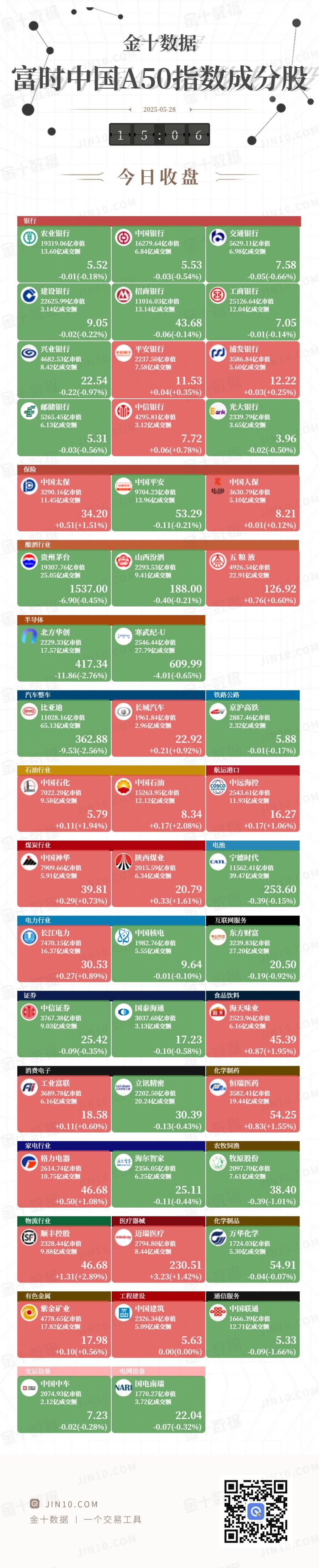
金十图示:2025年05月28日(周三)富时中国A50指数成分股今日收盘行情一览:石油、煤炭板块全天飘红,银行、汽车板块午后继续涨跌互现
news flash· 2025-05-28 07:12
Market Overview - The FTSE China A50 Index component stocks showed mixed performance with the oil and coal sectors gaining throughout the day, while the banking and automotive sectors fluctuated in the afternoon [1]. Sector Performance Insurance - China Pacific Insurance, China Ping An, and China Life Insurance had market capitalizations of 329.02 billion, 363.08 billion, and 970.42 billion respectively, with trading volumes of 1.145 billion, 1.396 billion, and 0.510 billion [3]. Alcohol Industry - Kweichow Moutai, Shanxi Fenjiu, and Wuliangye had market capitalizations of 1,930.78 billion, 229.35 billion, and 492.65 billion respectively, with trading volumes of 2.505 billion, 0.941 billion, and 2.291 billion [3]. Semiconductor - Northern Huachuang and Cambrian had market capitalizations of 222.93 billion and 254.64 billion respectively, with trading volumes of 1.757 billion and 2.779 billion [3]. Automotive - BYD, Great Wall Motors, and Beijing-Shanghai High-Speed Railway had market capitalizations of 1,102.81 billion, 288.75 billion, and 196.18 billion respectively, with trading volumes of 6.513 billion, 0.296 billion, and 0.232 billion [3]. Oil Industry - COSCO Shipping, Sinopec, and China National Offshore Oil Corporation had market capitalizations of 702.22 billion, 1,526.39 billion, and 254.36 billion respectively, with trading volumes of 0.958 billion, 1.212 billion, and 1.193 billion [3]. Coal Industry - Shaanxi Coal and Ningde Times had market capitalizations of 201.56 billion and 790.97 billion respectively, with trading volumes of 0.591 billion and 0.634 billion [3]. Power Industry - Yangtze Power and China Nuclear Power had market capitalizations of 198.28 billion and 747.01 billion respectively, with trading volumes of 1.637 billion and 0.555 billion [4]. Food and Beverage - Citic Securities, Guotai Junan, and Haitian Flavoring had market capitalizations of 303.76 billion, 376.74 billion, and 252.40 billion respectively, with trading volumes of 0.903 billion, 0.313 billion, and 0.616 billion [4]. Consumer Electronics - Industrial Fulian, Luxshare Precision, and Kairui Pharmaceutical had market capitalizations of 368.98 billion, 220.25 billion, and 358.24 billion respectively, with trading volumes of 2.024 billion, 0.616 billion, and 1.944 billion [4]. Home Appliances - Gree Electric, Haier Smart Home, and Muyuan Foods had market capitalizations of 261.47 billion, 209.77 billion, and 235.61 billion respectively, with trading volumes of 1.075 billion, 0.625 billion, and 0.761 billion [4]. Medical Devices - Mindray Medical, Wanhua Chemical, and SF Holding had market capitalizations of 172.40 billion, 232.84 billion, and 279.48 billion respectively, with trading volumes of 0.988 billion, 0.530 billion, and 0.844 billion [4]. Communication Services - Zijin Mining, China State Construction, and China Unicom had market capitalizations of 232.63 billion, 166.64 billion, and 477.87 billion respectively, with trading volumes of 1.782 billion, 0.509 billion, and 1.271 billion [4].



万华化学(600309):MDI价差环比改善,与科威特石化达成合资
Guohai Securities· 2025-05-27 12:33
Investment Rating - The investment rating for the company is "Buy" (maintained) [1] Core Views - The report highlights that the price spread of MDI has improved, and a joint venture has been established with Kuwait Petrochemical [5][7] - The company is positioned as a typical example of development driven by technological innovation in the chemical industry, aiming to become a global chemical giant [4] - The short-term profitability of the company is primarily influenced by product price spreads, while long-term growth is dependent on the ability to innovate and launch milestone products [5] Summary by Sections Recent Performance - As of May 26, 2025, the company's stock price is 55.41 CNY, with a market capitalization of approximately 173.97 billion CNY [3] - The company's performance relative to the CSI 300 index shows a decline of 37.1% over the past 12 months [3] Price Spread and Profitability - The MDI price spread index for Q2 2025 is at an average of 70.11, down 7.35 from Q1 2025, indicating a position in the historical 5.83 percentile [6][25] - The expected net profit for Q2 2025 is projected to be 3.4 billion CNY [6] Key Projects and Developments - A joint venture agreement was signed with Kuwait Petrochemical on April 25, 2025, with an investment of 638 million USD for a 25% stake in a subsidiary [7][35] - Several projects are in progress, including expansions in MDI and HDI production capacities, with expected revenues from new projects totaling 476 billion CNY in 2025 [37] Financial Forecast - Projected revenues for 2025, 2026, and 2027 are 197.6 billion CNY, 230.5 billion CNY, and 251.8 billion CNY, respectively, with corresponding net profits of 14.3 billion CNY, 18.4 billion CNY, and 22.3 billion CNY [11][13]