
Tsingtao Brewery(600600)

Search documents
精酿战局未歇 汽水烽烟又起啤酒巨头跨界开辟新战场
Zhong Guo Zheng Quan Bao· 2025-06-06 21:00
Core Insights - The craft beer trend is reflecting consumer upgrades, with over 24,000 craft beer-related companies in China, driven by personalized flavor and quality experiences [1][3][4] - Major beer companies are entering the craft beer market to capture high-end segments, while also exploring non-alcoholic beverage markets through a "beer + soda" strategy [1][6][8] Industry Overview - The craft beer market in China has seen rapid expansion, with new registrations increasing from 3,111 in 2021 to 3,832 in 2024, indicating a growing interest in craft beer [3] - The global craft beer market was valued at approximately 728 billion yuan in 2022, with a projected compound annual growth rate (CAGR) of 11.2%, expected to exceed 1.7 trillion yuan by 2030 [3] Market Dynamics - Craft beer is characterized by lower production volumes and more refined brewing processes compared to industrial beer, appealing to consumers seeking unique flavors and higher quality [4][5] - Major beer companies like Qingdao Beer and Yanjing Beer are launching craft beer sub-brands to enhance their product offerings and address the high-end market demand [5][6] Strategic Initiatives - Companies are leveraging their established distribution channels and supply chain management to expand into the non-alcoholic beverage market, particularly in the soda segment [6][7] - Yanjing Beer has introduced a new soda product, "Beistejia Bing," as part of its "beer + beverage" marketing strategy, aiming for long-term market penetration [7][8] Future Outlook - The craft beer segment is expected to continue growing, with companies focusing on expanding their product lines and enhancing brand recognition in both craft beer and non-alcoholic beverages [6][8]




雀巢、康师傅、伊利、海天等131家快消品上市公司发布年报,63家营收增长,68家营收下滑!
Sou Hu Cai Jing· 2025-06-06 10:07
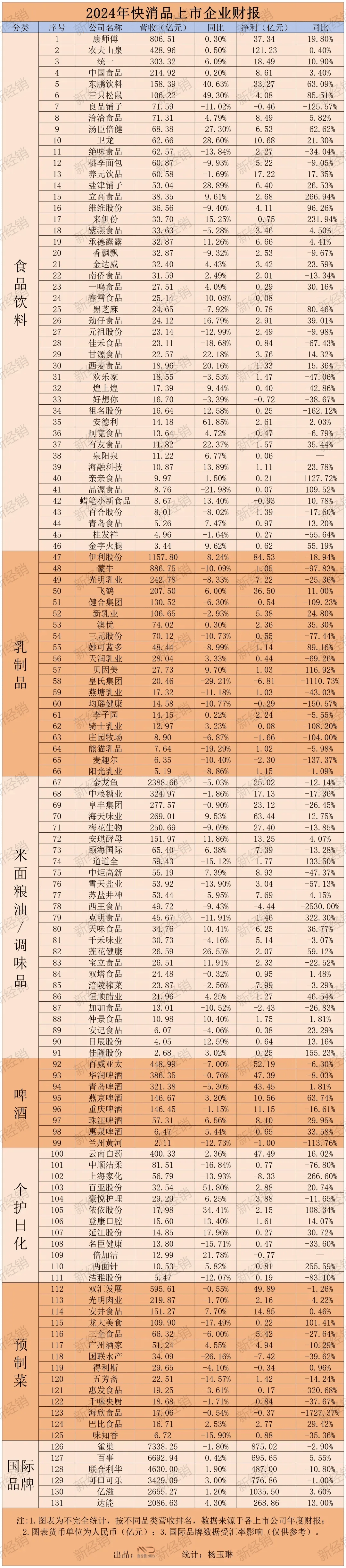
Core Insights - In 2024, China's total retail sales of consumer goods reached 48.79 trillion yuan, growing by 3.5%, marking the first time it fell below the GDP growth rate of 5% [1] - The fast-moving consumer goods (FMCG) industry is transitioning into a phase dominated by "stock competition," focusing on efficiency improvement, brand optimization, and structural adjustments [1] FMCG Company Performance - **Master Kong**: Achieved revenue of 806.51 billion yuan, a slight increase of 0.30%, with net profit rising by 19.80% to 37.34 billion yuan [2][6] - **Nongfu Spring**: Reported revenue of 428.96 billion yuan, up by 0.50%, and net profit of 121.23 billion yuan, a marginal increase of 0.40% [2][6] - **Uni-President**: Generated revenue of 303.32 billion yuan, a growth of 6.09%, with net profit of 18.49 billion yuan, increasing by 10.90% [2][6] - **China Foods**: Recorded revenue of 214.92 billion yuan, up by 0.20%, and net profit of 8.61 billion yuan, a growth of 3.40% [2][6] - **Eastroc Beverage**: Achieved significant growth with revenue of 158.39 billion yuan, up by 40.63%, and net profit of 33.27 billion yuan, increasing by 63.09% [2][6] - **Three Squirrels**: Reported revenue of 106.22 billion yuan, a substantial increase of 49.30%, with net profit rising by 85.51% to 4.08 billion yuan [2][6] Industry Trends - The FMCG sector is experiencing a shift towards efficiency and brand optimization as the era of rapid market growth driven by demographic dividends comes to an end [1] - Companies are adapting to market changes through product innovation, structural optimization, and brand rejuvenation to establish new growth curves and core competitiveness [13] - The beverage segment is seeing strong performance from Nongfu Spring's tea drinks, which have become a major revenue source despite challenges in the bottled water segment [8][13] - The snack segment is witnessing varied performance, with companies like Qinqin Foods achieving profitability through export and OEM manufacturing, while others like Liuyifei face challenges due to strategic adjustments [13] Dairy Industry Performance - **Yili Group**: Maintained its position as Asia's leading dairy company with revenue of 1,157.80 billion yuan, despite a decline of 8.24% [15][16] - **Mengniu Dairy**: Experienced a revenue drop of 10.09% to 886.75 billion yuan, with net profit significantly declining by 97.83% [15][16] - **Bright Dairy**: Reported revenue of 242.78 billion yuan, down by 8.33%, and net profit of 7.22 billion yuan, a decrease of 25.36% [15][16] - The dairy industry is facing challenges with supply-demand imbalances and declining consumer demand, leading to revenue declines for many traditional dairy giants [18]






食品饮料行业双周报(2025、05、23-2025、06、05):白酒动销平淡,关注啤酒等旺季消费-20250606
Dongguan Securities· 2025-06-06 09:40
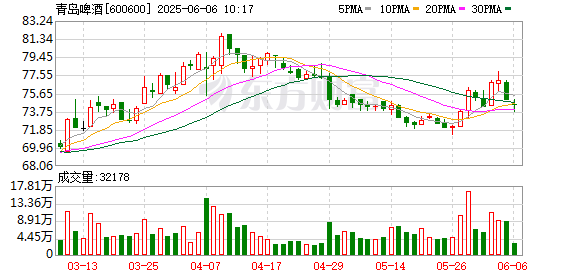
Investment Rating - The report maintains an "Overweight" rating for the food and beverage industry, expecting the industry index to outperform the market index by over 10% in the next six months [56]. Core Viewpoints - The white liquor market is experiencing sluggish sales, while attention should be paid to beer and other seasonal consumption [51]. - The SW food and beverage industry index fell by 1.83% from May 23 to June 5, 2025, underperforming the CSI 300 index by approximately 0.90 percentage points [13]. - Most sub-sectors within the industry outperformed the CSI 300 index during the same period, with the soft drink sector seeing the largest increase of 8.72% [15]. - Approximately 70% of stocks in the industry recorded positive returns, with notable gainers including Junyao Health (+62.74%) and Miaokelando (+21.27%) [17]. - The overall industry valuation is below the five-year average, with a current PE (TTM) of approximately 21.40 times, compared to the historical average of 34 times [21]. Summary by Sections Market Review - The SW food and beverage industry index underperformed the CSI 300 index, with a decline of 1.83% from May 23 to June 5, 2025 [13]. - Most sub-sectors outperformed the CSI 300 index, with the soft drink sector leading at an increase of 8.72% [15]. - About 70% of stocks in the industry achieved positive returns, with significant gains from Junyao Health and Miaokelando [17]. Industry Data Tracking White Liquor Sector - The prices of major white liquor brands, such as Feitian and Guojiao 1573, have decreased recently, indicating market pressure [24]. Seasonality and Consumer Trends - The report emphasizes the importance of monitoring seasonal consumption trends, particularly in beer and soft drinks, as the industry enters a peak consumption period [51]. Valuation Metrics - The current industry PE (TTM) is approximately 21.40 times, which is below the five-year average of 34 times, suggesting potential undervaluation [21]. Key Recommendations - The report suggests focusing on high-certainty stocks such as Kweichow Moutai (600519) and other regional liquor brands like Shanxi Fenjiu (600809) and Gujing Gongjiu (000596) [51]. - In the broader consumer goods sector, companies like Haitian Flavoring (603288), Qingdao Beer (600600), and Yili (600887) are highlighted for their growth potential [51].




一瓶青岛啤酒的“低碳账本”
Zhong Guo Xin Wen Wang· 2025-06-06 02:16
以"生态思维"领创可持续效益 技术创新是推动发展方式绿色低碳转型的关键引擎。 6月5日是世界环境日,在青岛啤酒的智能化生产车间,青翠的玻璃瓶在生产线上叮叮当当,吸引众多游 客拍照打卡。"可别小瞧这些啤酒瓶,它们可跟普通玻璃瓶不同,被称作'轻量瓶'。"青岛啤酒厂包装车 间的工人告诉记者,在满足使用要求和保证产品质量的条件下,轻量瓶重量更轻、用料更少、更加环 保。 秉承"为了更美好的世界"环境理念,青岛啤酒加速推动啤酒制造的高端化、智能化、绿色化转型以及全 价值链的可持续发展,青啤集团目前已有25家工厂获得国家级绿色工厂荣誉称号,17家工厂成为无废工 厂,3家工厂获得碳中和认证。 从"一滴水到一度电"精准把控 王健是青岛啤酒(济南)有限公司能源管理工程部高级业务经理,每天早上8点,他上班第一件事就是将 过去一天工厂所用的能源分析数据分享在微信群。从一滴水到一度电再到一立方米天然气,一旦哪个指 标出现异常,就落实到人现场查核、及时整改。 作为青啤集团首批实现绿色电力采购的公司,青岛啤酒济南公司得益于绿色电力、光伏发电、生物质锅 炉等独特优势,连续两年单位产品碳排放强度位列制造工厂第一,也成为青啤集团首家实现碳中和的 ...
探智造之城 览山海风华——青岛上市公司深度调研
21世纪经济报道· 2025-06-05 08:06
Core Viewpoint - The article highlights an upcoming event in Qingdao focused on deep industry and capital dialogue, featuring visits to benchmark companies and showcasing their innovative strategies in the context of the IoT era and consumer engagement. Group 1: Event Details - The "Qingdao Listed Companies Deep Research" event is scheduled for June 10-12, lasting three days and two nights, organized by Nanfang Financial Education Base in collaboration with Stock Market Broadcasting and Investment Express [1][6]. Group 2: Company Insights - The first company is recognized as a global leader in smart home ecosystems and a benchmark for transformation in the IoT era, having led global retail sales of large home appliances for 14 consecutive years [2]. - The second company, a century-old brand, is exploring youth marketing strategies to engage Generation Z, evolving from traditional products like "calcium milk biscuits" to trendy items [3]. - The third company is noted for its 120-year brewing legacy, ranking as the fifth largest beer brand globally and leading the high-end beer market in China [4]. Group 3: Research Highlights - The event will include a visit to the "Ecological Interconnected Factory" to experience comprehensive smart home solutions and observe the transformation of traditional manufacturing into an open ecological platform [3]. - Participants will analyze the global layout of the brands "Haier + Casarte + Candy," which operate in nearly 200 countries, focusing on localized operational innovations [3]. - The event will feature a tour of the Qingdao Beer Museum, showcasing the transition from traditional brewing methods to intelligent production, along with a tasting of high-end product lines to understand the brand matrix and scene marketing strategies [5].

“青岛啤酒交易所”何以出圈?
Sou Hu Cai Jing· 2025-06-04 19:13
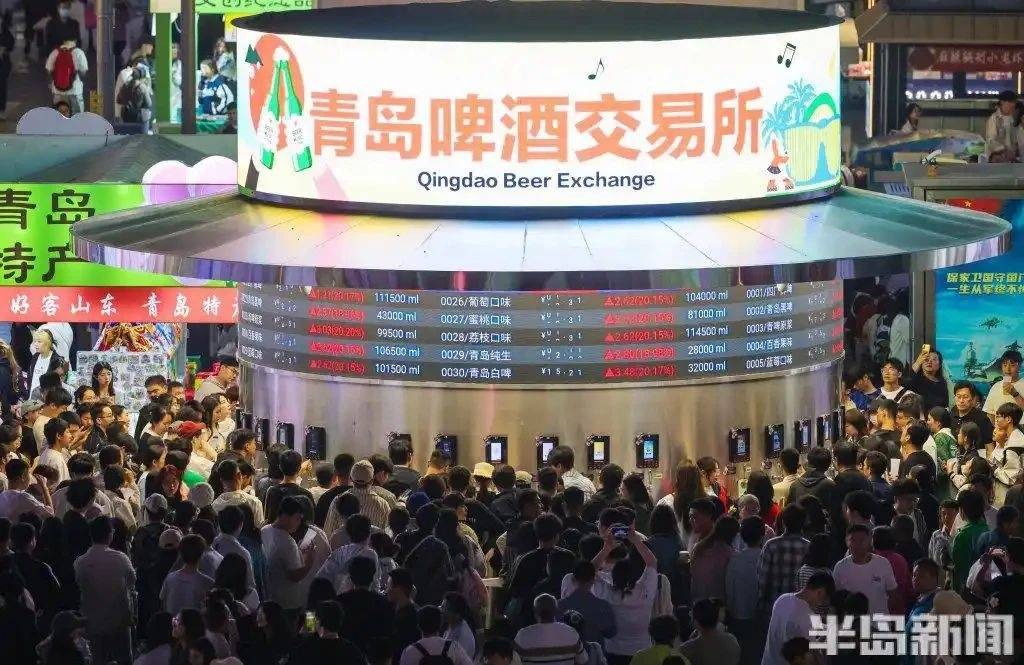
Core Insights - The "Qingdao Beer Exchange" has become a trending topic on social media, attracting over 10,000 daily visitors and selling more than 120,000 milliliters of beer in a single day during the Dragon Boat Festival holiday [1][2] Group 1: Concept and Features - The "Qingdao Beer Exchange" features a 3-meter tall, 360-degree smart beer column that allows consumers to purchase from 30 different types of beer, with real-time price fluctuations based on sales [1][2] - The exchange operates on a dynamic pricing mechanism that updates every 10 minutes, adjusting prices based on demand, similar to stock market trading [3][4] Group 2: Consumer Experience - Consumers engage in a unique, immersive experience where they act as "traders," influencing beer prices through their purchases, thus enhancing the overall enjoyment of the product [4] - The self-service model allows customers to select their beer and complete transactions via QR codes, creating an interactive and engaging environment [2][3] Group 3: Market Impact - The innovative concept not only revitalizes the local tourism and consumption market but also promotes a younger, more digital shopping experience, benefiting surrounding restaurants and cultural businesses [4]
上海汇正财经:啤酒行业进入旺季,助力夏季消费场景
Sou Hu Cai Jing· 2025-06-04 15:08
Group 1 - The peak season for beer production typically occurs from June to September due to increased demand for chilled beer in hot weather [1][3] - High temperatures significantly boost beer consumption, making the second and third quarters traditional sales peaks for the industry [3] - The Chinese beer industry has been undergoing a high-end upgrade since around 2018, shifting focus from market share to profitability, with leading companies enhancing their product offerings [4][5] Group 2 - In 2024, the overall beer consumption is expected to be weak, but the resilience of the industry remains, with leading companies still seeing profit levels increase despite a slowdown in growth rates [4][6] - Sales performance among leading beer brands varies, with some brands like Zhujiang Beer and Yanjing Beer showing positive growth while Qingdao Beer experiences a decline due to conservative marketing strategies [6][7] - The craft beer market in China is expanding rapidly, driven by a younger consumer base that values quality and unique experiences, with the market size expected to reach 11 billion yuan by 2028 [8] Group 3 - The beer industry is expected to recover in 2025, supported by improved consumer spending and favorable policies for the restaurant sector, which will positively impact beer sales [6][7] - The current low inventory levels and the approach of the beer consumption peak season present opportunities for investment in resilient companies with positive sales and pricing trends [9]
风评 | 端午小长假,火了“青交所”!
Sou Hu Cai Jing· 2025-06-04 14:34
Core Insights - The Qingdao Beer Exchange has gained significant popularity during the Dragon Boat Festival, merging local beer culture with modern financial symbols, appealing particularly to Generation Z consumers [2][6] - This innovative concept disrupts traditional commercial space logic, resembling a beer can-shaped vending machine with an LED screen displaying real-time beer prices and trading volumes, creating an engaging consumer experience [2][4] Industry Trends - The Qingdao Beer Exchange features over thirty types of beer, with prices fluctuating by up to 10%, providing a transparent and gamified consumption experience that resonates with younger consumers [4][6] - The integration of financial trading logic into the consumer space reflects a broader trend of experiential economy reshaping traditional retail environments [4][9] Market Performance - During the Dragon Boat Festival, the Qingdao Beer Exchange sold hundreds of barrels of beer, indicating strong consumer interest and engagement [6] - The Taidong Pedestrian Street, where the exchange is located, has seen significant foot traffic, with 2.245 million visitors during the Qingming and May Day holidays, and projected annual traffic of 110 million in 2024 [7] Cultural Significance - The Qingdao Beer Exchange not only serves beer but also embodies the cultural identity of Qingdao, transforming material consumption into a spiritual experience that reflects the city's character [9] - The success of the Qingdao Beer Exchange is a result of multi-dimensional synergy between industrial upgrades, cultural innovation, and urban governance, showcasing the city's evolution in the experience economy era [9]
中银证券研究部2025年6月金股
Bank of China Securities· 2025-06-04 12:28
Core Viewpoints - The market in June is expected to remain in a consolidation phase, with large-cap stocks likely to see a recovery. Domestic demand momentum is anticipated to improve marginally, while April's industrial profits continued to show a recovery trend but experienced a decline in both volume and price. The cost decline was the main driver of profit growth in April. PMI data for May indicates a slight recovery in domestic production demand compared to April. It is expected that growth-stabilizing policies will be implemented alongside resilient external demand, and the trend of weak inventory replenishment is likely to continue in the second quarter. However, global trade policies remain uncertain, compounded by concerns over rising US debt rates, which may pressure market sentiment in the short term. In June, various growth-stabilizing policies are expected to accelerate, maintaining a cautious and oscillating market environment. Key areas to watch for a breakthrough include developments in overseas tariffs and the implementation of domestic growth-stabilizing policies in June [4][10][12]. June Stock Recommendations - The June stock selection by the report includes: - SF Express (Transportation) - Anji Technology (Chemicals) - Bairen Medical (Pharmaceuticals) - Lingnan Holdings (Social Services) - Qingdao Beer (Food and Beverage) - Suochen Technology (Computers) [10][12]. Industry Summaries Transportation Industry: SF Express - SF Express reported a net profit of 2.234 billion yuan in Q1 2025, reflecting a steady growth trend. The company achieved a total express volume of 3.56 billion parcels, a year-on-year increase of 19.7%, with revenue reaching 69.85 billion yuan, up 6.9% year-on-year. The profit growth was primarily driven by the continuous improvement of the product matrix and enhanced service competitiveness. The company also focused on cost control through operational model reforms and network optimization, achieving a gross profit margin of 13.3%, an increase of 0.1 percentage points year-on-year [12][13]. Chemical Industry: Anji Technology - Anji Technology experienced rapid growth in revenue and net profit in 2024 and Q1 2025, driven by increased market coverage and new product introductions. The gross profit margin for 2024 was 58.45%, with a net profit margin of 29.08%. In Q1 2025, the gross profit margin was 55.70%, and the net profit margin was 30.96%. The company is seeing a steady increase in its global market share for polishing liquids, with a projected market size growth for semiconductor CMP polishing materials [14][15]. Pharmaceutical Industry: Bairen Medical - Bairen Medical reported rapid growth in revenue and profit in 2024, with significant increases in its three main business segments. The heart valve replacement and repair segment saw a year-on-year growth of 64.28%. The company is expected to maintain high growth rates in 2025, driven by the approval of its first interventional valve product, which offers significant advantages in terms of operation and safety [17][18]. Social Services Industry: Lingnan Holdings - Lingnan Holdings achieved a revenue of 4.309 billion yuan in 2024, a year-on-year increase of 25.43%, and a net profit of 150 million yuan, up 116.08%. The company’s travel agency operations and hotel management segments are expected to continue growing, particularly with the recovery of inbound tourism and the expansion of hotel management projects [20][21]. Food and Beverage Industry: Qingdao Beer - Qingdao Beer faced pressure on volume and price in Q3 2024, with a year-on-year decline in sales volume of 7.0%. However, the company benefited from a decrease in raw material costs, leading to an improvement in gross profit margins. Future growth is anticipated as restaurant demand recovers, supported by the company's strong brand and distribution network [23][24]. Computer Industry: Suochen Technology - Suochen Technology reported a revenue of 39 million yuan in Q1 2025, a year-on-year increase of 21.73%. The company is focusing on enhancing its CAE software capabilities and exploring AI applications in various fields. The engineering simulation software segment has shown significant growth, contributing to an overall increase in the company's gross profit margin [25][26][27].



中国必选消费6月投资策略:布局“高股息+基本面改善”的股票
Haitong Securities International· 2025-06-04 11:20
Investment Focus - The report emphasizes the strategy of investing in stocks with high dividends and improved fundamentals, particularly in the essential consumer sector [1][6] - Key stocks recommended for investment include Kweichow Moutai, Wuliangye, and Yili, all rated as "Outperform" [1] Industry Overview - In May 2025, six out of eight tracked industries maintained positive growth, with the restaurant sector growing by 3.7%, beer by 3.3%, and soft drinks by 3.1% [3][8] - The industries experiencing negative growth include mass-market and above mid-range liquor, with declines of 13.0% and 2.5% respectively [3][8] Price Trends - In May, the price of Moutai continued to decline, while high-end products like Wuliangye stabilized [4] - The overall price trend in the liquor market showed more declines than increases, particularly in the mid-range segment [4][10] Cost Analysis - The cost index for soft drinks, seasonings, and other categories showed slight increases, while beer and instant noodles experienced declines [4] - Packaging material prices have decreased significantly compared to last year, with aluminum can prices up by 12.01% [4] Fund Flows - As of the end of May, net inflows into Hong Kong Stock Connect amounted to 41.99 billion yuan, with the essential consumer sector's market capitalization share at 5.65% [5] - The food additives sector saw an increase in market share, while the dairy sector experienced a slight decrease [5] Valuation Metrics - The PE historical percentile for A-share food and beverage stocks was 19% (21.5x), a decrease from the previous month [5] - H-share essential consumer sector PE historical percentile increased to 34% (18.8x), reflecting a rise in valuation [5] Recommendations - The report suggests waiting for opportunities or buying high-dividend stocks, as the current fundamentals lack catalysts for growth [6] - Key stocks with high dividend yields include Master Kong, Uni-President, and China Feihe, among others [6]


