
FYG,FUYAO GLASS(600660)

Search documents
福耀玻璃(600660):2025年半年报点评:2025Q2业绩超预期,汽玻龙头强者恒强
Soochow Securities· 2025-08-21 23:30
Investment Rating - The investment rating for Fuyao Glass is "Buy" (maintained) [1] Core Views - The company's Q2 2025 performance exceeded expectations, with a significant increase in revenue and net profit, showcasing its strong competitive advantage in the global automotive glass industry [7] - Fuyao Glass is expected to continue benefiting from market share growth and an increase in average selling price (ASP) per vehicle due to the ongoing development of automotive intelligence and high-value-added products [7] Financial Summary - For Q2 2025, the company achieved total revenue of 11.537 billion yuan, a year-on-year increase of 21.39% and a quarter-on-quarter increase of 16.42% [7] - The net profit attributable to shareholders for Q2 2025 was 2.775 billion yuan, reflecting a year-on-year growth of 31.47% and a quarter-on-quarter growth of 36.72% [7] - The gross margin for Q2 2025 was 38.49%, up 3.08 percentage points from the previous quarter, attributed to improved capacity utilization and cost reduction measures [7] - The net profit margin for Q2 2025 was 24.05%, an increase of 3.57 percentage points from the previous quarter [7] Earnings Forecast and Valuation - The forecast for net profit attributable to shareholders for 2025-2027 has been revised upwards to 9.852 billion yuan, 11.163 billion yuan, and 13.089 billion yuan, respectively [7] - Corresponding EPS for the same period is projected to be 3.77 yuan, 4.28 yuan, and 5.02 yuan, with P/E ratios of 17.14, 15.13, and 12.90, respectively [7]

171家上市公司中期拟合计派现超1200亿元
Zheng Quan Ri Bao· 2025-08-21 16:39
Core Viewpoint - The focus of investors has shifted towards cash dividends as A-share listed companies disclose their semi-annual reports, with a total proposed distribution of 124.58 billion yuan across various industries [1][2]. Group 1: Dividend Distribution - A total of 171 A-share listed companies have disclosed their semi-annual dividend plans, with 13 companies already implementing them [1]. - Among these, 15 companies plan to distribute over 1 billion yuan, with China Mobile proposing over 54 billion yuan and China Telecom proposing 16.58 billion yuan [1]. - Seven companies are set to distribute over 2 billion yuan, including Moutai Foods with 5 billion yuan and Ningde Times with over 4 billion yuan [1][2]. Group 2: Investor Sentiment and Company Strategy - Companies are implementing mid-term dividends to enhance investor satisfaction, with Moutai Foods indicating that its proposed cash dividend of 5 billion yuan accounts for 47.5% of its net profit [2]. - The high mid-term dividends are seen as a positive signal to the market, reflecting deeper changes in the capital market and encouraging long-term capital inflow [2][3]. - Companies are encouraged to integrate dividend policies into their strategic planning, considering cash flow and investment needs to enhance governance and value [3].



这10家公司成A股“分红王” 金额最高竟达融资150多倍!
Di Yi Cai Jing· 2025-08-21 12:46
A股市场下起"红包雨",现金分红成为主流。 根据Wind数据,截至8月21日收盘,已有160家上市公司披露了2025年中期分红预案,仅20日晚间就有 23家公告了分红预案。其中,牧原股份(002714.SZ)的分红计划受到市场关注,该公司拟每10股派发 现金红利9.32元,分红金额超过50亿元。 此前的8月19日晚间,吉比特(603444.SH)、福耀玻璃(600660.SH)公告,每10股拟派发现金红利分 别为6.6元、0.9元,拟派发现金4.74亿元、23.49亿元。这两只股票的共同点在于,上市以来的分红总额 已超过实际募资总额。 其中,福耀玻璃是分红融资比排名前十的公司之一。依据Wind数据计算,贵州茅台(600519.SH)、山 西汾酒(600809.SH)、宁沪高速(600377.SH)、兖矿能源(600188.SH)、五粮液(000858.SZ)、 达安基因(002030.SZ)、格力电器(000651.SZ)、江铃汽车(000550.SZ)、重庆啤酒(600132.SH) 是另外9家,前十大"分红王"的分红融资比均超过24倍。其中,贵州茅台分红融资比超150倍,这意味着 每募集1元资金,仅现金分 ...





这10家公司成A股“分红王”,金额最高竟达融资150多倍!
Di Yi Cai Jing· 2025-08-21 12:41
分红多募资少。 A股市场下起"红包雨",现金分红成为主流。 根据Wind数据,截至8月21日收盘,已有160家上市公司披露了2025年中期分红预案,仅20日晚间就有 23家公告了分红预案。其中,牧原股份(002714.SZ)的分红计划受到市场关注,该公司拟每10股派发 现金红利9.32元,分红金额超过50亿元。 此前的8月19日晚间,吉比特(603444.SH)、福耀玻璃(600660.SH)公告,每10股拟派发现金红利分 别为6.6元、0.9元,拟派发现金4.74亿元、23.49亿元。这两只股票的共同点在于,上市以来的分红总额 已超过实际募资总额。 其中,福耀玻璃是分红融资比排名前十的公司之一。依据Wind数据计算,贵州茅台(600519.SH)、山 西汾酒(600809.SH)、宁沪高速(600377.SH)、兖矿能源(600188.SH)、五粮液(000858.SZ)、 达安基因(002030.SZ)、格力电器(000651.SZ)、江铃汽车(000550.SZ)、重庆啤酒(600132.SH) 是另外9家,前十大"分红王"的分红融资比均超过24倍。其中,贵州茅台分红融资比超150倍,这意味着 每募集1 ...



汽车行业研究周报:7月新能源汽车表现亮眼-20250821
Shengang Securities· 2025-08-21 12:18
Investment Rating - The report maintains an "Overweight" rating for the automotive industry [4] Core Insights - July saw strong performance in the new energy vehicle (NEV) sector, with sales growth remaining high due to ongoing stimulus policies and increasing consumer demand [11][28] - Total vehicle sales in July reached 2.593 million units, a year-on-year increase of 14.7%. Cumulative sales from January to July amounted to 18.269 million units, reflecting a 12% year-on-year growth [11] - NEV sales in July were 1.262 million units, up 27.4% year-on-year, with a penetration rate of 48.7%. For the first seven months of 2025, NEV sales totaled 8.22 million units, marking a 38.5% increase year-on-year and a penetration rate of 45.0% [11] Summary by Sections Weekly Discussion - The automotive market continues to show positive momentum, with new model releases and sustained consumer purchasing demand contributing to a favorable market environment [11] Investment Strategy and Key Focus - The report suggests focusing on undervalued leading companies in the vehicle and parts sectors due to improving performance, as well as key players in the NEV electrification and intelligence sectors. Recommended companies include BYD, Changan Automobile, Geely, and Li Auto [2][28][31] - The report highlights opportunities arising from domestic substitution due to the "dual circulation" strategy, with companies like Lingdian Electric Control and Sanhua Intelligent Control being of particular interest [2][31] Market Review - The automotive sector experienced a weekly increase of 3.08%, ranking 9th among 31 sectors in the Shenwan classification. The sector outperformed the CSI 300 index, which saw increases of 1.70% [30][36] - In the sub-sectors, automotive services, parts, passenger vehicles, commercial vehicles, and motorcycles had varying weekly performance, with automotive services declining by 1.35% [30][32]




强势涨停!史上最强单季报,半年收入破200亿,福耀玻璃:谁说我只是现金牛?
市值风云· 2025-08-21 10:35
Core Viewpoint - Fuyao Glass is demonstrating strong growth as a leading player in the automotive glass industry, with significant revenue and profit increases, indicating its status as a growing cash cow in a challenging market environment [3][29]. Financial Performance - In the first half of 2025, Fuyao Glass reported total revenue of 21.447 billion, a year-on-year increase of 16.94%, and a net profit of 4.805 billion, up 37.33%, marking the first time revenue exceeded 20 billion [3]. - The company has maintained an annual revenue growth rate of approximately 18% since 2021, showcasing its resilience and strong market position [3]. - The second quarter of 2025 was particularly strong, with revenue of 11.537 billion and net profit of 2.78 billion, likely making it the best single quarter in the company's history [9]. Product Performance - Fuyao Glass's core products include automotive glass and float glass, with float glass being a key raw material for automotive glass production. The gross margin for float glass improved by nearly 3.85 percentage points year-on-year [10][14]. - The gross margin for automotive glass remained stable at around 30%, reflecting the company's strong pricing power and market leadership [17]. Market Position and Growth Potential - In 2024, China's automotive production and sales reached 31.282 million and 31.436 million units, respectively, with growth rates of 3.7% and 4.5%, indicating a robust automotive market [19]. - Fuyao Glass holds a 68% market share in China and a 34% global market share, serving major clients such as Bentley, Mercedes-Benz, and BYD, solidifying its position as a global leader in the automotive glass sector [19][26]. - The company is focused on expanding its production capacity, with significant capital expenditures and ongoing projects in the U.S., Fujian, and Anhui [21][23]. Strategic Outlook - Fuyao Glass has a cumulative capital expenditure of 20 billion since 2020, with ongoing projects accounting for approximately 40% of its fixed assets [21]. - The company plans to distribute a cash dividend of 2.349 billion, reflecting its strong cash flow and commitment to returning value to shareholders [29].

成立以来涨400%,近十年涨374%!大成高鑫A稳健制胜,徐彦、刘旭两任基金经理成功接力
Xin Lang Ji Jin· 2025-08-21 10:04
Core Insights - The A-share market has reached a ten-year high, drawing attention to equity funds, with over 90% of the 1,053 equity funds showing positive returns over the past decade [1] Fund Performance - The top-performing fund, Dachen Gaoxin A, has achieved a cumulative return of 373.82% over the past ten years, with a fund size of 17.916 billion [2] - Dachen Gaoxin A has a total return of 400.83% since its inception, with an annualized return of 16.49%, ranking first among ordinary equity funds [3] - The fund's performance in recent years includes a return of 10.82% this year, 27.12% over the past year, and 43.18% over the past three years [3][7] Historical Returns - Dachen Gaoxin A has shown strong performance across various market conditions, with returns of 60.26% in 2020 and 27.95% in 2021, while it only declined by 17.92% in 2022, outperforming benchmarks [5][7] - The fund's returns for the last few years include 10.82% in 2025, 29.01% in 2024, and 5.23% in 2023 [6][7] Management Stability - The fund has been managed by only two managers since its inception, with an average tenure of 6.84 years, indicating management stability [7] - Current manager Liu Xu has achieved a total return of 397.35% since taking over in 2015, significantly outperforming the benchmark [7] Portfolio Composition - As of June 30, 2025, the fund's top holdings are concentrated in telecommunications, home appliances, manufacturing, and energy sectors, with a total market value close to 10 billion [9] - The fund has made slight adjustments to its holdings, increasing positions in companies like Midea Group and China National Offshore Oil, while reducing stakes in Tencent Holdings and China Unicom [9][10] Investment Strategy - Dachen Gaoxin A's success is attributed to in-depth fundamental research and strict value investment standards, showcasing the long-term viability of value investing in complex market environments [11]



福耀玻璃(600660):2025Q2业绩超预期,盈利能力显著优化
CMS· 2025-08-21 09:14
Investment Rating - Strongly recommended (maintained) [2] Core Views - The company reported revenue and profit growth, with a significant improvement in profitability and cash flow quality. Revenue for H1 2025 reached 21.447 billion yuan, a year-on-year increase of 16.95%, while net profit attributable to shareholders was 4.805 billion yuan, up 37.33% year-on-year [5][6] - Q2 2025 performance exceeded expectations, with revenue of 11.537 billion yuan, a year-on-year increase of 21.39%, and net profit of 2.775 billion yuan, up 31.45% year-on-year [5][6] - The company has increased capital expenditures significantly, with cash payments for fixed assets and other long-term assets amounting to 2.861 billion yuan in H1 2025 [5][6] - The proportion of high value-added glass products continues to rise, with a 4.81 percentage point increase compared to the same period last year [5][6] - Inventory turnover efficiency has improved, with inventory turnover days reduced from 84 days to 82 days year-on-year [5][6] Summary by Sections Financial Performance - H1 2025 revenue was 21.447 billion yuan, up 16.95% year-on-year; net profit was 4.805 billion yuan, up 37.33% year-on-year; operating cash flow reached 5.354 billion yuan, a significant increase of 61.02% year-on-year [5][6] - Q2 2025 revenue was 11.537 billion yuan, a year-on-year increase of 21.39%, and net profit was 2.775 billion yuan, up 31.45% year-on-year [5][6] Capital Expenditure - Capital expenditures in H1 2025 totaled 2.861 billion yuan, with significant investments in various projects including the US automotive glass project and multiple projects in Anhui [5][6] Product Development - The share of high value-added glass products has increased, contributing to improved profitability and revenue growth [5][6] Operational Efficiency - Inventory turnover days improved, indicating better inventory management and operational efficiency [5][6]
汽车零部件板块8月21日跌0.45%,飞龙股份领跌,主力资金净流出46.97亿元
Zheng Xing Xing Ye Ri Bao· 2025-08-21 08:26
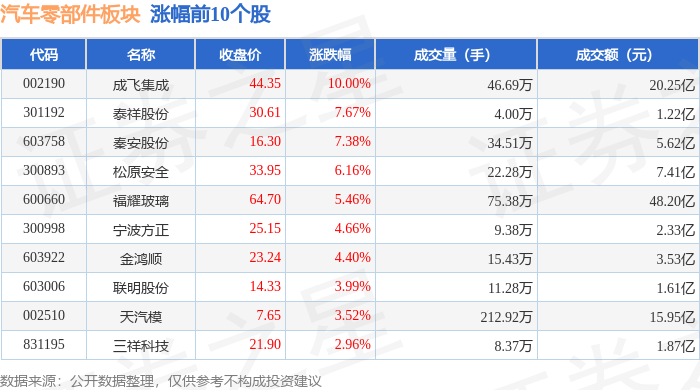
Market Overview - The automotive parts sector experienced a decline of 0.45% on August 21, with Feilong Co. leading the drop [1] - The Shanghai Composite Index closed at 3771.1, up 0.13%, while the Shenzhen Component Index closed at 11919.76, down 0.06% [1] Top Performers - Chengfei Integration (002190) saw a significant increase of 10.00%, closing at 44.35 with a trading volume of 466,900 shares and a transaction value of 2.025 billion [1] - Taixiang Co. (301192) rose by 7.67%, closing at 30.61 with a trading volume of 40,000 shares and a transaction value of 122 million [1] - Qin'an Co. (603758) increased by 7.38%, closing at 16.30 with a trading volume of 345,100 shares and a transaction value of 562 million [1] Underperformers - Feilong Co. (002536) led the decline with a drop of 9.99%, closing at 28.91 with a trading volume of 878,300 shares and a transaction value of 258.3 million [2] - Tenglong Co. (603158) fell by 9.97%, closing at 12.73 with a trading volume of 965,100 shares and a transaction value of 126.3 million [2] - Weichai Heavy Machinery (000880) decreased by 9.43%, closing at 50.72 with a trading volume of 278,000 shares and a transaction value of 144.3 million [2] Capital Flow - The automotive parts sector saw a net outflow of 4.697 billion in main funds, while retail investors contributed a net inflow of 4.052 billion [2] - The sector's overall capital flow indicates a mixed sentiment, with institutional investors withdrawing while retail investors increased their positions [2] Individual Stock Capital Flow - Weichai Power (000338) had a main fund net inflow of 158 million, but saw net outflows from both retail and speculative funds [3] - Top Group (601689) experienced a main fund net inflow of 102 million, with speculative funds showing a net outflow [3] - Zong'an Co. (603758) had a main fund net inflow of 100 million, but also faced significant outflows from speculative and retail investors [3]

里昂:福耀玻璃全球市场份额有望继续增长 目标价升至77港元 重申“跑赢大市”评级
Zhi Tong Cai Jing· 2025-08-21 07:12
Core Viewpoint - Credit Lyonnais reports that Fuyao Glass (600660) will continue to gain market share globally due to capacity expansion and leading technology, raising the target price for Hong Kong shares from HKD 68 to HKD 77, aligning with the A-share target price of RMB 71, maintaining an "outperform" rating for both markets [1] Group 1: Financial Performance - Fuyao Glass's profit margin significantly expanded in the first half of the year, primarily benefiting from efficiency improvements, operational leverage, and reduced raw material costs [1] - The company announced an interim dividend of RMB 0.9 per share, indicating a payout ratio of 49%, with expectations to maintain a payout ratio exceeding 60% from 2025 onwards [1] Group 2: Future Outlook - New production facilities in Fuzhou and Hefei are set to commence operations in November, leading to a gradual decrease in capital expenditures from the RMB 8 billion guidance by 2025 [1] - Continued high R&D spending is expected to provide the company with advantages in the development and production of high value-added products, with anticipated profit improvements in the second half of this year and next year [1]