Shede Spirits (600702)

Search documents
舍得酒业(600702) - 舍得酒业董事会议事规则(2025年11月修订)
2025-11-27 10:31
舍得酒业股份有限公司 董事会议事规则 (于 2025 年 11 月 27 日经公司 2025 年第二次临时股东大会审议通过) 第一章 总则 第一条 为进一步规范舍得酒业股份有限公司(以下简称"公司")董事会的议事 方式和决策程序,促使董事和董事会有效地履行其职责,提高董事会规范运作和科学决 策水平,根据《中华人民共和国公司法》《中华人民共和国证券法》《上市公司治理准则》 《上海证券交易所股票上市规则》和《舍得酒业股份有限公司章程》(以下简称《公司 章程》)等有关规定,制订本规则。 第二条 公司依法设立董事会。董事会是公司的经营决策机构,依据《公司法》等 相关法律、法规和《公司章程》的规定,经营和管理公司的法人财产,对股东会负责。 第三条 董事会下设董秘办,处理董事会日常事务。 董事会秘书兼任董秘办负责人,保管董事会印章。董事会秘书可以指定证券事务代 表等有关人员协助其处理日常事务。 第二章 董事会会议的召集及通知 第四条 董事会会议分为定期会议和临时会议。 董事会每年应当至少在上下两个半年度各召开一次定期会议。 第五条 在发出召开董事会定期会议的通知前,董秘办应当逐一征求各董事的意见, 初步形成会议提案后交董 ...

舍得酒业(600702) - 国浩律师(成都)事务所关于舍得酒业2025年第二次临时股东会的法律意见书
2025-11-27 10:30
国浩律师(成都)事务所 关于 舍得酒业股份有限公司 北京﹒上海﹒深圳﹒杭州﹒广州﹒昆明﹒天津·成都﹒宁波·福州·西安·南京·南宁·济南·重庆·苏州·长沙·太原 武汉·贵阳·乌鲁木齐·郑州·石家庄·合肥·海南·青岛·南昌·大连·香港·巴黎·马德里·硅谷·斯德哥尔摩·纽约 2025 年第二次临时股东会 法律意见书 成都市高新区天府二街 269 号无国界 26 号楼 6、9、10 层 邮编:610000 6F, 9F, 10F, Building 26, No.269 Second Tianfu Street,Hi-TechZone,Chengdu,China 电话/Tel:+862886119970 传真/Fax:+862886119827 网址/Website:http://www.grandall.com.cn 二〇二五年十一月 国浩律师(成都)事务所 法律意见书 国浩律师(成都)事务所 关于舍得酒业股份有限公司 2025 年第二次临时股东会 法律意见书 国浩蓉(2025)律见字第 30181 号 致:舍得酒业股份有限公司 根据国浩律师(成都)事务所(以下简称"本所")与舍得酒业股份有限公司 (以下简称"舍得 ...
舍得酒业(600702) - 舍得酒业2025年第二次临时股东大会决议公告
2025-11-27 10:30
证券代码:600702 证券简称:舍得酒业 公告编号:2025-053 舍得酒业股份有限公司 2025年第二次临时股东大会决议公告 本公司董事会及全体董事保证本公告内容不存在任何虚假记载、误导性陈述 或者重大遗漏,并对其内容的真实性、准确性和完整性承担法律责任。 重要内容提示: 本次会议是否有否决议案:无 一、 会议召开和出席情况 (一)股东大会召开的时间:2025 年 11 月 27 日 (二)股东大会召开的地点:公司艺术中心会议室 (一)非累积投票议案 1、 议案名称:《关于减少注册资本、取消监事会、增加董事会席位并修订<公 司章程>的议案》 审议结果:通过 (三)出席会议的普通股股东和恢复表决权的优先股股东及其持有股份情况: | 1、出席会议的股东和代理人人数 | 677 | | --- | --- | | 2、出席会议的股东所持有表决权的股份总数(股) | 124,443,590 | | 3、出席会议的股东所持有表决权股份数占公司有表决权股 | | | 份总数的比例(%) | 37.8749 | (四)表决方式是否符合《公司法》及《公司章程》的规定,大会主持情况等。 本次股东大会由公司董事会召集,采用 ...
研报掘金丨广发证券:舍得酒业经营拐点或已确立,维持“买入”评级
Ge Long Hui A P P· 2025-11-27 09:22
Core Insights - The report from GF Securities indicates that Shede Spirits has a deep heritage in fine liquor, and after the acquisition by Fosun, the company has undergone comprehensive empowerment, suggesting that an operational turning point may have been established [1] Revenue Growth - The company has achieved rapid revenue growth under the comprehensive transformation, with adjustments made based on external conditions expected to take place in 2024 [1] - Revenue growth in the second and third quarters of 2025 is expected to show significant improvement compared to the first quarter, indicating a potential operational turning point [1] Strategic Adjustments - During the adjustment period, the company has strengthened its internal capabilities in management, product, and channel aspects [1] - The product strategy focuses on "old liquor" as a core differentiating selling point, enhancing the functional value expression of "slow to get drunk, quick to wake up, and more comfortable" [1] Brand Positioning - The dual-brand strategy of "Tuopai + Shede" aims to leverage both high and low-end brands to achieve growth across multiple price segments [1] - The company is positioned to complete its layout in high-end light bottle liquor and the thousand-yuan price range despite market headwinds [1] Valuation - Given the strong recovery elasticity of the company's performance, a 30x PE valuation for 2026 is suggested, corresponding to a reasonable value of 67.15 yuan per share, maintaining a "buy" rating [1]
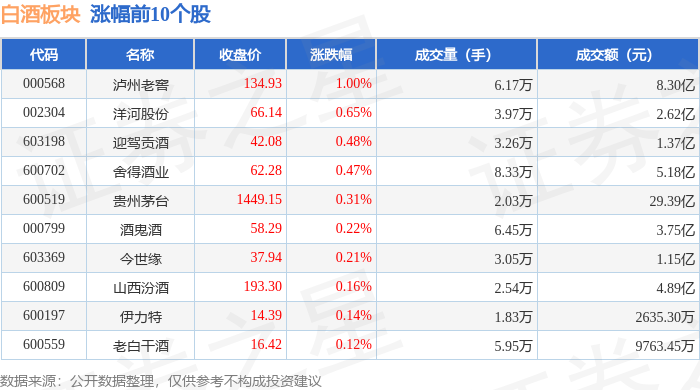
白酒板块11月26日涨0.21%,泸州老窖领涨,主力资金净流出9509.41万元
Zheng Xing Xing Ye Ri Bao· 2025-11-26 09:05
Market Overview - The liquor sector experienced a slight increase of 0.21% on November 26, with Luzhou Laojiao leading the gains [1] - The Shanghai Composite Index closed at 3864.18, down 0.15%, while the Shenzhen Component Index closed at 12907.83, up 1.02% [1] Individual Stock Performance - Luzhou Laojiao (000568) closed at 134.93, up 1.00% with a trading volume of 61,700 hands and a transaction value of 830 million [1] - Yanghe Brewery (002304) closed at 66.14, up 0.65%, with a transaction value of 262 million [1] - Guizhou Moutai (600519) closed at 1449.15, up 0.31%, with a transaction value of 2.939 billion [1] - Other notable stocks include Shanxi Fenjiu (600809) at 193.30, up 0.16%, and Jiu Gui Jiu (000799) at 58.29, up 0.22% [1] Fund Flow Analysis - The liquor sector saw a net outflow of 95.0941 million from main funds, while retail funds had a net inflow of 6.4507 million [2] - Luzhou Laojiao attracted a net inflow of 69.6728 million from main funds, while Guizhou Moutai experienced a net outflow of 64.6471 million from retail funds [3] - The overall fund flow indicates a mixed sentiment among institutional and retail investors within the liquor sector [2][3]





A股白酒年报图鉴:最“有钱”的不是茅台 酒鬼酒等股价增长3倍的逻辑在哪
Mei Ri Jing Ji Xin Wen· 2025-11-24 07:53
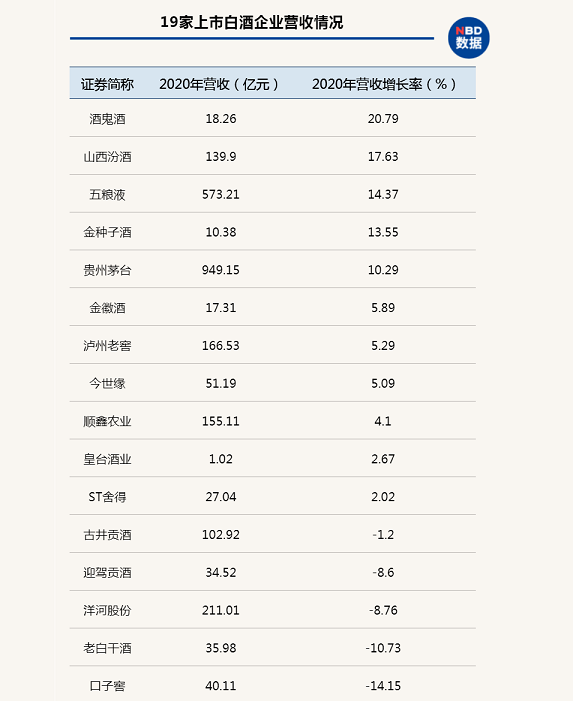
Core Insights - The Chinese liquor market, particularly the baijiu sector, experienced significant growth in 2020, with A-shares leading globally. The overall revenue for 19 listed baijiu companies reached 258.94 billion yuan, a year-on-year increase of 6.58% [1][5] - The net profit attributable to shareholders for these companies totaled 92.068 billion yuan, reflecting a growth of 11.95% compared to the previous year [1][5] - There is a notable divergence in performance among baijiu companies, with leading brands like Moutai and Wuliangye achieving double-digit growth, while some smaller brands faced significant declines [4][9] Revenue Performance - In 2020, 19 listed baijiu companies reported a total revenue of 258.94 billion yuan, with 11 companies showing positive growth and 8 experiencing negative growth [2][5] - The highest revenue growth was recorded by Jiugui Liquor at 20.79%, while Qingqing Qiao experienced a decline of 39.07%, marking a difference of 59.86 percentage points [2][3] - The top three companies by revenue were Moutai (94.915 billion yuan), Wuliangye (57.321 billion yuan), and Yanghe (21.101 billion yuan) [4] Profit Analysis - The six leading baijiu companies accounted for over 90% of the total profits in the sector, with Moutai alone contributing more than 36% of total revenue and over 50% of total profits [7][9] - Moutai's net profit reached 46.697 billion yuan, with a growth rate of 13.33%, while Wuliangye's net profit was 19.955 billion yuan, growing by 14.67% [6][7] - Jiugui Liquor showed remarkable performance with a net profit growth of 64.15%, while Qingqing Qiao reported a significant loss of 1.15 billion yuan [6][7] Market Dynamics - The pandemic initially impacted the baijiu industry negatively, but leading brands demonstrated resilience, with Moutai, Wuliangye, and Shanxi Fenjiu achieving substantial growth [9] - The disparity in performance is evident, with some companies like Shanxi Fenjiu and Jiugui Liquor seeing stock prices increase over threefold, while others struggled [9][11] - The overall tax contributions from the baijiu sector increased significantly, with a 48% rise in the first quarter of 2021 compared to the previous year, attributed to a recovery from the pandemic [14][15] Financial Health - As of March 2021, Wuliangye had the highest cash reserves among listed baijiu companies, totaling 73.38 billion yuan, while Moutai had approximately 50.743 billion yuan [17][18] - The financial strength of these companies is crucial for their ability to invest and expand in a competitive market [17] Compensation Trends - Moutai reported the highest average employee salary in the sector at over 300,000 yuan, while the lowest was at less than 52,000 yuan for Huangtai Liquor [19][20] - The management compensation for Moutai was relatively low compared to other companies, with total management salaries below 3.72 million yuan [21][23]


食品饮料行业周报:白酒筑底配置回暖,大众品细分赛道景气延续-20251123
Huaxin Securities· 2025-11-23 13:35
Investment Rating - The report maintains a "Recommended" investment rating for the food and beverage & commercial sectors [9][56] Core Insights - The white liquor sector is showing signs of bottoming out, with market sentiment improving, presenting a good opportunity for low-level positioning. Recent CPI recovery and consensus on destocking, along with the Double 11 shopping festival, have contributed to this trend. The Federal Reserve's dovish signals on November 21 have also created favorable conditions for the market [5][54] - Long-term prospects for leading liquor companies are promising due to their strong risk resistance and increasing market concentration, supported by domestic demand policies and recovering consumer sentiment. The industry is still in a destocking phase, with demand at a low point [5][54] - The consumer goods sector is experiencing structural differentiation, with the snack food segment remaining robust and soft drink leaders maintaining stability during the off-season. The dairy sector is approaching a supply-demand improvement point, while the restaurant industry is shifting from incremental to stock competition due to demand pressure [55] Summary by Sections Industry News - From January to October, white liquor production decreased by 11.5% [16] - The overall sentiment in the sector is improving, driven by the upcoming holiday season and promotional activities [5][54] Company News - Guizhou Moutai has initiated its annual meeting season for Moutai liquor [4] - Wuliangye is launching a new zodiac-themed product for the Year of the Horse [4] Key Company Feedback - The report highlights key companies with strong long-term investment value, including Guizhou Moutai, Wuliangye, Luzhou Laojiao, and Fenjiu, as well as more flexible stocks like Jiu Gui Jiu and Shede Liquor [5][54][57] Core Data Trends - The cumulative production of white liquor in 2024 is projected at 4.145 million tons, a decrease of 7.72% year-on-year, while industry revenue is expected to reach 796.4 billion yuan, an increase of 5.3% [32][33]

近一个月超140只个股评级调整食品饮料行业上调最多
Zhong Guo Zheng Quan Bao· 2025-11-21 20:09
Core Viewpoint - The A-share market is experiencing a notable shift towards stock selection and sector rotation, with over 50 stocks upgraded and more than 90 downgraded in ratings, indicating a more cautious market sentiment and a focus on structural opportunities in technology, consumption, and dividend sectors [1][2][3]. Stock Rating Adjustments - Over the past month, 52 stocks have been upgraded, with the food and beverage sector having the highest number of upgrades at 7 stocks, followed by electronics and power equipment with 5 each, and pharmaceuticals and light industry with 4 each [1]. - Conversely, 92 stocks have been downgraded across 25 industries, with the automotive sector leading with 12 downgrades, followed by food and beverage with 10, and basic chemicals with 9 [2][3]. Sector Analysis - In the food and beverage sector, several companies such as Baba Foods and Ximai Foods have seen their ratings upgraded due to improved revenue growth and store efficiency [2]. - The electronics sector is expected to benefit from a recovery in terminal demand, with companies like Crystal Technology and Green Link Technology receiving upgrades [2]. - The automotive sector has faced downgrades due to short-term performance pressures, with companies like Meihu and New Spring seeing their ratings lowered [3]. Market Trends and Strategies - Analysts suggest that the market is moving towards a balanced style, with a preference for large-cap stocks and a potential shift towards value stocks [4]. - The focus on growth stocks remains, but the key is whether the underlying valuation logic changes, which could drive future performance [4]. - Investment opportunities are seen in themes such as anti-involution and dividend stocks, with a particular emphasis on technology sectors that align with national strategies and possess real technological barriers [5].



舍得酒业涨2.01%,成交额4.39亿元,主力资金净流入1766.77万元
Xin Lang Cai Jing· 2025-11-20 05:35
Core Insights - Shede Liquor's stock price increased by 2.01% on November 20, reaching 64.30 CNY per share, with a total market capitalization of 21.396 billion CNY [1] - The company experienced a year-to-date stock price decline of 1.84%, with a 4.09% drop over the last five trading days, but a 3.84% increase over the last 20 days [1] Financial Performance - For the period from January to September 2025, Shede Liquor reported a revenue of 3.702 billion CNY, a year-on-year decrease of 17.00%, and a net profit attributable to shareholders of 472 million CNY, down 29.43% year-on-year [2] - The company has distributed a total of 2.29 billion CNY in dividends since its A-share listing, with 1.353 billion CNY distributed over the last three years [2] Shareholder Structure - As of September 30, 2025, the number of shareholders decreased by 11.81% to 114,400, while the average number of circulating shares per person increased by 13.39% to 2,908 shares [2] - Major shareholders include the China Securities White Wine Index A and the Wine ETF, with significant holdings remaining stable or increasing [2]
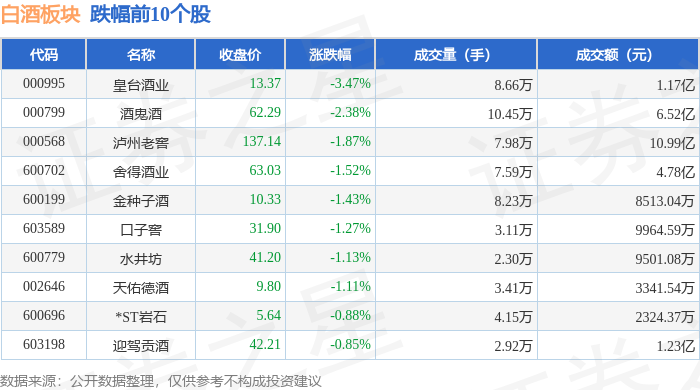
白酒板块11月19日跌0.55%,皇台酒业领跌,主力资金净流出6.91亿元
Zheng Xing Xing Ye Ri Bao· 2025-11-19 08:51
Core Insights - The liquor sector experienced a decline of 0.55% on November 19, with Huangtai Liquor leading the drop [1] - The Shanghai Composite Index closed at 3946.74, up 0.18%, while the Shenzhen Component Index closed at 13080.09, unchanged [1] Liquor Sector Performance - Key stocks in the liquor sector showed varied performance, with Qingdao Wenzhou down 3.47% to 13.37, and Jiu Gui Jiu down 2.38% to 62.29 [1] - Other notable declines included Luzhou Laojiao down 1.87% to 137.14 and Shede Liquor down 1.52% to 63.03 [1] Capital Flow Analysis - The liquor sector saw a net outflow of 6.91 billion yuan from main funds, while retail investors contributed a net inflow of 4.2 billion yuan [1] - The table of capital flow indicates that major stocks like Water Well and Huangtai Liquor experienced significant net outflows from main funds [2]