
CNOOC(600938)

Search documents
美伊仍无达成协议,关键条款差距明显,石油ETF鹏华(159697)涨超2.1%
Sou Hu Cai Jing· 2026-02-27 06:33
Group 1 - Venezuela's Ministry of Oil has suspended 19 oil production sharing contracts signed with private companies during Maduro's administration, but this has not yet affected the country's oil and gas output [1] - During the suspension, the state-owned Petróleos de Venezuela (PDVSA) continues to sell crude oil produced under these contracts [1] - Venezuela and the U.S. will review the contracts and may suggest the cancellation of some, while the qualifications of the signing companies will also be assessed [1] Group 2 - The geopolitical situation, particularly regarding the U.S.-Iran relations, remains uncertain, which supports rising oil prices [1] - Guosen Securities highlights that China's high dependence on foreign oil and gas has led the government to prioritize marine energy as a strategic focus for energy security [1] - The government aims to enhance domestic oil and gas supply capabilities through tax incentives to reduce import costs for marine oil and gas exploration equipment [1] Group 3 - As of February 27, 2026, the Guozhen Oil and Gas Index (399439) rose by 1.99%, with significant gains in constituent stocks such as Shun Oil (+10.00%), Shui Fa Gas (+9.60%), and Jereh (+7.69%) [1] - The oil ETF Penghua (159697) increased by 2.16%, with the latest price reported at 1.46 yuan [1] Group 4 - The Guozhen Oil and Gas Index closely tracks the performance of listed companies in the oil and gas sector on the Shanghai and Shenzhen stock exchanges [2] - As of January 30, 2026, the top ten weighted stocks in the index include China National Petroleum, China National Offshore Oil, and Sinopec, collectively accounting for 66.76% of the index [2]





油气ETF华泰柏瑞(561570)开盘跌0.76%,重仓股中国海油涨0.03%,中国石油跌0.09%
Xin Lang Cai Jing· 2026-02-27 05:41
Core Viewpoint - The oil and gas ETF Huatai-PineBridge (561570) opened with a slight decline of 0.76%, priced at 1.442 yuan, reflecting market fluctuations in the oil and gas sector [1] Group 1: ETF Performance - The performance benchmark for the oil and gas ETF Huatai-PineBridge is the CSI Oil and Gas Industry Index return rate [1] - Since its establishment on October 9, 2024, the fund has achieved a return of 45.25%, with a monthly return of 10.11% [1] Group 2: Major Holdings - Major stocks within the oil and gas ETF include: - CNOOC opened with a slight increase of 0.03% - PetroChina experienced a minor decline of 0.09% - Sinopec saw a rise of 0.15% - Jereh Group decreased by 0.33% - China Merchants Energy increased by 2.50% - Guanghui Energy rose by 0.35% - COSCO Shipping Energy gained 0.29% - Hengli Petrochemical fell by 0.47% - Rongsheng Petrochemical dropped by 0.13% - Continental Oil & Gas decreased by 0.16% [1]
石油ETF鹏华(159697)涨超1.1%,风险溢价推高运价中枢
Sou Hu Cai Jing· 2026-02-27 03:03
Group 1 - The geopolitical tensions between the US and Iran are increasing, leading to a normalization of risk premiums in oil transportation and raising freight rates [1] - In the short term, the crisis in the Strait of Hormuz is expected to trigger a large-scale rush for oil transport, resulting in a spike in oil and freight prices [1] - In the medium to long term, Iran may shift towards compliant markets, improving the supply-demand dynamics for VLCCs (Very Large Crude Carriers) [1] Group 2 - Sinokor, a South Korean shipowner, is significantly increasing its VLCC capacity, controlling/operating 120 VLCCs, which accounts for 18% of the compliant VLCC market capacity and 14% of the global VLCC capacity [1] - By the end of 2026, Sinokor's capacity is expected to reach approximately 158 VLCCs, representing 24% of the compliant VLCC market capacity [1] - The VLCC market is transitioning from a relatively fragmented structure to an oligopoly, with stricter sanctions from the US and Europe on non-compliant capacities, making compliant capacity a core asset and enhancing shipowners' bargaining power [1] Group 3 - As of February 27, 2026, the Guozheng Oil and Gas Index (399439) has risen by 0.86%, with significant increases in stocks such as Shun Oil (+10.00%) and Zhenwei (+6.30%) [2] - The Guozheng Oil and Gas Index reflects the price changes of publicly listed companies related to the oil and gas industry in the Shanghai and Shenzhen stock exchanges [2] - The top ten weighted stocks in the Guozheng Oil and Gas Index account for 66.76% of the index, including major companies like China National Petroleum, CNOOC, and Sinopec [2]



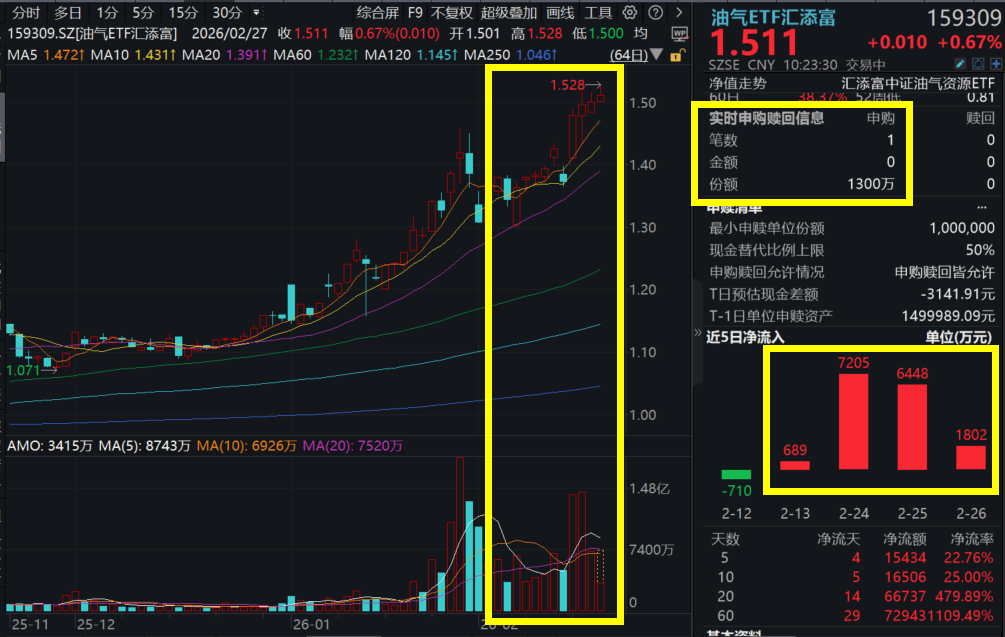
油价再度飙升,油气板块冲高!油气ETF汇添富(159309)盘中价创新高,冲击四连阳,强势吸金超1800万元!关注地缘局势影响下的石油板块!
Sou Hu Cai Jing· 2026-02-27 02:46
Core Viewpoint - The oil and gas sector in the A-share market is experiencing significant inflows, with the oil and gas ETF Huatai-PineBridge (159309) reaching new highs and attracting substantial capital over recent days [1][3]. Group 1: Market Performance - As of February 27, the oil and gas ETF Huatai-PineBridge (159309) rose by 0.67%, marking a new intraday high and aiming for a fourth consecutive day of gains, with a total inflow of 180 million yuan [1]. - The ETF has seen a strong capital influx, accumulating over 1.6 billion yuan in the previous four days [1]. - The performance of the underlying index components is mixed, with stocks like Jereh Group rising over 3% and China Oilfield Services experiencing a slight decline [3]. Group 2: Oil Prices and Geopolitical Factors - As of the latest reports, West Texas Intermediate (WTI) crude oil closed at $65.47 per barrel, while Brent crude oil was at $71.03 per barrel, supported by geopolitical tensions in the Middle East despite a significant increase in U.S. crude oil inventories by 16 million barrels [5]. - The geopolitical situation, particularly concerning U.S.-Iran relations, is driving oil prices, with expectations of high volatility in the coming month [6]. - The ongoing geopolitical conflicts are reshaping global energy flows and increasing concerns about supply disruptions, which have led to a rise in oil prices and freight rates [7]. Group 3: Investment Insights - The oil and gas ETF Huatai-PineBridge (159309) is noted for its focus on key oil and gas companies, providing a combination of high dividend yields and energy defensive attributes, with lower fees compared to other fund types [8]. - The ETF's underlying assets are closely tied to major oil companies, ensuring a concentrated investment in firms with quality reserves and stable dividend capabilities [8]. - The ETF is characterized by a streamlined sample size, currently comprising 44 stocks, ensuring a focus on leading oil and gas companies [8].


国信证券:税收优惠政策支持海洋油气开发及天然气进口利用 有助推动深海油气田开发
智通财经网· 2026-02-27 02:31
Core Viewpoint - The report from Guosen Securities highlights the implementation of tax incentives for the petrochemical industry, aimed at reducing the import tariffs on core equipment for marine exploration and development, thereby lowering overall project costs and enhancing internal rates of return [1] Group 1: Policy Changes - On February 13, 2026, the Ministry of Finance, General Administration of Customs, and State Taxation Administration announced tax incentives for energy resource exploration and development during the 14th Five-Year Plan period, including exemptions from import tariffs for equipment directly used in oil and gas exploration and emergency rescue projects [1] - The policy also includes exemptions from import tariffs and value-added tax for equipment used in cooperative oil and gas exploration projects that cannot be produced domestically or do not meet performance requirements [1] - Additionally, there is a mechanism for the return of value-added tax on imported natural gas for approved cross-border gas pipeline projects and LNG receiving and storage facilities, which helps mitigate cost fluctuations [1] Group 2: Industry Implications - The high dependence on foreign oil and gas in China has led the government to prioritize marine energy as a strategic focus for energy security, with tax incentives aimed at enhancing domestic oil and gas supply capabilities [2] - Imported natural gas plays a significant role in China's gas supply but is subject to high prices and volatility; the tax return mechanism for eligible imported natural gas is intended to support energy security [2] Group 3: Investment Recommendations - The report suggests monitoring companies such as China National Offshore Oil Corporation (CNOOC), CNOOC Services, and CNOOC Development in relation to marine oil and gas exploration [2] - For imported natural gas, it recommends paying attention to China National Petroleum Corporation (CNPC) and CNOOC [2]



石油ETF鹏华(159697)涨超1.1%,美伊谈判不断反复,扰动原油市场
Sou Hu Cai Jing· 2026-02-27 01:54
Group 1 - The core viewpoint of the articles highlights the ongoing geopolitical tensions between the US and Iran, which are significantly impacting the oil market, leading to increased volatility and a shift from supply-demand dynamics to geopolitical risk-driven factors [1] - Iran has rejected transferring its enriched uranium abroad during indirect negotiations with the US, insisting on its right to peaceful nuclear technology and the ability to produce nuclear fuel, while demanding the lifting of US sanctions [1] - The market is expected to experience high volatility in oil prices over the next month, with a tendency for prices to rise due to geopolitical issues, suggesting a focus on upstream companies with oil and gas resources and offshore oil and gas service engineering sectors [1] Group 2 - As of January 30, 2026, the top ten weighted stocks in the National Petroleum and Natural Gas Index (399439) include major companies such as China National Petroleum, China National Offshore Oil, and Sinopec, collectively accounting for 66.76% of the index [2] - The National Petroleum and Natural Gas Index reflects the price changes of publicly listed companies related to the oil and gas industry on the Shanghai and Shenzhen stock exchanges [1][2]

税收优惠政策支持海洋油气开发及天然气进口利用
Zhong Guo Neng Yuan Wang· 2026-02-27 01:53
Core Viewpoint - The report highlights the increasing global spending on offshore oil and gas exploration, which is driving a rapid rise in offshore oil and gas reserves and production [1][4]. Group 1: Offshore Oil and Gas Exploration Spending - Offshore oil and gas exploration spending significantly declined in 2020 due to the pandemic but has rebounded, surpassing $100 billion in 2022, with expectations to maintain this level in the coming years, indicating a high level of activity in the offshore oil and gas sector [1][4]. - The average annual discovered oil and gas reserves from 2000 to 2010 were 35 billion barrels of oil equivalent, with deepwater discoveries accounting for 30%. From 2011 to 2023, the average annual discovery dropped to 18 billion barrels of oil equivalent, but deepwater discoveries increased to 51% of total discoveries [4]. Group 2: Policy Implications - The Ministry of Finance, Customs, and the State Taxation Administration announced tax incentives for energy resource exploration and development during the 14th Five-Year Plan, including exemptions on import tariffs for essential equipment used in offshore oil and gas exploration [2][3]. - The policy aims to reduce the import costs of offshore oil and gas exploration equipment, enhancing domestic oil and gas supply capabilities and ensuring national energy security [2][3]. Group 3: Investment Recommendations - The tax exemptions on core equipment for offshore exploration are expected to lower procurement costs and improve internal rates of return for projects, particularly in deepwater oil fields. Companies to watch include China National Offshore Oil Corporation (CNOOC), China Oilfield Services Limited, and CNOOC Development [3][9]. - The mechanism for VAT refunds on imported natural gas will help stabilize costs, especially during periods of high gas prices, making companies like China National Petroleum Corporation and CNOOC attractive for investment [3][9]. Group 4: Natural Gas Supply and Pricing - Natural gas plays a crucial role in China's energy supply, with consumption projected to reach 4,320 billion cubic meters by 2025, and imports are essential despite their higher and more volatile prices [7][8]. - The government has implemented measures to refund VAT on certain imported natural gas, which will help mitigate price fluctuations and stabilize expectations for importers, thereby enhancing energy security [8].
中国海油2月26日获融资买入1.39亿元,融资余额17.22亿元
Xin Lang Cai Jing· 2026-02-27 01:28
Group 1 - The core viewpoint of the news is that China National Offshore Oil Corporation (CNOOC) experienced a decline in stock price and trading volume, with a notable net financing outflow on February 26 [1] - On February 26, CNOOC's stock fell by 2.53%, with a trading volume of 1.603 billion yuan, and a net financing outflow of 53.43 million yuan [1] - As of February 26, the total financing and securities lending balance for CNOOC was 1.731 billion yuan, with a financing balance of 1.722 billion yuan, accounting for 1.62% of the circulating market value [1] Group 2 - CNOOC was established on August 20, 1999, and listed on April 21, 2022, primarily engaged in the exploration, production, and sales of crude oil and natural gas [2] - The company's revenue composition includes 82.73% from oil and gas sales, 14.96% from trading, and 2.31% from other activities [2] - For the period from January to September 2025, CNOOC reported a revenue of 312.503 billion yuan, a year-on-year decrease of 4.15%, and a net profit attributable to shareholders of 101.971 billion yuan, down 12.59% year-on-year [2] Group 3 - CNOOC has distributed a total of 255.995 billion yuan in dividends since its A-share listing, with 179.051 billion yuan distributed over the past three years [3] - As of September 30, 2025, the number of CNOOC shareholders was 216,500, a decrease of 7.02% from the previous period [3] - The largest circulating shareholder, Hong Kong Central Clearing Limited, has exited the top ten shareholders list [3]
行业政策点评:税收优惠政策支持海洋油气开发及天然气进口利用
Guoxin Securities· 2026-02-26 12:38
Investment Rating - The investment rating for the industry is "Outperform the Market" (maintained) [3][26]. Core Insights - The report highlights the support of tax incentives for marine oil and gas development and natural gas import utilization, aiming to enhance domestic oil and gas supply capabilities and ensure national energy security [4][5]. - The report emphasizes the increasing importance of imported natural gas in China's energy supply, with a focus on stabilizing costs through tax refunds on eligible imports [5][14]. - The marine oil and gas sector is identified as a strategic focus for future development, with significant investments expected to continue in the coming years [6][9]. Summary by Sections Industry Policy Commentary - The Ministry of Finance, Customs, and the State Taxation Administration issued a notification on tax incentives for energy resource exploration and development during the 14th Five-Year Plan period, including exemptions on import duties for essential equipment used in marine oil and gas exploration [4]. - The policy aims to reduce the import costs of marine oil and gas exploration equipment, thereby enhancing project internal rates of return and promoting deep-sea oil and gas field development [5][22]. Market Trends - Global marine oil and gas exploration spending has been on the rise, with investments exceeding $100 billion in 2022 and expected to remain high in the coming years [6]. - China's marine oil and gas exploration and production expenditures are projected to continue increasing, with CNOOC's capital expenditure for 2024 estimated at 132.7 billion yuan, reflecting a growth trend [9]. Investment Recommendations - The report suggests focusing on companies such as CNOOC, CNOOC Services, and CNOOC Development due to the favorable tax policies that will lower equipment procurement costs and enhance project profitability [5][22]. - It also recommends monitoring China National Petroleum Corporation (CNPC) and CNOOC in light of the tax refund mechanism for imported natural gas, which is expected to mitigate cost fluctuations, especially during high gas price periods [5][22].
石油石化行业政策点评:税收优惠政策支持海洋油气开发及天然气进口利用
Guoxin Securities· 2026-02-26 12:07
Investment Rating - The investment rating for the industry is "Outperform the Market" (maintained) [3][26]. Core Insights - The report highlights the support of tax incentives for marine oil and gas development and natural gas import utilization, aiming to enhance domestic oil and gas supply capabilities and ensure national energy security [4][5]. - The report emphasizes the increasing importance of imported natural gas in China's energy supply, with a focus on stabilizing costs through tax refunds on eligible imports [5][14]. - The marine oil and gas sector is identified as a key area for future development, with significant investments expected to continue in the coming years, reflecting high industry prosperity [6][9]. Summary by Sections Industry Policy Commentary - The Ministry of Finance, General Administration of Customs, and State Taxation Administration issued a notification on tax incentives for energy resource exploration and development during the 14th Five-Year Plan period, which includes exemptions from import tariffs for essential equipment used in marine oil and gas exploration and emergency rescue projects [4]. - The policy aims to reduce the import costs of marine oil and gas exploration equipment, thereby enhancing the internal rate of return on projects and promoting the development of deep-sea oil and gas fields [5][22]. Investment Recommendations - The report suggests focusing on companies such as China National Offshore Oil Corporation (CNOOC), CNOOC Services, and CNOOC Development, as the tax incentives will lower procurement costs and improve project profitability [5][22]. - It also recommends paying attention to China National Petroleum Corporation (CNPC) and CNOOC, as the tax refund mechanism for imported natural gas will help mitigate cost fluctuations, especially during periods of high gas prices [5][22]. Market Trends - Global marine oil and gas exploration spending is on the rise, with investments expected to remain above $100 billion in the coming years, indicating a robust market outlook [6]. - China's marine oil and gas exploration and production expenditures are projected to continue increasing, with significant capital expenditures planned for 2024 and 2025 [9][14].