
CNOOC(600938)

Search documents
8年累计签约金额超 890亿美元
Zhong Guo Zi Ran Zi Yuan Bao· 2025-11-13 05:51
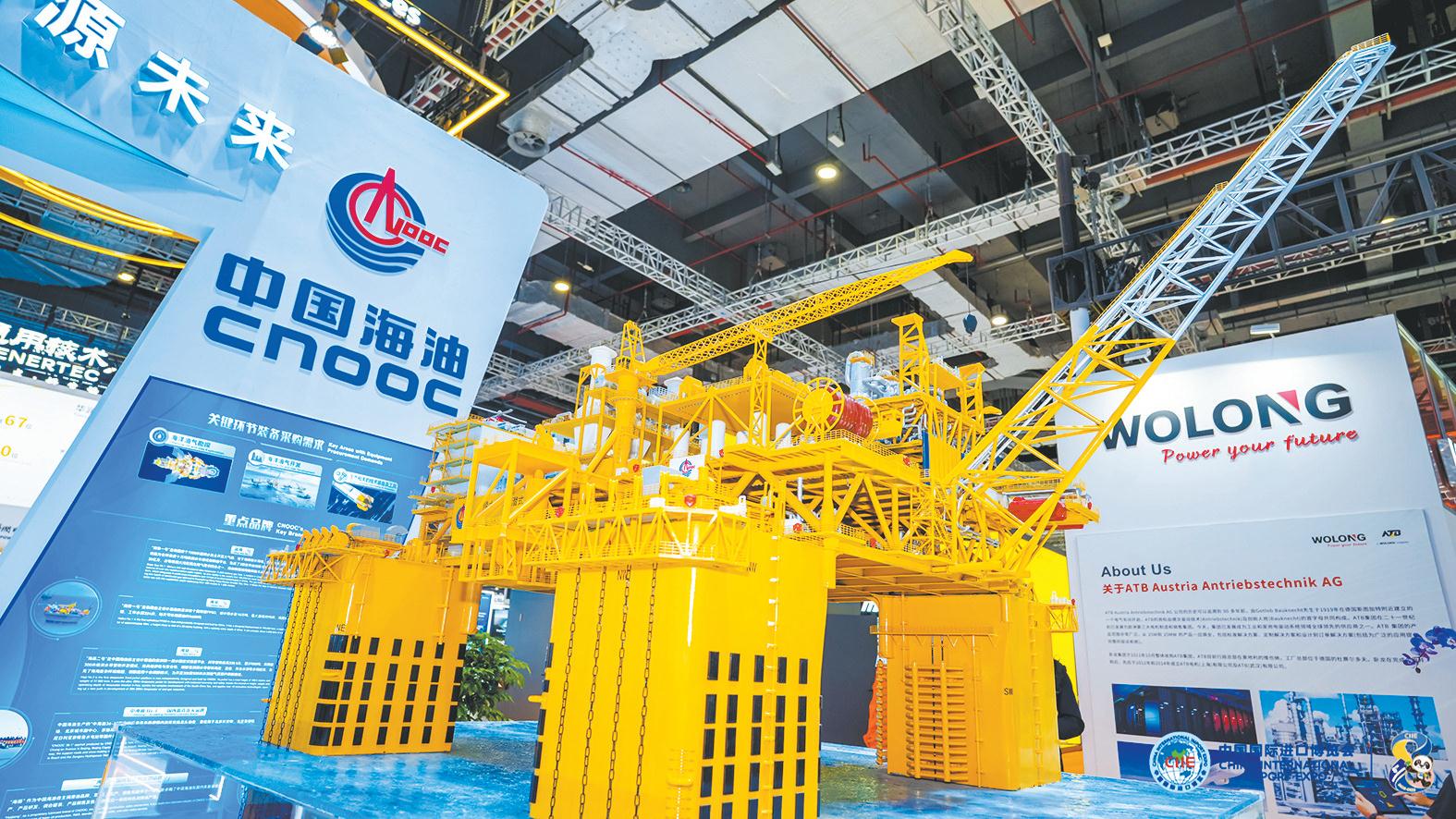
Core Insights - The eighth China International Import Expo (CIIE) saw China National Offshore Oil Corporation (CNOOC) sign contracts exceeding $13 billion, marking a historical high for a single CIIE event [2] Group 1: Contract Details - The signed contracts cover products including crude oil, natural gas, deepwater oil and gas equipment, and advanced technology services, indicating an ongoing optimization and upgrade in procurement structure [2] - Since the first CIIE, CNOOC has signed import contracts and agreements with over 100 global suppliers from more than 30 countries and regions, accumulating a total contract value exceeding $89 billion over 8 years [2] Group 2: Trade Volume - CNOOC has conducted oil trade exceeding 900 million tons and imported over 22 million tons of LNG, which accounts for 43% of China's total LNG imports [2] Group 3: Procurement Initiatives - The current CIIE introduced a dedicated procurement corridor, inviting large state-owned enterprises with strong purchasing power to participate, enhancing direct communication and collaboration opportunities between CNOOC and exhibitors [2]


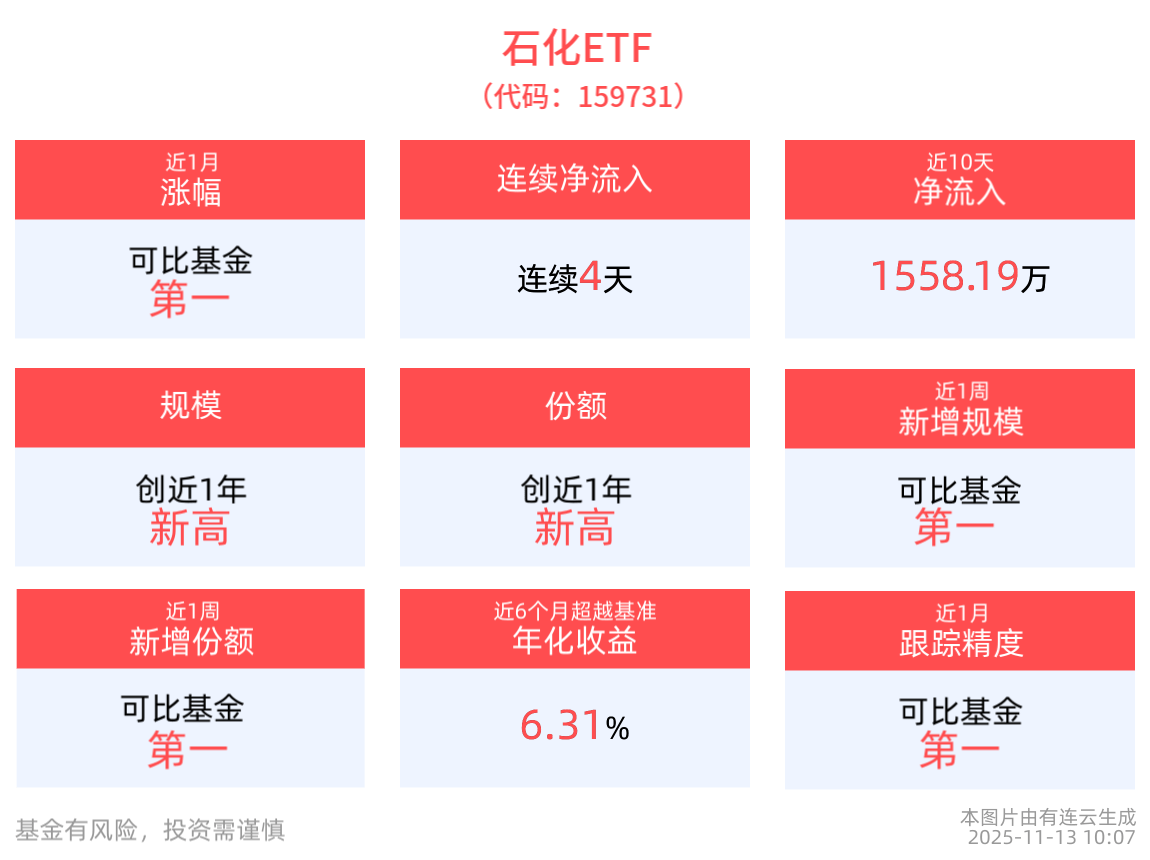
石化ETF(159731)连续4天获资金净流入,成分股联泓新科一字涨停
Sou Hu Cai Jing· 2025-11-13 02:35
Core Insights - The China Petroleum and Chemical Industry Index has shown a positive trend, with a 0.98% increase as of November 13, 2025, and significant gains in constituent stocks such as Lianhong Xinke and Cangge Mining [1] - The Petrochemical ETF (159731) has also performed well, with a 0.95% increase and a notable 6.83% rise over the past week, indicating strong investor interest [1][4] - The ETF has seen a net inflow of 8.41 million yuan over the last four days, reaching a total share count of 201 million and a scale of 170 million yuan, both marking a one-year high [1] Performance Metrics - The Petrochemical ETF has recorded a 27.44% increase in net value over the past six months, with a maximum monthly return of 15.86% since its inception [4] - The ETF has outperformed its benchmark with an annualized excess return of 6.31% over the last six months [4] - The top ten weighted stocks in the index account for 56.05% of the total, with Wanhua Chemical and China Petroleum being the most significant contributors [4] Stock Performance - Key stocks and their performance include: - Wanhua Chemical: +0.04%, 10.47% weight - China Petroleum: -0.80%, 7.63% weight - Salt Lake Co.: +6.06%, 6.44% weight - China Petroleum & Chemical: -1.05%, 6.44% weight - Cangge Mining: +6.30%, 3.82% weight [6]



港股异动丨三桶油回调 中国海洋石油跌2.5%昨日曾创新高 国际油价大跌
Ge Long Hui· 2025-11-13 02:21
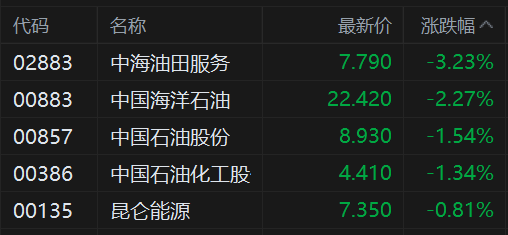
Group 1 - International oil prices have declined, leading to a collective pullback in Hong Kong oil stocks, with CNOOC Services down 3.2%, China National Offshore Oil Corporation down 2.5%, China Petroleum & Chemical Corporation down 1.3%, and Kunlun Energy down nearly 1% [1] - OPEC has revised its oil market outlook to indicate a surplus, with WTI December crude futures closing down $2.55, a 4.18% drop, at $58.49 per barrel, and Brent January crude futures down $2.45, a 3.76% drop, at $62.71 per barrel [1] - OPEC's latest monthly oil market report shows that in October, the combined daily oil production of OPEC and non-OPEC major oil-producing countries was 43.02 million barrels, a decrease of 73,000 barrels from September [1] Group 2 - The global oil market has shifted from a daily shortfall of 400,000 barrels to a daily surplus of 500,000 barrels, indicating a structural surplus due to unexpected growth in U.S. oil production [1]



港股开盘 | 恒指低开0.53% 华润万象生活(01209)跌近8%
智通财经网· 2025-11-13 01:40
Group 1 - The Hang Seng Index opened down 0.53%, with the Hang Seng Tech Index falling 0.82%. China National Offshore Oil Corporation dropped over 2%, and China Petroleum & Chemical Corporation fell over 1%. China Resources Mixc Lifestyle Services Limited saw a decline of nearly 8% as its controlling shareholder, China Resources Land Limited, proposed to place shares at HKD 41.7 each [1] - Guotai Junan Securities indicated that the foundation for a bull market in Hong Kong stocks remains intact, but the evolution is likely to be characterized by "oscillating upward with a gradually rising center" rather than a rapid one-sided increase. The fundamental drivers in November are strong, emphasizing the value of high-prosperity sectors [1][2] - Wang Qian from Yongying Fund noted that the recent adjustment in Hong Kong stocks is mainly due to weakened upward momentum and increased uncertainties, leading some investors to take profits. Additionally, the market remains uncertain about the Federal Reserve's interest rate cuts in December [1][2] Group 2 - Market focus will shift towards policy implementation and interest rate trends by year-end. As valuations of Hong Kong stocks become more attractive next year, a confirmed trend reversal in U.S. interest rates or clearer signals of domestic economic recovery could help the market regain upward momentum. Key sectors to watch include internet, high dividends, and high-end manufacturing [2] - The valuation of the Hang Seng Internet Technology Index is currently at a PE ratio of 21.45, which is at a historical low of 16.09% over the past decade, indicating significant valuation recovery potential [2][3] - The core narrative of Hong Kong's internet sector is shifting from user growth and business models to new growth curves driven by AI empowerment [2] Group 3 - Zhang Xia, Chief Strategy Analyst at招商证券, stated that the Hang Seng Tech Index is one of the few indices with a current PE ratio below its historical average, indicating substantial valuation recovery potential [3] - The Hong Kong market is primarily driven by liquidity, and uncertainties in external liquidity may lead to short-term oscillations. However, in the medium to long term, the opening of the U.S. interest rate cut cycle and the end of the Fed's balance sheet reduction could lead to a resonance of easing policies between China and the U.S. [3] - The current economic fundamentals in China are stable and improving, with continuous policy support, which has significantly boosted market confidence [3][4] Group 4 - Guotai Haitong Securities highlighted that the current position of Hong Kong stocks is not high compared to historical and overseas levels, suggesting potential for upward movement. The market is expected to attract over 1.5 trillion yuan in inflows next year due to low allocation and the backdrop of U.S. interest rate cuts [4] - Hong Kong is seen as a gathering place for innovative assets, with sectors like internet, new consumption, innovative pharmaceuticals, and dividends expected to support the ongoing bull market [4] - JPMorgan noted that the current valuation of Hong Kong stocks remains relatively low, supported by multiple favorable factors, and anticipates that the current rally will continue into next year [4][5]
派驻中管企业纪检监察机构认真学习领会全会精神
Zhong Yang Ji Wei Guo Jia Jian Wei Wang Zhan· 2025-11-13 00:51
Group 1 - The 20th Central Committee emphasizes the importance of enhancing the technological innovation capabilities of state-owned enterprises (SOEs) to achieve high-level self-reliance in technology [1][2] - Central enterprises are identified as key players in the national innovation chain, with a focus on gathering innovation resources and supporting enterprises in leading innovation consortiums [1][2] - The Central Commission for Discipline Inspection (CCDI) is actively engaging with SOEs to ensure compliance with the latest requirements for technological innovation as outlined in the 20th Central Committee's decisions [1][3] Group 2 - China National Offshore Oil Corporation (CNOOC) is under continuous supervision to promote the development of key core technologies and enhance major equipment and technical capabilities [2][3] - The CCDI emphasizes a long-term commitment to supervision in the field of technological innovation, focusing on areas such as oil and gas resource enhancement, deep-water development, and high-end marine equipment manufacturing [2][3] - The National Oil and Gas Pipeline Group is enhancing oversight on key technology research and the transformation of scientific achievements, ensuring that the board fulfills its responsibilities in technological innovation [3][4] Group 3 - The South-to-North Water Diversion Group is implementing a supervision plan for critical research projects, particularly focusing on the challenging geological conditions of the Yangtze River to Han River project [4][5] - The CCDI is guiding the South-to-North Water Diversion Group to strengthen the management of research projects, ensuring that technical talent is involved in decision-making and results transformation [5] - The emphasis is placed on the integration of production and research to ensure high-quality construction of the water diversion project, aligning with national water security and ecological protection goals [5]
万亿港元南向资金爆买港股,重点板块、个股曝光
2 1 Shi Ji Jing Ji Bao Dao· 2025-11-12 15:06
Core Viewpoint - The Hong Kong stock market has reached a milestone with cumulative net purchases from southbound funds exceeding 5 trillion HKD, reflecting unprecedented enthusiasm from mainland investors [1][4][5]. Group 1: Southbound Fund Inflows - As of November 11, southbound funds have recorded a net inflow of 1.31 trillion HKD in 2023, marking a historical high for the year [4][5]. - The inflow of southbound funds has accelerated, with 16 consecutive trading days of net purchases, and only 3 out of 23 trading days in October showing net outflows [5][9]. - The Hong Kong stock market has demonstrated significant profitability, with major indices like the Hang Seng Index and Hang Seng Tech Index rising over 30% this year [3]. Group 2: Investment Strategy Shift - There has been a notable shift in investment strategy among southbound funds, moving from a growth-oriented "offensive" approach to a focus on high-dividend "defensive" stocks [9][10]. - Financials have become the core asset for southbound funds, accounting for 39% of net purchases since 2025, with the top three sectors being financials, information technology, and consumer discretionary [9][10]. - The recent trend shows a significant reduction in holdings of high-growth, high-valuation sectors like pharmaceuticals and technology, while increasing investments in traditional sectors such as banking and oil, which offer low valuations and high dividend yields [10][11]. Group 3: Market Dynamics and Future Outlook - Analysts attribute the continued inflow of southbound funds to the low valuations and high dividend yields in the Hong Kong market, making it an attractive investment destination [6][7]. - The market is witnessing a rotation towards high-dividend sectors, with stocks like China National Offshore Oil Corporation gaining favor due to their strong dividend attributes [10]. - Despite the current defensive posture, there is potential for growth in undervalued quality stocks, suggesting future opportunities for a shift back to an offensive strategy [11].

万亿港元南向资金爆买港股,重点板块、个股曝光
21世纪经济报道· 2025-11-12 14:48
Core Viewpoint - The Hong Kong stock market has reached a milestone with cumulative net purchases from southbound funds exceeding 50 billion HKD, reflecting unprecedented enthusiasm from mainland investors for Hong Kong stocks [1][3]. Group 1: Southbound Fund Inflows - Southbound funds have recorded a net inflow of 1.31 trillion HKD in 2023, marking a historical high for the year, which is over 60% higher than the previous record of 810 billion HKD in 2024 [3]. - The Hang Seng Index and Hang Seng Tech Index have both seen gains exceeding 30% this year, with the Hong Kong Stock Connect Innovative Drug Index rising over 80% [3]. - The low valuation and high dividend yield of Hong Kong stocks are key factors driving the inflow of southbound funds [3][4]. Group 2: Investment Strategy Shift - There has been a notable shift in the investment strategy of southbound funds from a growth-oriented "offensive" approach to a more defensive strategy emphasizing high dividend yields [5][6]. - Financials have become the core asset for southbound funds, accounting for 39% of net purchases since 2025, with the top three sectors being financials, information technology, and consumer discretionary [6]. - A significant example of this shift is the movement of funds from Alibaba to China National Offshore Oil Corporation, with Alibaba experiencing a net sell-off of approximately 11 billion HKD in market value over the past month [6][7]. Group 3: Sector Rotation - Southbound funds are increasingly favoring high dividend sectors while reducing exposure to high-growth, high-valuation sectors such as pharmaceuticals, electronics, media, and computing [7]. - Traditional industries like banking, oil and gas, telecommunications, and coal are attracting significant inflows due to their low valuations and high dividend yields, becoming a "safe haven" for investors [7][8]. - The market's risk appetite appears to be shifting towards a more conservative stance, focusing on high dividend stocks rather than technology stocks [7].

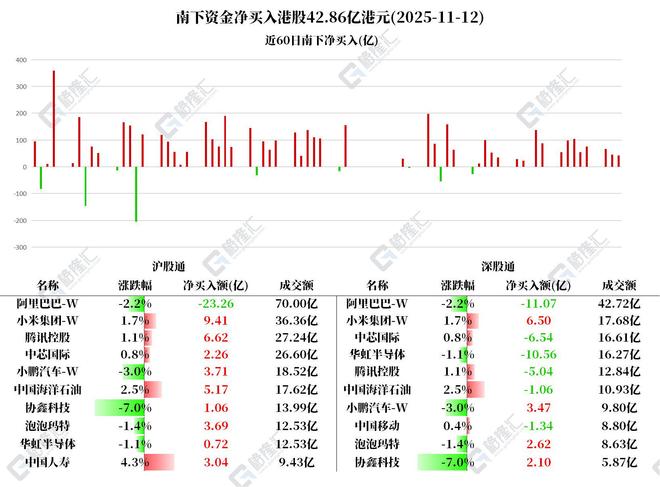
图解丨南下资金净卖出阿里超34亿港元,净买入小米16亿
Xin Lang Cai Jing· 2025-11-12 10:04
Core Insights - Southbound funds net bought Hong Kong stocks worth 4.286 billion HKD today, with significant purchases in Xiaomi, Xpeng Motors, and Pop Mart [1] Group 1: Net Purchases - Xiaomi Group-W saw a net purchase of 1.592 billion HKD, marking 11 consecutive days of net buying totaling 8.13635 billion HKD [1] - Xpeng Motors had a net purchase of 717 million HKD [1] - Pop Mart recorded a net purchase of 630 million HKD, with 3 consecutive days of net buying totaling 1.45466 billion HKD [1] - China National Offshore Oil Corporation (CNOOC) had a net purchase of 411 million HKD, with 4 consecutive days of net buying totaling 2.82105 billion HKD [1] - GCL-Poly Energy net bought 316 million HKD [1] - China Life Insurance saw a net purchase of 303 million HKD [1] - Tencent Holdings had a net purchase of 157 million HKD [1] Group 2: Net Sales - Alibaba-W experienced a net sell-off of 3.434 billion HKD, with 5 consecutive days of net selling totaling 6.78084 billion HKD [1] - Hua Hong Semiconductor had a net sell of 984 million HKD, with 3 consecutive days of net selling totaling 1.52638 billion HKD [1] - Semiconductor Manufacturing International Corporation (SMIC) saw a net sell of 427 million HKD, with 3 consecutive days of net selling totaling 1.08281 billion HKD [1] - China Mobile experienced a net sell of 133 million HKD [1] - Meituan had a net sell of 461.21 million HKD, with 4 consecutive days of net selling totaling 4.6121 billion HKD [1]



石油石化行业11月12日资金流向日报
Zheng Quan Shi Bao Wang· 2025-11-12 09:32
Market Overview - The Shanghai Composite Index fell by 0.07% on November 12, with 11 sectors experiencing gains, led by household appliances and comprehensive sectors, which rose by 1.22% and 1.05% respectively [1] - The oil and petrochemical sector increased by 0.84%, while the power equipment and machinery sectors saw declines of 2.10% and 1.23% respectively [1] Capital Flow Analysis - The main capital outflow from the two markets totaled 58.897 billion yuan, with five sectors seeing net inflows. The pharmaceutical and biological sector led with a net inflow of 2.402 billion yuan and a daily increase of 0.61% [1] - The banking sector followed with a net inflow of 1.810 billion yuan and a daily increase of 0.50% [1] - The power equipment sector experienced the largest net outflow, totaling 17.743 billion yuan, followed by the computer sector with a net outflow of 6.711 billion yuan [1] Oil and Petrochemical Sector Performance - The oil and petrochemical sector had a net inflow of 476 million yuan, with 28 out of 47 stocks in the sector rising, including two hitting the daily limit [2] - The top stock by net inflow was Sinopec Oilfield Service, with an inflow of 229.74 million yuan, followed by China National Offshore Oil Corporation and Zhun Oil Co., with inflows of 160.40 million yuan and 129.19 million yuan respectively [2] - Notable outflows included China National Petroleum Corporation, with a net outflow of 97.03 million yuan, and Tongkun Co. with 60.43 million yuan [2][3]


研报掘金丨国金证券:首予中国海油“买入”评级,目标股价32.88元
Ge Long Hui A P P· 2025-11-12 08:58
Core Viewpoint - China National Offshore Oil Corporation (CNOOC) has significantly reduced its oil and gas production costs in recent years, resulting in a strong competitive advantage in the international market [1] Cost and Profitability - CNOOC's production costs are comparable to major U.S. shale oil companies, indicating robust competitiveness [1] - The company is expected to achieve a net profit of $27.19 per barrel in 2024, while PetroChina and Sinopec's exploration and production segments are projected to have net profits of $8.69 and $15.20 per barrel, respectively [1] Capital Expenditure and Valuation - CNOOC maintains a high level of capital expenditure (CAPEX), supporting stable growth in both reserves and production [1] - The company's valuation metrics, such as PE, EV/EBITDA, and PB, are approximately 20%-50% lower than those of major international oil companies like ExxonMobil, indicating a valuation advantage [1] Market Outlook - According to EIA forecasts, the international oil market is expected to remain in a state of oversupply, with oil prices likely to experience short-term fluctuations downward [1] - CNOOC is assigned a target price of 32.88 yuan based on a 12x valuation for 2025, with an initial "buy" rating [1]
