
CSEC,China Shenhua(601088)

Search documents
大行评级|大摩:中国神华盈利预告大致符合预期,评级“增持”
Ge Long Hui· 2026-02-02 03:58
摩根士丹利发表研报指,中国神华预期2025年净利润将按年下降7%至16%,至495亿至545亿元,大致 符合市场预期。该行按此推算,预计公司上季净利润将介乎104亿至154亿元,相较2024年同期则为153 亿元。大摩续指,短期内矿井端供应减少支撑着动力煤价格,随着农历新年假期临近,下游补库需求略 为回升。国内煤炭总供应仍然充足。另一方面,由于水电、太阳能等可再生能源发电量上升,需求可能 出现温和下滑。疲弱的行业基本面将对动力煤价格及中国神华的盈利构成压力。然而,持续的成本管控 以及资产注入带来的预期产量增长,将为盈利提供更高稳定性。该行予中国神华H股目标价44.1港元, 评级为"增持"。 ...

港股中国神华(01088.HK)跌超4%
Mei Ri Jing Ji Xin Wen· 2026-02-02 03:00
每经AI快讯,中国神华(01088.HK)跌超4%,截至发稿,跌4.6%,报41.04港元,成交额2.75亿港元。 (文章来源:每日经济新闻) ...

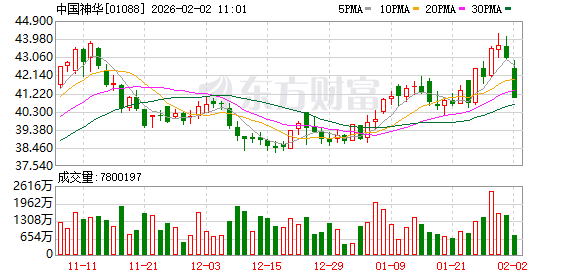
港股异动 | 中国神华(01088)跌超4% 煤炭销量及均价下降 预计去年利润同比减少6.3%至14.7%
智通财经网· 2026-02-02 02:53
中国神华(01088)跌超4%,截至发稿,跌4.6%,报41.04港元,成交额2.75亿港元。 消息面上,1月30日晚,中国神华公布,预计集团2025年度的归属于公司所有者的本年利润为人民币508 亿元至人民币558亿元,与上年披露数据相比,下降18.6%至10.6%;与经重述的上年数据相比下降 14.7%至6.3%。公告指,2025年,集团生产经营态势保持平稳,一体化运营核心优势持续巩固,能源安 全稳定供应得到有力保障。但受行业供需形势变化影响,集团煤炭销售量及平均销售价格下降,导致经 营业绩同比下降。 ...
中国神华跌超4% 煤炭销量及均价下降 预计去年利润同比减少6.3%至14.7%
Zhi Tong Cai Jing· 2026-02-02 02:47
Core Viewpoint - China Shenhua (601088) shares fell over 4%, currently down 4.6% at HKD 41.04, with a trading volume of HKD 275 million [1] Group 1: Financial Performance - China Shenhua expects its profit attributable to shareholders for the fiscal year 2025 to be between RMB 50.8 billion and RMB 55.8 billion, representing a decline of 18.6% to 10.6% compared to the previous year's disclosed data [1] - Compared to the restated figures from the previous year, the expected profit decline is between 14.7% to 6.3% [1] Group 2: Operational Insights - The company indicates that its production and operational situation will remain stable in 2025, with core advantages of integrated operations continuing to be reinforced [1] - Energy security and stable supply are effectively guaranteed, despite the challenges faced [1] Group 3: Market Conditions - The decline in performance is attributed to changes in industry supply and demand dynamics, leading to a decrease in coal sales volume and average selling prices [1]
迎接煤炭新周期-库存再降与预期升温
2026-02-02 02:22
Summary of Conference Call on Coal Industry and Key Companies Industry Overview - The coal market is experiencing a new cycle with decreasing inventories and rising expectations for prices, driven by rising crude oil prices and geopolitical risks, indicating that coal is currently undervalued and has significant upside potential [1][3] - The overall performance of the coal industry in 2026 is expected to be optimistic, with a slight increase in coal prices leading to significant improvements in production and sales [6] Key Companies and Performance China Shenhua - Expected to achieve a profit of 49.5 to 54.5 billion yuan in 2025, with a quarterly profit of 12.95 billion yuan in Q4, aligning with market expectations [4][5] - Anticipated 10% growth in 2026 post-asset injection, potentially reaching 57 to 58 billion yuan, with a possible increase to 60 billion yuan if prices rise slightly [5] - Projected market capitalization could reach 1 trillion yuan, with dividend yields of 4.4% and 4.7% in A-shares and H-shares respectively [5] Shanxi Coking Coal - Forecasted profit for 2025 is between 970 million to 1.358 billion yuan, representing a year-on-year decline of 56.3% to 68.75% [5] - Expected to see a price increase in coking coal in 2026, indicating a potential turning point for performance [5] Panjiang Coal and Electricity - Projected profit for 2025 is between 318 million to 380 million yuan, with a year-on-year increase of 205.3% to 264.83% [5] - Q4 profit approached 400 million yuan, exceeding market expectations, indicating strong future growth potential [5] Huai Bei Mining - Expected to see significant growth in 2026, with total production capacity projected to reach 42.25 million tons, a year-on-year increase of 23.36% [15][18] - The company is also expected to benefit from its electricity business and sand and gravel aggregate operations, contributing to overall profitability [17][18] Market Dynamics - Recent trends show a divergence in prices: crude oil prices increased by 15.7%, natural gas by 9.4%, while coal prices decreased by 7.8% [3] - The demand for coal is expected to remain strong due to high consumption levels in power plants, with coal inventories at power plants decreasing by 2.4% week-on-week [9] - The cold wave in February is expected to maintain high daily consumption levels in power plants, further tightening supply and demand dynamics, which is favorable for coal prices [12] Investment Opportunities - The coal sector is viewed positively for investment, with recommendations for China Shenhua and Yanzhou Coal Mining as key stocks to watch [2][13] - Other companies with strong growth potential include Huai Bei Mining, which is expected to benefit from market trends and management initiatives [19] - The overall sentiment is optimistic, with expectations of price increases and improved performance across the coal sector in 2026 [14][19] Additional Insights - The geopolitical landscape, particularly tensions involving the U.S. and Iran, could further elevate crude oil prices, which historically correlate with coal prices [3] - The coal market is currently seen as undervalued, presenting a compelling investment opportunity as prices are expected to align with rising crude oil prices [3]



煤炭开采行业周报:BTU市值新高到中国秦发破百亿,“海外3小煤”务必加大重视
国盛证券有限责任公司· 2026-02-02 01:24
Investment Rating - The report maintains a "Buy" rating for several coal companies, including China Shenhua, Shaanxi Coal and Electricity, and Xinji Energy, while recommending "Hold" for Pingmei Shenma [8][9]. Core Insights - The coal market is expected to focus on overseas opportunities rather than domestic ones, with potential "black swan" events in the international market that could significantly impact coal prices [1]. - The report emphasizes the importance of companies with overseas operations, specifically China Qinfa (Indonesia), Power Development (South Africa), and Yancoal Australia (Australia) [1]. - The report highlights that the coal price is expected to remain volatile, driven by pre-holiday stockpiling and tightening supply as the Chinese New Year approaches [10][34]. Summary by Sections Market Overview - The CITIC Coal Index rose to 3892.74 points, an increase of 3.98%, outperforming the CSI 300 Index by 3.90 percentage points [69]. - China Qinfa's market capitalization reached a historical high of 10.6 billion HKD, reflecting strong market sentiment [1]. Coal Price Trends - As of January 30, 2026, the price of thermal coal at North Port was 695 CNY/ton, up by 4 CNY/ton week-on-week [34]. - The report notes that coal prices are expected to stabilize as supply tightens and demand fluctuates due to the upcoming holiday [34]. Focus on Key Companies - The report recommends focusing on companies like China Shenhua, Shaanxi Coal, and Xinji Energy, which are expected to perform well due to their strong fundamentals [9]. - Companies like China Qinfa, which are expanding overseas, are highlighted as having significant growth potential [1][9]. Supply and Demand Dynamics - The report indicates that coal supply is tightening as some mines halt production for the holiday, while demand is supported by pre-holiday stockpiling [10][34]. - The report also mentions that the inventory levels at major ports are decreasing, which could support price stability [14]. Future Outlook - The report suggests that the coal industry will continue to play a crucial role in China's energy landscape, with a focus on high-quality development amid structural reforms [34]. - Long-term prospects for the coal sector remain positive, with expectations of increased concentration and stability in supply-demand dynamics [34].



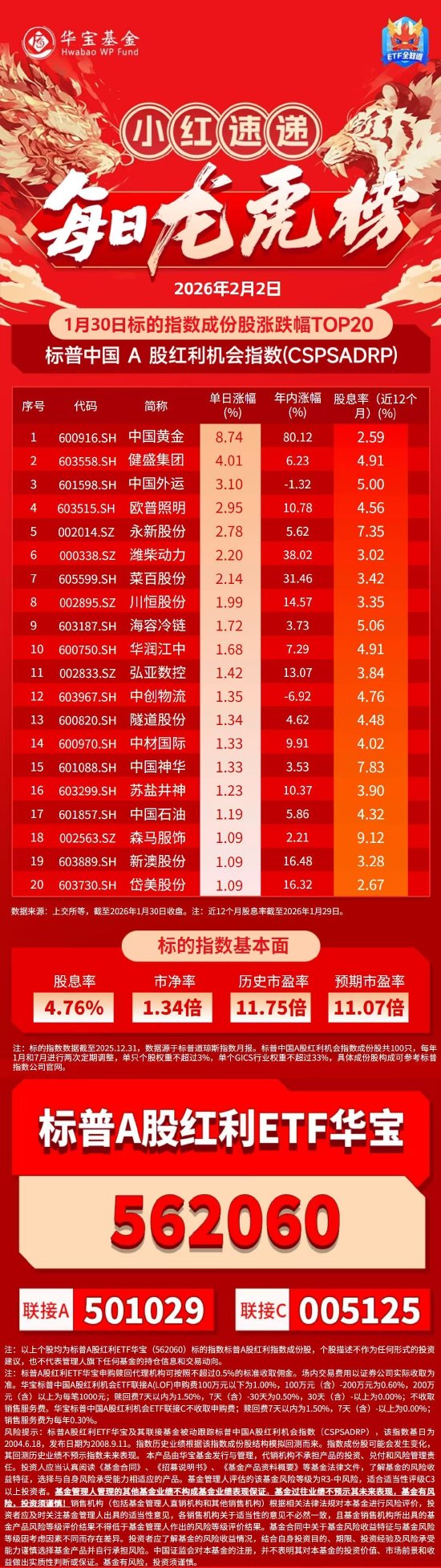
小红日报|能源交运多股收涨,标普A股红利ETF华宝(562060)标的指数回调0.54%
Xin Lang Cai Jing· 2026-02-02 01:17
Core Insights - The article highlights the top 20 stocks in the S&P China A-Share Dividend Opportunity Index (CSPSADRP) based on their daily and year-to-date performance as of January 30, 2026, showcasing significant price movements and dividend yields [1][5]. Group 1: Stock Performance - China Gold (600916.SH) leads with a daily increase of 8.74% and a year-to-date increase of 80.12%, with a dividend yield of 2.59% [1][5]. - Jian Sheng Group (603558.SH) follows with a daily rise of 4.01% and a year-to-date increase of 6.23%, offering a dividend yield of 4.91% [1][5]. - China National Foreign Trade Transportation Group (601598.SH) shows a daily increase of 3.10% but a year-to-date decline of 1.32%, with a dividend yield of 5.00% [1][5]. Group 2: Dividend Yields - The average dividend yield for the index is reported at 4.76%, with an expected price-to-earnings ratio of 11.07 times [2]. - Notable dividend yields include Semir Apparel (002563.SZ) at 9.12% and China Shenhua Energy (601088.SH) at 7.83% [1][5]. Group 3: Market Signals - The article mentions the formation of a MACD golden cross signal, indicating positive momentum for the stocks listed [4][8].


电煤消费规模是否已经达峰?
ZHONGTAI SECURITIES· 2026-02-02 00:45
Investment Rating - The report maintains a rating of "Buy" for key companies in the coal industry, including China Shenhua, Yanzhou Coal, Shaanxi Coal, and others, while some companies like Huayang Co. and Shanmei International are rated as "Overweight" [4]. Core Insights - The coal consumption scale has reached a peak plateau, with the demand for electricity generated from coal expected to stabilize in the coming years. The report suggests that the traditional growth model of coal-fired power generation may face a turning point due to the increasing share of clean energy [6][7]. - The transition of coal-fired power from a primary energy source to a supporting role in the new energy system is emphasized, with a significant expansion in installed capacity expected in the next few years [6][11]. Summary by Sections 1. Coal-fired Power: Transitioning to Peak Regulation and Support - The role of coal-fired power is shifting towards providing peak regulation and support, with its share in the energy mix declining but still remaining a core component of energy security [6][11]. - Installed capacity of coal-fired power is expected to continue expanding, with projections of new installations reaching 87 GW, 86 GW, and 43 GW from 2026 to 2028, respectively [6][29]. 2. Clean Energy: Becoming the Main Source of New Installations - Hydropower is expected to play a dual role in stable supply and peak regulation, with new installations projected to reach 17 GW, 18 GW, and 33 GW from 2026 to 2028 [7][39]. - Wind power is anticipated to see significant growth, with new installations expected to reach 109 GW, 161 GW, and 193 GW during the same period, reflecting its transition to a primary energy source [7][52]. - Solar energy is entering a stable development phase, with new installations projected at 192 GW, 139 GW, and 153 GW from 2026 to 2028, despite recent challenges in energy consumption and bidding processes [7][59]. 3. Investment Recommendations: Focus on Dividend and Flexibility - The report recommends focusing on companies with strong cash flow stability and dividend potential, such as China Shenhua and Shaanxi Coal, while also highlighting companies like Yanzhou Coal and Huayang Co. as having potential benefits from high coal demand [6][7][8].


煤炭行业周报:煤价回归合理才是常态,稳煤价逻辑依旧
KAIYUAN SECURITIES· 2026-02-02 00:24
Investment Rating - The industry investment rating is "Positive" (maintained) [1] Core Viewpoints - The report indicates that coal prices are expected to rebound, with a focus on the cyclical elasticity of both thermal coal and coking coal prices, which are currently at historical lows, providing room for recovery [5][15] - The report emphasizes that the price of thermal coal is influenced by supply constraints and increasing demand due to seasonal factors, while coking coal prices are more market-driven [4][5] Summary by Relevant Sections Investment Logic - Thermal coal prices are expected to rise through a four-step process: repairing central and local long-term contracts, reaching the coal-electricity profit-sharing line, and approaching the breakeven point for power plants, estimated at around 750 RMB per ton for 2025 [4][15] - Coking coal prices are determined by supply and demand fundamentals, with target prices based on the ratio of coking coal to thermal coal prices [4][15] Investment Recommendations - The report suggests a dual logic for coal stocks: cyclical elasticity and stable dividends. Key stocks to consider include: - Cyclical logic: Jin控煤业, 兖矿能源 for thermal coal; 平煤股份, 淮北矿业, 潞安环能 for metallurgical coal - Dividend logic: 中国神华, 中煤能源, 陕西煤业 - Diversification and growth logic: 神火股份, 电投能源, 新集能源, 广汇能源 [5][16] Key Market Indicators - The coal index increased by 3.68%, outperforming the Shanghai and Shenzhen 300 index by 3.6 percentage points [10][25] - As of January 30, the price of Qin港 Q5500 thermal coal was 692 RMB per ton, reflecting a slight increase of 7 RMB from the previous period [21] - The report notes a significant drop in coal inventory at ports, indicating tightening supply conditions [21][23]


煤炭行业周报:煤价回归合理才是常态,稳煤价逻辑依旧-20260201
KAIYUAN SECURITIES· 2026-02-01 14:41
Investment Rating - The industry investment rating is "Positive" (maintained) [1] Core Viewpoints - The report indicates that coal prices are expected to rebound, with a focus on the cyclical elasticity of both thermal coal and coking coal prices, which are currently at historical lows, providing room for recovery [5][15] - The report outlines a four-step process for the upward movement of thermal coal prices, including the restoration of long-term contracts and reaching a breakeven point for coal and power companies [4][15] - The report emphasizes that the overall investment logic remains unchanged, driven by a dual influence of tightening supply and increasing demand, particularly during the heating season [3][4] Summary by Sections Investment Logic - Thermal coal and coking coal prices are at a turning point, with thermal coal being a policy-driven commodity. The price recovery is expected to follow a specific process involving the restoration of long-term contracts and reaching a breakeven price of around 750 RMB per ton [4][15] - Coking coal prices are more influenced by market fundamentals, with target prices based on the ratio of coking coal to thermal coal prices, indicating potential target prices of 1608 RMB to 2064 RMB depending on thermal coal price movements [4][15] Investment Recommendations - The report suggests a dual logic for coal stocks: cyclical elasticity and stable dividends. It identifies four main lines for stock selection: 1. Cyclical logic: Jin控煤业 and 兖矿能源 for thermal coal; 平煤股份, 淮北矿业, and 潞安环能 for metallurgical coal 2. Dividend logic: 中国神华, 中煤能源, and 陕西煤业 3. Diversified aluminum elasticity: 神火股份 and 电投能源 4. Growth logic: 新集能源 and 广汇能源 [5][16] Key Market Indicators - The coal index increased by 3.68%, outperforming the Shanghai and Shenzhen 300 index by 3.6 percentage points, with notable gains from companies like 盘江股份 and 山西焦化 [10][25] - The report provides various market indicators, including port prices for thermal coal at 692 RMB per ton, reflecting a slight increase, and coking coal prices remaining stable at 1800 RMB per ton [21][23]