
PING AN OF CHINA(601318)

Search documents
融资客一周扫货名单出炉!下周两大板块获投资者看好
Sou Hu Cai Jing· 2026-02-01 09:53
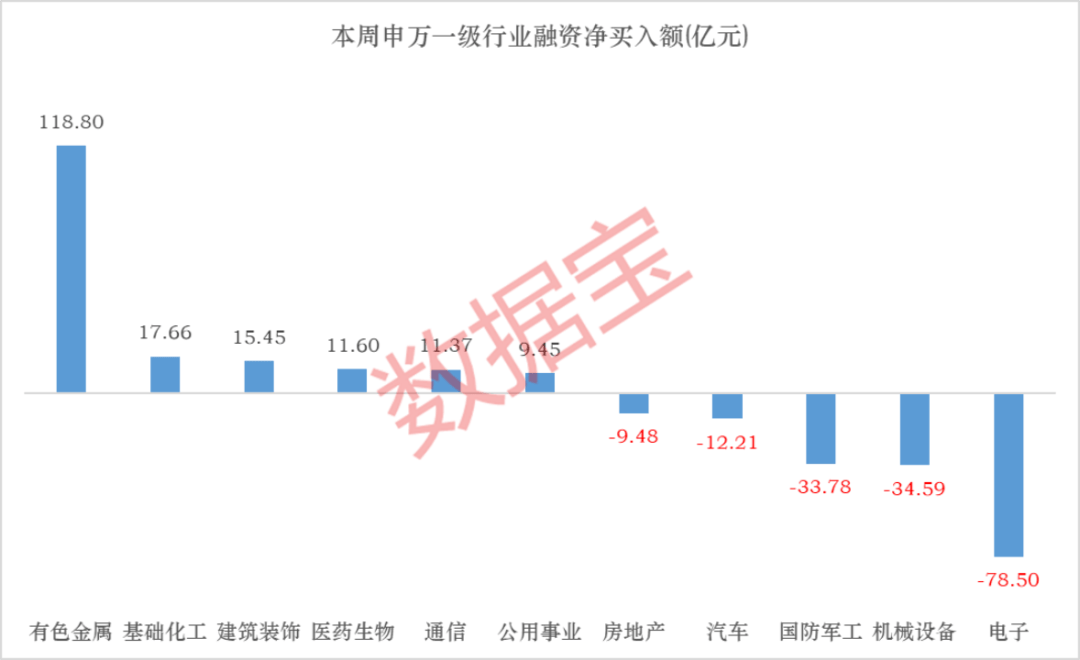
Group 1 - The core point of the article highlights that the A-share financing balance remains high at 27,222.32 billion yuan, with a net financing inflow of 5.279 billion yuan for the week [1] - In terms of industry performance, non-ferrous metals lead with a net financing inflow of 11.88 billion yuan, while sectors like basic chemicals, construction decoration, pharmaceuticals, and communications also saw inflows exceeding 1 billion yuan [1] - The electronics sector experienced significant net repayments amounting to 7.85 billion yuan, followed by machinery and defense industries with repayments over 3 billion yuan each [1] Group 2 - Individual stocks saw substantial net inflows, with Zijin Mining, Tianfu Communication, and China Ping An leading at 2.873 billion yuan, 2.559 billion yuan, and 1.254 billion yuan respectively [3] - Zijin Mining announced a strategic acquisition of all issued shares of a gold mining company, which includes significant assets in Mali and Ivory Coast, expected to enhance its position in the global gold market [3] - The non-ferrous metals sector includes multiple stocks with net inflows over 4 billion yuan, indicating strong demand driven by global energy and supply chain dynamics [4] Group 3 - The electric equipment sector, including stocks like Maiwei Co., Mingyang Smart Energy, and CATL, also attracted significant financing interest [5] - A total of 131 stocks experienced net repayments exceeding 1 billion yuan, with Industrial Fulian and China Satellite leading the repayments at 1.701 billion yuan and 1.475 billion yuan respectively [10] - The commercial aerospace sector, previously popular, faced large net repayments, indicating a shift in investor sentiment despite ongoing government support and technological advancements [8] Group 4 - The A-share market showed mixed performance, with the Shanghai Composite Index slightly down by 0.44%, closing at 4,117.95 points [11] - Investor sentiment remains neutral, with 54% expecting the market to oscillate between 4,100 and 4,200 points in the coming week [11] - The technology sector is favored for the upcoming week, with 54% of surveyed investors expressing optimism, while the enthusiasm for non-ferrous metals has decreased [13]





《证券期货法律适用意见第 18 号》征求意见稿点评:证监会拟放松战略投资者限制,中长期入市再迎政策支持
Shenwan Hongyuan Securities· 2026-02-01 07:13
保险工 2026 年 02 月 01 日 相关研究 券研究报 证券分析师 罗钻辉 A0230523090004 luozh@swsresearch.com 孙冀齐 A0230523110001 sunjq@swsresearch.com 联系人 目 孙冀齐 A0230523110001 sunjq@swsresearch.com 申万宏源研究微信服务号 证监会拟放松战略投资者限制 长期入市再迎政策支持 —《证券期货法律适用意见第 18 号》征求意见稿点评 证监会拟放松战略投资者限制,中长期资金入市再迎政策支持。1 月 30 日,证监会发布《关 于修改〈《上市公司证券发行注册管理办法》第九条、第十条、第十一条、第十三条、第四十 条、第五十七条、第六十条有关规定的适用意见 -- 证券期货法律适用意见第 18号)的决定 (征求意见稿)》(简称《征求意见稿》),拟放松战略投资者限制。2025年 1 月 22 日,六部 门联合印发《关于推动中长期资金入市工作的实施方案》(简称 《实施方案》),提出要允许 公募基金、商业保险资金、基本养老保险基金、企(职)业年金基金、银行理财等作为战略 投资者参与上市公司向特定对象发行股 ...




基于《保险公司资产负债管理办法(征求意见稿)》的分析:2503险企偿付能力报告传递了哪些信息?
Hua Yuan Zheng Quan· 2026-02-01 06:42
Report Industry Investment Rating - Not provided in the content Core Views of the Report - The new "Insurance Company Asset - Liability Management Measures (Draft for Comment)" has five major changes, aiming to strengthen the supervision of insurance companies' asset - liability management and guide long - term operations [2]. - In 25Q3, the solvency indicators of the insurance industry declined, mainly due to the increase in equity capital occupation and the pressure on both the asset and liability sides [2]. - The rise in long - term bond yields and the good performance of the A - share market in 25Q3 improved the investment returns of the insurance industry and reduced industry risks, but the credit risks of some under - performing insurers need attention [2]. - Large - scale life insurance companies have an advantage in scale premium growth, while small and medium - sized insurers show significant differentiation [2]. - The issuance scale of insurance sub - debt has shrunk [2]. Summary by Relevant Catalogs New "Insurance Company Asset - Liability Management Measures (Draft for Comment)" - **Five major changes**: System integration, organizational framework improvement, clear regulatory indicators, optimized indicator calculation methods, and improved regulatory measures [2][4]. - **Regulatory indicators for property insurance companies**: Precipitation fund coverage ratio to prevent short - term fund long - term investment, income coverage ratio and pressure - scenario liquidity coverage ratio to guide long - term operations [2][5]. - **Regulatory indicators for life insurance companies**: Effective duration gap to prevent asset - liability table fluctuations, comprehensive investment income coverage ratio and net investment income coverage ratio to guide long - term operations [2][5]. 25Q3 Insurance Industry Solvency - **Solvency indicators**: The comprehensive solvency ratio was 186.3% and the core solvency ratio was 134.3%, down 18.2 and 13.5 percentage points respectively from 25Q2, mainly due to the decline of life insurance companies [2]. - **Reasons for the decline**: Increased equity asset allocation, higher risk factors for equity assets under the new rules, and pressure on both the asset and liability sides [2]. 25Q3 Insurance Industry Investment and Profit - **Investment returns**: The rise in long - term bond yields and the good performance of the A - share market improved investment returns, with the total net profit of most insurers with outstanding insurance sub - debt increasing from 92.7 billion yuan in Q2 to 246.9 billion yuan in Q3 [2][24]. - **Profit differentiation**: Among 41 insurers with available data and outstanding insurance sub - debt, property insurance companies' net profit decreased by 3.306 billion yuan in 25Q3, while life insurance companies' net profit increased by 155.65 billion yuan [2]. Scale Premium Growth of Insurance Companies - **Large - scale life insurance companies**: As of 25Q3, China Post Life and New China Life had year - on - year scale premium growth rates of 18.65% and 17.96% respectively, showing relatively high and stable growth [2]. - **Small and medium - sized life insurance companies**: There was significant differentiation, with some companies having high growth rates and others having negative growth [2]. Insurance Sub - debt Issuance - **Issuance scale**: In 2024, 117.5 billion yuan of insurance sub - debt was issued, with 57.3 billion yuan in 24Q3. In 2025, 104.2 billion yuan was issued, a 11.3% year - on - year decrease. As of January 22, 2026, only 5 billion yuan was issued [2]. Investment Recommendations - Screened state - owned and central - owned enterprise insurance company sub - debt with a valuation yield > 2.2%, core solvency ratio > 100%, comprehensive solvency ratio > 150%, and risk comprehensive rating of BBB or above, such as 24 China Property Insurance Capital Supplementary Bond, 25 Great Wall Life Perpetual Bond 01, etc. [3]
非银金融行业投资策略周报:券商与保险基本面持续向好,关注非银板块配置价值-20260201
GF SECURITIES· 2026-02-01 06:10
Core Viewpoints - The non-bank financial sector, including brokerage and insurance, shows continued improvement in fundamentals, highlighting the investment value of the non-bank sector [1] Group 1: Market Performance - As of January 31, 2026, the Shanghai Composite Index reported 4117.95 points, down 0.44%, while the Shenzhen Component Index was at 14205.89, down 1.62% [10] - The CSI 300 Index increased by 0.08%, and the ChiNext Index decreased by 0.09% [10] - The CITIC II Securities Index fell by 0.71%, while the CITIC II Insurance Index rose by 5.41% [10] Group 2: Industry Dynamics and Weekly Commentary Insurance Sector - Listed insurance companies are expected to maintain high growth, with a marginal improvement in long-term interest rate spreads [15] - As of January 30, 2026, the 10-year government bond yield was 1.81%, down 2 basis points from the previous week, indicating a cautious risk preference in the equity market [12] - The insurance sector is benefiting from a stable long-term interest rate environment and an upward trend in the equity market, which is expected to drive performance growth in Q1 2026 [15] Securities Sector - The securities market is showing positive core indicators, with a projected high growth in Q1 2026, supported by improved trading volume and margin financing [16] - As of January 30, 2026, 17 brokerages reported a total net profit of 1153.44 billion CNY for 2025, a year-on-year increase of 60.27% [19] - The average daily trading volume of all A and B shares reached 2.90 trillion CNY, a 144.26% increase compared to the same period in 2025, indicating a significant rise in market activity [21] Group 3: Investment Opportunities - The launch of commercial real estate REITs is expected to expand business opportunities, with the first three products anticipated to raise over 13 billion CNY [27] - The REITs initiative aims to activate existing commercial real estate assets and enhance the supply of capital market products, indicating strong market demand [27] - The insurance sector is advised to focus on companies like China Ping An, China Life, and New China Life, which are expected to benefit from favorable market conditions [15]

保险业2025年12月保费点评:寿险保费增速转正,产险保费改善延续
HUAXI Securities· 2026-02-01 06:10
Investment Rating - The industry investment rating is "Recommended" [2] Core Insights - The life insurance premium growth turned positive in December, with a total premium income of 436.24 billion yuan for the year 2025, reflecting a year-on-year increase of 8.9% [1] - Property insurance premiums also showed improvement, with total premium income of 175.70 billion yuan for 2025, up 3.9% year-on-year [2] - The total assets of the insurance industry reached 4,131.45 billion yuan by the end of 2025, a 15.1% increase from the end of 2024 [3] - The report anticipates a significant increase in new business value (NBV) in Q1 2026, driven by high demand and the transformation of dividend insurance, which will alleviate pressure on profit margins [4] Summary by Sections Life Insurance - In December, life insurance premium income was 215.2 billion yuan, a year-on-year increase of 6.0%, marking a recovery from a previous decline of -2.4% [1] - The premium income for life insurance, health insurance, and accident insurance for 2025 was 355.57 billion, 76.99 billion, and 3.68 billion yuan, respectively, with year-on-year changes of +11.4%, -0.4%, and -9.8% [1] Property Insurance - The property insurance sector saw a total premium income of 1,413 billion yuan in December, up 4.4% year-on-year [2] - The December premium income for auto insurance was 977 billion yuan, reflecting a 2.2% increase, while non-auto insurance premiums reached 437 billion yuan, up 9.6% [2] Asset Growth - By the end of 2025, the total assets of life insurance companies were 3,639.37 billion yuan, and property insurance companies had assets of 311.74 billion yuan, representing increases of 15.3% and 7.5% respectively [3] - The net assets of the insurance industry totaled 366.40 billion yuan, a 10.2% increase from the previous year [3] Investment Recommendations - The report maintains a positive outlook for the insurance sector, suggesting that the current valuation remains low, with a price-to-earnings value (PEV) of 0.68-0.85x for January 30, 2026 [4]
《证券期货法律适用意见第18号》征求意见稿点评:证监会拟放松战略投资者限制,中长期入市再迎政策支持
Shenwan Hongyuan Securities· 2026-02-01 06:04
Investment Rating - The report maintains an "Overweight" rating for the insurance sector, indicating a positive outlook for the industry compared to the overall market performance [3][11]. Core Insights - The China Securities Regulatory Commission (CSRC) is proposing to relax restrictions on strategic investors, which is expected to support the entry of long-term capital into the market [1]. - The proposed changes will allow various institutional investors, including public funds, commercial insurance funds, and pension funds, to participate as strategic investors in non-public offerings of listed companies [2]. - The report highlights that participation in private placements by long-term capital investors is likely to yield excess returns due to diverse sources of income, including discount gains and dividend income [3]. Summary by Sections Regulatory Changes - The CSRC's draft proposal aims to expand the types of strategic investors and clarify their classification, including social security funds and commercial insurance funds [2]. - A minimum shareholding requirement of 5% for strategic investors is established, allowing them to participate in corporate governance [2]. Investment Opportunities - The report emphasizes that the alignment of long-term capital with private placements is expected to enhance investment returns, with the potential for smoother profit fluctuations through accounting measures [3]. - The report recommends several companies in the insurance sector, including China Life, New China Life, Ping An, China Pacific Insurance, China Property Insurance, and China Re, while suggesting to pay attention to China Taiping and ZhongAn Online [3]. Valuation Metrics - The report provides a valuation table for key insurance companies, detailing metrics such as market capitalization, P/E ratios, and dividend yields, indicating the financial health and investment potential of these firms [6].
从李亚鹏嫣然医院到大企业,可持续公益到底有多难?阿里、腾讯、万科、宁德时代等巨头给出不同模式
Mei Ri Jing Ji Xin Wen· 2026-02-01 05:54
Core Viewpoint - The article discusses the challenges and strategies of corporate philanthropy in China, highlighting the need for sustainable models that integrate social responsibility into business operations. It emphasizes that relying solely on a few individuals for charitable efforts is not sustainable in the long run [1][2]. Group 1: Corporate Philanthropy Models - Five main types of corporate philanthropy are identified among the top 50 companies in China: 1. **Participation by Everyone**: Companies like Tencent encourage public involvement through low-barrier donation options, such as the "Fenfen Donation" program, which has engaged 400 million users by the end of 2024 [2][3]. 2. **Technical or Industrial Support**: Companies like CATL engage in rural revitalization through initiatives that support local agriculture, such as the "I Have an Acre of Land" program, which has reclaimed 280 acres of wasteland [3][4]. 3. **Establishment of Charitable Trusts/Funds**: Many companies, including Vanke, have set up foundations that have collectively invested over 1 billion yuan in various social causes by the end of 2024 [4]. 4. **Creating Charity IPs**: Notable examples include Ping An's Hope Primary Schools, which have supported over 31,000 students and trained over 20,000 rural teachers [4][5]. 5. **Direct Charitable Donations**: This straightforward approach remains a primary method for many companies, although it is seen as less sustainable [4][5]. Group 2: Sustainability of Philanthropic Models - Among the five models, "Technical or Industrial Support" is considered the most sustainable, as it aligns social needs with business capabilities, allowing for a synergy between social and commercial value [5][6]. - Establishing charitable trusts or funds is also viewed as sustainable, as it allows for independent management of social issues, facilitating long-term planning [5][6]. - The "Participation by Everyone" model enhances brand image and is well-suited for platform companies like Tencent, while the "Charity IP" model maximizes brand benefits [5][6]. Group 3: Challenges in Corporate Philanthropy - Companies face significant challenges in creating sustainable philanthropic models, including the need for strategic integration of philanthropy into business operations and the establishment of a culture that promotes ongoing participation [11][12]. - The lack of dedicated personnel in many corporate foundations raises concerns about the effectiveness and management of charitable initiatives [8][9]. - A comprehensive approach to philanthropy is necessary, requiring professional management processes and a clear understanding of social issues to ensure long-term impact [12][13]. Group 4: Financial Contributions and Impact - In 2024, corporate donations accounted for 983 billion yuan, representing 74.21% of total charitable contributions in China, underscoring the critical role of businesses in philanthropy [8]. - Notable large donations include BYD's commitment of 3 billion yuan to education and significant stock donations from individuals supporting educational institutions [8][9]. - The article highlights the diverse forms of donations, including cash, stocks, and services, reflecting a growing trend in corporate philanthropy [8].




保险Ⅱ行业点评报告:保险行业12月保费:产寿25Q4保费增速均有所放缓,看好寿险2026年新单增长
Soochow Securities· 2026-02-01 03:24
Investment Rating - The report maintains an "Overweight" rating for the insurance industry, indicating a positive outlook for the sector in the next 6 to 12 months [1]. Core Insights - The insurance industry experienced a slowdown in premium growth in Q4 2025, with life insurance premiums expected to see new policy growth in 2026 [1]. - The report highlights that the total premium income for life insurance companies in 2025 reached CNY 436.24 billion, reflecting a year-on-year increase of 9.1%, while the total premium income for the industry was CNY 526.96 billion, up 8.5% year-on-year [5]. - The report anticipates a strong performance for listed insurance companies in the 2026 New Year, driven by the ongoing trend of "deposit migration" and the attractiveness of insurance products compared to bank deposits [5]. Summary by Sections Life Insurance - In 2025, life insurance premiums grew by 9.1%, but Q4 saw a significant slowdown with a growth rate of only 0.3% compared to Q3, primarily due to a decrease in market demand following a reduction in the preset interest rate [5]. - December 2025 saw a monthly premium income of CNY 215.2 billion, marking a 6.0% year-on-year increase, reversing the negative growth seen in November [5]. Health Insurance - Health insurance premiums increased by 2.0% in 2025, but Q4 experienced a slight decline of 0.1% year-on-year [5]. - The report notes that the health insurance sector is expected to grow significantly due to product innovation and improved pricing strategies [5]. Property Insurance - Property insurance premiums reached CNY 17,570 billion in 2025, with a year-on-year growth of 3.9%. However, Q4 saw a slowdown with a growth rate of only 0.5% [5]. - The report indicates that the growth in non-auto insurance premiums was driven by significant increases in agricultural, health, accident, and liability insurance premiums in December [5]. Financial Performance and Valuation - The report suggests that both liability and asset sides of insurance companies are improving, with significant upward potential in valuations [5]. - As of January 30, 2026, the insurance sector's valuation is at historical lows, with expected PEV ratios ranging from 0.67 to 0.88 and PB ratios from 1.15 to 2.38 [5].
公募基金去年四季度加码非银金融,保险、券商股获青睐
Huan Qiu Wang· 2026-02-01 03:00
Core Viewpoint - The non-bank financial sector has become a significant focus for fund allocation, with public funds increasing their positions in this area, particularly in insurance and brokerage stocks, which are now the fourth largest area of increase in holdings [1][3]. Group 1: Non-Bank Financial Sector - Public funds have increased their allocation to non-bank financials (insurance, brokerages) by over 1 percentage point, making it the fourth largest area of fund increase, following non-ferrous metals, communications, and basic chemicals [1]. - The insurance sector has shown remarkable performance, with leading companies like China Ping An and China Pacific Insurance receiving significant over-allocations due to improved balance sheets and recovery in new business value [3]. - The brokerage sector is experiencing a trend of concentration among leading firms, with public funds increasing their holdings in major brokerages like CITIC Securities and Huatai Securities, while smaller firms see limited increases [3]. Group 2: Investment Trends and Market Outlook - The current increase in non-bank financials is primarily driven by value-oriented funds, contrasting with growth-driven sectors like non-ferrous metals and communications [3]. - The insurance index has risen by 23.42% in the fourth quarter of 2025, significantly outperforming bank and brokerage stocks, highlighting the sector's stability and growth potential [3]. - The outlook for the non-bank financial sector remains focused on "performance-driven" strategies, with attention on new policy developments and market activity levels, suggesting that this sector may become a key allocation area for medium to long-term funds in a low-interest-rate environment [4].


保险行业12月保费:产寿25Q4保费增速均有所放缓,看好寿险2026年新单增长
Soochow Securities· 2026-02-01 00:45
Investment Rating - The report maintains an "Overweight" rating for the insurance industry, indicating a positive outlook for the sector in the next 6 months [1]. Core Insights - In December 2025, the growth rate of insurance premiums for both life and property insurance slowed down, but there is optimism for new business growth in life insurance by 2026 [1]. - The total premium income for personal insurance companies in 2025 reached CNY 46,491 billion, reflecting a year-on-year increase of 9.1%, while the fourth quarter saw a significant slowdown in growth to just 0.3% [5]. - The report anticipates a strong performance for listed insurance companies in the 2026 New Year, driven by the ongoing trend of "deposit migration" and the attractiveness of insurance products compared to bank deposits [5]. - Health insurance premiums grew by 2% in 2025, but the fourth quarter saw a slight decline of 0.1% year-on-year [5]. - Property insurance premiums reached CNY 17,570 billion in 2025, with a year-on-year increase of 3.9%, but the growth rate in the fourth quarter dropped to 0.5% [5]. - The report highlights that the liability side and asset side of insurance companies are continuously improving, with significant upward potential in valuations [5]. Summary by Sections Personal Insurance - The original premium income for personal insurance companies in 2025 was CNY 46,491 billion, with a year-on-year growth of 9.1% [5]. - The fourth quarter saw a premium income of CNY 5,191 billion, with a growth rate of only 0.3%, a decline of 24.7 percentage points from the previous quarter [5]. - December 2025 saw a monthly premium income of CNY 2,152 billion, marking a year-on-year increase of 6.0% [5]. Health Insurance - Health insurance premiums in 2025 increased by 2.0%, but the fourth quarter experienced a slight decline of 0.1% [5]. - The report notes that the health insurance market has significant growth potential due to product innovation and scientific pricing [5]. Property Insurance - Property insurance premiums totaled CNY 17,570 billion in 2025, with a year-on-year increase of 3.9% [5]. - The fourth quarter saw a growth rate of only 0.5%, a decline of 4.1 percentage points from the previous quarter [5]. - December 2025 recorded a monthly premium income of CNY 1,413 billion, with a year-on-year increase of 4.4% [5]. Market Outlook - The report suggests that the market demand remains strong, and the optimization of liability costs will alleviate pressure from interest rate spreads [5]. - The valuation of insurance stocks is currently at historical lows, with the insurance sector's estimated valuation for January 30, 2026, ranging from 0.67 to 0.88 times PEV and 1.15 to 2.38 times PB [5].