
GWMOTOR(601633)

Search documents
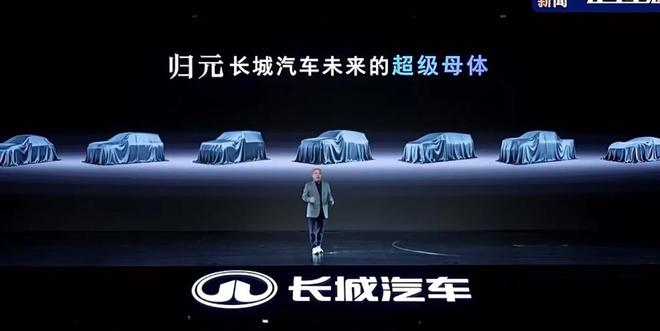
长城汽车发布“归元”平台:兼容5大动力 将推出超50款全球车型
Jing Ji Guan Cha Bao· 2026-01-18 03:03
Core Viewpoint - Great Wall Motors has launched a new vehicle platform named "Guiyuan," which emphasizes a modular architecture and aims to enhance global competitiveness and reduce manufacturing costs [2][4][5]. Group 1: Platform Overview - The "Guiyuan" platform was named through a public vote, receiving 22,000 votes, and is designed to return to the essence of automotive service [2]. - It features a highly modular architecture inspired by movable type printing, allowing for flexible combinations of 49 core modules and 329 shared components [2][3]. - The platform supports five powertrain types: plug-in hybrid, hybrid, pure electric, fuel, and hydrogen, covering seven vehicle categories [3]. Group 2: Global Market Strategy - The high compatibility of the "Guiyuan" platform will help Great Wall Motors expand into international markets, addressing diverse regional demands for vehicle powertrains [4]. - The company aims to sell over 500,000 vehicles in overseas markets by 2025, with a target of 600,000 units in 2026, representing one-third of total sales [4]. Group 3: Cost Efficiency and Production - The "Guiyuan" platform boasts an 80% parts commonality rate and a 30% reduction in development cycles, leading to more stable and cost-effective supply chains [5]. - The platform's design is expected to enhance vehicle resale value and lower long-term ownership and maintenance costs for consumers [5]. Group 4: Integration with Existing Platforms - The "Guiyuan" platform is part of a broader platform system that includes the Lemon, Tank, and Coffee Intelligent platforms, each serving different vehicle types and technologies [6]. - Great Wall Motors plans to launch over 50 global models based on the "Guiyuan" platform, which will further integrate and adjust existing platforms [6]. Group 5: Sales Performance and Future Goals - In 2025, Great Wall Motors achieved a total sales volume of 1.324 million units, a year-on-year increase of 7.33%, with 403,700 units being new energy vehicles, up 25.44% [6]. - The sales target for 2026 is set at 1.8 million units, with an ambitious growth rate of 36% anticipated as the "Guiyuan" platform models are introduced [6].

崔东树:2025年汽车企业整车出口超强!国产车出口同比增21%
智通财经网· 2026-01-17 06:43
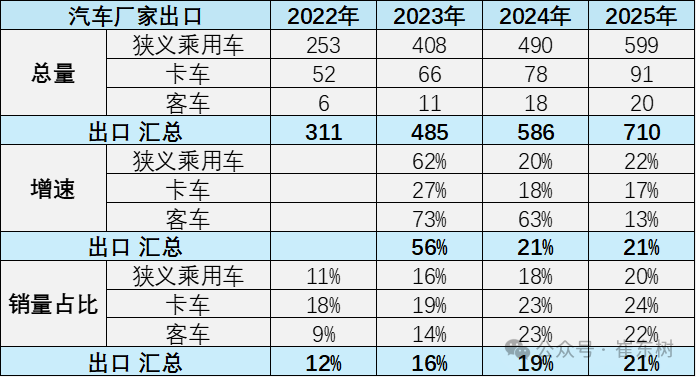
Overall Situation of Automobile Exports - In 2025, China's automobile manufacturers are expected to export a total of 7.1 million vehicles, representing a year-on-year growth of 21%, maintaining the position as the world's largest automobile exporter [1] - The export growth is characterized by an increase in both volume and value, with a significant enhancement in product added value [1] Export Growth Drivers - Passenger vehicles have become the core engine of export growth, significantly outpacing the growth of bus exports [2] - The main export destinations remain Europe, ASEAN, and South America, with a notable performance in countries along the "Belt and Road" initiative [2] Structure of Exporting Enterprises - The structure of automobile export enterprises has undergone significant changes, with a trend of increased concentration among leading companies, the rise of private enterprises, and a reduction in the market share of foreign-funded enterprises [4] - Domestic brands have shown remarkable performance, with their export share increasing from 22% in 2024 to 24% in 2025 [4] Performance of Major Automobile Groups - BYD leads the industry with an export volume of 1.05 million new energy vehicles, particularly excelling in high-end markets such as Europe and Japan [5] - SAIC Group exported 950,000 vehicles, leveraging its joint ventures and domestic brands to maintain a leading position in ASEAN and South American markets [5] Export Performance of Different Types of Enterprises - Different types of automobile enterprises show varied export performance, with leading companies demonstrating strong results [7] - New energy vehicle companies like BYD, Leap Motor, and Xpeng have seen significant year-on-year growth in export volumes [8] Challenges and Recommendations - The industry faces challenges such as overseas trade barriers, supply chain risks, and intensified global market competition [1] - Companies are advised to increase investment in core technology research and development, optimize export products, and strengthen localized production and services to enhance global supply chain influence [1]



长城归元全球发布:魏建军的“活系统”哲学藏在千年活字印刷里
Zhong Guo Qi Che Bao Wang· 2026-01-17 05:53
Core Insights - The article highlights the cultural significance of the "Guiyuan" platform launched by Great Wall Motors, emphasizing the integration of traditional Chinese wisdom with modern automotive technology [1][4][10] Group 1: Cultural Significance - The encounter with wood movable type printing symbolizes a dialogue between ancient wisdom and modern automotive precision, reflecting the "living system" concept that aims to return to user-centric needs [1][3] - The name "Guiyuan," chosen by 96,000 voters with a margin of 22,000 votes, encapsulates users' desires for safety, reliability, and affordability, showcasing Great Wall's commitment to user-centered design [4] Group 2: Technological Innovation - The "Guiyuan" platform embodies the principle of "first principles," breaking away from rigid structures to allow for flexible combinations, akin to how movable type printing revolutionized efficiency and customization [6][8] - The platform features a unique five-power compatibility, allowing for gasoline, diesel, electric, hybrid, and hydrogen power without the need for a complete chassis redesign, demonstrating over 20 years of industry experience [8][11] Group 3: Global Strategy - The platform is designed to adapt to various global energy structures and infrastructure, implementing a "one strategy for each region" approach that reduces costs and enhances user accessibility [11][13] - Great Wall aims to transition from "product output" to "ecosystem export," with plans for 506,100 vehicles to reach over 170 countries by 2025, positioning itself as a reliable global mobility partner [13]

打造高端品牌需要耐得住寂寞 访长城汽车创始人、董事长魏建军
Zhong Guo Jing Ying Bao· 2026-01-16 20:13
Core Insights - The essence of a true high-end brand lies in its spiritual value proposition and the recognition of its values by users, emphasizing trust and responsibility in addressing issues [2][8][21] - The founder of Great Wall Motors, Wei Jianjun, emphasizes the importance of maintaining the original intention of creating a high-end brand, which requires patience and resilience [3][22] - The brand WEY, named after the founder's surname, represents a commitment to integrity and courage, reflecting the responsibility associated with its name [6][20] Brand Development - The WEY brand was established as China's first high-end automotive brand named after its founder, aiming to unify product DNA and create a dedicated high-end SUV brand [6][10] - Despite challenges, the brand's positioning as a high-end entity has not wavered, with a focus on building brand value rather than just high-end products [10][11] - The brand's logo design draws inspiration from historical elements, showcasing a connection to its roots and a sense of pride in its heritage [7] Market Strategy - The company believes that a true high-end brand must prioritize user-centric values, focusing on creating vehicles that are beneficial to users and society rather than merely pursuing luxury [9][12] - The transition to high-end markets is challenging, with many domestic brands still in the entrepreneurial phase, and the company acknowledges the need for a focused approach to high-end product development [10][11][22] - The company has invested over 2 billion yuan in establishing a direct sales system to better support its high-end brand strategy [11] Technological Advancements - The WEY brand has made significant strides in intelligent driving technology, with the latest models featuring advanced systems that enhance user experience [12][13] - The introduction of a multi-power platform aims to adapt to various market needs and energy structures globally, reflecting the company's commitment to innovation [12][14] Organizational Structure - The company has restructured its organization to be more user-centric, allowing for agile responses to market demands while maintaining a focus on long-term strategic goals [16][17] - The new organizational model emphasizes the integration of resources to support brand development and ensure quality consistency across products [17] Long-term Vision - The company maintains a long-term perspective on investment in research and development, focusing on building a solid technological foundation for future growth [19] - The global strategy is pragmatic, aiming to adapt to different markets while ensuring that the brand's core values remain intact [19]
长城汽车股份有限公司关于“长汽转债”预计满足转股价格向下修正条件的提示性公告
Xin Lang Cai Jing· 2026-01-16 19:05
Group 1 - The company has announced that the "Changqi Convertible Bonds" are expected to meet the conditions for a downward adjustment of the conversion price [1] - The company issued 35 million convertible bonds with a total value of 3.5 billion yuan, which began trading on July 8, 2021 [2] - The initial conversion price was set at 38.39 yuan per share, and the current conversion price is 39.16 yuan per share [2] Group 2 - The downward adjustment clause allows the company to propose a new conversion price if the stock price is below 85% of the current conversion price for at least 15 out of 30 consecutive trading days [3] - The adjustment requires approval from two-thirds of the voting rights at a shareholders' meeting, excluding bondholders from voting [3] - If the adjustment is made, the new conversion price must be higher than the average stock price over the 20 trading days prior to the meeting [3] Group 3 - The company previously decided not to exercise the downward adjustment right on July 4, 2025, and will reconsider after January 5, 2026, if the conditions are met again [5] - As of January 16, 2026, the company's stock price has been below 85% of the current conversion price for ten trading days, indicating a potential trigger for the adjustment [6] - If the stock price remains below the threshold for five out of the next twenty trading days, the downward adjustment clause may be triggered [6]
长城发布归元平台,将推出50余款全球车型
2 1 Shi Ji Jing Ji Bao Dao· 2026-01-16 16:01
Core Viewpoint - Great Wall Motors announced plans to leverage its Guiyuan platform to launch over 50 global vehicle models across 5 powertrain types and 7 categories, including sedans, sports cars, pickups, and MPVs [1] Group 1 - The company aims to cover a wide range of product forms with its new vehicle lineup [1] - The initiative reflects Great Wall Motors' strategy to expand its global presence and diversify its offerings [1]
长城汽车(601633) - 长城汽车股份有限公司关于“长汽转债”预计满足转股价格向下修正条件的提示性公告
2026-01-16 10:03
| 证券代码:601633 | 证券简称:长城汽车 | 公告编号:2026-004 | | --- | --- | --- | | 转债代码:113049 | 转债简称:长汽转债 | | 长城汽车股份有限公司 关于"长汽转债"预计满足转股价格向下修正条件的提示性公告 在本次发行的可转债存续期间,当公司A股股票在任意连续三十个交易日中至少有 十五个交易日的收盘价低于当期转股价格的85%时,公司董事会有权提出转股价格向下 修正方案并提交公司股东大会审议表决。 上述方案须经出席会议的股东所持表决权的三分之二以上通过方可实施。股东大会 进行表决时,持有本次发行的可转债的股东应当回避。修正后的转股价格应不低于前述 的股东大会召开日前二十个交易日公司股票交易均价和前一个交易日公司股票交易均 价之间的较高者。 本公司董事会及全体董事保证本公告内容不存在任何虚假记载、误导性陈述或者重 大遗漏,并对其内容的真实性、准确性和完整性承担法律责任。 一、"长汽转债"发行上市概况 经中国证券监督管理委员会《关于核准长城汽车股份有限公司公开发行可转换公司 债券的批复》(证监许可[2021]1353号)核准,长城汽车股份有限公司(以下简称 ...
长城汽车(02333) - 海外监管公告
2026-01-16 08:47
香港交易及結算所有限公司及香港聯合交易所有限公司對本公告的內容概不負責,對其準確性或完整性亦不發表任何 聲明,並明確表示,概不對因本公告全部或任何部份內容而產生或因倚賴該等內容而引致的任何損失承擔任何責任。 長 城 汽 車 股 份 有 限 公 司 GREAT WALL MOTOR COMPANY LIMITED* (於中華人民共和國註冊成立的股份有限公司) 股份代號:02333(港幣櫃台)及82333(人民幣櫃台) 海外監管公告 於本公告日期,董事會成員如下: 執行董事: 魏建軍先生、趙國慶先生及李紅栓女士。 职工董事:盧彩娟女士。 非執行董事:何平先生。 獨立非執行董事: 樂英女士、 輝先生及鄒兆麟先生。 此海外監管公告是根據香港聯合交易所有限公司證券上市規則第 13.10B 條發出。以下為長城汽 車股份有限公司於上海證券交易所網站(www.sse.com.cn)所刊發之「長城汽車股份有限公司關 於"長汽轉債"預計滿足轉股價格向下修正條件的提示性公告」。 承董事會命 長城汽車股份有限公司 公司秘書 李紅栓 李紅栓 公司秘書 中國河北省保定市,2026 年 1 月16日 * 僅供識別 | 证券代码:60163 ...
2026年销量目标现分化: 传统车企稳健推进 新势力冲刺高增长
Zhong Guo Zheng Quan Bao· 2026-01-15 21:12
Core Insights - The automotive market in 2026 is characterized by significant differentiation in sales targets among major car manufacturers, with a total target exceeding 21.55 million units, approximately 63% of the 2025 domestic sales volume [1] - Traditional automakers are focusing on stable growth rates of 10% to 30%, while new entrants and cross-industry brands are setting aggressive targets of 34% to 67.5%, indicating a strong push for market share [1] Summary by Company - **Geely**: Set a sales target of 3.45 million units for 2026, a 14% increase from 2025, with a focus on 2.22 million units of new energy vehicles (NEVs), achieving a penetration rate of 64.3% [1] - **Chery**: Aims for 3.2 million units, a 14.03% increase from 2025's 2.81 million units, with plans to launch 17 key models [2] - **Dongfeng Group**: Targets 3.25 million units, a 30% increase from 2025, with 1.7 million NEVs and 600,000 units for export [2] - **Great Wall Motors**: Sets a more conservative target of 1.8 million units, a 36% increase from 2025's 1.32 million units [2] - **Leap Motor**: Aims for 1 million units, a 67.5% increase from 2025's 596,600 units, leveraging core technology and a competitive parts system [2] - **Xiaomi**: Targets 550,000 units, a 34% increase from 2025's 410,000 units, emphasizing a stable expansion strategy [3] - **NIO**: Plans for a sales range of 456,000 to 489,000 units, maintaining a growth rate of 40% to 50% [3] - **GAC Toyota**: Sets a conservative target of 800,000 units, a 3.6% increase from 2025 [3] - **SAIC Volkswagen**: Aims for 1 million units, maintaining 2025 levels, with plans for 7 new NEV models [3] Market Dynamics - The automotive industry is shifting from incremental expansion to competition within existing market shares, with varying growth rates reflecting companies' strategies and market conditions [4] - Traditional automakers are generally targeting growth rates between 13% and 30%, with NEV sales growth rates significantly higher, indicating a consensus on NEVs as the main growth driver [4] - New energy vehicle sales targets are notably higher than overall sales targets, with Geely and Changan targeting 32% and 26.2% growth rates respectively [4] Strategic Considerations - The high growth targets set by new entrants are driven by the need for scale to improve cash flow and profitability, but achieving these targets will require strong organizational capabilities [5] - Key factors influencing the achievement of sales targets include the rollout of new energy products, success in overseas markets, and the overall capability of the companies [6] - The industry is expected to see a 4.3% growth in exports, with companies like BYD targeting 1.5 to 1.6 million units for overseas sales [6]





传统车企稳健推进 新势力冲刺高增长
Zhong Guo Zheng Quan Bao· 2026-01-15 20:48
Core Insights - The automotive market in 2026 is characterized by significant differentiation in sales targets among major car manufacturers, with a total target exceeding 21.55 million units, approximately 63% of the 2025 domestic sales volume [1] - Traditional automakers are focusing on stable growth rates of 10% to 30%, while new entrants and cross-industry brands are setting aggressive targets ranging from 34% to 67.5%, indicating a strong push for market share [1] Summary by Company - Geely aims for a sales target of 3.45 million units in 2026, a 14% increase from 2025, with a focus on 2.22 million units of new energy vehicles, achieving a penetration rate of 64.3% [1] - Chery targets 3.2 million units, a 14.03% increase from 2025, with plans to launch 17 key models focusing on electrification and intelligence [2] - Dongfeng Group sets an ambitious target of 3.25 million units, a 30% increase from 2025, with a focus on 1.7 million new energy vehicles and 600,000 exports [2] - Great Wall Motors adopts a more cautious approach with a target of 1.8 million units, reflecting a 36% increase from 2025 [2] - Leap Motor aims for 1 million units, a 67.5% increase, building on a strong 2025 performance of 596,600 units [2] - Xiaomi targets 550,000 units, a 34% increase, emphasizing a production strategy driven by orders [3] - NIO sets a sales target range of 456,000 to 489,000 units, maintaining a growth rate of 40% to 50% [3] - GAC Toyota's target is 800,000 units, a modest 3.6% increase, while SAIC Volkswagen aims for 1 million units, maintaining its 2025 target [3] Market Dynamics - The differentiation in sales targets reflects a shift from incremental expansion to competition within existing market shares, with the difficulty of achieving these targets closely tied to each company's base, product layout, and systemic capabilities [4] - Traditional automakers are generally targeting growth rates between 13% and 30%, with a notable emphasis on new energy vehicle sales growth, which is significantly higher than overall growth targets [4] - New energy vehicles are recognized as the main growth engine, with companies like Geely and Changan setting ambitious growth targets for their new energy vehicle sales [4] - The aggressive targets set by new entrants are seen as a response to the need for scale, cash flow improvement, and valuation support, although they face challenges in converting scale into systemic strength [5] Key Factors for Target Achievement - The success of sales targets hinges on three main dimensions: the rollout of new energy products, effectiveness in overseas market expansion, and the overall systemic support capabilities of the companies [5] - Companies like Geely and Changan are expected to achieve their targets due to stable completion rates and robust channel layouts, while some joint venture brands may face risks of market share erosion despite conservative targets [5]