
SWHY(000166)

Search documents
申万宏源杨成长:建设统一信用市场 筑牢信用经济基石
申万宏源证券上海北京西路营业部· 2025-11-24 02:17
Core Viewpoint - The article emphasizes the importance of establishing a unified credit market in China as part of the "14th Five-Year Plan" to enhance market efficiency and optimize the business environment, which is crucial for achieving strategic goals [3][5][11]. Summary by Sections 1. Importance of a Sound Credit System - A robust credit system is fundamental for improving financial services to the real economy, as it enhances market efficiency and resource allocation [5][6]. - The credit system is essential for modern financial operations and risk pricing, impacting financing costs and systemic risk management [4][6]. 2. Current Challenges in Credit Market Construction - There are four main shortcomings in China's credit market: limited accessibility to credit services, low proportion of credit financing, inadequate credit infrastructure, and insufficient credit rating and pricing [6][7][8]. - Over 90% of small and micro enterprises have never received bank loans, indicating a significant gap in credit service availability [6]. - Credit loans account for less than 40% of total loans among major banks, with a slow development of the credit bond market [7]. 3. Progress in Credit System Construction - Since the 18th National Congress, significant strides have been made in credit system construction, including the establishment of a national credit information sharing platform that has collected over 807 billion pieces of credit information [5][4]. - The "14th Five-Year Plan" calls for a unified, open, competitive, and orderly market system, highlighting the growing importance of the credit market [5][11]. 4. Recommendations for Credit Market Development - Emphasizing the need to recognize credit as a valuable economic resource, the article suggests that enterprises should manage credit as a core asset [12][14]. - It advocates for the establishment of high-standard credit infrastructure and a unified credit evaluation standard to enhance the efficiency of credit information sharing [15][18]. - The article calls for the digitalization and intelligent transformation of credit assessment processes to better reflect real-time business conditions [19][20]. 5. Enhancing Credit Management Capabilities - Companies are encouraged to adopt credit management as a strategic priority, integrating it into their operational frameworks [21][22]. - The establishment of public platforms for credit services aimed at small and micro enterprises is recommended to improve their credit management capabilities [22].


申万宏源:“怀疑牛市级别”的调整正在发生,2026下半年或迎来牛市2.0
Ge Long Hui A P P· 2025-11-24 01:21
格隆汇11月24日|申万宏源策略发文,"怀疑牛市级别"的调整正在发生,但这个阶段更要坚定牛市认 知。调整到位(核心赛道牛熊分界线附近)就是一个大级别的底部,可以等待"牛市2.0"。 MACD金叉信号形成,这些股涨势不错! "牛市两段论"是A股牛市周期的典型特征。牛市1.0阶段(2013、2017和2025),机构投资者风格切换基本 完成+赚钱效应累积产生质变+产业趋势资产性价比不足。牛市1.0到2.0的过渡期(2014年2-10月、2018 年,本轮可能是2026上半年),等待全面牛市条件累积+产业趋势调整后磨底,消化性价比问题。牛市 2.0全面牛(2015、2021,本轮可能是2026下半年),核心是基本面周期性改善/产业趋势新阶段 + 居民资 产配置向权益迁移。 展望2026年行业风格节奏,牛市1.0到2.0的过渡阶段,高股息防御可能占优;牛市2.0阶段经济体感改善 (实际改善)将催化顺周期引领指数突破,最终科技产业趋势和制造业全球影响力提升才是牛市主线。 当前,AI产业链"产业趋势大波段没结束+中小波段有波折+长期低性价比区域",这神似2014年初的创 业板、2018年初的食品饮料、2021年初的新能源 ...
申万宏源:12月美联储暂停降息概率高,鲍威尔表态成关键
Sou Hu Cai Jing· 2025-11-23 23:42
本文由 AI算法生成,仅作参考,不涉投资建议,使用风险自担 【申万宏源:12月暂停降息概率更高,鲍威尔表态成关键】11月23日,申万宏源研究指出,12月暂停降 息概率较大,最大不确定性在于鲍威尔如何塑造"共识"。10月美联储例会上,鲍威尔称内部对未来降息 分歧大。近期公布的10月会议纪要显示,"许多"参会者支持维持利率不变,仅"几个"认为应继续降息。 近期有投票权的FOMC成员表态,支持与不支持降息人数比约4:5,后者略占上风。库克、杰斐逊、鲍 威尔未对12月降息明确表态,9月点阵图支持年内降息3次,其政策倾向成关键"选票"。 鲍威尔在美联 储内部建立、引导"共识"至关重要,但自10月会议以来,他尚未表态。 ...
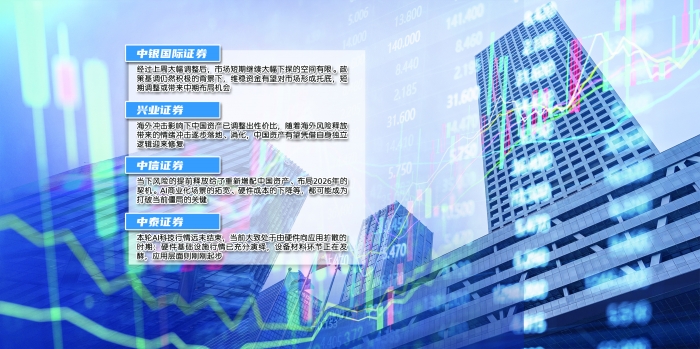
A股本轮上涨行情基础并未改变短期调整或带来布局良机
Shang Hai Zheng Quan Bao· 2025-11-23 18:02
Market Overview - The recent global market downturn, driven by heightened risk aversion, has led to a significant adjustment in the A-share market, with the Shanghai Composite Index falling below 3900 points [2][3] - Key sectors such as new energy, photovoltaic, and power equipment have experienced notable pullbacks, while banking, shipbuilding, and consumer sectors have shown relative resilience [2] External Influences - The adjustment in the A-share market is primarily attributed to external factors, including concerns over the "AI bubble," a retreat in expectations for Federal Reserve interest rate cuts, and a cautious shift in market sentiment [3][4] - The volatility in global risk assets has been exacerbated by year-end fund settlement periods, prompting some investors to lock in profits and rankings through selling [3] Fundamental Support - Despite recent market fluctuations, the fundamental factors supporting the current rally in the Chinese stock market remain intact, including steady macroeconomic recovery, improved competitiveness of key industries, and enhanced capital market positioning [4][5] - The adjustment is viewed as a short-term disturbance rather than a fundamental shift in market dynamics, with expectations for a potential recovery as market sentiment stabilizes [4] Investment Opportunities - The current market adjustment presents a strategic opportunity for investors to reposition their portfolios ahead of the anticipated spring market rally in 2026 [6] - There is a consensus among institutions that the internal certainties of the Chinese market, such as new growth momentum and clear policy direction, will not be adversely affected by external disturbances [5][6] - Following the adjustment, sectors such as banking and insurance, along with consumer stocks with stable fundamentals, may present rotation opportunities before the technology sector regains momentum [6]





申万宏源策略:降息预期波动加大,美元走强使全球权益回调
Xin Lang Cai Jing· 2025-11-23 13:48
Global Capital Market Overview - The U.S. added 119,000 non-farm jobs in September, significantly exceeding the expected 51,000, but the unemployment rate rose to 4.4%, increasing market volatility regarding the Federal Reserve's interest rate cuts [1][5] - The U.S. dollar index increased by 0.87%, reaching a current level of 100.2, indicating the end of a weak dollar phase [1][5] - Global risk assets mostly declined, with equity markets experiencing significant drops, particularly in A-shares, Northbound 50, and Hang Seng Technology indices [1][5] Fund Flows - As of November 19, 2025, both domestic and foreign capital flowed into the Chinese stock market, with foreign capital inflows of $318 million and domestic inflows of $3.677 billion [2][10] - Overseas active funds saw an outflow of $301 million, while passive funds experienced an inflow of $619 million [2][10] - The U.S. equity market saw substantial inflows, particularly in technology and healthcare sectors, with a total of $11.8 billion entering the equity market [2][10] Valuation Metrics - As of November 21, 2025, the Shanghai Composite Index's valuation is at the 81.9 percentile over the past decade, second only to the S&P 500 and France's CAC40, but remains significantly lower than U.S. stocks in absolute terms [3][10] - The risk-adjusted return percentile for the S&P 500 decreased from 47% to 39%, while the Nasdaq's dropped from 46% to 35% [3][10] Market Sentiment Indicators - The S&P 500 closed at 6602.99, below the 20-day moving average, with an increase in implied volatility [4][10] - The put-call ratio for the S&P 500 decreased to 1.03 from 1.14, indicating a marginally more optimistic sentiment among investors [4][10] - In the A-share market, there was a significant increase in the open interest for call options on the CSI 300 index, reflecting high optimism for future market performance [4][10] Economic Data - The U.S. non-farm payrolls and unemployment rate data suggest a robust labor market, which may influence the Federal Reserve's interest rate decisions [5][10] - The probability of a 25 basis point rate cut in December rose to 71% from 44.4% the previous week, indicating increasing market expectations for monetary easing [5][10] - China's economic indicators show a weakening investment trend, but CPI and PPI are showing signs of marginal recovery, confirming further recovery signals [5][10]

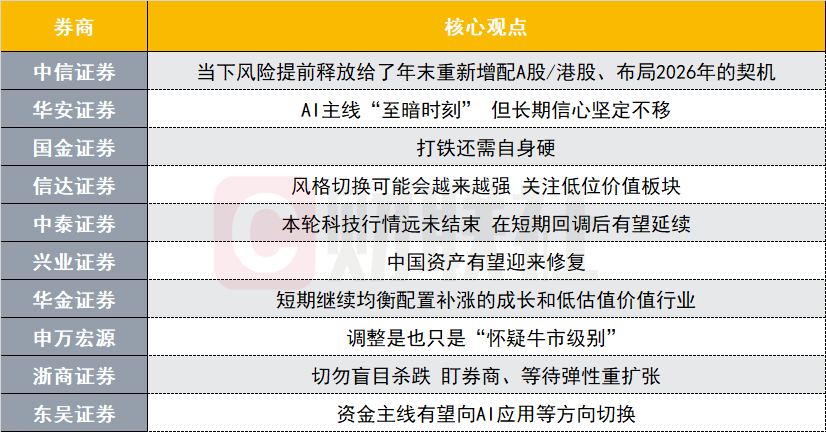
年末重新增配A股迎来契机?投资主线有哪些?十大券商策略来了
Feng Huang Wang· 2025-11-23 13:21
Core Viewpoints - Current risk release provides an opportunity for reallocating A-shares and Hong Kong stocks by year-end and planning for 2026 [2] - The AI sector is experiencing a "darkest hour," but long-term confidence remains unwavering [4] - The adjustment phase is merely a "doubtful bull market level" [11] Industry Insights - Focus on resource and traditional manufacturing opportunities, particularly in chemicals, non-ferrous metals, and new energy [3] - The AI industry is expected to continue its growth trajectory, with significant valuation growth potential for A-share companies [8] - The market is likely to experience a style switch, with increasing attention on low-valued sectors [6] Investment Recommendations - Emphasize sectors benefiting from physical asset consumption, such as upstream resources (copper, aluminum, lithium, oil, coal) and midstream industries [5] - Maintain a balanced allocation between growth sectors and undervalued value industries, particularly in the consumer sector as year-end approaches [10] - Focus on AI applications and sectors closely related to the "14th Five-Year Plan," such as hydrogen energy, nuclear energy, and quantum technology [14]


申万宏源:联想业绩超预期 AI服务器维持高增
Zhi Tong Cai Jing· 2025-11-23 00:49
因此,申万宏源维持"买入"评级。维持此前盈利预测,预计公司FY25/26-FY27/28财年实现收入794.9、 915.5、1052.4亿美元,实现归母净利润16.7、20.3、24.3亿美元,基于公司在PC市场的领先地位和AIPC 产品的不断推进,以及人工智能趋势下AI服务器的强劲增长,我们维持"买入"评级。 IDG智能设备业务集团:PC业务表现亮眼,AIPC加速渗透。FY25/26Q2IDG板块实现营业收入151.07亿 美元,同比+11.79%。根据IDC数据计算,PC收入约为111亿美元,同比增长17.58%,远高于IDC公布的 25Q3全球PC出货量同比增速10.32%。公司AIPC在全球市场出货量占整体PC出货量的33%;国内市场, 公司AIPC出货量占比笔记本总出货量的30%,较上一财季环比提升3pcts,AIPC加速渗透。PC市场整体 保持较高景气度,公司继续领跑行业。 ISG基础设施解决方案:AI服务器双位数高增,后续将维持高景气。FY25/26Q2ISG板块实现营业收入 40.87亿美元,同比+23.65%。拆分来看,AI服务器高两位数增长,订单储备情况良好;海神液冷技术收 入同比大增1 ...

券商策略会门口“卖衣服”?申万宏源:建议关注策略会本身
Nan Fang Du Shi Bao· 2025-11-22 09:59
Core Viewpoint - The recent annual investment strategy conference held by Shenwan Hongyuan featured an outdoor clothing sale, which attracted attention but was stated to have no significant impact on the conference itself [4][5]. Company Overview - Shenwan Hongyuan hosted its annual investment strategy conference at the Grand Hyatt Hotel in Shanghai, with over 1,900 investors and representatives from 518 listed companies in attendance [8]. - The conference included a main forum and 12 sub-forums covering various core areas such as asset allocation, high-end manufacturing, artificial intelligence, consumption, and cyclical sectors [8]. Market Outlook - The macroeconomic outlook for 2026 suggests that the "15th Five-Year Plan" will accelerate reform dividends, with nominal GDP expected to improve and the economy transitioning from atypical recovery to a virtuous cycle [10]. - The strategy indicates a two-phase bull market for A-shares, with an initial high-level adjustment followed by a comprehensive bull market in the second half of 2026 [10]. - The bond market is anticipated to experience fluctuations, focusing on "asset allocation rebalancing" and "price recovery" as key themes for 2026 [10].

政策与创新是关键支撑 券商2026年度A股策略会集体锚定“新”机遇
Zheng Quan Ri Bao· 2025-11-22 01:41
Core Viewpoint - The market is focused on the expected development trends for 2026, with a consensus emerging that A-shares present structural opportunities and that the macroeconomic environment will continue to show signs of recovery [1][2]. Group 1: Economic Outlook - Major securities firms predict China's economic growth for 2026 will be in the range of 4.9% to 5.0%, with a "front low, back high" growth pattern expected [3]. - The overall judgment from economists is that the macroeconomic environment will be "stable and improving, with structural optimization" [2][3]. - Export resilience and ongoing industrial upgrades are viewed as key supports for the macroeconomy, with expectations of strong export performance in 2026 [2]. Group 2: Policy and Structural Changes - The core direction for policy in 2026 will focus on structural optimization and a balanced approach to supply and demand [3]. - There is an expectation of moderate expansion in fiscal policy, which will support the conclusion of the deleveraging cycle [2][3]. - The need to address weak domestic demand remains a critical issue for 2026, with price stability being essential for growth [4]. Group 3: Investment Themes - The investment focus for A-shares in 2026 is expected to shift from being driven by sentiment, funds, and valuation to being driven by performance verification [5]. - Key areas of interest include technology growth, external demand breakthroughs, and cyclical recovery [5][6]. - The AI revolution is entering a critical application phase, which is anticipated to support the performance of Chinese assets [6]. Group 4: Sectoral Insights - Three main structural themes for 2026 include recovery trades in cyclical sectors, technology industry trends particularly in AI, and the enhancement of manufacturing influence [6][7]. - The potential for Chinese companies to improve their position in the global value chain is highlighted, with a focus on upgrading traditional manufacturing and expanding global presence [7].


券商2026年度A股策略会集体锚定“新”机遇
Zheng Quan Ri Bao· 2025-11-21 16:52
Core Viewpoint - The market is focused on the expected development trends for 2026, with consensus emerging around structural opportunities in the A-share market and a continued recovery in the macro economy [1][3]. Group 1: Policy and Innovation - The annual strategy meetings of various securities firms highlight "new" and "seizing opportunities" as high-frequency keywords, reflecting insights into new market trends and opportunities [2]. - Themes from different firms include "Embarking on a New Journey" by CITIC Securities and "Riding the New Wave" by Huatai Securities, indicating a collective focus on innovation and market dynamics [2]. Group 2: Macroeconomic Outlook - Securities firms express a consensus on a "stable and improving, structurally optimized" macroeconomic outlook for 2026, with expectations of strong export resilience and continued industrial upgrades [3][4]. - Economic growth predictions for 2026 range from 4.9% to 5.0%, with a "front low, back high" growth pattern anticipated [3]. - Fiscal policy is expected to maintain a moderately expansionary stance, supporting the end of the deleveraging cycle [3]. Group 3: Investment Themes - The A-share market is expected to shift from being driven by "sentiment, funds, and valuation" in 2025 to "performance verification" in 2026, with a focus on technology growth, external demand, and cyclical recovery [5][6]. - Analysts emphasize that the "performance is king" narrative will dominate, with a potential for the A-share market to reach new highs due to increased allocations from both domestic and foreign investors [5][6]. - Key investment themes include recovery trades in cyclical sectors, technology industry trends, and the enhancement of manufacturing influence [6].

