LZLJ(000568)

Search documents
泸州老窖(000568) - 000568泸州老窖投资者关系管理信息20251103
2025-11-03 07:58
Group 1: Industry Outlook - The Chinese liquor industry is undergoing a new adjustment cycle, shifting from "capacity expansion" to "quality improvement, brand influence, cultural expression, and value creation" [2] - Consumer preferences are evolving from "quantity satisfaction" to "quality pursuit," with a focus on product value and brand connotation [2] - Young consumers prefer personalized, lower-alcohol, and enjoyable drinking experiences, along with "light social" scenarios [2] Group 2: Market Strategies - The company is implementing a long-term strategy for market cultivation, focusing on consumer service and sustainable growth in lower-tier markets [2] - Continuous product innovation is prioritized, with a focus on developing 38° products and promoting new drinking methods [3] - The company is reinforcing its core product lines, shifting resources towards mid-to-high-end products and exploring the light bottle liquor segment [3] Group 3: Channel and Marketing - The company is enhancing its digital marketing system to improve the precision of marketing expenditures and increase cost-effectiveness [3] - A comprehensive online and offline marketing network is being established to strengthen direct consumer engagement [3] - The company aims to maintain a balanced pricing strategy across different product tiers to ensure channel health and profitability [3] Group 4: Financial Performance - The company reported stable pricing for its flagship product, Guojiao 1573, maintaining its position in the high-end liquor market [3] - The company’s regional performance is synchronized with overall corporate health, particularly in Southwest, North China, and East China markets [3] - Future marketing expenditures will focus on brand building and consumer engagement while maintaining a reasonable expense ratio [3]

食品饮料三季报总结及展望
2025-11-03 02:35
Summary of Industry and Company Insights from Conference Call Records Industry: Baijiu (Chinese Liquor) Key Points: - The overall performance of the baijiu industry in Q3 was under pressure, with most companies experiencing a decline in net profit, particularly those with significant revenue drops. [1][7] - Moutai maintained a stable performance with a 7% revenue increase, despite a drop in batch prices from 1,760 RMB to around 1,670 RMB, reflecting a more than 20% year-on-year decline. [1][10] - Wuliangye saw a significant revenue decline of 52% and a profit drop of 65%, indicating substantial pressure on its performance. [1][4] - Luzhou Laojiao performed better than expected, with effective strategies in place, although external environmental factors need to be monitored. [1][6] - The second-tier brand Fenjiu showed stable performance, with the Qinghua series growing by 9-10%, while Qinghua 30 experienced a decline of 20-30%. [1][5] - The overall baijiu sector is expected to continue adjustments in Q4 in preparation for the Spring Festival, which is a critical sales period. [1][8] Industry: Dairy Products Key Points: - The dairy sector faced weak terminal demand in Q3, with Yili's liquid milk revenue declining by 8.8%, while New Dairy achieved double-digit growth. [1][12] - The outlook for Q4 remains challenging, with expectations of continued pressure on liquid milk demand due to weak consumer confidence. [1][13] - New Dairy and Miaokelando are expected to maintain good growth through product innovation and market expansion. [1][13][14] Industry: Soft Drinks Key Points: - The soft drink industry showed stable performance in Q3, driven by strong travel demand and the introduction of new products. [1][15] - Dongpeng Beverage reported a 30.4% revenue increase, benefiting from new product launches, while competitors like Master Kong and Uni-President experienced revenue declines. [1][15][16] - Long-term growth prospects for Dongpeng and Nongfu Spring are viewed positively, while Master Kong and Uni-President are considered defensive dividend investment options. [1][18] Industry: Frozen Foods Key Points: - The frozen food sector is showing signs of stabilization, with demand not expected to worsen significantly. [1][20] - Leading companies are reducing expenditure, leading to some profit recovery, although growth rates remain modest. [1][20] - The industry is at a bottom turning point, with expectations for improvement in restaurant demand. [1][20] Industry: Snacks Key Points: - The snack sector saw slight revenue growth but at a slower pace, with rapid growth in bulk snack channels. [1][21] - New retail channels like Sam's Club are contributing significantly to revenue growth, despite some short-term impacts from public sentiment. [1][21] - The performance of key brands like Yanjin and Youyou has improved, indicating better operational efficiency and profitability. [1][25] Industry: Meat Products Key Points: - The meat product sector is considered a defensive dividend segment, with companies like Shuanghui Development and WH Group showing stable performance. [1][22] - Shuanghui's meat product sales remained steady, with a target of 30% growth in new channels for the upcoming year. [1][23] - WH Group's U.S. market performance was stable, with expectations for relatively stable pork prices in 2026. [1][24] Overall Market Performance Key Points: - The food and beverage sector has underperformed compared to the CSI 300 index, with a 5.5% decline as of October 31, 2025. [1][9] - The baijiu sector's valuation has decreased, with a forecasted P/E ratio of 18.9 times, lower than historical averages. [1][9] - Fund holdings in the baijiu sector have decreased, indicating potential for future capital inflow if demand improves. [1][9]





小红日报 | 再秀防御力!标普红利ETF(562060)标的指数逆市收涨0.45%
Xin Lang Ji Jin· 2025-11-03 02:01
Core Insights - The article highlights the top-performing stocks in the S&P China A-Share Dividend Opportunity Index, showcasing significant price increases and dividend yields for various companies [1]. Group 1: Stock Performance - The top stock, 健盛集团 (Jiansheng Group), experienced a daily increase of 6.42% and a year-to-date increase of 19.34%, with a dividend yield of 4.65% [1]. - 江苏国泰 (Jiangsu Guotai) follows closely with a daily increase of 6.26% and a year-to-date increase of 32.93%, offering a dividend yield of 4.28% [1]. - Other notable performers include 岱美股份 (Daimai Co.) with a daily increase of 5.10% and a year-to-date increase of 15.36%, and 新澳股份 (Xinao Co.) with a daily increase of 4.17% and a year-to-date increase of 20.00% [1]. Group 2: Dividend Yields - The article lists several companies with attractive dividend yields, such as 森马服饰 (Semir Fashion) at 9.24%, 长沙银行 (Changsha Bank) at 6.48%, and 家非业 (Jiafei Industry) at 7.69% [1]. - The dividend yields for other companies in the top 20 range from 2.08% to 5.12%, indicating a generally favorable income potential for investors [1]. Group 3: Year-to-Date Performance - The year-to-date performance of the listed stocks varies significantly, with some companies like 水星家纺 (Mercury Home Textiles) showing a remarkable increase of 40.30%, while others like 科思股份 (Kesi Co.) have seen a decline of 23.81% [1]. - Overall, the data reflects a mixed performance landscape, with certain stocks demonstrating resilience and growth potential in the current market environment [1].






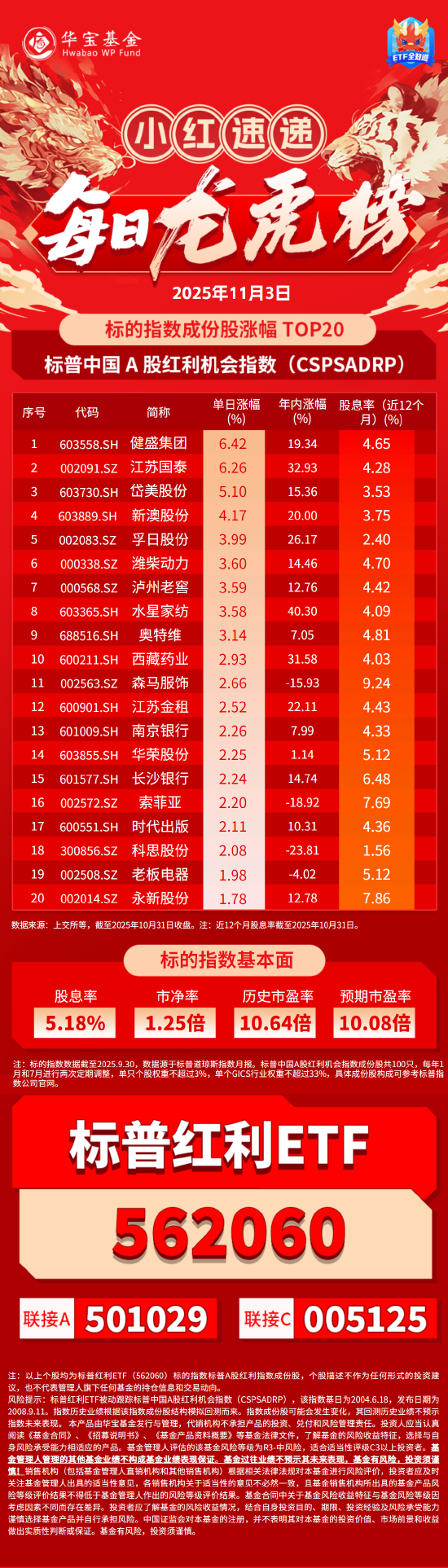
川企百强榜五年间入围门槛高了近30亿元
Si Chuan Ri Bao· 2025-11-02 21:50
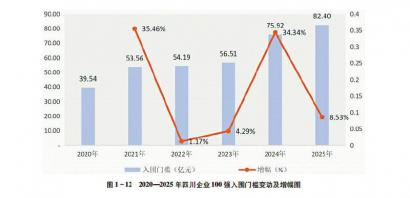
Core Insights - The threshold for entering the top 100 enterprises in Sichuan has significantly increased from 39.54 billion yuan in 2020 to 82.40 billion yuan in 2025, indicating a robust growth in the province's economy [3][4] - The number of billion-dollar enterprises in Sichuan has doubled from 4 in 2021 to 8 in 2025, highlighting the emergence of strong players in the energy, agriculture, and manufacturing sectors [3][4] - New entrants in the hundred-billion level enterprises are primarily from emerging industries such as renewable energy, smart manufacturing, and finance, reflecting a shift in the economic landscape [3][4] Group A: Billion-Dollar Enterprises - The eight billion-dollar enterprises in Sichuan include Tongwei Co., Ltd., Yibin Wuliangye Group Co., Ltd., Sichuan Changhong Electric Co., Ltd., and others, contributing significantly to employment and industrial stability [3] - Tongwei Co., Ltd. has achieved remarkable growth, with revenues increasing from under 100 billion yuan in 2021 to over 240 billion yuan in 2025, driven by the global photovoltaic industry's expansion [3][4] - The emergence of new players like Xiya Group, which focuses on non-ferrous metals, showcases the dynamic nature of the Sichuan economy [3] Group B: Hundred-Billion Enterprises - Over 70% of the hundred-billion enterprises are new entrants, indicating a strong middle force in the economy, with significant contributions from sectors like new energy and artificial intelligence [3][4] - Companies like Yibin Meijie Communication Technology Co., Ltd. and Sichuan Highview Solar Technology Co., Ltd. have made their debut in the rankings, reflecting the growth of the smart terminal and photovoltaic industries [3][4] - The rise of companies in the new energy and AI sectors demonstrates a proactive approach to industry transformation and differentiation [3] Group C: Market Dynamics - Traditional industries are facing challenges, with companies like Sichuan Blu-ray Development Co., Ltd. dropping out of the rankings due to the downturn in the real estate sector [4] - The construction and food and beverage industries are also experiencing volatility, with several companies failing to meet the entry threshold for the top 100 list [4] - The lithium industry has seen significant fluctuations, with companies like Chengdu Bamo Technology Co., Ltd. and Sichuan Yahua Industrial Group Co., Ltd. exiting the rankings due to market oversupply [4] Group D: Regional Distribution - The majority of the top 100 enterprises are concentrated in Chengdu, which reflects the city's dominant economic position in Sichuan [4] - Other cities like Mianyang and Luzhou are also seeing growth in their number of top enterprises, but the overall regional development remains uneven [4] - The state-owned enterprises dominate the rankings, comprising over 70% of the top 100, while private enterprises, though fewer, are showing strong market vitality and operational efficiency [4]


2025三季报总结:白酒加速出清,大众品景气分化
GOLDEN SUN SECURITIES· 2025-11-02 13:22
Investment Rating - The report suggests a positive investment outlook for the liquor sector, indicating that the absolute allocation value is gradually becoming apparent, with specific recommendations for various companies [1][2]. Core Insights - The liquor industry is experiencing a significant downturn, with a notable decline in revenue and profit margins, particularly in the high-end and regional segments. The report highlights that the industry is at a turning point, with potential for recovery as supply clears and demand stabilizes [2][3]. - In the beverage sector, leading companies are maintaining high growth rates, while the snack food segment shows a mixed performance, with some companies achieving remarkable growth through product innovation and channel expansion [3][4]. - The report emphasizes the recovery in the restaurant supply chain, with seasonal income improvements despite competitive pressures in pricing [4][7]. Summary by Sections 1. Liquor Industry - In Q3 2025, the liquor sector reported revenues of 786.9 billion, a year-on-year decline of 18.4%, with net profits down 22.0% to 280.6 billion. This marks the largest quarterly decline since 2013 [2][12]. - The high-end liquor segment saw revenues of 546.6 billion, down 15.0%, while regional liquor revenues fell by 35.2% [2][15]. - Major brands like Guizhou Moutai and Shanxi Fenjiu showed slight revenue increases, while others like Wuliangye and Luzhou Laojiao experienced declines exceeding 50% [2][19]. 2. Beverage and Snack Food - The beverage sector achieved Q3 revenues of 123.1 billion, up 11.3%, with net profits increasing by 30.2% to 22.2 billion. The overall growth in the beverage sector is driven by leading brands like Dongpeng Beverage [3][21]. - The snack food segment reported Q3 revenues of 133.8 billion, a slight decline of 1.0%, with net profits down 32.9% to 7.6 billion, indicating a need for strategic adjustments in this area [3][8]. 3. Restaurant Supply Chain - The restaurant supply chain reported Q3 revenues of 112.3 billion, a year-on-year increase of 1.8%, although net profits decreased by 6.3% to 5.2 billion, reflecting ongoing competitive pressures [4][7]. - The beer segment showed a slight revenue increase of 0.5% in Q3, with net profits rising by 7.4% to 28.3 billion, indicating resilience in the face of weak demand [4][7]. 4. Dairy and Health Products - The dairy sector reported Q3 revenues of 443.7 billion, down 1.5%, but net profits increased by 0.7% to 34.6 billion, suggesting a stabilization in profitability [8][19]. - The health products segment saw significant growth, with Q3 revenues of 59.7 billion, up 12.4%, and net profits soaring by 66.0% to 6.0 billion, highlighting a strong recovery in this area [8][19].

白酒业交出近十年“最差季报” 至暗时刻或许正是光明到来的前奏
Mei Ri Jing Ji Xin Wen· 2025-11-02 12:58
Core Viewpoint - The Chinese liquor industry is currently experiencing a significant downturn, referred to as its "darkest hour," with many companies reporting substantial declines in profits, including a 92.55% drop in net profit for Kuozi Jiao [1][2] Group 1: Industry Performance - The recent quarterly reports from the liquor industry are described as the "worst in a decade," with most companies showing accelerated profit declines [2] - Even leading companies like Kweichow Moutai reported a revenue of over 130 billion yuan with a 6.25% year-on-year growth in net profit, marking the lowest growth rate in nearly ten years [1][2] - The industry is transitioning from a phase of rapid growth to a more stable and mature development cycle, indicating a shift in investment logic [2][3] Group 2: Market Reactions - The market response to the poor performance reports has been mixed, with some investors remaining optimistic about a potential recovery, while others express concern [2][5] - Despite the negative reports, certain stocks like Gujing Gongjiu saw price increases, suggesting a potential market rebound and a shift towards rational investment considerations [5] Group 3: Long-term Outlook - The current downturn is seen as a necessary phase for the industry, allowing stronger companies to emerge and adapt, ultimately leading to a more resilient market [3] - High-end liquor and collectible old liquor maintain stable demand, providing a solid foundation for the industry despite overall demand slowing [4] - The high gross margins of leading companies, such as Kweichow Moutai at 91.29%, indicate that the long-term value of the liquor industry remains intact despite short-term adjustments [4]


泸州老窖(000568)2025年三季报点评:控量稳价逐步出清
Xin Lang Cai Jing· 2025-11-02 12:38
Core Viewpoint - The company reported a decline in revenue and net profit for Q1-Q3 2025, indicating resilience in performance despite industry challenges [1][3]. Financial Performance - For Q1-Q3 2025, the company achieved revenue of 231.27 billion yuan, a year-on-year decrease of 4.84%, and a net profit attributable to shareholders of 107.62 billion yuan, down 7.17% [1]. - In Q3 2025, revenue was 66.74 billion yuan, with a net profit of 30.99 billion yuan, reflecting a year-on-year decline of 9.80% and 13.07% respectively [1]. Product Performance - The company maintained a strategy of controlling volume and stabilizing prices during the downturn, with stable pricing for high-end products [2]. - Lower-end products, particularly those with strong market foundations, performed better than high-end products [2]. Cost and Margin Analysis - Gross margins for Q1-Q3 2025 were 87.11%, down 1.32 percentage points year-on-year, primarily due to poor collection on high-end products [3]. - The sales and management expense ratios increased, indicating a reduction in scale effects due to declining revenue [3]. Contract Liabilities and Revenue Matching - As of Q3 2025, contract liabilities stood at 38.38 billion yuan, a year-on-year increase of 44.60%, reflecting normal quarterly fluctuations [4]. - Real revenue for Q3 2025, adjusted for contract liabilities, was 69.82 billion yuan, a decrease of 9.45% year-on-year, aligning with revenue growth trends [4]. Investment Outlook - The company is expected to achieve revenues of 271 billion yuan in 2025, with a projected decline of 13.2%, followed by slight growth in subsequent years [4]. - The current stock price corresponds to a price-to-earnings ratio of 17 for 2025, indicating a favorable investment recommendation [4].
泸州老窖(000568):控量稳价,逐步出清
Minsheng Securities· 2025-11-02 11:28
Investment Rating - The report maintains a "Recommended" rating for the company [4] Core Views - The company has shown strong performance resilience and operational toughness amidst industry demand weakness, gradually clearing inventory in an orderly manner [1] - The company adheres to a strategy of controlling volume and stabilizing prices during the downturn, with stable pricing for high-end products and better performance for mid-tier products [2] - The gross margin is under pressure due to a shift in product mix and cost factors, with a decrease in profitability metrics observed [3] Financial Performance Summary - For the first three quarters of 2025, the company achieved revenue of 231.27 billion yuan, a year-on-year decrease of 4.84%, and a net profit attributable to shareholders of 107.62 billion yuan, down 7.17% [1] - The gross margin for Q1-3 and Q3 of 2025 was 87.11% and 87.17%, respectively, reflecting a decline of 1.32 and 0.95 percentage points year-on-year [3] - The company expects revenues of 271 billion yuan in 2025, with a projected decline of 13.2% year-on-year, followed by a slight recovery in subsequent years [4][5] Product and Market Strategy - The company focuses on optimizing channel distribution and enhancing cooperation with e-commerce platforms to increase consumer reach [2] - The performance of mid-tier products, represented by the "Old Brand Special" series, aligns well with current consumer trends, showing resilience against market pressures [2] Future Outlook - The company is expected to achieve a net profit of 114 billion yuan in 2025, with a projected decline of 15.4% year-on-year, followed by a recovery in subsequent years [4][5] - The report highlights the potential for digital transformation to enhance management efficiency in the medium to long term [4]
千亿险资系私募基金,最新动向曝光
Zhong Guo Zheng Quan Bao· 2025-11-02 04:10
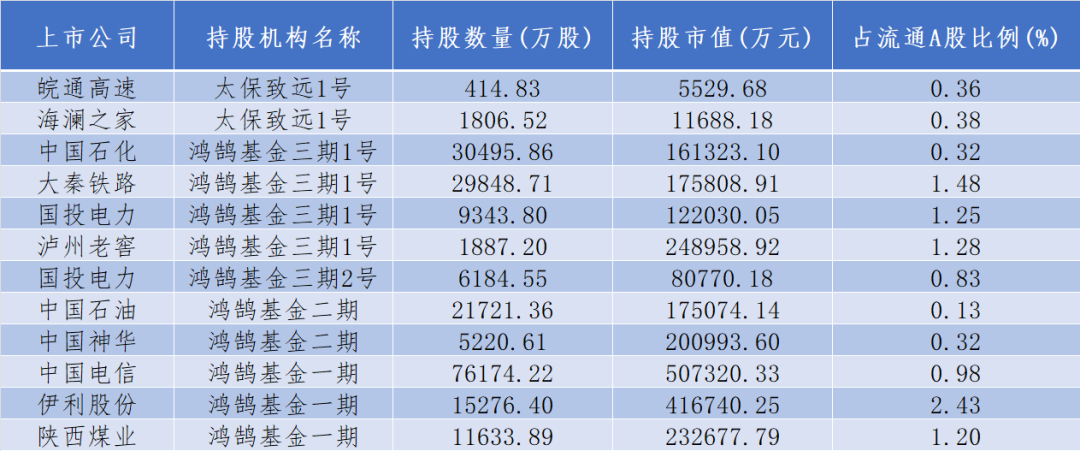
Core Insights - The trial reform for long-term investment of insurance funds has accelerated this year, with the latest holdings of insurance-related private equity funds revealed following the disclosure of listed companies' Q3 reports [1][9] - Five insurance-related private equity funds have disclosed their latest holdings, with significant investments in companies such as Sinopec, Daqin Railway, Guotou Power, Luzhou Laojiao, Anhui Expressway, and HLA [1][4] Holdings Summary - As of the end of Q3, Taibao Zhiyuan No. 1 Private Securities Investment Fund has appeared in the top ten circulating shareholders of Anhui Expressway and HLA, holding 4.1483 million shares and 18.0652 million shares respectively [3][6] - The holdings of five insurance-related private equity funds are detailed in a table, showing the number of shares, market value, and percentage of circulating A-shares for each listed company [5] - The Honghu Fund Phase III No. 1 has emerged as a major shareholder in Sinopec, Daqin Railway, Guotou Power, and Luzhou Laojiao, with holdings of 304.9586 million shares, 298.4871 million shares, 93.438 million shares, and 18.872 million shares respectively [6][7] Investment Focus - The insurance-related private equity funds are primarily concentrated in sectors such as petrochemicals, transportation, coal, public utilities, food and beverage, telecommunications, and textiles, with many holdings being industry leaders characterized by high dividends and low volatility [7][10] - The ongoing trial reform has seen the number of operational insurance-related private equity funds increase to seven, with a total approved scale of 222 billion yuan [9][10]



白酒业新观察:“马太效应”愈发显著
Shang Hai Zheng Quan Bao· 2025-11-01 12:57
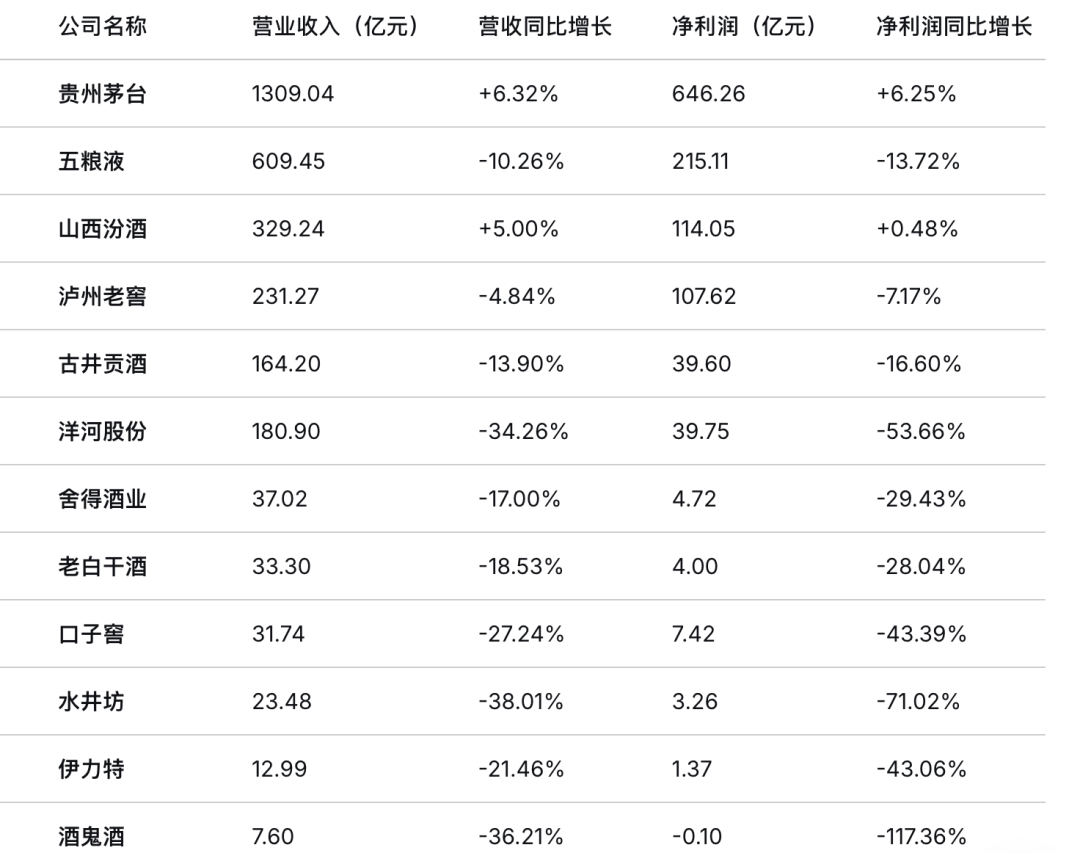
Core Viewpoint - The high-end liquor industry is struggling with growth, while mid-range and regional liquor companies are experiencing significant declines in performance, as evidenced by the third-quarter reports of 20 A-share liquor companies, highlighting challenges such as weak consumption, high channel inventory, and falling prices [1][8]. Company Performance Summary - Guizhou Moutai reported revenue of 130.9 billion yuan, a year-on-year increase of 6.32%, and a net profit of 64.6 billion yuan, up 6.25% [2][9]. - Wuliangye's revenue was 60.9 billion yuan, down 10.26%, with a net profit of 21.5 billion yuan, a decline of 13.72% [2][11]. - Shanxi Fenjiu achieved revenue of 32.9 billion yuan, a 5.00% increase, but its net profit fell by 1.4% to 39.7 billion yuan [2][10]. - Luzhou Laojiao's revenue decreased by 4.84% to 23.1 billion yuan, with a net profit of 10.8 billion yuan, down 7.17% [2][12]. - The performance of regional liquor companies like Kuaijie and Yingjia Gongjiu showed significant declines, with Kuaijie reporting a 46.23% drop in revenue and a 92.6% decrease in net profit [4][6]. Industry Trends - The third quarter showed a clear downward trend, with many regional liquor companies experiencing accelerated declines, and some even reporting losses [3][8]. - The "Matthew Effect" is becoming more pronounced, with only Guizhou Moutai and Shanxi Fenjiu achieving positive growth in both revenue and net profit among the 20 companies [8][13]. - The overall industry is undergoing a profound supply-side adjustment, with strong brand power and national distribution allowing leading companies to withstand cyclical fluctuations, while smaller companies face greater challenges [13]. Market Outlook - Expectations for the upcoming Mid-Autumn Festival and National Day indicate a potential 20%-30% decline in overall liquor demand, with inventory expected to increase by 10%-20% [13]. - The current high channel inventory and weak consumption scenarios suggest that the liquor industry will continue to face significant pressure into the 2026 Spring Festival [13].