GUJING(000596)

Search documents
古井贡酒(000596) - 2025年第二次临时股东大会决议公告
2025-09-29 12:45
证券代码:000596、200596 证券简称:古井贡酒、古井贡 B 公告编号:2025-023 本公司及董事会全体成员保证本公告内容真实、准确和完整,没有虚假记载、 误导性陈述或重大遗漏。 特别提示: 1.本次股东大会没有出现否决议案; 2.本次股东大会没有涉及变更前次股东大会决议的情形。 安徽古井贡酒股份有限公司 一、会议召开的情况 1.召开时间 (1)现场会议时间:2025年9月29日上午9:30; (2)网络投票时间:通过深圳证券交易所交易系统投票的具体 时间为:2025 年 9 月 29 日 9:15-9:25,9:30-11:30 和 13:00-15:00;通过 互联网投票系统(http://wltp.cninfo.com.cn)进行网络投票的具体时 间为:2025 年 9 月 29 日上午 9:15 至下午 15:00。 2.会议召开地点:安徽省亳州谯城区安徽古井贡酒股份有限公司 (以下简称"公司")总部十楼会议室。 2025年第二次临时股东大会决议公告 7.出席本次股东大会并投票表决的股东(代理人)共430人,代 1 表股份329,416,847股,占公司有表决权总股份的62.3187%。其 ...

古井贡酒(000596) - 关于安徽古井贡酒股份有限公司2025年第二次临时股东大会的法律意见
2025-09-29 12:35
北京德恒(合肥)律师事务所 关于安徽古井贡酒股份有限公司 2025 年第二次临时股东大会的 法律意见 合肥市梅山路 18 号安徽国际金融中心 45 层 电话:(86-551) 65226519 传真:(86-551)65226502 邮编:230000 北京德恒(合肥)律师事务所 关于安徽古井贡酒股份有限公司 2025 年第二次临时股东大会的法律意见 北京德恒(合肥)律师事务所 关于安徽古井贡酒股份有限公司 2025 年第二次临时股东大会的 法律意见 (2025)德恒 19G20240197-1 号 致:安徽古井贡酒股份有限公司 北京德恒(合肥)律师事务所接受安徽古井贡酒股份有限公司(以下简称"公 司")委托,指派张蕾律师、王睿律师(以下简称"本所律师")出席公司 2025 年 第二次临时股东大会(以下简称"本次股东大会"),并就本次股东大会的召集、 召开程序、出席会议人员资格、股东提出议案的资格和程序以及会议表决程序的 合法性进行见证并出具法律意见。 本所律师依据《中华人民共和国公司法》(以下简称"《公司法》")《中华人 民共和国证券法》(以下简称"《证券法》")《上市公司股东会规则》(以下简 称"《股东会 ...
食品饮料行业周报(2025.09.22-2025.09.27):蜜雪、幸运咖双品牌共振,万辰港股IPO展示规模壁垒,白酒中秋动销本周起速-20250929
China Post Securities· 2025-09-29 12:11
Investment Rating - The industry investment rating is "Outperform" and is maintained [2] Core Insights - The new tea and coffee market in China has become an important consumption sector, with Mixue Group emerging as a significant player due to its unique market positioning and strong supply chain capabilities [2][16] - Mixue Group's brands, Mixue Ice City and Lucky Coffee, have distinct market positions and clear development strategies, indicating long-term growth potential [2][16] - The group effectively leverages the synergy between its tea and coffee brands, with Mixue Ice City focusing on mass tea consumption and Lucky Coffee targeting the coffee market with a beverage-oriented product strategy [3][22] Summary by Sections Industry Overview - The food and beverage sector's performance this week saw a decline of 2.49%, ranking 26th among 30 sectors, underperforming the CSI 300 index by 3.56 percentage points [10][31] - Only the soft drink segment experienced an increase, with a rise of 0.86% [10][32] Company Developments - Mixue Group has a total of 53,014 stores globally, with 48,281 in China and 4,733 overseas, focusing on lower-tier markets [16][23] - Lucky Coffee has rapidly expanded, surpassing 8,000 stores by August 2025, targeting entry-level coffee consumers [16][23] - Wanchen Group submitted its IPO application in Hong Kong, reinforcing its leading position in the Chinese snack retail sector, with plans to use the funds for network expansion and product diversification [25][26] Market Dynamics - The competitive landscape in the coffee sector shows Lucky Coffee adopting a beverage-oriented strategy, differentiating itself from specialized coffee brands [3][22] - The potential for expansion in lower-tier cities remains significant, with Mixue Ice City and Lucky Coffee poised to capture unmet demand in these markets [4][23] - The overall market sentiment is cautious, with expectations of a significant decline in sales during the Mid-Autumn Festival, although some brands are showing signs of recovery [27][30]





当非遗邂逅世博:古井贡酒以年份原浆与国潮新品开启国际化突围
Zhong Guo Jing Ying Bao· 2025-09-29 10:41
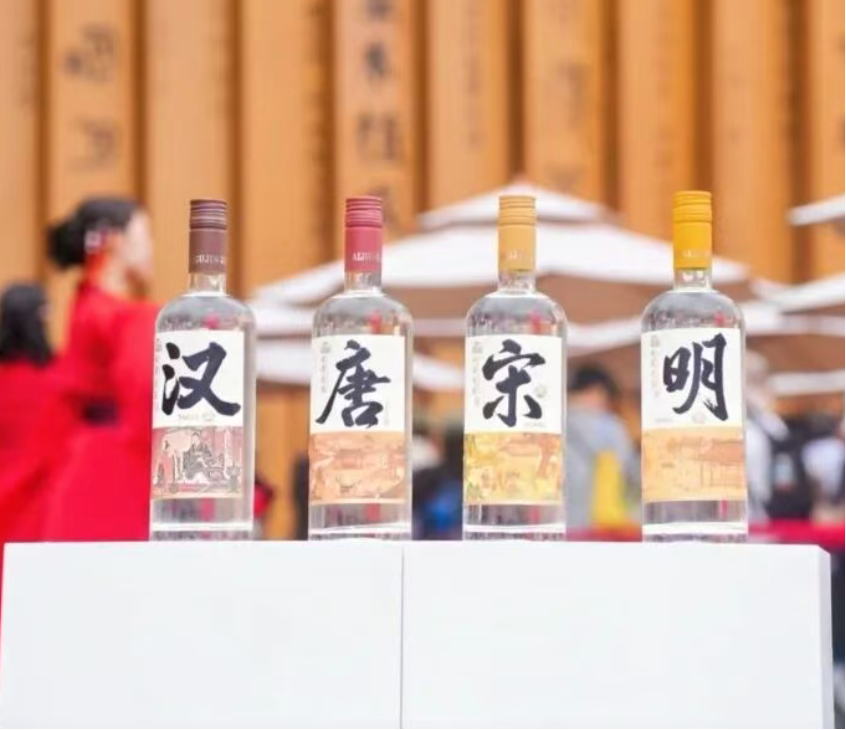
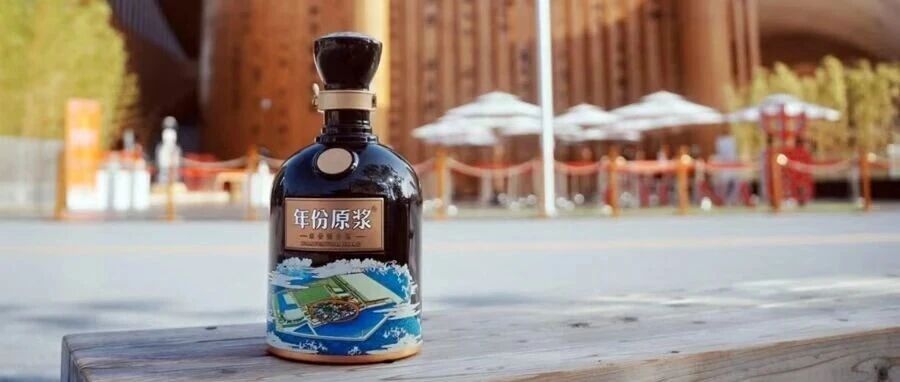
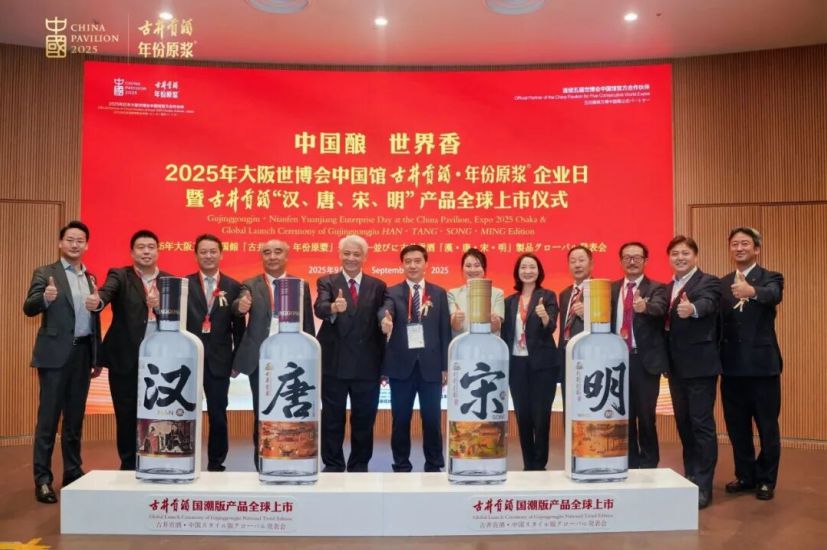
Core Viewpoint - The event marks the international launch of Gujinggongjiu's "Han, Tang, Song, Ming" product series and the promotion of its vintage raw liquor, signifying a significant step in the internationalization of Chinese liquor, particularly in the Japanese market [4][13]. Group 1: Strategic Choices - Gujinggongjiu's choice to launch at the Osaka Expo leverages the global influence of the event to enhance brand recognition while combining "national trend + high-end" strategies [6]. - The company presented a cultural performance and donated a commemorative liquor to the China Pavilion, integrating cultural dissemination with commercial activities [6][10]. Group 2: Product Lines - The vintage raw liquor series targets the high-end and collectible market, utilizing traditional brewing techniques and Ming Dynasty cellar resources to create a quality barrier, suitable for business gifts and core liquor enthusiasts [7]. - The "Han, Tang, Song, Ming" series emphasizes cultural symbols and visual expression, appealing to the curiosity of younger overseas consumers [7]. Group 3: Market Expansion - Gujinggongjiu has established a "dual-driven" internationalization model, focusing on high-end product lines in Japan's political and business sectors, as well as retail and e-commerce for the national trend series [11]. - The company aims to transition from merely exporting products to embedding itself within local consumption circles, supported by partnerships with local distributors and networks [11][13]. Group 4: Future Outlook - As the international standardization of Chinese liquor accelerates, Gujinggongjiu's brand influence is expected to grow, reflecting the broader trend of Chinese liquor moving onto the global stage [13].

中国酿·世界香——古井贡酒·年份原浆中国酒文化全球巡礼绽放东京
Xin Lang Cai Jing· 2025-09-29 08:48
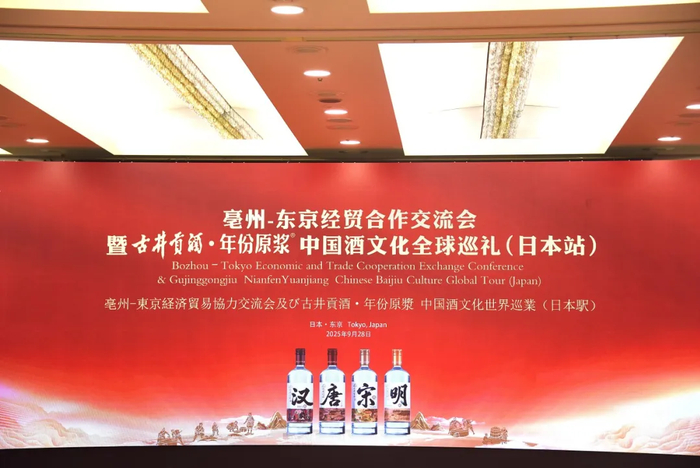
Core Insights - The event in Tokyo marked a significant cultural and economic exchange between Bozhou and Japan, showcasing the international brand appeal of Gujing Gongjiu [1][3][10] - Former Japanese Prime Minister Yukio Hatoyama praised Gujing Gongjiu's efforts in promoting Chinese liquor culture internationally, emphasizing the importance of cross-border cultural exchanges [19][21] Group 1: Event Highlights - The event featured a cocktail demonstration using Gujing Gongjiu, allowing guests to experience the unique flavors of the brand while enjoying cultural performances [5][27] - A dedicated exhibition booth for Bozhou highlighted its historical and cultural significance, as well as its industrial advantages [9] - The unveiling of the "Gujing Gongjiu Year Original Culture Research Institute - Tokyo Center" aims to deepen Sino-Japanese cultural research and collaboration [12][16] Group 2: Strategic Partnerships - Gujing Gongjiu signed strategic cooperation agreements with Japanese companies, extending its cultural ties into practical economic collaborations [41][43] - The event served as a platform for Gujing Gongjiu to strengthen its market presence in Japan, aiming to introduce high-quality products to Japanese consumers [10][19] Group 3: Long-term Strategy - Gujing Gongjiu's global liquor culture tour reflects its commitment to long-term strategies in promoting Chinese liquor culture worldwide, having previously held events in major cities across the globe [44][46] - The brand's slogan "Chinese Brew, World Fragrance" encapsulates its vision of making Chinese liquor a global language [44]
“王健林们”退场,万亿房地产消费遇冷,中国白酒未来增量在哪?
Sou Hu Cai Jing· 2025-09-29 07:49
Core Viewpoint - The decline of the real estate industry in China has significantly impacted the high-end liquor market, leading to a need for transformation and new consumption drivers in the liquor sector [1][4][7]. Group 1: Real Estate and Liquor Industry Interconnection - The real estate sector's growth has historically driven the high-end liquor market, with a notable increase in business-related consumption [2][4]. - From 2004 to 2013, real estate investment surged over 520%, while the liquor industry experienced a "golden decade" with production up 293%, revenue up 719%, and profits soaring 1272% [5]. - The collapse of major real estate companies like Evergrande and the subsequent economic downturn have led to a significant decline in the liquor industry, which is now facing intense competition and adjustment [7][8]. Group 2: Current State of the Liquor Industry - As of early 2025, the number of large-scale liquor enterprises has decreased to 887, with a slight revenue increase of 0.19% but a significant profit drop of 10.93% [8]. - Major liquor companies have initiated strategic transformations, focusing on new consumer demographics, international markets, and affordable product lines to adapt to changing market conditions [10][11][12]. Group 3: Strategic Transformations in the Liquor Industry - Companies like Moutai are targeting new consumer groups in emerging industries and enhancing personalized service offerings [10]. - The liquor industry is also expanding its international presence, with initiatives aimed at promoting Chinese liquor globally [10]. - There is a growing emphasis on affordable products, with several brands launching new offerings to capture the mass market [11][12]. Group 4: Future Outlook and Challenges - Despite initial successes in transformation, the liquor industry faces ongoing challenges, including the need to find new consumption drivers to replace the real estate sector [14]. - The export market for Chinese liquor is still in its infancy, and the profitability of mass-market products lags behind that of premium offerings [14].

销量爆了!吃喝板块猛攻,“茅五泸汾洋”齐涨!食品ETF(515710)盘中涨超1%
Xin Lang Ji Jin· 2025-09-29 06:33
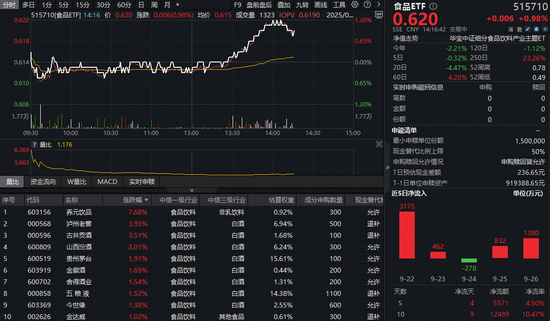
Group 1 - The food and beverage sector experienced a significant rally on September 29, with the Food ETF (515710) reaching an intraday price increase of up to 1.3% before settling at a 0.98% gain [1][3] - Key stocks in the sector showed strong performance, with Yangyuan Beverage soaring over 7%, and major liquor brands like Luzhou Laojiao and Gujing Gongji rising over 3% [1][3] - The Food ETF (515710) has seen substantial net inflows, with a total of 55.71 million yuan in net subscriptions over the last five trading days, indicating strong investor interest [3] Group 2 - Sales of popular gift items such as liquor and mooncakes surged ahead of the Mid-Autumn and National Day holidays, with liquor sales on Meituan increasing approximately eightfold year-on-year [3][4] - The current valuation of the food and beverage sector is considered low, with the food index's price-to-earnings ratio at 20.21, placing it in the lower 5.88% percentile over the past decade, suggesting a favorable investment opportunity [3][4] - Analysts predict a recovery in the liquor sector due to government policies promoting high-quality development, with expectations for Maotai's prices to rebound as market conditions improve [4][5] Group 3 - The food and beverage industry is witnessing significant policy catalysts, such as the upcoming public consultation on the national standards for prepared food safety, which may benefit leading brands [4][5] - The Food ETF (515710) is strategically positioned, with approximately 60% of its holdings in leading high-end and mid-range liquor stocks, and nearly 40% in other beverage and food segments [5] - Investors can also access core assets in the food and beverage sector through the Food ETF linked funds [5]

再度亮相大阪世博会,古井贡酒携国潮新品续写中国品牌硬实力
Bei Ke Cai Jing· 2025-09-29 05:23
Core Viewpoint - Gujinggongjiu is leveraging its participation in the 2025 Osaka World Expo to promote Chinese liquor culture globally, showcasing its traditional brewing techniques and modern innovations in green and intelligent manufacturing [1][3][10]. Group 1: Event Participation and Product Launch - Gujinggongjiu hosted two corporate days at the China Pavilion of the Osaka Expo, highlighting its role as the only official partner to do so for five consecutive expos [1][8]. - The company launched four new products, "Han, Tang, Song, Ming," during the second corporate day, emphasizing a modern interpretation of Chinese liquor culture [4][6][7]. Group 2: Cultural Promotion and Brand Identity - The events aim to bridge cultural exchanges, showcasing the essence of Chinese heritage and craftsmanship through liquor [1][3][10]. - Gujinggongjiu's commitment to promoting Chinese liquor culture aligns with the expo's theme of building a community of life between humans and nature [3][10]. Group 3: Innovation and Sustainability - The company emphasizes "green brewing" and "intelligent manufacturing," integrating traditional methods with modern technology to enhance production efficiency and product quality [10][11]. - Gujinggongjiu is focused on sustainable practices, from sourcing high-quality raw materials to utilizing ancient well water for brewing, ensuring a premium product [10][11]. Group 4: Social Responsibility and Global Outreach - Gujinggongjiu is dedicated to showcasing its hometown, Bozhou, and its rich cultural heritage while promoting local brands internationally [12][14]. - The company is actively engaging in global cultural exchanges, including events in Tokyo, to further its mission of spreading Chinese liquor culture worldwide [14][15].
天猫白酒中秋热卖榜双榜热销!古井贡酒老瓷贡掀起囤货热潮
Xin Hua Wang· 2025-09-29 05:18
同时,产品的热销,也吸引来众多白酒大V为老瓷贡的热度再添一把火,推荐为"国民十大光瓶酒""50 元以下超高性价比口粮酒"榜单之列。古井贡酒也聚焦济南、呼尔浩特等大商布局城市,邀请当地网红 达人测评,目前#老瓷贡话题在抖音播放量已超4000万,引发不少酒友晒图分享、搜索,老瓷贡关键词 指数同比、环比均增长200%+。 在古井贡酒老瓷贡布局的重点市场,多处城市地标建筑上,老瓷贡的宣传海报频频可见,也为城市里忙 碌的人群,挑选品质口粮酒提供一个不错的选择。 临近中秋,朋友欢聚,回家探亲,独饮小酌,少不了带上两瓶纯粮好酒。在这个中秋档活动中,古井贡 酒老瓷贡,传承老味道、老工艺,深受酒友喜爱,成了不少人囤货清单的必买产品。 天猫白酒中秋热卖榜双榜热销 在刚结束的2025年天猫中秋团圆季大促活动,古井贡酒老瓷贡连续上榜中秋热卖榜单TOP1、200-500元 热销榜单TOP3,同时借助天猫古井贡酒超级品牌日资源的加持,掀起光瓶酒的囤货热潮。 在天猫古井贡酒官方旗舰店的评论区里,众多酒友对老瓷贡评价颇高,"包装好,大气复古"、"50元价 位段的品质口粮酒"、"口感好"、"物超所值",这些评价是酒友的认可,也是老瓷贡最大的产 ...
“茅五”等名酒动销回暖;古井贡酒推26度国际化新品
2 1 Shi Ji Jing Ji Bao Dao· 2025-09-29 03:41
Industry Overview - The liquor industry is experiencing a seasonal recovery, with premium brands like Moutai and Wuliangye seeing improved sales, while overall market conditions remain challenging [1][2] - Moutai's sales have reportedly increased significantly, with a year-on-year growth of over 20% and a month-on-month increase of approximately 100% in September [1] - Despite the recovery in premium liquor sales, the overall sales performance across the industry is still below previous years, indicating a disparity between leading brands and the broader market [3] Production Data - In September, the national liquor production dropped by 18.2% year-on-year, totaling 20.7 million tons, with a cumulative production of 235.2 million tons for the first nine months, reflecting a 9% decline [4] - Beer production also saw a slight decrease of 1.8% in September, with a total of 358.3 million tons produced, and a cumulative production of 2,683.3 million tons for the first nine months, down by 0.2% [5] Company Developments - Gujing Gongjiu launched a new product line named "Han, Tang, Song, Ming," aimed at the international market, featuring a 26-degree alcohol content that balances flavor and smoothness [6][7] - Jian Nan Chun plans to reduce its stake in Huaxi Securities by up to 26.25 million shares, representing 1% of the company's total shares, to meet liquidity needs, potentially raising around 250 million yuan [9][10] - Moutai 1935 has intensified its marketing efforts by sponsoring events such as the "Bay Area Moonrise" film music concert and partnering with the Golden Rooster and Hundred Flowers Film Festival [11] - Dazhen Zhenjiu has signed over 3,000 alliance merchants, significantly increasing its market presence across 30 provinces and 212 cities [13] - Qingdao Beer is enhancing its international presence through a strategic partnership in Thailand, building on its established sales network [14] - Asahi Beer has announced price increases for certain imported products in response to rising operational costs [15]