ZGXT(000831)

Search documents
稀土股价值重估正当时?
2 1 Shi Ji Jing Ji Bao Dao· 2025-10-13 23:40
Core Viewpoint - The rare earth sector has experienced a significant rebound after a collective pullback in September, with a notable increase in stock prices driven by improving demand and strategic value in rare earth products [1][2]. Group 1: Market Performance - On October 13, the Wind rare earth index rose by 9.49%, leading all popular concept sectors, with several stocks, including Baotou Steel and Northern Rare Earth, hitting the daily limit [1]. - Northern Rare Earth's stock has surged over 170% year-to-date, with its current valuation reaching 75 times the expected annual profit of 2.8 billion yuan [1][2]. Group 2: Industry Dynamics - Despite the stock market's enthusiasm, the rare earth industry remains rational, with prices for various rare earth products, except for dysprosium, showing a downward trend [2]. - Baotou Steel, despite being the largest rare earth raw material base globally, derives only a small portion of its revenue from rare earth products, with steel products accounting for 77% of its total revenue in 2024 [2][4]. Group 3: Profitability Trends - Northern Rare Earth's net profit for the first three quarters is projected to be between 1.51 billion and 1.57 billion yuan, reflecting a year-on-year increase of 272.54% to 287.34% [2][3]. - The profit growth rate for Northern Rare Earth is considered typical for the basic materials sector and does not stand out significantly [4]. Group 4: Historical Context - Northern Rare Earth's profits have not returned to the historical peak levels of over 5 billion yuan in 2021 and 2022, yet its stock price is nearing the 2021 high [5][6]. - Other companies in the sector, such as China Rare Earth and Guangsheng Nonferrous, have also seen their stock prices exceed the 2021 cycle highs [7]. Group 5: Regulatory Impact - Recent export control measures by the Ministry of Commerce have expanded the scope of restrictions on rare earth-related items, which may strengthen supply rigidity in the market [8][9]. - Since the announcement of these measures, the rare earth sector has experienced a continuous upward trend, with the Wind rare earth index increasing by approximately 14% [9]. Group 6: Valuation Concerns - The current valuations of rare earth companies are exceptionally high, with estimates for China Rare Earth, Guangsheng Nonferrous, and Shenghe Resources at 177 times, 83 times, and 52 times, respectively [10]. - The valuation re-evaluation in the sector has already begun, raising concerns about potential overvaluation [11].


中国稀土管制令打响“时间争夺战”,能否重塑全球格局?
Sou Hu Cai Jing· 2025-10-13 19:43
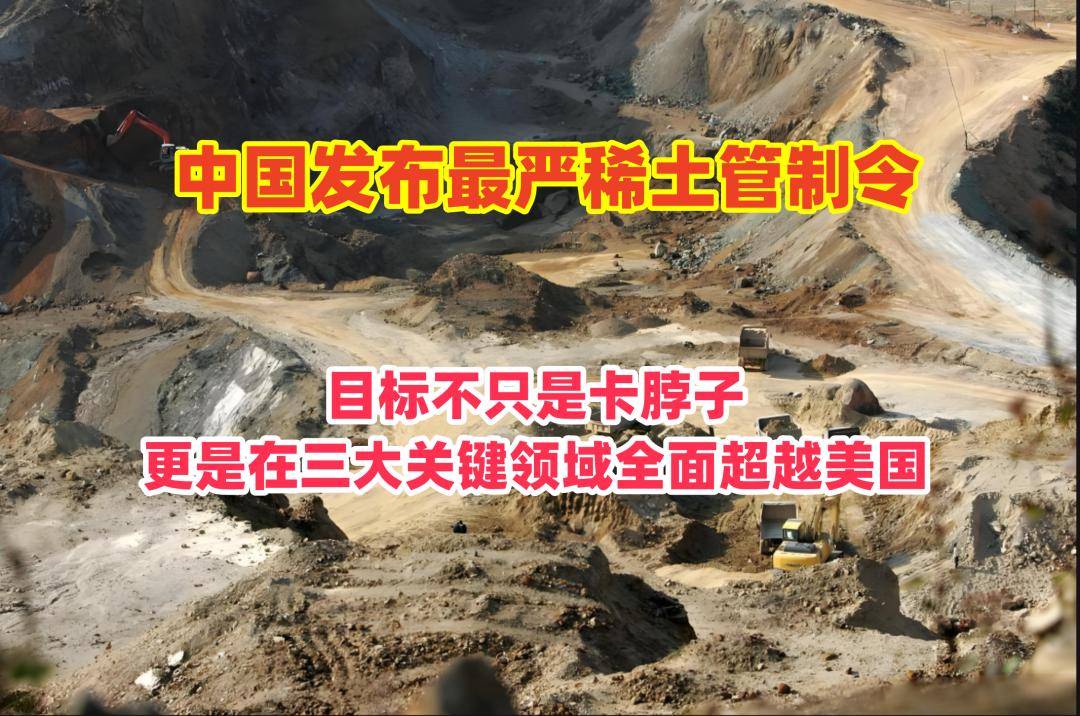
Core Insights - The recent announcement of China's strict rare earth regulations is viewed as a strategic move in a "race against time" that impacts global markets and technology sectors [1][3][8] - The competition between China and the U.S. in key areas such as AI, semiconductors, and military technology will shape the future global landscape [3][5] Industry Analysis - China's rare earth control is not merely a trade tactic but a strategic maneuver to secure a buffer period for industrial upgrades and technological breakthroughs [1][3] - The U.S. faces significant challenges in establishing a self-sufficient rare earth supply chain, with estimates suggesting it could take 5 to 10 years to reduce dependence on Chinese supplies [3][5] - China's rare earth regulations are creating opportunities in AI, where U.S. data center expansions are hindered by shortages, while Chinese AI chip performance is rapidly improving [3][5] - In the semiconductor sector, while U.S. companies struggle with supply issues, Chinese firms like SMIC and Yangtze Memory Technologies are making significant advancements in production capabilities [5] - The military sector is also affected, with U.S. defense production facing rare earth supply constraints, while China accelerates the development of advanced military technologies [5][7] Strategic Implications - The interplay between rare earth resources and advancements in AI, semiconductors, and military technology is creating a virtuous cycle that enhances China's competitive edge [5][7] - The strategic foresight of China's rare earth policy may lead to a significant shift in global industrial dynamics, positioning China as a leader in critical technology sectors [7][8]

中国稀土管制触发美国过度反应,商务部:中方将坚决反制
Sou Hu Cai Jing· 2025-10-13 16:50
Core Viewpoint - The trade conflict between the U.S. and China has escalated, with the U.S. imposing a 100% tariff on Chinese goods in response to China's export controls on rare earth materials, significantly impacting global supply chains and financial markets [2][4][12]. U.S. Tariff Announcement - On October 10, 2025, President Trump announced a 100% additional tariff on all Chinese imports effective November 1, alongside export controls on key software [2][7][8]. - This decision was a direct response to China's rare earth export control measures announced on October 9 [2][4]. China's Rare Earth Export Controls - China's Ministry of Commerce issued two announcements on October 9, 2025, implementing export controls on rare earth materials, affecting items with a Chinese component of 0.1% or more, and technologies related to rare earth extraction and processing [4][5]. - The measures are framed as necessary for national security and compliance with international obligations, following a history of concerns regarding the military use of Chinese rare earth materials [5][19]. Market Reactions - Financial markets reacted negatively, with the Dow Jones Industrial Average dropping nearly 900 points and semiconductor stocks declining over 5% following the announcements [2][15]. - The S&P 500 index fell by 2.7%, marking its largest single-day drop since April [15][22]. Global Economic Implications - The renewed trade conflict is expected to disrupt global supply chains, particularly in the semiconductor and technology sectors, with companies like Nvidia and AMD experiencing significant stock price declines [15][21]. - The situation poses a risk of broader economic repercussions, as both nations' actions could lead to a "mutually assured destruction" scenario, affecting global economic stability [21][24]. Future Outlook - There remains potential for negotiation, as Trump indicated that tariffs could be reconsidered before the November 1 deadline, and a meeting with Chinese leaders is not entirely ruled out [17][22]. - The next three weeks are critical, with the U.S. tariff implementation date coinciding with China's full enforcement of rare earth controls on December 1 [23][24].
“A股太强了”冲上热搜!超级赛道大爆发,批量涨停
Sou Hu Cai Jing· 2025-10-13 16:47
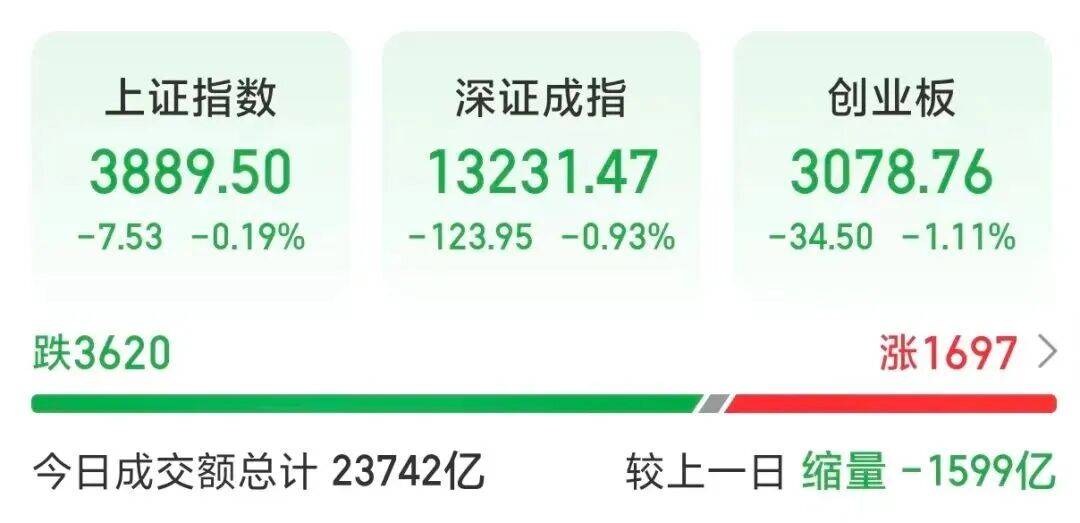
Market Overview - On October 13, the market experienced fluctuations, with the three major indices opening lower but recovering throughout the day. The STAR Market 50 Index opened nearly 3% down but surged over 1% in the afternoon [1] - By the close, the Shanghai Composite Index fell by 0.19%, the Shenzhen Component Index dropped by 0.93%, and the ChiNext Index decreased by 1.11%. The total market turnover exceeded 2.37 trillion yuan, a decrease of 159.9 billion yuan compared to the previous trading day [1] Sector Performance - The rare earth permanent magnet sector continued to strengthen, with stocks like Galaxy Magnetic, China Rare Earth, and Northern Rare Earth hitting the daily limit [4] - The semiconductor industry also saw a surge, with over ten stocks including Newray Material and Kaimete Gas reaching the daily limit. The non-ferrous metals sector became active again, with China Ruilin and Western Gold achieving two consecutive limits [4] - Conversely, the automotive parts and gaming sectors experienced the largest declines [4] Rare Earth Sector Insights - The rare earth sector exploded again, with stocks like Jiuling Technology rising nearly 27% and several others hitting the daily limit. On October 9, the Ministry of Commerce and the General Administration of Customs announced multiple regulations on the export of rare earth-related items, technologies, and equipment, expanding the control range to overseas markets [5][6] - According to CITIC Securities, the security of rare earth resources has become a core aspect of national security, and the rare earth industry chain is expected to enter a new era of high-quality development. The supply-demand dynamics are likely to remain favorable, with rare earth prices expected to stabilize and gradually increase [6] - China’s strategic position in rare earths is expected to strengthen, with overseas stockpiling actions likely to increase, further driving up rare earth prices. The long-term control over the entire rare earth industry chain will enhance China's competitive advantage [6] Semiconductor Sector Recovery - The semiconductor sector rebounded after a significant decline, with stocks like Ruvi Optoelectronics and Huahong Semiconductor both hitting the daily limit. Other stocks such as SMIC and Baiwei Storage saw increases of nearly 7% [6] Nuclear Fusion Sector Activity - The nuclear fusion concept stocks remained active, with companies like Hezhong Intelligent and Dongfang Tantalum hitting the daily limit. Over the past five trading days, the nuclear fusion concept has risen by 10.59% [9] - Recent positive developments in the nuclear fusion field include breakthroughs in the construction of the compact fusion energy experimental device BEST and the successful delivery of the world's largest toroidal field magnet coil box [10] - The Shanghai government has introduced measures to accelerate the layout of cutting-edge technologies, including nuclear fusion, emphasizing support for tackling technical challenges and product feasibility verification [10] Upcoming Events - The International Atomic Energy Agency's Fusion Energy Conference (FEC2025) will be held in Chengdu from October 13 to 18 [11]


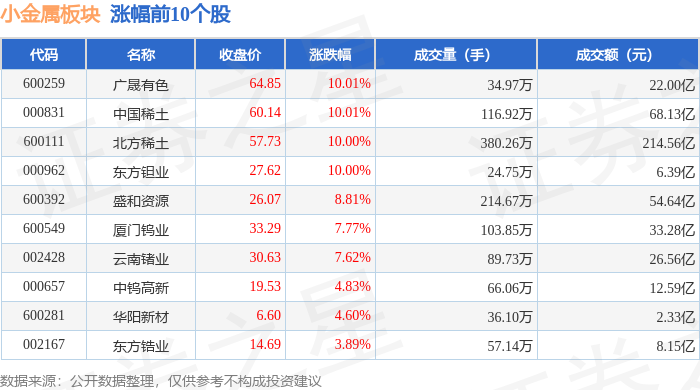
小金属板块10月13日涨6.26%,广晟有色领涨,主力资金净流入11.89亿元
Zheng Xing Xing Ye Ri Bao· 2025-10-13 12:38
Core Insights - The small metals sector experienced a significant increase of 6.26% on October 13, with Guangsheng Nonferrous leading the gains [1] - The Shanghai Composite Index closed at 3889.5, down 0.19%, while the Shenzhen Component Index closed at 13231.47, down 0.93% [1] Small Metals Sector Performance - Guangsheng Nonferrous (600259) closed at 64.85, up 10.01% with a trading volume of 349,700 shares and a transaction value of 2.2 billion [1] - China Rare Earth (000831) also rose by 10.01% to close at 60.14, with a trading volume of 1,169,200 shares and a transaction value of 6.813 billion [1] - Northern Rare Earth (600111) increased by 10.00% to 57.73, with a trading volume of 3,802,600 shares and a transaction value of 21.456 billion [1] - Other notable performers include Dongfang Silver Industry (000962) up 10.00% to 27.62 and Shenghe Resources (600392) up 8.81% to 26.07 [1] Capital Flow Analysis - The small metals sector saw a net inflow of 1.189 billion from main funds, while retail funds experienced a net outflow of 510 million [2][3] - Notable net inflows from main funds include Northern Rare Earth with 724 million and China Rare Earth with 208 million [3] - Retail funds showed significant outflows from several companies, including Northern Rare Earth and China Rare Earth, indicating a shift in investor sentiment [3]


中美博弈或升温,关注避险需求与战略小金属
East Money Securities· 2025-10-13 12:30
Investment Rating - The report maintains an "Outperform" rating for the industry [2][9]. Core Insights - The report highlights the increasing geopolitical tensions between China and the U.S., which may elevate demand for safe-haven assets like gold and strategic metals such as rare earths and tungsten [5][9]. - The copper market is experiencing supply disruptions, with prices trending upward due to tight supply conditions [5]. - Aluminum demand is expected to continue, with potential opportunities for investment following market corrections [5]. - The strategic importance of rare earths and tungsten is emphasized due to recent export controls and geopolitical developments [5][9]. Summary by Sections Copper Sector - Supply disruptions are ongoing, with LME copper prices at $10,735 per ton, reflecting a week-on-week increase of 1.9% [5]. - The processing fee for imported copper concentrate is negative, indicating tight supply [5]. - Companies with rich copper reserves are recommended for investment [9]. Aluminum Sector - LME aluminum prices reached $2,800 per ton, up 3.6% week-on-week [5]. - The operating rate for aluminum processing enterprises has slightly decreased, but demand is expected to remain stable [5]. - Investment opportunities are suggested for companies in the aluminum sector following market corrections [9]. Gold Sector - Gold prices are rising, with SHFE gold at 901.6 RMB per gram, up 3.1% week-on-week [5]. - The report suggests that geopolitical tensions may enhance gold's strategic position as a safe-haven asset [5]. - Investment in gold-related companies is recommended due to their undervalued resource potential [9]. Rare Metals Sector - Rare earth prices remain stable, with praseodymium-neodymium oxide at 683,000 RMB per ton [5]. - Recent export controls on rare earths have heightened their strategic importance amid U.S.-China tensions [5][9]. - Investment opportunities are highlighted in companies involved in rare earth production [9]. Steel Sector - Steel prices are stable, with SHFE rebar at 3,103 RMB per ton, reflecting a week-on-week increase of 1.0% [6]. - The report notes frequent disruptions in iron ore supply negotiations, which may impact future prices [6]. - Companies with high self-sufficiency in iron ore are recommended for investment [9].




花旗:中国稀土深度报告,配额紧&需求爆(双语)
Sou Hu Cai Jing· 2025-10-13 12:11
Core Viewpoint - The rare earth industry is in an early to mid-cycle uptrend, supported by China's strict supply management, favorable policy momentum, and the strategic role of rare earths in energy transition and advanced manufacturing [3][5][9]. Industry Overview - The rare earth market is experiencing a recovery phase, driven by strong demand from electric vehicles and renewable energy sectors, despite some fluctuations in light rare earth prices [5][9]. - Heavy rare earth prices remain robust due to supply constraints, with geopolitical risks contributing to price stability in the short term [6][9]. Price Outlook - Short-term prices are expected to remain firm with an upward trend due to supply tightness and geopolitical risks, while mid-term prices are projected to stabilize at a higher range as new capacities come online [6][43]. - Light rare earth elements may see moderate price fluctuations, while heavy rare earth elements could experience more significant volatility due to limited supply and difficulty in substitution [6][43]. Valuation Insights - The valuations for NRE and CRE are above their historical averages, reflecting the industry's strategic importance and policy support [6][9]. - NRE is assigned a target price of RMB 72, based on a 9.5x P/B ratio for 2026, while CRE is given a neutral rating with a target price of RMB 61.6, reflecting its smaller scale and limited integration [7][49]. Company Analysis - Northern Rare Earth (NRE) is the largest light rare earth producer in China, benefiting from a vertically integrated value chain and exclusive access to Bayan Obo resources, which supports stable profit margins [7][45]. - China Rare Earth Resources and Technology (CRE) focuses on heavy rare earths and is strategically important in the supply chain, but its valuation appears high relative to its earnings potential [49][52]. Supply Chain Dynamics - China dominates the global rare earth supply chain, accounting for approximately 70% of production and over 85% of refining capacity, which solidifies its control over pricing and supply [22][25]. - The U.S. and other countries are working to diversify their supply chains, but significant structural bottlenecks remain, particularly in refining and separation capabilities [30][36]. Global Trade and Supply Vulnerabilities - China plays a central role in global rare earth trade, exporting significant quantities while also importing raw materials to support domestic processing [25][28]. - The geopolitical landscape, particularly risks from Myanmar, poses challenges to supply stability, prompting countries to seek alternative sources [28][30].

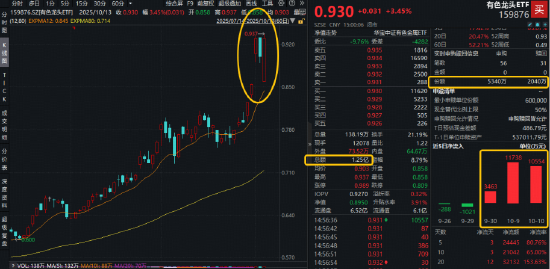
反包大涨!有色龙头ETF逆市上探4.2%创新高!中国稀土迎来涅槃时刻?金价冲击4100美元!
Xin Lang Ji Jin· 2025-10-13 11:55
Core Viewpoint - The non-ferrous metal sector is leading the market with over 17.5 billion in main capital inflows, particularly highlighted by Northern Rare Earth's strong performance in A-shares [1] Group 1: Market Performance - The non-ferrous metal sector has seen significant capital inflows, with Northern Rare Earth topping the A-share capital absorption list [1] - The Non-Ferrous Metal Leader ETF (159876) experienced a price surge of over 4.2%, closing up 3.45%, and achieving a new listing high with a total trading volume of 1.25 billion [1] - The ETF recorded a net subscription of 33 million units in a single day, accumulating 258 million in the last three days and 321 million over the past 20 days [1] Group 2: Price Movements and Regulations - On October 10, Northern Rare Earth and Baotou Steel announced price increases, coinciding with new export control regulations from the Ministry of Commerce on rare earth-related items and technologies [2][3] - The new regulations expand the scope of export controls to include rare earth secondary resource recovery technologies, covering the entire rare earth industry chain and impacting sectors like semiconductors and artificial intelligence [3] Group 3: Financial Performance - In the first half of 2025, 55 out of 60 companies in the China Non-Ferrous Metal Index reported profits, with over 91% profitability [6] - Northern Rare Earth's net profit surged by 1951%, leading the sector, while Guocheng Mining also saw a significant increase of 1111% [6][7] Group 4: Industry Outlook - Analysts suggest that the non-ferrous metal sector is positioned for a long-term upward price cycle due to capital expenditure trends and increasing demand for strategic metal resources amid global manufacturing investment growth [8] - The Non-Ferrous Metal Leader ETF (159876) provides diversified exposure across various metals, including copper, gold, aluminum, rare earths, and lithium, which helps mitigate risks associated with investing in single metal sectors [8]
稀土出口管制新观点评:稀土出口管制强化,板块战略价值凸显-20251013
Shenwan Hongyuan Securities· 2025-10-13 11:50
Investment Rating - The report rates the rare earth industry as "Overweight," indicating that the industry is expected to outperform the overall market [8]. Core Insights - The new export control regulations on rare earths, issued by the Ministry of Commerce and the General Administration of Customs, expand the range of controlled elements, adding five new heavy rare earth elements to the existing seven [3]. - The regulations impose stricter controls on the export purposes of rare earth products, particularly prohibiting military applications and requiring case-by-case approval for advanced semiconductor-related uses [3]. - The new regulations create a comprehensive control system over the entire rare earth industry chain, enhancing China's pricing power in the sector [3]. Summary by Sections Export Control Regulations - The new regulations include export controls on additional heavy rare earth elements and strengthen the control over the export purposes of rare earth products, particularly for military and advanced semiconductor applications [3]. - The regulations also cover the export of technologies, equipment, and raw materials related to rare earths, establishing a multi-layered control system [3]. Investment Analysis - The report suggests that the strengthened export controls will enhance the strategic value of the rare earth sector amid the ongoing US-China competition, indicating potential upward valuation for the sector [3]. - Recommended companies for investment include: - China Rare Earth: Focused on heavy rare earths with clear integration expectations - Northern Rare Earth and Baotou Steel: Strong in light rare earths with significant cost advantages - Guangsheng Nonferrous: A platform for rare earth resource integration in Guangdong with accelerated high-end magnetic material layout - Jieneng Permanent Magnet and Zhenghai Magnetic Materials: Expected to benefit from increased concentration in rare earth product exports [3]. Company Valuation - The report provides a valuation table for key companies in the rare earth sector, detailing their stock prices, earnings per share (EPS) forecasts, and price-to-earnings (PE) ratios for the upcoming years [4].

抢筹码啊!
Datayes· 2025-10-13 11:47
Core Viewpoint - The article discusses the recent fluctuations in the A-share market, influenced by political statements and economic data, highlighting the resilience of China's export growth amid trade tensions and the potential for policy adjustments in the near future [1][4][5][6]. Economic Data - China's export growth in September exceeded expectations, with a year-on-year increase of 8.3%, surpassing the forecast of 6.6% and the previous value of 4.4%. Imports also rose by 7.4%, compared to a prior value of 1.3% [5][6]. - Morgan Stanley attributes the strong trade data to the timing of the Mid-Autumn Festival, which shifted from September to October in 2025, along with a low base effect [6]. Market Performance - On October 13, A-shares opened significantly lower but recovered slightly by the end of the day, with the Shanghai Composite Index down 0.19% and the Shenzhen Component down 0.93% [8]. - The total trading volume in the Shanghai and Shenzhen markets was 23,745.45 billion yuan, a decrease of 1,599.53 billion yuan from the previous day [8]. Sector Analysis - The article notes that sectors such as metals, rare earths, semiconductors, and banking saw significant gains, while automotive and non-bank financial sectors experienced outflows [22][30]. - The rare earth sector saw a surge, with multiple stocks hitting the daily limit up, driven by rising prices of gold and silver [8]. Policy Outlook - Goldman Sachs predicts that the actual GDP growth rate for the third quarter may remain around 5%, with expectations for the implementation of previously announced policies, but no new easing measures anticipated in the near term [7]. - Analysts expect that the current tariff suspension period may be extended beyond November 10, with limited concessions from both sides in trade negotiations [4][6]. Company Performance - Notable company forecasts include: - Jucheng Technology expects a net profit of 151 million yuan for the first three quarters, a year-on-year increase of 112.94% [20]. - New China Life Insurance anticipates a net profit between 29.986 billion yuan and 34.122 billion yuan, reflecting a growth of 45% to 65% [20]. - Chuangjiang New Materials projects a staggering net profit growth of 2057.62% to 2242.56% for the same period [20]. Investment Trends - The article highlights that the main capital inflow was into the non-ferrous metals sector, with Baogang Group leading the net inflow [22]. - The article also mentions that the automotive sector saw significant net outflows, particularly from companies like BYD and Sailis [22].