
WENS FOODSTUFF GROUP CO.(300498)

Search documents
行业点评报告:2025Q3生猪开启去化,饲料动保后周期经营改善
KAIYUAN SECURITIES· 2025-11-03 14:12
Investment Rating - The investment rating for the agriculture industry is "Positive" (maintained) [1] Core Viewpoints - The agriculture sector's profit has contracted significantly due to the unexpected decline in pig prices, leading to a year-on-year profit drop of 58.8% in Q3 2025 [17] - The overall revenue for the agriculture industry in Q1-Q3 2025 reached 872.718 billion, with a year-on-year increase of 6.44%, while the net profit attributable to shareholders was 35.477 billion, up 10.63% year-on-year [5][17] - The average price of pigs in Q3 2025 was 13.81 yuan/kg, down 28.89% year-on-year, with the lowest price of 10.84 yuan/kg recorded on October 13, 2025 [5][17] Summary by Sections Overall Industry - In Q3 2025, the agriculture sector's profit contracted by 58.8% due to falling pig prices [17] - The industry's sales gross margin for Q1-Q3 2025 was 11.79%, up 0.12 percentage points year-on-year, while the net profit margin was 4.21%, up 0.21 percentage points year-on-year [20] - The industry’s net asset return rate was 6.75%, an increase of 0.28 percentage points year-on-year [20] Subsector Analysis - The pig farming sector has entered a de-stocking cycle, while the feed and animal health sectors are experiencing post-cycle operational improvements [6][25] - In Q1-Q3 2025, the revenue growth rates for pet food, animal health, feed, and planting were 20.34%, 17.69%, 12.38%, and 9.50% respectively [6][25] - The net profit growth rates for animal health, agricultural product processing, and feed sectors were 69.40%, 59.33%, and 54.17% respectively [6][25] Pig Farming - In Q1-Q3 2025, pig farming enterprises achieved revenue of 341.269 billion, a year-on-year increase of 8.32%, with a net profit of 22.175 billion, up 14.29% year-on-year [7][28] - The overall pig output from 12 enterprises was 123.9948 million heads, a year-on-year increase of 19.45% [41] - The profitability of the pig farming sector has declined due to falling prices, with average gross margin, net margin, and ROE at 12.25%, 4.08%, and 5.87% respectively [31] Poultry Farming - In Q1-Q3 2025, revenue for poultry farming reached 40.215 billion, a year-on-year increase of 6.92%, while net profit was 1.646 billion, down 9.52% year-on-year [44] - The profitability metrics for poultry farming were a gross margin of 12.61%, a net margin of 2.83%, and a return on equity of 4.18% [46] Feed Industry - The feed sector generated revenue of 152.955 billion in Q1-Q3 2025, reflecting a year-on-year increase of 11.69%, with a net profit of 4.505 billion, up 8.72% year-on-year [8][57] - The average gross margin, net margin, and ROE for feed enterprises were 9.41%, 1.17%, and 3.65% respectively [57] Animal Health - The animal health sector achieved revenue of 9.977 billion in Q1-Q3 2025, a year-on-year increase of 14.08%, with a net profit of 1.265 billion, up 45.51% year-on-year [63] - The average gross margin, net margin, and ROE for animal health enterprises were 53.42%, 17.77%, and 4.35% respectively [63] Seed Industry - The seed sector reported revenue of 6.814 billion in Q1-Q3 2025, down 5.82% year-on-year, with a net profit of -880 million, a decline of 53.87% year-on-year [68]





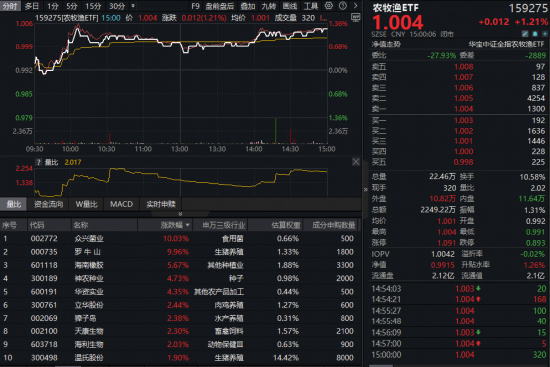
农牧渔爆发!众兴菌业、罗牛山双双涨停,全市场唯一农牧渔ETF(159275)收涨1.21%!生猪价格显著回升
Xin Lang Ji Jin· 2025-11-03 12:09
Group 1 - The agricultural, animal husbandry, and fishery sector showed strong performance, with the only agricultural ETF (159275) rising by 1.21% at the close [1][2] - Key stocks in the sector included edible fungi, pig farming, and seeds, with notable gains from companies like Zhongxing Junye and Luoniushan, both hitting the daily limit [1][3] - The recent rebound in pig prices, with an increase of 6.1% from the previous week, has positively impacted the sector [2][3] Group 2 - Short-term pressure on pig sales has eased, with a decrease in the overall output from large enterprises and an increase in secondary fattening [3][4] - The industry is expected to focus on quality improvement and efficiency, with a gradual elimination of outdated production capacity [4][5] - The agricultural ETF (159275) is currently at a relatively low price-to-book ratio of 2.56, indicating a good long-term investment opportunity [3][5] Group 3 - The agricultural ETF tracks the CSI Agricultural, Animal Husbandry, and Fishery Index, with a significant concentration in leading companies in the sector, including Muyuan Foods and Wens Foodstuffs [5][6] - Investors can also access the agricultural ETF through linked funds for broader exposure to the sector [5]




实业为基,资本为翼!温氏股份上市十周年再启新篇
Guang Zhou Ri Bao· 2025-11-03 11:08
Core Viewpoint - Wens Foodstuff Group has successfully integrated traditional agriculture with capital markets over the past decade, achieving significant growth and resilience despite industry challenges [3][30]. Group 1: Company Milestones - Wens Foodstuff Group celebrated its 10th anniversary of listing on the Shenzhen Stock Exchange on November 2, 2025, marking a significant milestone in its journey [3]. - The company has supplied a total of 43 million tons of poultry and livestock products over the past decade, equating to an annual supply of 6.1 pounds of meat per person in China [3]. - Wens achieved a revenue milestone of over 100 billion yuan, with a compound annual growth rate of 8.1% from 482.4 billion yuan to 1,049.2 billion yuan [30]. Group 2: Governance and Compliance - The company has implemented high standards of governance and compliance, resulting in a significant improvement in information disclosure quality, achieving an A-level rating from 2018 onwards [7][8]. - Wens has maintained a zero compliance record since its listing, setting a governance benchmark for agricultural enterprises [7][8]. - The company has conducted regular training for key personnel on regulatory policies, ensuring that governance principles are deeply ingrained within the organization [7]. Group 3: Industry Challenges and Responses - The African swine fever outbreak in 2018 led to unprecedented challenges in the pig farming industry, with Wens experiencing its first annual loss post-listing [9][10]. - In response to the crisis, Wens focused on biosecurity measures and halted new pig farm constructions to stabilize cash flow and production [10][12]. - The company successfully raised $600 million through overseas bonds and 9.297 billion yuan through convertible bonds, enhancing its financial resilience during downturns [10][12]. Group 4: Technological and Strategic Innovations - Wens has embraced digital transformation by integrating cloud computing, IoT, big data, and AI into its farming processes, enhancing operational efficiency [20][22]. - The company has established the world's largest live breeding resource bank for lean pigs, breaking foreign monopolies in breeding technology [22]. - Wens has invested 6.64 billion yuan in green development initiatives, significantly reducing carbon emissions and promoting sustainable practices [25][30]. Group 5: Financial Performance and Shareholder Returns - Wens has distributed a total of 28.12 billion yuan in cash dividends over 14 occasions, maintaining a dividend payout ratio of 60.1% [30][31]. - The company has successfully executed multiple capital operations, including the issuance of bonds and strategic acquisitions, to strengthen its market position [31][32]. - Wens has implemented several employee incentive plans, benefiting over 17,164 individuals and fostering a culture of shared success [32][33]. Group 6: Future Outlook - Wens aims to continue its focus on the agricultural sector, positioning itself as a leader in meat, egg, and dairy products in China [34]. - The company plans to enhance its brand "Wens Food" and prioritize consumer needs and services in its future strategies [34]. - Wens is committed to achieving its vision of becoming a century-old enterprise, ensuring that its partners and stakeholders thrive alongside its growth [34].

猪价回暖难掩周期之困:温氏股份三季报里的行业困局
Xin Lang Cai Jing· 2025-11-03 08:23
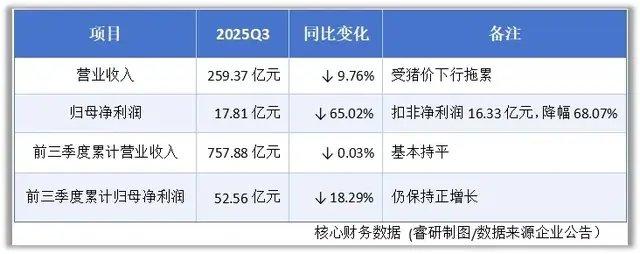
Core Viewpoint - The financial performance of Wen's Foodstuffs Group in Q3 reflects significant challenges in the pig farming industry, with notable declines in both revenue and net profit, indicating ongoing pressures from market conditions and cyclical fluctuations [1][2][3]. Financial Performance Summary - Q3 revenue for Wen's Foodstuffs Group was 25.937 billion yuan, a year-on-year decrease of 9.76%, primarily due to falling pig prices [1][2]. - Net profit for Q3 was 1.781 billion yuan, down 65.02%, with the adjusted net profit at 1.633 billion yuan, reflecting a decline of 68.07% [1][2]. - Cumulative revenue for the first three quarters was 75.788 billion yuan, showing a slight decrease of 0.03% year-on-year, while cumulative net profit was 5.256 billion yuan, down 18.29% [1][2]. Industry Context - The pig farming industry is experiencing a cyclical downturn, with Wen's Foodstuffs Group's financial results indicating that the company has not fully escaped the impacts of the "pig cycle" [2][3]. - Historical data shows a strong correlation between Wen's profitability and pig prices, with profits soaring during high price periods and declining during low price phases [3]. - Current data indicates that the breeding sow inventory remains high, suggesting continued ample supply of pigs and limited potential for significant price increases in the near future [3]. Market Conditions - National pig prices showed a fluctuating upward trend in Q3 but remained lower than the previous year, corroborating Wen's report of decreased meat pig sales prices [4]. - As of October 20, 2025, the price of external three yuan pigs was 11.18 yuan/kg, down 35.41% year-on-year, which has pressured many farming enterprises below their cost lines [4]. - Despite an increase in sales volume to 9.7358 million pigs in Q3, the significant drop in price led to a substantial compression of overall gross margins [4]. Strategic Developments - Wen's Foodstuffs Group is focusing on enhancing breeding efficiency, cost control, and disease prevention, which, while increasing short-term expenditures, are expected to strengthen the company's long-term resilience and sustainability [5]. - The company’s performance is representative of broader industry challenges, including sluggish revenue growth, narrowing profit margins, and increasing financial pressures faced by many listed pig farming companies [5]. - The industry is transitioning from a fragmented and small-scale model to a more concentrated and intensive one, with larger enterprises like Wen's Foodstuffs Group gaining market share and leading the direction of industry transformation [5].
南农晨读丨药香入馔
Nan Fang Nong Cun Bao· 2025-11-03 07:05
Group 1 - The 15th National Games torch relay was successfully completed in Hong Kong, Macau, Guangzhou, and Shenzhen, marking a significant moment in Chinese sports history and showcasing the connectivity of the Guangdong-Hong Kong-Macau Greater Bay Area [4][5][6] - The first "Guanghua Red Palm" Art Festival was inaugurated in Guangzhou, aimed at promoting the high-quality development of the flower industry [9][10] - The Guangdong marine fishery is transitioning towards a socialized service system, moving away from individual operations to a more integrated service model, which includes financial support and talent cultivation [14][15][18] Group 2 - Wens Foodstuff Group has distributed a total of 30.1 billion yuan in dividends over its ten years since listing, benefiting cooperative farmers with over 92.9 billion yuan in breeding income [22][23] - The transformation of service areas into cultural tourism hubs is underway, with events promoting local specialties and cultural experiences [26][30] - The second Chaozhou Food Culture Week was held in Shenzhen, allowing visitors to experience authentic Chaozhou cuisine without traveling to Chaozhou [36][37][39] Group 3 - Agricultural technology is seen as a key driver for revitalizing rural areas, with innovations in active enzyme technology being introduced to enhance crop quality and empower farmers [42][43][44]

温氏股份总裁黎少松:龙头企业要带头去产能,我们在全国关停了七个猪场
Xin Lang Cai Jing· 2025-11-03 05:05
Core Viewpoint - The core challenge facing the industry is the pressure on profitability due to oversupply in the market [1] Industry Challenges - The industry is experiencing deep losses due to oversupply, which many participants find unsustainable [1] - There is a need to strictly control new production capacity to stabilize the overall supply [1] - Inefficient production capacity, especially in restricted areas and those failing to meet environmental standards, should be eliminated [1]
温氏股份涨2.02%,成交额3.11亿元,主力资金净流入1842.14万元
Xin Lang Cai Jing· 2025-11-03 02:12
Core Viewpoint - The stock of Wens Foodstuff Group Co., Ltd. has shown a mixed performance in recent trading sessions, with a year-to-date increase of 13.73% but a slight decline over the past 20 days, indicating potential volatility in the market [1]. Financial Performance - For the period from January to September 2025, Wens Foodstuff reported a revenue of 75.817 billion yuan, reflecting a year-on-year growth of 0.53%. However, the net profit attributable to shareholders decreased by 17.98% to 5.256 billion yuan [2]. - Cumulatively, the company has distributed 30.11 billion yuan in dividends since its A-share listing, with 6.935 billion yuan distributed over the last three years [3]. Shareholder Information - As of September 30, 2025, the number of shareholders for Wens Foodstuff decreased by 10.94% to 81,100, while the average number of circulating shares per person increased by 12.11% to 73,543 shares [2]. - Among the top ten circulating shareholders, Hong Kong Central Clearing Limited holds 144 million shares, an increase of 5.5013 million shares compared to the previous period, while E Fund's ChiNext ETF reduced its holdings by 19.091 million shares to 113 million shares [3]. Stock Performance - On November 3, the stock price of Wens Foodstuff rose by 2.02% to 18.21 yuan per share, with a trading volume of 311 million yuan and a turnover rate of 0.29%. The total market capitalization reached 121.168 billion yuan [1]. - The stock has experienced a 0.17% increase over the last five trading days, a 1.94% decline over the past 20 days, and a 7.05% increase over the last 60 days [1].
谁在增配转债,增配了哪些?
Ge Long Hui· 2025-11-03 00:15
Core Insights - The public funds held convertible bonds accounted for 55.34% of the total market value of convertible bonds as of Q3 2025, with a quarter-on-quarter increase of 12.93 percentage points, indicating a slight rise in positions by 0.09 percentage points [1][7] - Despite a decrease in the total balance of convertible bonds to 572.07 billion yuan, the proportion of convertible bonds held by institutions continues to increase [1][7] Group 1: Public Fund Holdings - As of Q3 2025, public funds held convertible bonds worth 316.57 billion yuan, representing 55.34% of the total market value, an increase of 12.93 percentage points from Q2 [1][14] - The number of public funds holding convertible bonds exceeded 2,009, with 61 funds holding over 1 billion yuan in convertible bonds, accounting for 69.46% of the total value of convertible bonds held by public funds [14][17] Group 2: Convertible Bond Fund Holdings - Convertible bond funds, totaling 40, held convertible bonds worth 121.21 billion yuan, a quarter-on-quarter increase of 42.2% [3][17] - The average position of convertible bond funds rose from 84.99% in Q2 to 87.17% in Q3, while the leverage ratio decreased from 142.08% to 135.17% [19][22] Group 3: Sector Performance - The fastest growth in public fund holdings of convertible bonds was observed in the oil and petrochemical sector, which increased by 59.14% quarter-on-quarter, followed by the electric power equipment sector with a 40.93% increase [4][26] - Significant increases were also noted in the beauty care, computer, steel, and communication sectors, while reductions were seen in the media, non-ferrous metals, social services, and household appliances sectors [4][26] Group 4: Fund Performance - The average annualized return of convertible bond funds in Q3 2025 was 67.31%, outperforming the average annualized return of the Zhongzheng Convertible Bond Index, which was 41.57% [22][24] - Notable performers included the Southern Changyuan Convertible Bond Fund with a return of 172.4% and the Huaxia Convertible Bond Enhanced Fund with a return of 160.4% [22][24]


温氏上市十年的故事:实业为基,资本为翼——祝贺温氏股份上市十周年
Sou Hu Cai Jing· 2025-11-02 19:21
Core Insights - The article celebrates the 10th anniversary of Wens Foodstuff Group's listing, highlighting its journey of integrating traditional industry with capital markets, achieving significant milestones in revenue and product supply [2] - Over the past decade, Wens has maintained a focus on its core philosophy of being industry-based while leveraging capital, resulting in substantial contributions to the agricultural sector and a remarkable growth story [2] Chapter Summaries Chapter 1: Breaking Ground - Wens' journey to listing began with the vision of its founder to create a strong company that could be publicly traded, culminating in its successful listing in 2015 with a market value exceeding 200 billion yuan on the first day [3] - The current chairman emphasized the importance of using industrial strength to support market trust and the need for effective capital tools to build an ecosystem [3] Chapter 2: Rooting Development - The listing brought social oversight, prompting Wens to enhance its governance and operational standards, ensuring compliance with regulatory requirements and modernizing its management [7][8] - The company established a robust governance structure, transitioning from unilateral decision-making to a more systematic approach, which improved management efficiency [8][9] Chapter 3: Riding the Storm - The African swine fever outbreak in 2018 led to significant challenges for the pig farming industry, with Wens facing its first annual loss post-listing [10] - Despite these challenges, Wens demonstrated resilience by focusing on biosecurity measures and strategic adjustments, including halting new pig farm constructions to safeguard cash flow [10][11] - The company successfully raised capital through bond issuances, enhancing its financial stability during downturns [11][14] Chapter 4: Transforming and Growing - Wens has consistently emerged stronger from industry cycles, achieving record sales figures in 2024, including 30.18 million pigs sold and over 1 billion yuan in revenue [18] - The company has invested in digital technologies and innovative breeding practices, establishing itself as a leader in the industry [18][20] - Wens has committed to green development, investing over 6.64 billion yuan in sustainable practices and significantly reducing carbon emissions [22] Chapter 5: A Decade of Growth and Responsibility - Over the past ten years, Wens has seen its revenue grow from 48.24 billion yuan to 104.92 billion yuan, with a compound annual growth rate of 8.1% [28] - The company has distributed over 28.12 billion yuan in dividends, maintaining a high payout ratio even during losses [28] - Wens has positively impacted its partner farmers, generating 86.66 billion yuan in income for them, reflecting its commitment to social responsibility [28] Chapter 6: The Next Chapter - Wens aims to continue its focus on the agricultural sector, aspiring to become a leading provider of meat, egg, and dairy products in China while enhancing consumer engagement [31] - The company emphasizes a long-term vision of sustainable growth and collaboration with partners to ensure mutual success in the agricultural landscape [31]

农林牧渔行业2025年第44周周报:2025年三季报收官,农业板块总结和展望-20251102
Tianfeng Securities· 2025-11-02 14:46
Investment Rating - Industry Rating: Outperform the market (maintained rating) [11] Core Views - The agricultural sector is experiencing a mixed performance with significant opportunities in various sub-sectors, particularly in pig farming, cattle, pets, poultry, and planting industries. The report emphasizes the importance of focusing on leading companies with strong profitability and market positioning [3][4][5][6][8][26]. Summary by Relevant Sections 1. Pig Farming Sector - The decline in pig prices has led to a divergence in profitability among companies, highlighting the need to focus on expected differences in the pig farming sector. The average selling price of pigs in Q3 2025 was between 13-14 CNY/kg, down from 14-15 CNY/kg in H1 2025 [3][15]. - Key companies to watch include leading players like Muyuan Foods and Wens Foodstuff, with valuations at historical low levels [3][16]. 2. Cattle Sector - The raw milk price is stabilizing, while the beef cattle sector may be entering a super cycle. The average price for beef cattle in Q3 2025 was 25.88 CNY/kg, up 2.34% from the previous quarter [4][17]. - Companies with mother cow resources or those adopting a "milk-meat linkage" model are expected to have stronger profitability [4][18]. 3. Pet Sector - The pet economy is thriving, with domestic brands rapidly rising. Major pet food companies reported revenues of 4.737 billion CNY for Guibao Pet and 3.860 billion CNY for Zhongchong Co., with growth rates of 29% and 21% respectively [5][19]. - Recommended companies include Guibao Pet, Zhongchong Co., and Petty Co. [5][20]. 4. Poultry Sector - The white chicken segment is under pressure, with a focus on the need for improved breeding practices. The average price for white chicken was reported to be 3.5 CNY/kg, with a slight increase [6][21]. - The yellow chicken market is expected to see price recovery due to seasonal demand, with companies like Lihua and Wens showing improved performance [6][23]. 5. Planting Sector - The seed industry is anticipated to recover, with a focus on the commercialization of genetically modified corn. Leading companies in the seed sector include Longping High-Tech and Dabeinong [8][26]. - The report emphasizes the importance of agricultural technology and innovation in enhancing competitiveness [8][27]. 6. Feed and Animal Health Sectors - The feed sector has shown revenue and profit growth among leading companies, with Haida Group reporting a revenue increase of 13.24% [8][28]. - The animal health sector is facing challenges due to competition, but there are opportunities for innovation in vaccine development [8][32].