
BABA(BABA)

Search documents
阿里千问30亿红包活动出现服务器卡顿
Xin Lang Cai Jing· 2026-02-06 01:30
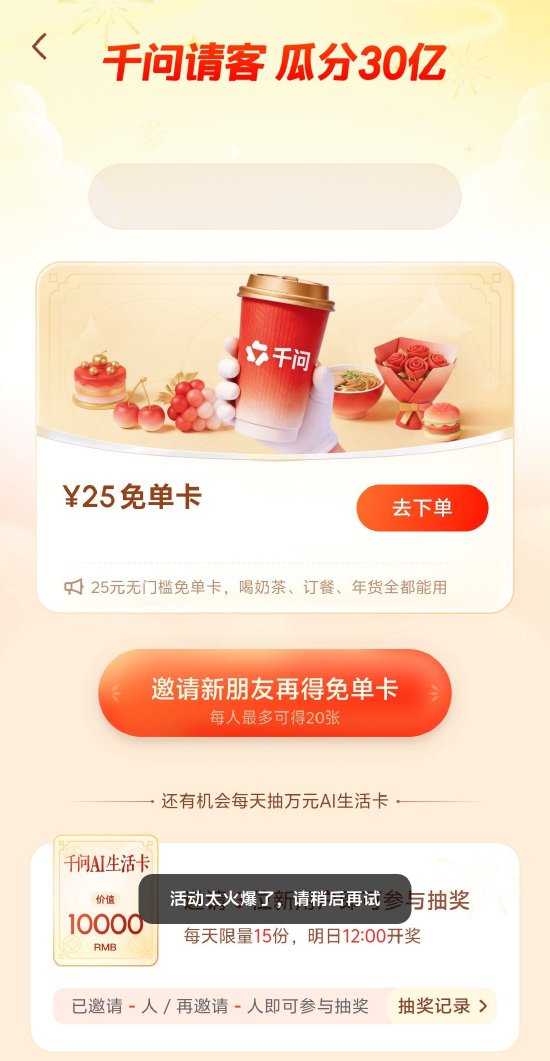
Core Insights - Alibaba's Qianwen launched a significant promotional campaign called the "Spring Festival Treat Plan," offering a total of 3 billion yuan in red envelopes, marking the largest investment in a Spring Festival activity in the company's history [1][4]. Group 1: Promotional Details - The campaign includes a first-round giveaway of 25 yuan no-threshold discount cards for milk tea, which can be used at over 300,000 stores nationwide, including popular brands like Heytea, Nayuki, Luckin Coffee, A Little Bit, and Gu Ming [4]. - Users can update the Qianwen app to the latest version to receive one 25 yuan discount card, with a maximum of 20 cards available per person [5]. Group 2: Technical Issues - Users reported server lag during the promotional event, with messages indicating "The activity is too popular, please try again later" appearing on some pages [1][3]. - As of the time of reporting, Alibaba had not responded to inquiries regarding the server issues [4].


阿里千问红包分享链接被微信屏蔽
Di Yi Cai Jing· 2026-02-06 01:30
(文章来源:第一财经) 2月6日,阿里千问正式上线"春节30亿免单",发放奶茶免单卡。记者发现,继微信封杀自家腾讯元宝、 百度文心助手后,千问的红包分享链接也被微信屏蔽,页面显示网页存在诱导或误导下载/跳转的内 容,需要跳转第三方浏览器访问。同时,部分用户在千问APP点击分享活动至微信好友时,已自动改为 复制口令形式。 ...


SpaceX 100万颗卫星申请获受理,马斯克否认将推出星链手机;李斌兑现承诺!蔚来:2025年Q4经营利润至少7个亿;千问APP启动30亿免单
雷峰网· 2026-02-06 00:46
Key Points - SpaceX's application to launch 1 million satellites has been accepted by the FCC, aiming to create a data center network in orbit to support advanced AI models [4][5] - NIO has announced a profit forecast for Q4 2025, expecting an adjusted operating profit between RMB 700 million (approximately $100 million) and RMB 1.2 billion (approximately $172 million), marking its first quarterly profit [7][8] - The 2025 Hurun China 500 list shows TSMC retaining the top position with a value increase of RMB 3.5 trillion, while Xiaomi enters the top ten for the first time with a valuation of RMB 1 trillion [13][14] - Alibaba has unified its AI model branding under "Qwen" and launched a promotional campaign offering 3 billion RMB in discounts through its Qwen app [15][16] - Baidu plans to distribute dividends for the first time in 2026 and has authorized a share buyback program of up to $5 billion [16][17] - Li Auto is set to implement a "store partner" program to enhance operational efficiency and market responsiveness, giving store managers greater decision-making power [19] - Intel has appointed a new chief GPU architect, while Qualcomm has lost three key executives in a month [45][46] - Coupang has reported an expansion of a personal information leak affecting an additional 165,000 accounts, following a previous incident [53][54]





早报 (02.06)| 血洗全球!金银、原油、美股、币圈集体崩盘;亚马逊砸2000亿美金豪赌AI;OpenAI与Anthropic王炸对决
Ge Long Hui· 2026-02-06 00:33
亚马逊发布最新财报显示,第四季度销售净额2133.9亿美元,预估2114.9亿美元,每股收益1.95美元, 预估1.96美元。公司预计2026年将投资约2000亿美元用于资本支出,预计第一季度营收为1735亿至1785 亿美元。这是迄今最新迹象表明美国科技企业短期内不会放缓其巨额人工智能投资。 2026年春节休市安排:2月15日(星期日)至2月23日(星期一)休市,2月24日(星期二)起照常开 市。另外,2月14日(星期六)、2月28日(星期六)为周末休市。此外,2月15日(星期日)至2月23日 (星期一)不提供港股通服务,2月24日(星期二)起照常开通港股通服务。 美股方面,三大指数集体收跌,道指跌1.2%,纳指跌1.59%,标普500指数跌1.23%。 大型科技股普跌,微软跌近5%,亚马逊跌超4%,AMD跌超3%,特斯拉跌超2%,英伟达跌超1%。谷 歌、苹果小幅下跌,Meta微涨。 纳斯达克中国金龙指数收涨0.9%,热门中概股涨跌不一,蔚来涨近6%,理想汽车涨超2%,小鹏汽车、 百度微涨;京东、网易、阿里巴巴、拼多多小幅下跌。 | | | 隔夜美股概览 | | | | --- | --- | --- | ...





奥特曼发长文回应Anthropic超级碗广告;西门子收购法国半导体量测软件公司Canopus AI丨AIGC日报
创业邦· 2026-02-06 00:08
Group 1 - Alibaba has unified its AI branding under the name "Qwen," which includes both foundational and specialized models to eliminate confusion from multiple previous names [2] - OpenAI's CEO Sam Altman responded to Anthropic's Super Bowl advertisement, criticizing their portrayal of OpenAI's advertising model and promoting OpenAI's commitment to providing free access and developer tools [2] - The International Olympic Committee announced the launch of the first official Olympic model based on Alibaba's Qwen, which will be used at the Milan Winter Olympics to assist national Olympic committee staff with multilingual support [2] Group 2 - Siemens announced the acquisition of French semiconductor measurement software company Canopus AI, which aims to enhance the precision and efficiency of wafer and mask measurement processes using AI technology [2]

马斯克刚提拔了一位武汉理工校友;贾跃亭:FF发布3大系列机器人;美团7.17亿美元收购叮咚买菜;阿里巴巴大模型品牌统一为千问丨邦早报
创业邦· 2026-02-06 00:08
Group 1 - Meituan announced the acquisition of Dingdong Maicai for approximately $717 million, aiming to enhance operational efficiency and align with their mission of improving food quality and living standards [3] - Dingdong Maicai's CEO emphasized that the merger will not diminish their core competencies in product quality, service, and supply chain efficiency, but rather enhance their value on a larger platform [3] Group 2 - Faraday Future launched three series of EAI robots, with the Futurist series starting at $34,990, and received 1,211 paid pre-orders by the end of the launch event [7] - Tesla promoted Phil Duan to the position of Director of Autonomous Driving Engineering, coinciding with the launch of their Robotaxi service [9] Group 3 - Alibaba unified its AI model branding under "Qwen" to eliminate confusion from multiple names, with the core brand now being Qwen [11] - Baidu's Wenxin Assistant faced issues with WeChat blocking its red envelope sharing links, leading to a shift to a "password red envelope" format [11] Group 4 - Xiaomi reduced the safety mileage threshold for its assisted driving feature from 1,000 km to 300 km to help users gradually familiarize themselves with the technology [11] - Leap Motor's COO set a target of 1.05 million units for 2026, emphasizing a steady and efficient approach to growth [12] Group 5 - Bosch China denied rumors of layoffs, clarifying that personnel adjustments were limited to specific departments and were normal in the context of industry changes [15] - Tesla's Shanghai Gigafactory is projected to account for over half of Tesla's global deliveries by 2025 [15] Group 6 - TSMC plans to invest $17 billion in its Japan factory to mass-produce 3nm chips, supported by government subsidies [16] - OpenAI's CEO responded to competition from Anthropic, defending their advertising model and emphasizing their commitment to providing affordable AI services [16] Group 7 - North Chip Life successfully listed on the STAR Market, marking it as the first innovative medical device company to pass the new standards [17] - Qian Gu Technology completed a C round financing of 700 million yuan, with participation from multiple investment firms [18] Group 8 - The AI comic market in China is expected to see a significant increase, with over 80,000 related companies registered by 2025, reflecting a 37.1% year-on-year growth [22] - The global automotive market is projected to see China's market share reach 35.6% by 2025, with a notable increase in vehicle sales [22][23]







千问APP“春节30亿大免单”正式上线 用AI一句话免费点奶茶
Huan Qiu Wang· 2026-02-05 23:58
通过千问APP一句话下单,免单卡可立即在全国30多万家奶茶店使用,蜜雪冰城、瑞幸咖啡、霸王茶 姬、奈雪的茶、沪上阿姨、茶百道、库迪咖啡等茶饮咖啡品牌都可使用。 此外,每邀请一名新朋友下载千问APP,双方可各得一张25元免单卡,每人最多可得21张,相当于525 块钱。当日累计成功邀请3位新朋友,则可获得机会,抽取价值万元的千问AI生活卡。 【环球网科技综合报道】2月6日一早,千问APP"春节30亿大免单"正式上线,发动奶茶攻势,邀请全国 人民用AI一句话免费点奶茶。千问APP人士表示,"我们希望通过春节大免单活动,邀请全国人民体验 AI时代的全新生活方式,让AI融入到人们真实的生活消费之中。" 今年春节的AI大战硝烟弥漫,此次千问春节30亿大免单,在阿里历史上的春节活动中投入最大,在春 节AI大战中投入金额也最高。 此前的1月15日,千问APP已接入淘宝闪购、支付宝、淘宝、飞猪、高德等阿里生态场景,上线AI购物 功能。 有网友对比各家AI应用的红包活动,千问的玩法简单直接、下载就给25元免单卡,门槛最低、金额最 大。 千问APP活动页面显示,第一波免单活动时间为2月6日-2月12日。所有用户更新千问APP后,都 ...
一边红包大战,一边高薪抢人!
Mei Ri Jing Ji Xin Wen· 2026-02-05 23:57
Group 1 - The core idea of the articles revolves around the intense competition among major tech companies like Alibaba, Tencent, and Baidu in the AI sector, particularly through cash incentives and high salaries to attract users and talent [1][2][3] - Alibaba's "Qianwen" app offers salaries up to 1.28 million yuan for positions related to user growth, while Tencent's "Yuanbao" has salaries exceeding 750,000 yuan for user operations roles [1] - Baidu initiated a 500 million yuan red envelope plan to promote its AI assistant "Wenxin Yiyan," which attracted over 50 million participants within a week, showcasing the effectiveness of cash incentives in user engagement [1][2] Group 2 - Tencent doubled its red envelope pool to 1 billion yuan, aiming to recreate the success of WeChat's red envelope feature, emphasizing user interaction and engagement [2] - Alibaba's 3 billion yuan "Spring Festival Treat" plan allows users to redeem cash and purchase services, integrating various services within its ecosystem to enhance user experience [2] - The user base for generative AI in China has reached 515 million, indicating a significant untapped market, with major players like Baidu, ByteDance, Alibaba, and Tencent all surpassing 100 million monthly active users [2][3] Group 3 - The articles highlight that while cash incentives can attract initial user engagement, long-term user retention requires a robust ecosystem and high-quality AI functionalities [3] - The success of AI applications will depend on their practical utility, accuracy, and integration into users' daily lives, rather than just one-time cash rewards [3] - Companies face the challenge of converting initial user interest into sustained engagement, as reliance on cash incentives alone may lead to a transient user base [3]
买入叮咚买菜 美团不只盯上即时零售
Bei Jing Shang Bao· 2026-02-05 23:57
买入叮咚买菜 美团不只盯上即时零售 零售江湖再被搅动。2月5日,美团宣布以约7.17亿美元初始对价,完成对生鲜即时零售平台叮咚买菜中 国业务100%股权的收购。后者成熟的生鲜供应链、超千家前置仓能为美团再添弹药。在行业人士眼 中,此举是美团应对京东、阿里围攻的防御性策略。 以即时零售为核心战场,电商行业已进入"巨头全面对抗"的新阶段,供应链能力、配送网络及数字化运 营成为平台赢得市场的关键变量,美团、京东和阿里三大巨头的差异化角逐将更为胶着。 填补区域空白 美团零售再扩版图。公告显示,美团高度重视即时零售业务,本次收购将有助于充分发挥双方在商品 力、技术、运营等方面的优势,为消费者提供更优质的消费和配送体验。公开资料显示,截至2025年9 月,叮咚买菜月购买用户数超过700万。 据了解,叮咚买菜的海外业务不在本次交易范围内,交易过渡期内,叮咚买菜将按交易前的模式继续经 营。2月5日,叮咚买菜创始人梁昌霖在内部信中表示,叮咚买菜的业务和团队将保持稳定。 美团此次出手,本质上是对即时零售赛道的战略补强。近年来,美团持续探索零售新业态,从"美团买 菜"的探索,到2023年后升级为"小象超市";从"送餐"到"送一切" ...

开业半个月,电器卖场销售额近千万元
Sou Hu Cai Jing· 2026-02-05 23:55
本报记者 毕京津 "之前在网上看中了这款电视,来门店实地看了看,效果很好。线上领券线下抵扣,原价6999元,有国 补和企业补,再加上天猫的额外优惠,便宜了2300多元。"陈明说。 门店也纷纷推出优质产品、提升服务品质。记者来到虚拟现实购物区,戴上设备,空间计算技术便扫描 生成以现实比例还原的家居空间。选空调时,可以各角度查看压缩机细节、听噪声模拟;看冰箱时,内 部分层布局清晰可见,还能感受制冷设备运行时的静音效果。 "一些消费者怕买电器'踩坑',担心买回家不合适。我们想用技术手段解决这些困扰。"万聪介绍,通过 虚拟现实设备,电器的优缺点以及相关政策优惠信息能更好展现给消费者,让大家更放心、省心。门店 还开设补贴咨询台,导购员人手一份补贴指南。"每天都有上百名消费者咨询补贴政策,我们要把关键 信息讲清楚。"万聪说。 17.4% "门店1月17日开业,当月销售额近千万元。消费者通过云闪付小程序实名认证申领补贴券,到店消费付 款实时抵扣。"万聪说,好政策带来好价格,加上好体验、好服务,不少消费者置办了新家电。 在智能家电体验区,从郑州中牟县农村赶来的张建国刚购买完洗衣机,"原价3999元,按1级水效标准补 贴叠加平 ...