LI AUTO(LI)

Search documents
车企2025年产销量放榜 突破多个“里程碑”
Zheng Quan Shi Bao Wang· 2026-01-04 14:38
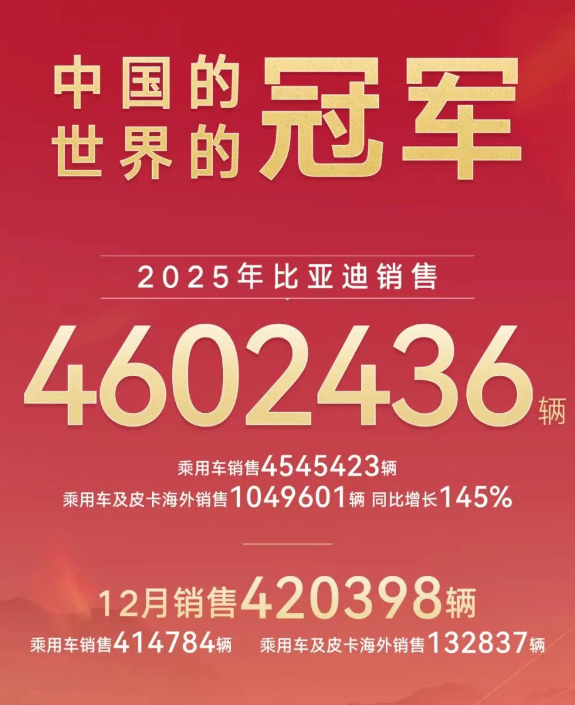
Core Insights - Major automotive companies in China, including BYD, Changan Automobile, and Geely, reported significant sales growth for 2025, with a notable increase in overseas sales and milestones achieved by new energy vehicle manufacturers [1][2][5][7]. BYD - BYD's total sales for 2025 reached 4.6024 million units, a year-on-year increase of 7.73%, with pure electric vehicle sales growing nearly 28% and commercial vehicle sales increasing by approximately 162% [2]. - BYD's overseas exports of new energy vehicles totaled 133,200 units in December 2025, with annual overseas sales surpassing 1 million units, reflecting a 145% year-on-year growth [4]. - The total installed capacity of BYD's power batteries and energy storage batteries was approximately 285.634 GWh, marking a nearly 47% increase from the previous year [4]. Changan Automobile - Changan's total sales for 2025 reached 2.913 million units, a year-on-year growth of 8.54%, with self-owned brand sales increasing by 10.86% and new energy vehicle sales growing by about 50% [5]. BAIC Blue Valley - BAIC Blue Valley achieved significant production and sales growth, with total production reaching 206,300 units, a year-on-year increase of 127.17%, and total sales of 209,600 units, up 84.06% [6]. Geely Automobile - Geely's total vehicle sales for 2025 were 3.0246 million units, a 39% increase compared to the previous year, exceeding its annual sales target [7]. - Geely set a sales target of 3.45 million units for 2026, representing a growth of approximately 14% from 2025, with a new energy vehicle sales target of 2.22 million units, up 32% [7]. NIO - NIO reported a delivery of 48,100 units in December 2025, a year-on-year increase of 54.6%, with total deliveries for the year reaching 326,000 units, up 46.9% [8]. Li Auto - Li Auto delivered 44,200 new vehicles in December 2025, with a historical cumulative delivery surpassing 1.5 million units, expanding its market presence in Central Asia and Africa [9]. XPeng - XPeng delivered 37,500 smart electric vehicles in December 2025, with total annual deliveries of 429,400 units, reflecting a year-on-year growth of 126% [10]. - The company expanded its overseas market presence with 45,000 units delivered abroad, a 96% increase, and established 1,100 new charging stations, bringing the total to 3,000 [10].




车企2025“年终考”成绩单出炉
Mei Ri Jing Ji Xin Wen· 2026-01-04 14:21
Core Insights - The 2025 Chinese automotive market showcased a "stronger getting stronger, increasing differentiation" trend amid deepening new energy transitions and intense industry competition [1] Group 1: Performance of Leading Companies - BYD achieved sales of 4.6024 million vehicles in 2025, with overseas sales surpassing 1 million for the first time, marking a 145% year-on-year increase in passenger and pickup truck sales [2] - BYD's pure electric vehicle sales reached 2.2567 million units, a nearly 28% increase, surpassing Tesla's 1.636 million units, making BYD the global leader in annual electric vehicle sales [2] - Geely also exceeded its annual sales target, achieving 3.0246 million units sold, a 39% year-on-year increase, with new energy vehicle sales reaching 1.6878 million units, up 90% [2] Group 2: Performance of Other Companies - Dongfeng Motor achieved its dual target of over 1 million new energy vehicles and 1.5 million total vehicle sales, with new energy vehicle sales reaching 1.04 million, a 21% increase [3] - Changan Automobile reported sales of 2.913 million vehicles, a growth of 8.5%, with new energy vehicle sales of 1.109 million, up 51% [5] - Chery Group sold 2.8064 million vehicles, a 7.8% increase, with new energy vehicle sales reaching 903,800 units, a 54.9% increase [5] Group 3: Underperformance of Certain Companies - China FAW achieved a total vehicle sales of 3.302 million, a 3.2% increase, but fell short of its target of 3.45 million [4] - Great Wall Motors reported sales of 1.3237 million vehicles, a 7.33% increase, but only achieved 33.09% of its 4 million target [5][6] - New energy vehicle sales for Great Wall reached 403,700 units, a 25.44% increase, but the overall performance was below expectations [5][6] Group 4: New Forces in the Market - Among new forces, Leap Motor, Xiaomi, and Xpeng all exceeded their annual sales targets, with Leap Motor achieving 596,600 units sold, marking a 119.3% target completion rate [7] - Xiaomi's vehicle deliveries surpassed 50,000 in December 2025, exceeding its annual target of 350,000 [7] - NIO and Li Auto, however, did not meet their targets, with NIO selling 326,000 units and Li Auto selling 406,300 units, both falling short of their respective goals [8][9]


电力设备及新能源周报20260104:国内政策助力商业航天产业化,多家车企创单月销量新高-20260104
Guolian Minsheng Securities· 2026-01-04 12:20
Investment Rating - The report maintains a "Recommended" rating for several key companies in the electric equipment and new energy sectors, including Ningde Times, Keda Li, and others [5][6]. Core Insights - The electric equipment and new energy sector experienced a decline of 2.18% in the last week, underperforming compared to the Shanghai Composite Index [1]. - The report highlights significant sales achievements in the new energy vehicle sector, with multiple companies reporting record monthly deliveries in December 2025 [2][14]. - The photovoltaic industry is facing a mixed scenario with rising upstream prices but weak downstream demand, leading to a "price without market" situation [3][38]. Summary by Sections New Energy Vehicles - In December 2025, several new energy vehicle manufacturers reported record sales, including Li Auto with 44,246 units delivered, a year-on-year decrease of 24.4% [15][21]. - Leap Motor achieved a delivery of 60,423 units, up 42% year-on-year, while BYD delivered 420,398 units, reflecting a year-on-year decrease of 17.5% [2][21]. New Energy Generation - The main industry chain prices are on the rise, with silicon material prices testing above 65 yuan/kg, although actual transactions are still based on previous orders [38]. - The report notes a significant reduction in demand, with a 78% decrease in procurement for domestic centralized projects [39]. Electric Equipment and Automation - The report indicates that the sixth batch of State Grid's bidding for power transmission and transformation equipment reached 13.205 billion yuan, with a total of 495 packages awarded [54]. - The largest single package was valued at 399.66 million yuan, with various categories such as switchgear and transformers receiving substantial funding [54]. Commercial Aerospace - Domestic policies are accelerating the industrialization of the commercial aerospace sector, with the National Space Administration incorporating commercial aerospace into the national development framework [4]. Market Trends - The report emphasizes the importance of technological advancements and market dynamics in shaping the future of the electric equipment and new energy sectors, suggesting a focus on companies that can leverage these changes for competitive advantage [40][41].


12月国内销量跟踪
数说新能源· 2026-01-04 03:59
Sales Performance - BYD sold 420,398 vehicles, a year-on-year decrease of 18.3% and a month-on-month decrease of 11.5% [1] - NIO delivered 48,135 vehicles, a year-on-year increase of 54.6% and a month-on-month increase of 32.7% [1] - Li Auto delivered 44,246 vehicles, a year-on-year decrease of 24.4% but a month-on-month increase of 33.3% [1] - Xpeng delivered 37,508 vehicles, a year-on-year increase of 2.2% and a month-on-month increase of 2.1% [1] - Leap Motor delivered 60,423 vehicles, a year-on-year increase of 42.1% but a month-on-month decrease of 14.1% [1] - Lantu delivered 15,954 vehicles, a year-on-year increase of 31.5% but a month-on-month decrease of 20.2% [1] - Seres sold 57,000 vehicles, a year-on-year increase of 88.7% and a month-on-month increase of 4.9% [1] - Avita delivered 10,470 vehicles, a year-on-year decrease of 5.4% and a month-on-month decrease of 25.5% [1] - Geely sold 154,264 vehicles, a year-on-year increase of 38.7% but a month-on-month decrease of 17.9% [1] - SAIC-GM sold 11,307 vehicles, a year-on-year increase of 89.9% and a month-on-month increase of 6% [1] - Wuling sold 122,838 vehicles, a year-on-year increase of 31.2% and a month-on-month increase of 11.2% [1] - It is expected that 1.92 million electric vehicles (including commercial vehicles) will be sold in December in China, a year-on-year increase of 20.3% and a month-on-month increase of 5.32% [1] Industry Trends - The procurement of battery cells by manufacturers is focusing on balancing performance and cost [5] - BYD is expanding its presence in Southeast Asia [5] - CATL indicates that the growth in the energy storage market is outpacing that of the power market [9]

雷军回应“小字营销”;罗永浩否认与华为有过节;宝马中国回应30多款车型降价;Kimi完成5亿美元新融资,杨植麟:账上有超百亿元现金
Sou Hu Cai Jing· 2026-01-04 01:56
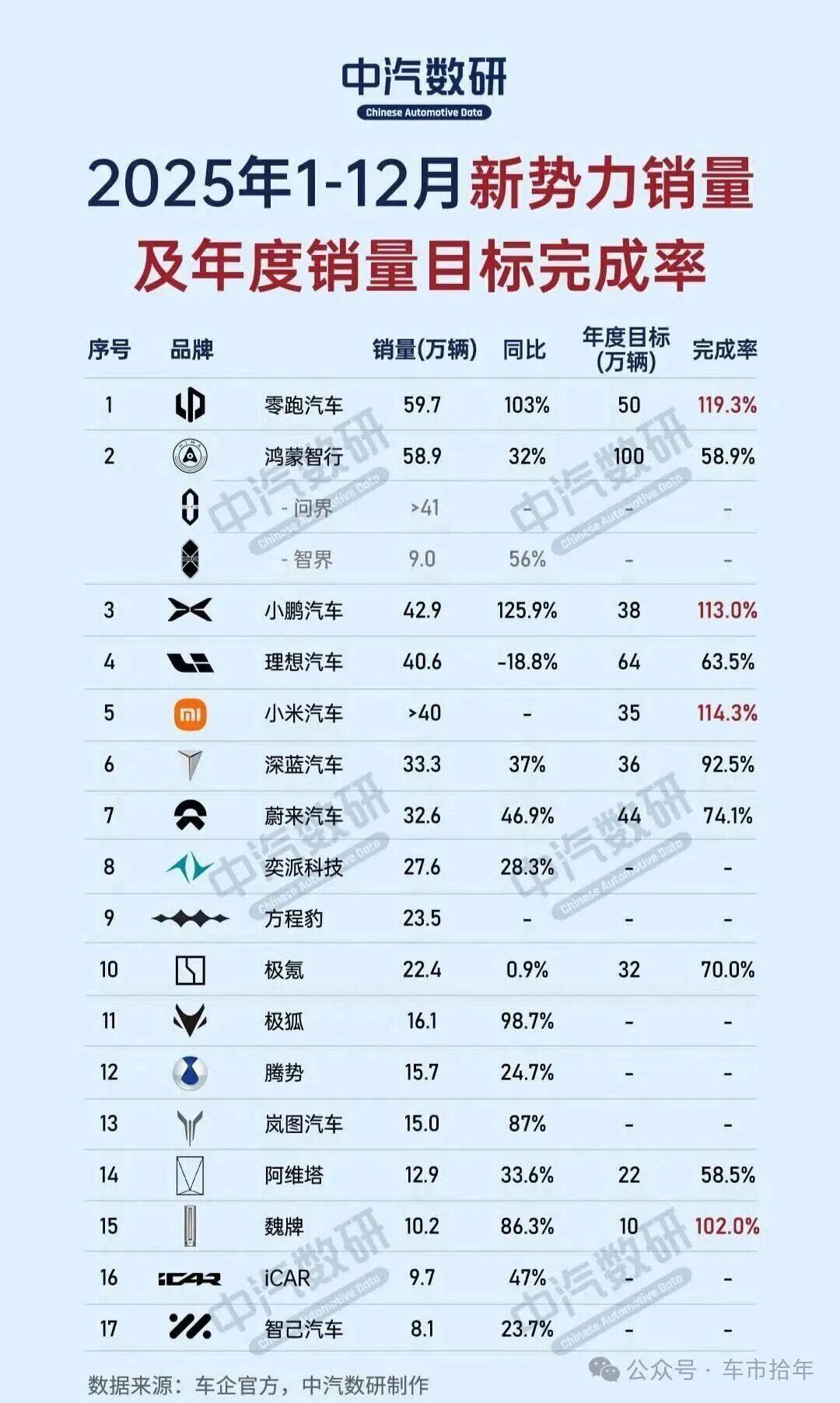
Sales Performance - The sales data for various electric vehicle manufacturers shows significant growth for several companies, with Li Auto experiencing a decline of 18.8% year-on-year, while companies like Leap Motor and Xpeng Motors reported increases of 103% and 125.9% respectively [1] - BYD has surpassed Tesla for the first time, achieving over 4.6 million total new car sales in 2025, a year-on-year increase of approximately 8%, with pure electric vehicle sales exceeding 2.25 million, up 28% [10] Company Developments - Xiaomi's chairman Lei Jun addressed concerns regarding the quality of their vehicles during a live stream, emphasizing the company's commitment to transparency and correcting misconceptions about their marketing practices [4] - Kimi completed a $500 million Series C financing round, with a post-investment valuation of $4.3 billion, indicating strong market interest and a substantial cash reserve of over 10 billion RMB [6] - Baidu announced plans to spin off Kunlun Chip and seek independent listing on the Hong Kong Stock Exchange, which could enhance its market position and operational focus [25] Market Trends - The overall electric vehicle market is witnessing a shift, with BYD taking the lead in global sales, while Tesla's deliveries have declined, indicating a competitive landscape [10] - The trend of price adjustments in the automotive sector is evident, with BMW adjusting prices across a wide range of models, suggesting a strategic response to market conditions [6]


2025年杀青汽车渠道瘦身进行时
Xin Lang Cai Jing· 2026-01-04 01:19
Core Viewpoint - In 2025, the Chinese automotive industry is at a historic turning point, with the penetration rate of new energy vehicles exceeding 50%, marking a shift towards a high-quality development phase characterized by a balance between traditional and electric vehicles [2][16]. Group 1: Industry Transformation - The automotive channel system is undergoing unprecedented restructuring, shifting from scale expansion to integration optimization, model innovation, and deepening market penetration [2][16]. - The era of merely pursuing the number of outlets has ended, with a focus on quality improvement and efficiency optimization becoming the core issues [2][3]. - The automotive channel transformation is clearly presenting three major trends: lightweight, hybrid, and downward expansion, aimed at addressing high costs and low efficiency in the industry [2][3][11]. Group 2: Lightweight Trend - The traditional heavy asset 4S stores are facing high rent and inventory pressures, prompting automakers to explore lightweight outlet models [4][19]. - Lincoln China's "Spark Plan" serves as a benchmark for lightweight transformation, significantly reducing single-store investment from 20-30 million yuan to 4 million yuan, leading to a 40% decrease in dealer operating costs [4][18]. - The optimization of profit structure in lightweight stores allows after-sales profits to fully cover operating costs, enhancing profitability [4][18]. Group 3: Hybrid Trend - The trend of channel hybridization, which began in 2024, continues to deepen in 2025, with brands exploring flexible combinations of direct sales, agency, and authorization models [7][21]. - NIO is cautiously adopting a hybrid approach, allowing local agents to manage market operations while maintaining brand control [7][21]. - BYD's Tengshi and Fangchengbao brands are implementing a dual-track system of direct sales and authorization to enhance channel efficiency [8][22]. Group 4: Downward Expansion Trend - The trend of channel downward expansion is accelerating, with significant sales growth in lower-tier cities, reflecting a clear shift in the automotive consumption market [11][25]. - Leap Motor's strategy of lowering the price of main models to the 150,000 yuan range has led to a 113.42% year-on-year increase in deliveries, with over 60% of sales coming from lower-tier markets [11][25]. - Third-party involvement, such as JD Auto's collaboration with GAC and CATL, is creating new models for the lower-tier market, significantly reducing the purchase threshold [12][26]. Group 5: Efficiency Revolution - The core of channel transformation is an efficiency revolution, focusing on serving more users at lower costs [12][26]. - The automotive channel is undergoing structural reshaping through lightweight, hybrid, and downward expansion trends, but the evolution of channels is far from over [12][26].


2025年新势力成绩单出炉,零跑小米小鹏完成年度目标
3 6 Ke· 2026-01-04 00:37
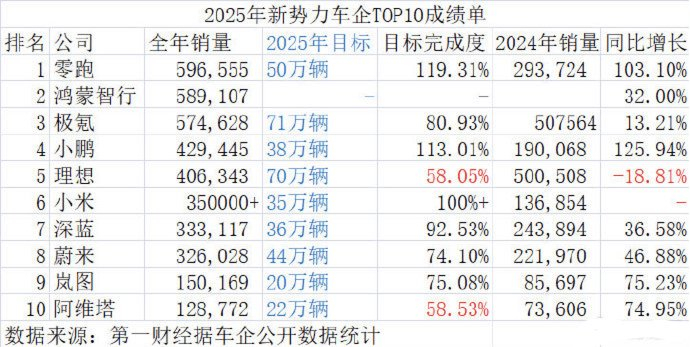
Core Insights - In 2025, only three new energy vehicle brands, Leap Motor, Xiaomi, and Xpeng, achieved their annual sales targets, with Leap Motor emerging as the top performer with nearly 600,000 units sold, exceeding its target by over 19% [1][4] - The performance of traditional leading brands, often referred to as "Wei Xia Li" (Weilai, Xiaopeng, and Li Auto), showed significant divergence, with Xpeng achieving a 125.94% year-on-year growth, while Li Auto experienced an 18.81% decline in sales [2] - State-owned enterprises like Changan and Dongfeng are also facing challenges in scaling their new energy vehicle brands, with Deep Blue and Avita struggling to meet their revised sales targets [3] Group 1: Performance of New Energy Vehicle Brands - Leap Motor sold 596,555 units, achieving a target completion rate of 119.31% and a year-on-year growth of 103.10% [4] - Hongmeng Zhixing delivered 589,107 units, marking a 32% increase year-on-year [1][4] - Zeekr, after merging with Lynk & Co, reported a total delivery of 574,628 units, but fell short of its target with an 80.93% completion rate [4] Group 2: Performance of Traditional Leading Brands - Xpeng sold 429,445 units, achieving a target completion rate of 113.01% and a year-on-year growth of 125.94% [2][4] - Li Auto's sales reached 406,343 units, but this represented a significant decline of 18.81% compared to the previous year, with a completion rate of only 58.05% against its initial target of 700,000 units [2][4] - NIO delivered 326,028 units, reflecting a year-on-year growth of 46.88%, but its main brand saw a decline in performance compared to the previous year [2][4] Group 3: Performance of State-Owned Enterprises - Deep Blue, a brand under Changan, sold 333,117 units, achieving a completion rate of 92.53% after revising its target down to 360,000 units [3][4] - Avita's sales remained low at 128,772 units, with a completion rate of only 58.53% against its target of 220,000 units [3][4] - Dongfeng's brand, Lantu, sold 150,169 units, achieving a completion rate of 75.08% [3][4]
新造车2025年复盘:零跑登顶,小鹏逆袭,理想遇挫
创业邦· 2026-01-03 10:22
Core Viewpoint - The 2025 sales data reveals a significant shift in the Chinese electric vehicle (EV) market, with new players like Leap Motor, Huawei's Homologous Intelligent Driving, and Xiaomi emerging as strong competitors against established brands like BYD and Geely [6][12]. Group 1: 2025 Sales Performance - BYD led the market with 4.6024 million units sold, achieving 100% of its target [7]. - Geely surpassed 3 million units, reaching 3.0246 million with a 39% year-on-year growth [7]. - Leap Motor emerged as the top new force with nearly 600,000 units sold, marking a 103% increase [8][12]. - Homologous Intelligent Driving ranked second among new forces with 589,100 units delivered, primarily driven by the Wanjie brand [8]. - Xiaomi entered the top five with over 400,000 units sold, leveraging its ecosystem and brand loyalty [17]. Group 2: Competitive Landscape - The competition among new forces has intensified, with Leap Motor, Homologous Intelligent Driving, and Xiaomi leading the charge, while traditional players like BYD and Geely maintain their dominance [10][12]. - The market is shifting from a focus on capturing the fuel vehicle market to a more competitive landscape where companies vie for each other's market share [10]. - The new forces are increasingly focusing on systemic capabilities rather than just product features or pricing [18]. Group 3: Strategic Insights - Leap Motor's success is attributed to its cost control and high component sharing rate, which allows it to offer competitive pricing while maintaining quality [15][18]. - Xiaomi's approach combines its consumer electronics experience with automotive production, achieving a gross margin of 26.4% in Q3 2025 [17]. - The high-end players like Ideal, Homologous Intelligent Driving, and NIO face challenges as the market shifts towards technology competition rather than just configuration [19][23]. Group 4: Future Outlook - The penetration rate of new energy vehicles is expected to exceed 60% in 2026, leading to intensified competition [10]. - Companies are setting ambitious sales targets for 2026, with Homologous Intelligent Driving aiming for 1 to 1.3 million units and Leap Motor targeting 1 million [10]. - The competition will evolve into a "value war," focusing on better battery performance, intelligent features, and overall vehicle quality [29][30].



“沸腾了”!中国资产,大爆发!
Zhong Guo Ji Jin Bao· 2026-01-03 00:20
Market Performance - On January 2, 2026, U.S. stock markets showed mixed results with the Dow Jones Industrial Average rising by 0.66% to 48,382.39 points, and the S&P 500 increasing by 0.19% to 6,858.47 points, while the Nasdaq Composite fell by 0.03% to 23,235.63 points [1] - The Nasdaq Composite index was affected by declines in several major tech stocks, including Tesla down 2.59%, Microsoft down 2.21%, Amazon down 1.88%, Meta down 1.41%, and Netflix down 2.97% [2] Semiconductor Sector - The semiconductor sector experienced a significant rally, with the Philadelphia Semiconductor Index rising by 4%, driven by strong performances from AI chip stocks [5] - Notable individual stock performances included Micron Technology up over 10%, TSMC up 5.19%, Intel up 6.72%, and AMD up 4.35% [5][6] - TSMC received a U.S. government annual license to export chip manufacturing equipment to its Nanjing plant, which has garnered market attention [7] Chinese Stocks - Chinese stocks saw a strong performance on the first trading day of 2026, with the Nasdaq Golden Dragon China Index rising by 4.38% [8] - Key individual stock movements included Alibaba up 6.24%, NetEase up 7.22%, Baidu up 14.97%, and JD.com up 2.89% [10][11] Electric Vehicle Market - BYD topped the global electric vehicle sales chart, with approximately 2.26 million pure electric vehicles sold in 2025, marking a nearly 28% increase from 2024 [11] - Tesla's total vehicle deliveries for 2025 were approximately 1.64 million, slightly above market expectations of 1.6 million [12] Economic Indicators - The final value of the U.S. Manufacturing PMI for December 2025 was reported at 51.8, unchanged from expectations and the previous value, but down from 52.2 in November [13] - Despite manufacturers increasing production in December, the economic outlook for early 2026 appears less optimistic, with rising costs for U.S. businesses continuing to outpace those of competitors in other major economies [13]



EV Wars: Who Won In December?
Seeking Alpha· 2026-01-02 21:22
Group 1 - The article highlights the focus on businesses with strong cash generation, ideally those with a wide moat and significant durability, which can be highly rewarding when bought at the right time [1] - Electric vehicle sales are on the rise in many markets, although the U.S. market faced challenges due to the expiration of tax credits earlier in 2025 [1] - The author, Jonathan Weber, has been active in the stock market and as a freelance analyst since 2014, primarily focusing on value and income stocks while occasionally covering growth [1] Group 2 - The Cash Flow Club offers features such as access to a leader's personal income portfolio targeting yields of 6% or more, community chat, a "Best Opportunities" List, and coverage of various sectors including energy midstream and commercial mREITs [1]