
Morgan Stanley(MS)

Search documents
摩根士丹利与智利国家铜业公司“暗箱操作”遭曝光
Shang Wu Bu Wang Zhan· 2025-05-29 04:09
Core Points - Chile's President Boric announced the "National Lithium Strategy" on April 20, 2023, which led to negotiations between Codelco and SQM authorized by Corfo on May 24, 2023 [1] - Codelco disclosed that discussions with Morgan Stanley regarding an "underground agreement" began 21 days prior to the announcement of the lithium strategy, with Morgan serving as a financial advisor during negotiations with SQM [1] - A financial advisory agreement between Codelco and Morgan Stanley was signed on March 30, 2023, prior to the announcement of the lithium strategy, with Morgan's commission set at 0.4% of the net profits from the Codelco-SQM collaboration [1] Company Developments - Codelco's president submitted a copy of the agreement with Morgan Stanley to the Chilean House of Representatives, revealing undisclosed terms, including a provision that no base commission would be paid until a final agreement with SQM was signed [1] - On May 15, 2023, Codelco announced the establishment of two subsidiaries, Codelco de Chile SpA and MineralTararSpA [1] - Codelco sent a letter to Corfo on May 22, 2023, agreeing to enter into cooperation negotiations with SQM [1]


盘前必读丨MSCI纳A指数样本调整将生效;美联储公布5月议息会议纪要
Di Yi Cai Jing· 2025-05-28 23:51
Group 1 - The overall market liquidity remains tight, with structural market conditions leading to rotations in new consumption and new manufacturing sectors [1][18] - There are left-side investment opportunities in fields such as robotics, intelligent driving, and internet platforms [1][18] - The basic chemical industry is currently undervalued, presenting medium to long-term investment potential [18] Group 2 - The performance of sectors like consumption and pharmaceuticals is expected to be relatively stable, with short-term elasticity likely to be better [18] - The chemical industry is anticipated to see structural opportunities and valuation recovery in 2025, driven by policy stimulus and improving demand [18] - The supply side of the chemical industry is experiencing a slowdown in capital expenditure and new capacity growth, which will take time to digest [18]





学生贷冲击!摩根士丹利:还贷挤压消费,今年美国GDP或下滑0.1%
Hua Er Jie Jian Wen· 2025-05-26 13:03
Core Viewpoint - The end of the federal student loan repayment pause has led to a significant increase in default rates, posing a risk not only to individuals but also to the broader U.S. economy [1][2][4]. Group 1: Default Rates and Credit Impact - In the first quarter of this year, 5.6 million borrowers began to default on their student loans, with the default rate soaring from 0.7% in Q4 of the previous year to 8% [2][3]. - Among the new defaulters, 2 million had credit scores between 620-719, and 400,000 had scores above 720, with average score drops of 140 and 177 points respectively [2][3]. - Many borrowers were unaware of the repayment resumption due to a lack of communication from loan servicers, leading to sudden drops in credit scores [2][3]. Group 2: Economic Implications - Morgan Stanley estimates that the monthly repayment burden will increase by $10 billion to $30 billion, which will squeeze consumer spending and potentially reduce U.S. GDP by 0.1% in 2025 [1][4]. - The situation may worsen as approximately 8 million borrowers are enrolled in the SAVE plan, which is facing legal challenges, delaying their repayment obligations [4]. Group 3: Vulnerable Borrowers - The most affected borrowers are those from two-year or for-profit institutions, or those who dropped out without a degree, facing higher default risks and often coming from economically fragile backgrounds [5]. - In Mississippi, 45% of student loan borrowers are in default, highlighting the correlation between poverty rates and loan repayment difficulties [5].
摩根士丹利:上调中国经济增速及股指目标
天天基金网· 2025-05-26 03:26
Core Viewpoint - Morgan Stanley has raised its GDP growth forecast for China to 4.5% for this year, while also increasing its stock index targets, suggesting that investors can achieve excess returns through selective stock and sector investments [2][3]. Economic Outlook - The chief economist of Morgan Stanley, Xing Ziqiang, noted that while trade tensions have eased, challenges in real estate and consumption persist. The GDP growth forecasts for this year and next have been adjusted from 4.2%/4.0% to 4.5%/4.2% respectively. The GDP growth for Q4 this year is expected to be 4.0%, up from a previous estimate of 3.7% [3]. - The report anticipates that the U.S. tariffs on China will remain at the current 30% level for the next two years, reducing the urgency for new policy measures. The existing policy framework aims to stabilize the economy while gradually addressing structural issues like debt and economic imbalances [3]. - It is expected that the government may introduce additional fiscal stimulus of 0.5 trillion to 1 trillion RMB to support infrastructure investments, alongside potential interest rate cuts of 15-20 basis points and a reserve requirement ratio reduction of 50 basis points [3]. Risks and Optimistic Scenarios - Key risk factors include tariffs and domestic policy directions. In an optimistic scenario, Morgan Stanley predicts that the U.S. may further eliminate 20% of the fentanyl tariffs by the end of Q3 this year, coupled with more consumer stimulus and accelerated structural reforms from Chinese policymakers. Under this scenario, actual GDP growth could reach 4.7% and 4.5% for the next two years [4]. Stock Market Outlook - Morgan Stanley's chief equity strategist, Wang Ying, has raised the stock index targets for China due to structural improvements such as a rebound in return on equity (ROE) and stabilization in earnings. However, macroeconomic pressures persist, leading to a maintained market weight rating for Chinese stocks, with a recommendation for selective stock and sector investments [5]. - The reasons for the upgraded rating include: (1) a rebound in net asset returns and upward adjustments in valuation, particularly for offshore stocks; (2) confirmed government support for the private sector; (3) the emergence of leading tech companies in AI and smart manufacturing that can compete globally [5]. - The projected index targets for June 2026 are: MSCI China Index at 78 points (up 5%), Hang Seng Index at 24,500 points (up 5%), Hang Seng China Enterprises Index at 8,900 points (up 5%), and CSI 300 Index at 4,000 points (up 3%) [5]. Market Preferences and Sector Recommendations - Morgan Stanley favors offshore Chinese stocks, recommending an overweight position in Hong Kong stocks and American Depositary Receipts (ADRs). The expectation of a stronger RMB and continued inflow of southbound capital into the Hong Kong market are seen as positive factors [6]. - In terms of sector allocation, the recommendation is to overweight two main areas: (1) leading companies in technology and internet sectors, particularly those involved in AI and smart manufacturing; (2) high dividend strategies to hedge against volatility. Conversely, it suggests underweighting cyclical sectors such as energy and real estate [6].
大摩:忘掉“卖出美国”交易!美股、美债明年将主宰全球市场
美股研究社· 2025-05-23 09:52
Core Viewpoint - The article discusses the recent downgrade of the US credit rating by Moody's and its impact on US assets, highlighting a potential rebound in US equities despite current sell-offs [1][2]. Group 1: US Equity Market - Following the downgrade, the S&P 500 index fell approximately 1% over two days, while the 10-year Treasury yield rose by 10 basis points in four days [1]. - Morgan Stanley's strategists predict that US equities will outperform global peers next year, emphasizing the "TINA" (There Is No Alternative) theme, suggesting limited alternatives to holding stocks [1]. - The strategists forecast that the S&P 500 index will reach 6,500 points by Q2 2026, representing a 10% increase from current levels, driven by expected Fed rate cuts and a weaker dollar [1]. Group 2: US Treasury Market - Despite the recent rise in the 10-year Treasury yield, Morgan Stanley's strategists view this as a temporary trend, expecting yields to remain range-bound until Q4, when investors will start pricing in potential rate cuts for 2026 [2]. - The strategists anticipate that the 10-year Treasury yield will decline to 3.45% by mid-2026, down from the current level of approximately 4.54% [2]. - There is no evidence of a sustained "retreat" from US assets, as global stock funds have not withdrawn from the US, and foreign holdings of US dollar-denominated bonds are at an all-time high, indicating continued demand for high-quality US assets [2].

30年日债这么跌,会把30年美债一起拖下水?
华尔街见闻· 2025-05-23 09:20
Core Viewpoint - The recent surge in 30-year Japanese government bond yields to historical highs has raised concerns about the global bond market, indicating potential structural issues within the market [1][2][3]. Group 1: Japanese Bond Market Dynamics - The rise in 30-year Japanese bond yields began in mid-April and has led to fears of a "value trap," where bonds appear cheap but may continue to decline in value due to structural supply-demand imbalances [2][3][6]. - Since early April, the 30-year Japanese bond yield has increased by 85 basis points, while the 30-year U.S. bond yield rose by 60 basis points during the same period [3]. - For dollar investors, the 30-year Japanese bond yield, after currency hedging, stands at 7.03%, significantly higher than the 4.96% yield of the 30-year U.S. bond [4]. Group 2: Global Bond Market Implications - The issues in the Japanese bond market may serve as a warning signal for the global bond market, reflecting three major trends affecting bond markets worldwide: persistent inflation pressures, declining demand from asset-liability management (ALM) investors, and high government financing needs [8]. - Japan's core inflation rate has exceeded the Bank of Japan's 2% target for two consecutive years, contributing to rising equilibrium yields [8]. - The demand for long-term bonds is decreasing as market interest rates rise, with domestic holdings of long-term bonds stabilizing [8]. Group 3: Potential Responses from the Bank of Japan - The Bank of Japan's future policy direction is a focal point for market observers, with potential measures including reducing the maturity of issued debt, fiscal constraints, adjusting the quantitative tightening path, and possibly restarting a rate hike cycle [13][14][18]. - The expectation is that the Bank of Japan will maintain a steady pace of reducing its bond purchases, with a target of 2 trillion yen per month starting in April 2026 [17].


市场为何不喜欢减税法案?德银:将新增5万亿债务,“特朗普几乎没有在认真控制赤字”
Hua Er Jie Jian Wen· 2025-05-22 03:40
该法案预计将节省1.9万亿美元,大部分(1.2万亿美元)直到10年预算窗口的后半段才能实现: 德意志银行的Brett Ryan指出,JCT的评分与德意志银行此前预计的总体赤字假设基本一致。然而,JCT的评分并未关注财政前景的关键要素,如关税收 入和潜在支出增加的估算。德银强调: (特朗普任期内)似乎没有采取任何认真的措施来控制历史高位的赤字,未来几年赤字仍将超过 GDP 的 6% 以上。 特朗普的税改法案将导致近期财政赤字大幅增加,十年内为美国新增约5万亿美元债务,即使考虑税收延期措施也难以抵消这一趋势。 近期,美国税务联合委员会(JCT)对众议院筹款委员会标记版本的初步评分,税改法案将在未来10年增加3.8万亿美元赤字,其中2.2万亿美元(约58%) 将在前五年产生。更令人担忧的是,负责任联邦预算委员会(CRFB)估计,若将临时条款考虑在内,该法案实际将为美国增加5.2万亿美元债务。 支出前置、节约后置的结构性问题 德银表示,这项法案的独特之处在于支出和减税措施集中在前期,而抵消措施则集中在后期。 根据法案,约55%的总赤字增加(2.8万亿美元)将发生在预算窗口的前半部分,而只有40%的抵消措施(9700亿 ...

美元指数失守100点关口!美联储警告→
第一财经· 2025-05-21 23:34
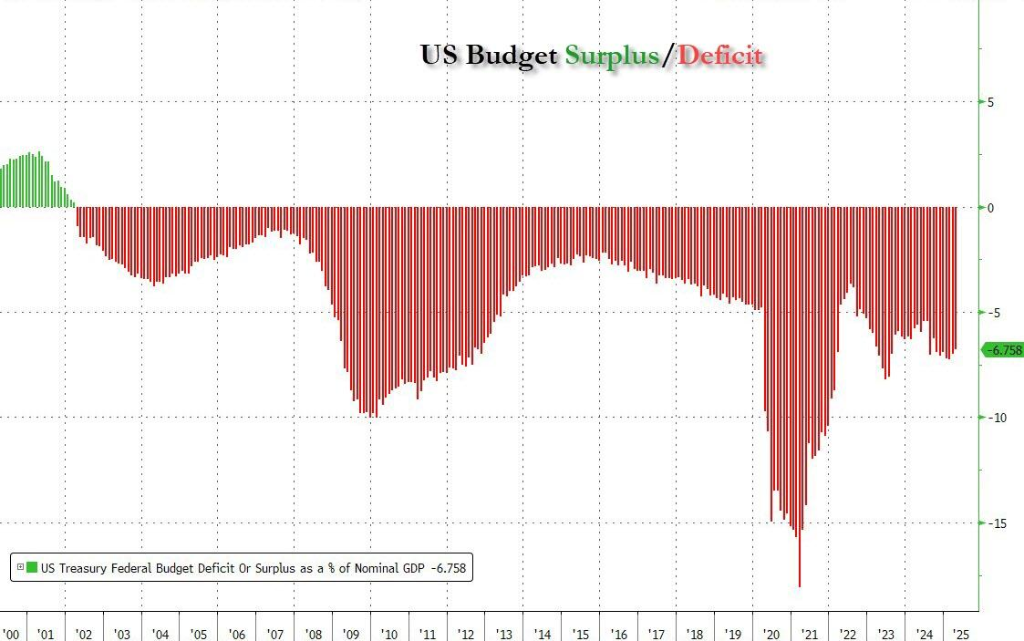
Core Viewpoint - The article discusses the recent decline of the US dollar following Moody's downgrade of the US credit rating, highlighting concerns over economic uncertainty and the impact of trade policies on market sentiment [1][5]. Group 1: G7 Meeting and Currency Policy - The G7 meeting focused on monetary policy, with a record high of 80% of investors believing the US is on an unsustainable debt path [3]. - Deutsche Bank's survey indicates that over half of the investors expect future crises to lead to deficit reduction, while 26% see quantitative easing as a potential solution [3]. - Analysts from Brown Brothers Harriman noted that the broad decline of the dollar reflects a loss of confidence in US policies, exacerbated by rising stagflation risks and implicit support for a weaker currency from the Trump administration [3]. Group 2: Market Outlook on the Dollar - Morgan Stanley has a bullish outlook on US assets, raising ratings for US stocks and bonds, but predicts a continued decline of the dollar due to diminishing economic growth premiums relative to other countries [4]. - The dollar index is forecasted to drop by 9% over the next 12 months, reaching 91 points, with significant weakness expected against the euro, yen, and Swiss franc [4]. Group 3: Economic Concerns from Federal Reserve Officials - Recent statements from Federal Reserve officials express growing concerns about economic uncertainty, with deteriorating business and consumer confidence attributed to US trade policies [6][7]. - Atlanta Fed President Bostic supports only one rate cut in 2025, warning that inconsistent tariff policies could disrupt US trade logistics [7]. - Despite a temporary easing of trade tensions, Wall Street perceives ongoing risks of economic recession, particularly following Moody's downgrade of the US credit rating [7].
上调中国GDP增速预期 提高A股目标点位预测 外资机构对中国资产关注度持续升温
Shang Hai Zheng Quan Bao· 2025-05-21 19:14
Core Viewpoint - International investors are increasingly focused on Chinese assets, as evidenced by multiple foreign institutions hosting "China-themed" forums and raising GDP growth forecasts for China by 2025 [1][2]. Group 1: Economic Growth Predictions - Foreign institutions have recently raised their GDP growth forecasts for China in 2025 due to a decrease in external disturbances and increased internal growth policies [1]. - Morgan Stanley's chief economist for China, Qiang Xing, has raised GDP growth predictions for 2025 and 2026, anticipating a fiscal package worth 500 billion to 1 trillion yuan to support infrastructure [2]. - Nomura's chief economist for China, Ting Lu, also revised the GDP growth forecast for 2025, citing stronger-than-expected retail data supported by the "trade-in" policy [2]. Group 2: Capital Market Outlook - There is an expectation of long-term capital returning to the Chinese stock market, with UBS's head of China equity strategy, Zonghao Wang, indicating that foreign capital inflow will be a key trading logic in the coming quarters [3]. - Goldman Sachs has raised its 12-month target for the MSCI China Index and the CSI 300 Index to 84 points and 4600 points, respectively, indicating potential upside of 11% and 17% [3]. - Morgan Stanley has also adjusted its target indices for major Chinese stock indices, forecasting 78 points for the MSCI China Index and 4000 points for the CSI 300 Index by June 2026 [3]. Group 3: Earnings Performance - The MSCI China Index showed strong performance last year, with actual EPS growth reaching 16%, surpassing the initial expectation of 14%, particularly in the internet and healthcare sectors [4]. - The market's consensus EPS growth expectation for the MSCI China Index this year is 8%, with leading internet companies continuing to perform well [4]. - Predictions for the MSCI China Index's baseline and optimistic scenarios for this year are set at 80 points and 89 points, respectively, while the CSI 300 Index is forecasted at 4150 points and 4420 points [4].


每日机构分析:5月21日
Xin Hua Cai Jing· 2025-05-21 13:39
Group 1 - Morgan Stanley upgraded the ratings of US stocks and sovereign bonds from "neutral" to "overweight," anticipating that a series of future rate cuts by the Federal Reserve will support bonds and boost corporate earnings [1] - The US dollar is expected to continue weakening due to diminishing economic growth advantages and narrowing yield differentials with other countries [1] - The global economy is still expanding despite uncertainties, with Morgan Stanley's economists predicting seven rate cuts by the Federal Reserve by 2026, which will support above-average valuations [1] Group 2 - The overall inflation rate in the UK rose from 2.6% in March to 3.5% in April, exceeding economists' expectations of 3.4%, but the possibility of a rate cut by the Bank of England in August should not be ruled out [3] - Thailand experienced accelerated external demand growth in the first quarter, attributed to importers making advance purchases to avoid potential future cost increases due to US tariffs [3] - The financial sector is considered the best investment opportunity in the market, with Singapore's expected P/E ratio at 14.3 and a dividend yield of 4%, indicating attractive valuations [3]