
Microsoft(MSFT)

Search documents
摩根士丹利建议买入这9只被AI冲击的折价软件股
美股IPO· 2026-02-09 12:27
Core Viewpoint - The report highlights that high uncertainty has significantly impacted software valuation multiples, which have declined by approximately 33% since October 2025 [2] Group 1: Software Valuation - The average software valuation multiple has returned to around 4.4 times enterprise value/sales, reflecting levels seen during previous periods of high uncertainty in the public cloud sector [3] - Investors are underestimating the ability of existing vendors to benefit from AI adoption [3] Group 2: Investment Opportunities - The report suggests that pessimistic views on generative AI have led to a lack of trust in the ability of existing software vendors to participate in this innovation cycle [4] - Morgan Stanley identifies Microsoft, ServiceNow, Salesforce, Atlassian, Snowflake, Cloudflare, Shopify, and Palo Alto Networks as attractive investment opportunities due to their strong product cycles, improved financial metrics, and discounted valuations [4] - Microsoft is noted as a key player in significant innovation cycles, while the valuation of ServiceNow is described as "very attractive" [4] - Salesforce's AI-related annual recurring revenue has increased by 114% year-over-year [4] - Shopify is viewed as highly capable of capturing a larger share of the expanding online commerce market [4] Group 3: Long-term Opportunities - Generative AI represents a significant long-term opportunity, with an estimated potential to add approximately $400 billion to the broader enterprise software total addressable market by 2028 [5] - The key issue is not whether software will ultimately monetize in this innovation cycle, but rather which companies will participate [6]




美软件股危机未除!花旗:AI冲击或让终端价值蒸发三分之一
Hua Er Jie Jian Wen· 2026-02-09 12:08
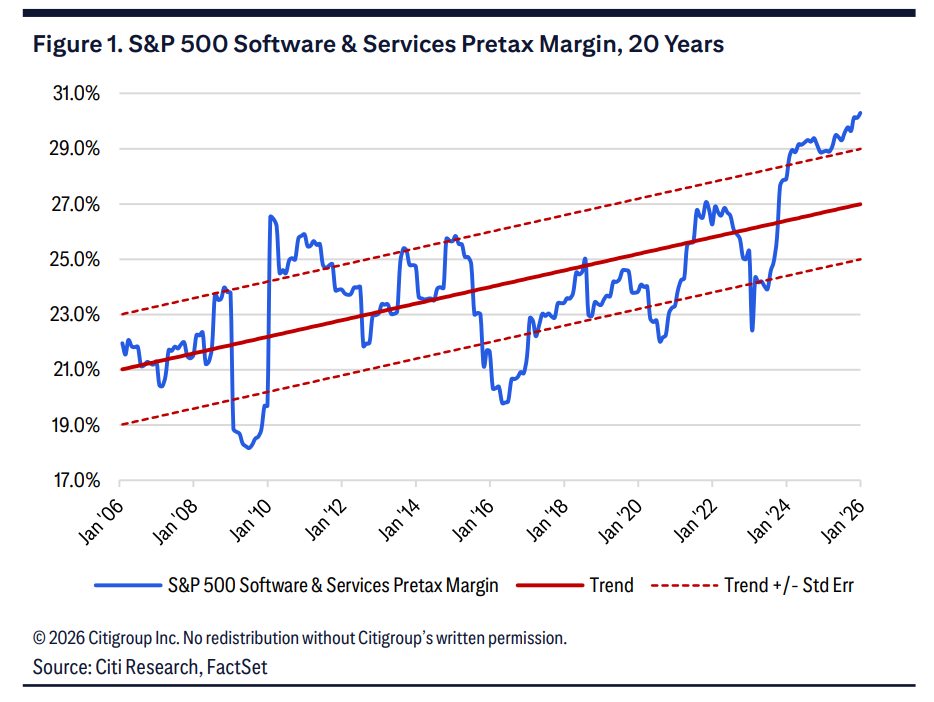
花旗指出,软件与服务板块正经历一场由"AI颠覆恐惧"引发的剧烈估值重估。 据追风交易台,花旗在2月6日发布的最新美股策略研报中认为,当前的市场抛售并非源于短期基本面恶化,而是投资者正在激进地重新定价该行 业的"终端价值"。 研报指出,市场正在计入未来利润率的结构性下降,目前股价已充分反映了终端倍数压缩10%的预期,并接近反映20%的压缩。然而,如果AI对 商业模式的冲击导致终端倍数压缩幅度达到30%,股价恐将跌至"解放日低点"甚至更低。 对投资者而言,尽管短期内可能因超卖出现反弹,但AI 带来的长期不确定性意味着软件股的"躺赢"时代结束,未来将进入剧烈的个股分化阶段。 花旗研报强调,软件与服务板块的暴跌(年初至今下跌20%,自2025年10月29日以来下跌28%)核心驱动力是对AI相关颠覆的担忧。这种担忧虽 然尚未完全体现在短期财报数字中,但已在股价上显露无疑——即通过"终端倍数压缩"的形式呈现。 微软作为该行业权重的核心(占比55%),其自1月28日财报发布以来的17%跌幅主导了整个板块的走势。花旗认为,市场正在迅速计入未来利润 率降低的预期,导致对长期增长前景的重新评估。尽管近期基本面依然强劲,但估值逆风 ...
北美云4QCapEx:算力投资积极
HTSC· 2026-02-09 11:40
Investment Rating - The report maintains a "Buy" rating for several key companies in the communication and AI computing chain, including沃尔核材, 奥飞数据, 锐捷网络, 中国移动, 新易盛, 中际旭创, 万国数据, 天孚通信, and 亨通光电 [8][39]. Core Insights - The North American cloud service providers (CSPs) have shown a significant increase in capital expenditures, with a year-on-year growth of 66.64% in Q4 2025, totaling $117.6 billion. This trend is expected to continue into 2026, with a projected capital expenditure of $570.77 billion, reflecting a 53.2% increase [2][12][13]. - Major CSPs such as Microsoft, Amazon, Meta, and Google are optimistic about their capital spending for 2026, with Microsoft estimating $115.2 billion, Amazon $161.3 billion, Meta $123.7 billion, and Google $170.5 billion [2][12][13]. - The report emphasizes the potential for growth in the global AI computing chain, including components like optical modules, liquid cooling, copper connections, and switches, driven by the increasing demand for computing power [1][11]. Summary by Sections Market Overview - The communication index fell by 6.95% last week, while the Shanghai Composite Index and Shenzhen Component Index decreased by 1.27% and 2.11%, respectively [1][11]. Key Companies and Dynamics - The report identifies a primary investment theme in the communication industry for 2026, focusing on the AI computing chain, with recommended companies including 中际旭创, 新易盛, 天孚通信, and others [3]. - The report highlights the strong performance of the four major North American cloud providers, collectively known as MAMG, which includes Microsoft, Amazon, Meta, and Google, with a total capital expenditure of $372.55 billion in 2025 [2][12]. Company Recommendations - Specific companies are recommended for investment based on their growth potential and market position, including: - 沃尔核材 (Target Price: 43.21) [39] - 奥飞数据 (Target Price: 31.17) [39] - 锐捷网络 (Target Price: 102.51) [39] - 中国移动 (Target Price: 126.20) [39] - 新易盛 (Target Price: 476.71) [39] - 中际旭创 (Target Price: 626.68) [39] - 万国数据 (Target Price: 45.83) [39] - 天孚通信 (Target Price: 211.92) [39] - 亨通光电 (Target Price: 25.73) [39]



资讯日报:日本自民党在众议院选举中取得胜利-20260209
Guoxin Securities Hongkong· 2026-02-09 11:30
资讯日报:日本自民党在众议院选举中取得胜利 股票市场概览 港股市场表现 美股市场表现 2026 年 2 月 9 日 资讯日报 海外市场主要股市上日表现 | 指数 | 收盘价 | 日常跌 | 周常失 | 年初至今 | | --- | --- | --- | --- | --- | | | | (%) | (%) | 湖铁 | | | | | | (%) | | 恒生指数 | 26.560 | (1.21) | (3.02) | 3.63 | | 恒生科技 | 5.346 | (1.11) | (6.51) | (3.08) | | 恒生国企 | 9.031 | (0.68) | (3.07) | 1.32 | | 上证指数 | 4.066 | (0.25) | (1.27) | 2.44 | | 日经225 | 53.818 | 0.81 | 1.75 | 7.78 | | 新加坡海峡 | 4.976 | (0.83) | 0.60 | 0.00 | | 标普500 | 6.798 | 1.97 | (0.10) | 1.27 | | 纳斯达克 | 22,541 | 2.18 | (1.84) | (0.91) ...



Big Tech stocks are treading water after $1 trillion sell-off week
CNBC· 2026-02-09 11:13
Big Tech stocks were treading water in premarket trading on Monday, after a bruising week that saw more than $1 trillion wiped from their market caps.As of 6:12 a.m. ET, Oracle was up 1.5% and Microsoft had edged 0.8% higher. Meta was down 0.3% and Amazon was down 0.1%. Alphabet fell 0.6% and Nvidia was down around 1% after rebounding 7.9% on Friday.The market grew jittery last week after expenditure outlooks continued to shoot through the roof in Big Tech earnings last week, as companies doubled down on AI ...


数据中心供配电设备行业跟踪:海外主要云厂商资本开支持续增长,DRAM价格小幅回落
Shanghai Aijian Securities· 2026-02-09 11:02
Investment Rating - The report rates the industry as "Outperform" [2] Core Insights - The data center industry has become the core incremental application scenario for the power equipment sector, directly driving demand growth and technological iteration for power equipment [5][2] - The report emphasizes the need to incorporate AI industry multidimensional indicators to accurately gauge the demand for power distribution equipment, given the capital expenditure scale and long investment return cycles in the data center sector [2][5] - Key indicators are constructed from three aspects: demand side (capital expenditure from leading cloud vendors), supply chain (GPU supply tracking), and AI application side (development of AI applications) [2][5] Summary by Sections Demand Side - Capital expenditure from overseas major cloud vendors reached $113.862 billion in Q4 2025, a year-on-year increase of 59.42% and a quarter-on-quarter increase of 14.30% [7] - Alibaba's capital expenditure in Q3 2025 was 31.5 billion yuan, a year-on-year increase of 80.10% but a quarter-on-quarter decrease of 18.55% [10] - Tencent's capital expenditure in Q3 2025 was 13 billion yuan, a year-on-year decrease of 24.05% and a quarter-on-quarter decrease of 32.05% [10] Supply Chain - NVIDIA's total revenue in Q3 2025 was $57.006 billion, with data center product revenue reaching $51.215 billion, marking a historical peak with a quarter-on-quarter growth of 24.62% and a year-on-year growth of 66.44% [15] - TSMC's revenue in December 2025 was 335 billion NTD, a year-on-year increase of 20.4% [22] - The CPU price index in December 2025 was 101.21, showing a slight increase from 99.04 in November [27] AI Application Side - The token call volume from January 27 to February 2, 2026, was 9.81 trillion, reflecting a quarter-on-quarter growth of 26.91% [36] - The price of tokens for models scoring over 40 on the Artificial Analysis Intelligence Index decreased by over 50% in Q3 2025 [45] - The report highlights the steady growth in the number of AI models and the increasing application deployment, which directly impacts the capital expenditure cycle of data centers [29]





大手笔AI投资之后:亚马逊、谷歌、Meta要花光现金流了?
美股研究社· 2026-02-09 10:46
以下文章来源于硬AI ,作者专注科技产研的 硬AI . AI时代,快人一步~ 来源 | 硬AI 随着AI基础设施建设的军备竞赛进入"深水区",一个令投资者不安的转折点已然浮现:为了支撑AI算力需求,亚马逊、谷歌和Meta正 面临自由现金流被耗尽甚至透支的风险。 根据摩根大通2026年2月5日发布的研究报告,美国四大云巨头——亚马逊、谷歌、Meta和微软,2026年总资本支出预计将达到6450 亿美元,同比激增56%,新增支出将达到惊人的2300亿美元。 对于投资者而言,2026年,或将是紧盯科技巨头资产负债表的一年。 谷歌97%的增速与亚马逊的"现金赤字" 在这场基建狂潮中,谷歌的投入非常激进。 2026年,谷歌的资本支出指引已上调至1750亿至1850亿美元,同比增速高达97%,其资金正疯狂涌向服务器和技术基础设施。 如果说谷歌还只是在"疯狂花钱",那么亚马逊则堪称"透支未来"。 2026年,亚马逊的资本支出指引约为2000亿美元(同比增长52%)。但问题的核心在于,亚马逊赚回来的现金已经盖不住支出了—— 据标普全球市场分析师预测,亚马逊2026年的运营现金流(OCF)约为1780亿美元。 这意味着,亚马逊 ...

微软价值 6250 亿美元的人工智能飞轮,不改长期价值
美股研究社· 2026-02-09 10:46
作者 Yiannis Zourmpanos ,内容为转载编译,仅为呈现不同市场观点与研究视角,并不意 味着本公众号对文中观点结论认可。 微软不仅在持续增长,更在实现 复利式扩张 :巨额未履约合同储备(RPO)锁定未来收入, Azure、Foundry、Copilot 从基础设施到应用层形成互补,大幅提升客户粘性 。公司主动加 大投入,正在搭建具备长期生命力的 AI 基础设施。值得注意的是,微软股价回调,而长期投 资逻辑并未改变。 6250 亿美元未履约合同:12 个月内将转化约 1560 亿美元收入 微软凭借一体化云服务与 AI 规模化,形成独特运营优势,核心在于 Azure 云基础设施、自研 模型平台(Foundry)、终端应用(Copilot) 三者深度协同,推动多业务板块营收复利增 长。 2026 财年第二季度,微软云业务收入达 515 亿美元,同比增长 26%,公司正从技术栈的每 一层实现商业化变现。 其中,Azure 及其他云服务同比大增 39%,AI 服务是核心增长引 擎,远超行业 9.22% 的收入增速中位数。这种多层级变现模式包括:销售底层算力 (Azure)、模型访问权限(Foundry)、 ...

看好太空算力带动太空光伏需求,关注SpaceX合并xAI
INDUSTRIAL SECURITIES· 2026-02-09 10:45
Investment Rating - The industry investment rating is "Recommended (Maintain)" [1] Core Insights - The report highlights the potential growth in the space photovoltaic sector driven by SpaceX's acquisition of xAI, which is expected to create significant demand for solar energy in space [9][18] - The AIDC (Artificial Intelligence Data Center) sector is experiencing a surge in capital expenditure from major cloud companies, indicating strong growth opportunities for related electrical equipment manufacturers [9][13] - The solid-state battery industry is advancing towards commercialization, with significant policy support and technological developments expected to enhance profitability and valuation in the lithium battery sector [17][18] - The energy storage sector is set to benefit from the newly implemented capacity pricing policy, which is anticipated to drive rapid growth in demand for energy storage solutions [19] - The wind power sector is witnessing significant overseas expansion, with Chinese companies successfully securing projects and increasing exports, particularly in the offshore wind segment [20][22] Summary by Sections AIDC Electrical Equipment - Continuous high growth in capital expenditure is observed, with major companies like Alphabet and Amazon significantly increasing their 2026 capital expenditure forecasts [9][13] - The demand for high-density power solutions is expected to rise, providing historical growth opportunities for domestic AIDC manufacturers [10][13] Robotics - The launch of the full-size humanoid robot "Bolt" and advancements in AI-driven robotics are expected to create new investment opportunities in the robotics sector [14] - Companies like Xiaomi and Huawei are positioned to leverage their existing technology in the robotics field, presenting potential investment avenues [14] Solid-State Batteries - The solid-state battery industry is moving towards mass production, with key technological breakthroughs and supportive policies expected to accelerate the commercialization process [17][18] - Companies with strong technological capabilities and production capacity in solid-state battery materials and equipment are likely to benefit [17] Photovoltaics and Energy Storage - The integration of space computing capabilities is projected to open new growth avenues for the photovoltaic industry, with significant investments planned by SpaceX and Tesla [18] - The newly established capacity pricing policy for energy storage is expected to enhance investment confidence and drive rapid growth in the sector [19] Wind Power - Chinese companies are making significant strides in overseas markets, particularly in offshore wind projects, with a notable increase in exports expected [20][22] - The wind power sector is anticipated to enter a new growth cycle, supported by favorable policies and technological advancements [20][22] Grid Investment - The State Grid's investment is set to increase significantly, marking the beginning of a new phase of high-quality development in China's grid infrastructure [21][22] - The demand for smart grid solutions is expected to rise, driven by the need for enhanced energy management and integration of renewable sources [21][22]

