
XPENG(XPEV)

Search documents
小鹏汽车-W(09868):三季度亏损收窄,人形机器人及Robotaxi加速落地
招商香港· 2025-11-19 12:45
Investment Rating - The report maintains a "Buy" rating for the company with a target price of HKD 115 / USD 29, indicating a potential upside of 20% from the current price [3][7]. Core Insights - The company reported a narrower loss in Q3, which was better than expected, driven by high-margin revenue from collaboration with Volkswagen [1][3]. - The "dual-energy" strategy and international expansion are expected to support sales growth in 2026, with accelerated deployment of Robotaxi and humanoid robots [1][2]. - The earnings forecast has been revised downward due to increased competition in the industry, with expected sales reductions of 3% to 11% for 2025-2027 [3][6]. Financial Performance - In Q3, the company recorded a net loss of RMB 380 million, a year-on-year and quarter-on-quarter reduction of 78.9% and 20.3%, respectively, outperforming the market expectation of RMB 564 million by approximately 32.5% [1]. - Revenue for Q3 reached RMB 20.4 billion, representing a year-on-year increase of 102% and a quarter-on-quarter increase of 11.5% [1]. - The gross margin improved to 20.1%, up 4.9 percentage points year-on-year, attributed to high-margin income from the partnership with Volkswagen [1][3]. Sales and Production Outlook - The company aims to deliver between 125,000 and 132,000 vehicles in Q4, reflecting a year-on-year growth of 37% to 44% [1]. - The upcoming launch of the X9 super-range extender model is expected to significantly drive profitability, with pre-order volumes three times that of the previous generation [2]. - The company plans to introduce three different price models for Robotaxi in 2026, utilizing cost-effective technologies to enhance adaptability [2]. Profitability Forecast - The revised profit forecasts for 2025, 2026, and 2027 are projected at RMB -1.4 billion, RMB 1.2 billion, and RMB 3.7 billion, respectively, reflecting adjustments due to increased R&D investments in AI [3][24]. - The average selling price of vehicles is expected to decrease slightly, with a forecasted average of RMB 161,679 in 2025 [23]. Market Positioning - The company is positioned favorably in the market due to its advancements in humanoid robots and Robotaxi, which are expected to provide a competitive edge over peers [3][6]. - The report highlights the company's valuation at 1.9x FY26 P/S, which is below the historical average of 4.2x, indicating potential for growth [3][27].
从技术路线到人员更迭,为什么智能驾驶又开始了“新造词”?
3 6 Ke· 2025-11-19 12:19
Core Insights - The automotive and intelligent driving industry is experiencing rapid technological iterations, leading to new terminologies and concepts that challenge user understanding and acceptance [1] - The transition from rule-based systems to end-to-end and world model architectures is reshaping the landscape of autonomous driving, with significant implications for company strategies and personnel [2][4][10] Industry Trends - The shift towards end-to-end systems, exemplified by Tesla's FSD V12, has prompted other companies like Huawei, Xpeng, and NIO to explore similar approaches, indicating a trend towards more integrated solutions [2][4] - The industry recognizes the upcoming critical period for the implementation of advanced driver assistance technologies, particularly from Q4 2023 to mid-2024, as companies race to adopt and refine these technologies [1] Technical Developments - Current autonomous driving systems, whether rule-based or end-to-end, primarily rely on mimicking human driving through extensive data collection and learning, which presents challenges in efficiency and adaptability [4][5] - The introduction of VLA (vision-language-action) models aims to enhance understanding of the physical world, moving beyond mere imitation to a more human-like comprehension of driving scenarios [7][11] Company Strategies - Companies like Xpeng and Li Auto are pivoting towards VLA models, with Xpeng's second-generation VLA eliminating the language translation step to improve efficiency and data utilization [8][11] - The restructuring of R&D departments within companies such as Li Auto and NIO reflects a strategic shift towards prioritizing VLA and world model approaches, indicating a broader industry trend towards adapting organizational structures to new technological demands [15][17] Competitive Landscape - The competition between self-developed autonomous driving technologies and third-party solutions is intensifying, with companies increasingly opting for partnerships with specialized suppliers to enhance their capabilities [18][21] - The financial burden of self-development is prompting companies to reconsider their strategies, as seen in Xpeng's significant investment in computing resources and the need for profitability in Q4 2023 [19][22]


高工锂电年会直击②:锂电新周期,先找场景再谈突破
高工锂电· 2025-11-19 12:06
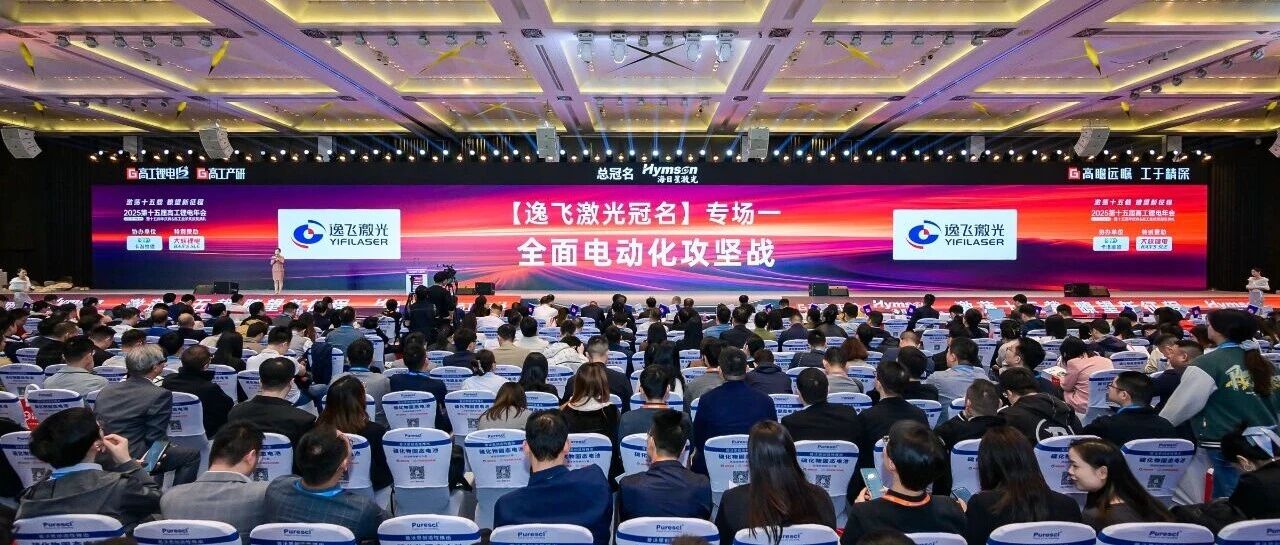
Core Viewpoint - The lithium battery industry is transitioning from a growth logic to a system logic, emphasizing safety, intelligence, and collaborative ecosystems in battery development and application [4][8][24]. Group 1: Event Overview - The 2025 (15th) High-Performance Lithium Battery Annual Conference was held in Shenzhen, gathering over 400 companies and more than 1200 industry leaders [2][11]. - The event focused on the future of the lithium battery industry, featuring discussions on the comprehensive electrification challenge [3][4]. Group 2: Industry Trends - Comprehensive electrification has shifted from a growth logic to a system logic, with safety, intelligence, and ecosystem collaboration becoming key priorities [4][8]. - The battery is evolving from a simple energy component to a foundational infrastructure for various intelligent systems, including vehicles, robots, and energy storage [5][6]. Group 3: Regional Development - Jiangmen is positioned as a key player in the lithium battery industry, offering sustainable land supply, a complete industrial chain, and a strong talent pool [9][11]. - The city has established a comprehensive and structured new energy industry system, with significant investments and projects driving growth [11][12]. Group 4: Technological Innovations - Companies like XPeng Motors are innovating in battery systems, focusing on safety, intelligence, and new ecosystems, with significant improvements in battery performance and charging efficiency [13][15]. - The industry is witnessing a clear trend towards semi-solid and solid-state battery technologies, with advancements in safety and performance [39][46]. Group 5: Market Dynamics - The commercial vehicle sector is experiencing rapid electrification, with penetration rates expected to exceed 50% in the coming years due to cost reductions in the lithium battery supply chain [15][18]. - The concept of "zero-carbon mining" is emerging as a significant application curve for new energy, particularly in regions with high diesel dependency [19][20]. Group 6: Safety and Quality Standards - Safety is being prioritized across the industry, with companies implementing rigorous testing and design standards to enhance battery reliability and performance [33][36]. - The industry faces challenges related to rapid equipment iteration and insufficient standardization, necessitating a focus on quality and consistency [36][37]. Group 7: Future Outlook - The next generation of batteries is expected to focus on longer range, faster charging, and higher cost-effectiveness, with an emphasis on integrating the entire supply chain [15][39]. - The solid-state battery market is still facing challenges, but collaborative efforts across the industry are essential for achieving commercialization [46].
小鹏汽车-W(09868.HK):3Q业绩符合预期;关注AI生态及增程周期
Ge Long Hui· 2025-11-19 11:55
Performance Review - The company reported 3Q25 revenue of 20.38 billion, with a Non-GAAP net loss of 1.5 billion, significantly narrowing both year-on-year and quarter-on-quarter, meeting market expectations [1] - The company delivered 116,007 vehicles in 3Q, with overall revenue increasing by 101.8% year-on-year to 20.38 billion [1] - The comprehensive gross margin reached a historical high of 20.1%, with automotive business gross margin at 13.1%, up 4.5 percentage points year-on-year [1] Development Trends - The company’s R&D expenses were 2.43 billion, up 48.7% year-on-year, while selling and administrative expenses were 2.49 billion, up 52.6% year-on-year [1] - The gross margin for other businesses was 74.6%, with revenue increasing by 0.94 billion quarter-on-quarter to 2.33 billion, mainly due to increased revenue from technology R&D services provided to partner car manufacturers [1] - The company expects to achieve positive earnings in 4Q [1] Product and Technology Strategy - The company recently launched pre-sales for the Xiaopeng X9 super-range model, with expected pricing between 350,000 to 370,000, likely lower than the pure electric version [2] - The company is initiating a product cycle for super-range electric vehicles, with expectations for strong order performance and the ability to create popular models [2] - The company showcased its comprehensive AI technology layout, planning to start mass production of robots, flying cars, and Robotaxis by 2026, aiming to transition from a smart electric vehicle company to a comprehensive mobility and technology platform [2] International Expansion and Market Outlook - The company expressed confidence in its export business, with overseas vehicle sales exceeding 5,000 units in September [2] - Current stock prices correspond to a 2.0x P/S ratio for 2025, maintaining an outperform rating and profit forecast, with target prices of 108 HKD and 28 USD, indicating an upside potential of 13% and 12% respectively [2]
小鹏汽车-W(9868.HK):三季度亏损进一步收窄 物理AI与新车周期共振
Ge Long Hui· 2025-11-19 11:55
Core Insights - The company reported its Q3 2025 earnings, achieving a revenue of 20.38 billion yuan, with year-on-year and quarter-on-quarter increases of 101.8% and 11.5% respectively, while the net profit attributable to shareholders was -0.38 billion yuan, narrowing by 78.9% year-on-year and 20.3% quarter-on-quarter [1] Group 1: Financial Performance - In Q3, the company delivered 116,000 vehicles, representing a year-on-year growth of 149.3% and a quarter-on-quarter increase of 12.4% [1] - The automotive business revenue reached 18.05 billion yuan, with year-on-year and quarter-on-quarter growth of 105.3% and 6.9% respectively [1] - The average selling price (ASP) per vehicle in Q3 was 156,000 yuan, showing a slight decline of 0.8 thousand yuan quarter-on-quarter [1] - The automotive gross margin for Q3 was 13.1%, down by 1.2 percentage points from the previous quarter, attributed to product upgrades [1] Group 2: Strategic Partnerships and Revenue Growth - The overall gross margin for the company in Q3 was 20.1%, an increase of 4.8 and 2.8 percentage points year-on-year and quarter-on-quarter respectively, driven by improved profitability from service and other income [2] - Revenue from service and other income reached 2.33 billion yuan, with year-on-year and quarter-on-quarter increases of 78.1% and 67.3% respectively, and a gross margin of 74.6%, up by 14.5 and 21.1 percentage points [2] - The company expanded its collaboration with Volkswagen, which became a strategic partner for the second-generation VLA, indicating potential for increased revenue from R&D services [2] Group 3: Product Development and Future Outlook - The company launched the Kunpeng Super Range Extender, featuring a fast-charging lithium iron phosphate battery with a pure electric range exceeding 450 km, and plans to release seven new models with super range extender configurations by 2026 [3] - The second-generation VLA model was introduced, enabling direct output from visual signals to action commands, with a full rollout planned for Q1 2026 [3] - The company aims to launch three Robotaxi models in 2026 and initiate trial operations in cities like Guangzhou, with plans to open the SDK for global partners [3] Group 4: Profit Forecast and Investment Recommendations - The company adjusted its net profit forecasts for 2025-2027 to -1.4 billion, +2 billion, and +4.5 billion yuan respectively, reflecting expectations for growth driven by the new range extender models and AI capabilities [4] - The company maintains a "recommended" rating, anticipating new business models emerging from advancements in AI and mass production capabilities [4]
美银证券:升小鹏汽车-W目标价至109港元 第三季亏损胜预期
Zhi Tong Cai Jing· 2025-11-19 10:57
小鹏第三季收入达200亿元人民币(下同),同比及按季分别增长102%及12%,大致符合该行预期。综合 毛利率为20.1%,同比及按季上升4.8及2.8个百分点,好过该行预期的17.7%。整车利润率为13.1%,同 比升4.5个百分点,按季跌1.2个百分点,主要因清库存而进行促销。期内非通用会计准则净亏损1.52亿 元,好过该行预期的净亏损3.98亿元。展望第四季,小鹏管理层预期交付量为12.5万至13.2万辆,同比 增长37%至44%,收入为215亿至230亿元,同比增长34%至43%。 美银证券发布研报称,下调对小鹏汽车-W(09868)的2025年销量预测1%,但将2026及27年预测分别上调 3%及5%; 将2025年非通用会计准则净亏损预测由10.94亿元下调至8.84亿元,同时将2026及27年非通用 会计准则净利润分别下调20%及9%。该行对小鹏港股目标价由105港元升至109港元,美股(XPEV.US)目 标价由27美元升至28美元,反映销量预测上调,重申"买入"评级,看好2026年强劲的产品布局。 ...
小鹏汽车:未来两年将年产数千辆自动驾驶出租车消息不实
2 1 Shi Ji Jing Ji Bao Dao· 2025-11-19 10:32
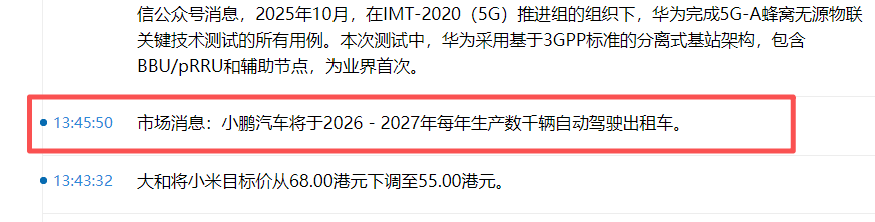
Core Viewpoint - Recent market rumors suggested that XPeng Motors (9868.HK) would produce thousands of autonomous taxis annually between 2026 and 2027, but the company has confirmed that these claims are not based on official data [1][2]. Group 1: Company Response - XPeng Motors verified the market rumors and found them to be unsubstantiated, clarifying that the information originated from a predictive analysis report rather than actual production plans [2]. - The original source of the rumor has since been modified to indicate that analysts estimated the annual production of autonomous taxis by XPeng Motors could be within the thousands during 2026-2027 [2]. Group 2: Company Announcements - On November 5, during the "2025 XPeng Technology Day," the company announced plans to launch three Robotaxi models in 2026 and initiate trial operations, with AutoNavi as the first global ecological partner for Robotaxi services [2]. - XPeng Motors reported a total delivery of 116,000 units in Q3 2025, representing a year-on-year increase of 149.3%, and total revenue of RMB 20.38 billion, up 101.8% compared to the same period in 2024 [2]. Group 3: Market Performance - On November 19, XPeng Motors' stock experienced slight fluctuations, closing at HKD 85.70 per share, down 0.29%, with a total market capitalization of HKD 163.7 billion [3].
从技术路线到人员更迭,为什么智能驾驶又开始了“新造词”? | 电厂
Xin Lang Cai Jing· 2025-11-19 10:20
Core Insights - The automotive and smart driving industry is experiencing rapid technological iterations, leading to new terminologies and concepts that challenge user understanding and acceptance [1] - The transition from rule-based systems to end-to-end and world model architectures is reshaping the industry, with significant implications for company strategies and personnel [2][6] Group 1: Technological Evolution - The shift from rule-based to end-to-end systems has highlighted the limitations of modular approaches, particularly in terms of latency and information loss [2] - Tesla's introduction of the end-to-end FSD V12 has sparked interest among other companies like Huawei, Xpeng, and NIO, who are also developing similar solutions [2][5] - The industry is moving towards VLA (vision-language-action) models, which aim to better understand the physical world and improve driving actions [8][12] Group 2: Challenges in Implementation - Current systems, whether rule-based or end-to-end, rely heavily on passive learning from vast amounts of driving data, which limits their ability to adapt to new scenarios [5][6] - The VLA model faces challenges such as multi-modal feature alignment and the inherent limitations of language models in processing complex real-world situations [11][15] - Companies like Ideal Auto and Xpeng are exploring innovative VLA approaches to enhance their systems' capabilities and efficiency [8][12] Group 3: Organizational Adjustments - The transition to new technological routes has led to significant organizational restructuring within companies like Xpeng, Ideal Auto, and NIO, reflecting a shift in focus towards foundational models [13][14] - Xpeng's leadership changes indicate a strategic pivot from traditional VLA to innovative VLA, emphasizing the need for a robust foundational model [14] - NIO and Ideal Auto have also undergone multiple organizational adjustments to align their resources with the evolving technological landscape [15][17] Group 4: Competitive Landscape - The trend of self-research in autonomous driving technology is shifting towards partnerships with specialized suppliers, as seen with companies like Chery and Great Wall [18][19] - Suppliers are gaining an edge in flexibility and rapid iteration capabilities compared to traditional automakers, which face constraints in their development processes [21] - The competition is intensifying, with suppliers expected to play a more dominant role in the market as they advance their solutions [18][22]

美银证券:升小鹏汽车-W(09868)目标价至109港元 第三季亏损胜预期
智通财经网· 2025-11-19 09:57
Group 1 - Bank of America Securities has lowered its 2025 sales forecast for XPeng Motors (09868) by 1%, while increasing the forecasts for 2026 and 2027 by 3% and 5% respectively [1] - The non-GAAP net loss forecast for 2025 has been revised down from 1.094 billion yuan to 884 million yuan, while the forecasts for 2026 and 2027 non-GAAP net profit have been reduced by 20% and 9% respectively [1] - The target price for XPeng's Hong Kong stock has been raised from 105 HKD to 109 HKD, and the target price for its US stock (XPEV.US) has been increased from 27 USD to 28 USD, reflecting the upward revision in sales forecasts [1] Group 2 - XPeng's revenue for the third quarter reached 20 billion yuan, representing a year-on-year growth of 102% and a quarter-on-quarter increase of 12%, which is in line with the bank's expectations [1] - The overall gross margin was 20.1%, up 4.8 percentage points year-on-year and 2.8 percentage points quarter-on-quarter, exceeding the bank's forecast of 17.7% [1] - The vehicle profit margin was 13.1%, an increase of 4.5 percentage points year-on-year, but a decrease of 1.2 percentage points quarter-on-quarter, primarily due to promotional activities for inventory clearance [1] Group 3 - For the fourth quarter, XPeng's management expects delivery volumes to be between 125,000 and 132,000 units, representing a year-on-year growth of 37% to 44% [1] - Revenue for the fourth quarter is projected to be between 21.5 billion and 23 billion yuan, indicating a year-on-year growth of 34% to 43% [1]
小鹏汽车-W(09868):Q3毛利率突破20%创历史新高
HTSC· 2025-11-19 09:41
Investment Rating - The report maintains a "Buy" rating for the company with a target price of HKD 122.71 [6][14]. Core Insights - The company reported Q3 2025 revenue of RMB 20.4 billion, a year-on-year increase of 120%, and a net loss of RMB 3.8 billion, narrowing losses by 79% year-on-year [1][4]. - The gross margin for Q3 2025 reached 20.1%, marking a significant improvement due to scale effects and cost control measures [2][4]. - The company is optimistic about its growth prospects in Q4 2025 and 2026, driven by multiple growth avenues including "dual energy + AI + robotics + external collaborations" [1][4]. Financial Performance - Q3 2025 revenue was RMB 20.4 billion, with a quarter-on-quarter increase of 12% and a year-on-year increase of 102% [1][19]. - The gross margin improved to 20.1%, up 4.8 percentage points year-on-year, with vehicle gross margin at 13.1% [2][19]. - The company expects Q4 2025 deliveries to be between 125,000 and 132,000 units, projecting revenue of RMB 21.5 to 23 billion [2][19]. Business Segments - The automotive sales segment is projected to generate RMB 118 billion in revenue for 2026, with a price-to-sales ratio of 0.95x [4][11]. - The humanoid robot business is valued at approximately RMB 40 billion, with significant advancements in humanoid capabilities expected by the end of 2026 [4][11]. - The Robotaxi business is estimated to be worth RMB 33 billion, with plans to launch three models by 2026 [4][11]. Market Position and Collaborations - The company is set to launch the new X9 super range extender vehicle, which is expected to achieve high sales volumes due to its advanced features [2][4]. - Collaboration with Volkswagen is anticipated to enhance revenue through technology service fees and new model launches [4][13]. Valuation - The overall market capitalization of the company is estimated at approximately RMB 215 billion, with a target price adjustment to HKD 122.71 [4][14]. - The report employs a segmented valuation approach, considering automotive sales, robotics, and Robotaxi businesses [4][11].