协鑫科技

Search documents
美国低招聘+低裁员延续:环球市场动态
citic securities· 2026-01-12 03:08
Market Overview - US non-farm payrolls for December were below expectations, with a decrease in unemployment rate to 4.4%[5] - The S&P 500 index reached a record high, closing at 6,966.3 points, up 0.6%[9] - European markets showed positive sentiment, with the Euro Stoxx 600 index rising by 1.0%[9] Commodity and Currency Insights - Oil prices increased significantly due to geopolitical uncertainties, with WTI crude oil rising to $59.12 per barrel, up 2.35%[25] - Gold prices surged above $4,500 per ounce, reflecting market concerns over geopolitical instability[25] - The US dollar index rose by 0.2%, closing at 99.13[24] Employment and Economic Indicators - The US added 58,400 non-farm jobs in 2025, significantly lower than the levels seen in 2023 and 2024[5] - The Michigan Consumer Sentiment Index for January reached its highest level in four months[5] Stock Market Performance - A-shares continued their strong performance, with the Shanghai Composite Index rising by 0.92% to 4,120.43 points[14] - The Hang Seng Index increased by 0.32%, closing at 26,231.79 points, with notable gains in materials and gold sectors[11] Investment Strategies - Alibaba's revenue for FY2026Q3 is expected to grow by approximately 4% to 290.2 billion yuan, with a focus on AI and cloud computing[8] - Chinese oil companies are expected to show resilience despite pressure from falling oil prices, with a projected 5% decrease in capital expenditure for 2026[11]
西部证券晨会纪要-20260112
Western Securities· 2026-01-12 00:56
Group 1: Home Appliances Industry - The report emphasizes the importance of capturing opportunities at the bottom of the consumer sector, focusing on the "dividend +" allocation direction as high-end consumption and certain mass-market products show signs of recovery [1][5] - The report highlights that the market is gradually returning its attention to the consumer sector due to the implementation of national subsidy policies and the demand for high-quality investments, although high valuations and non-mainstream sectors remain less attractive [1][5] - Key recommendations include focusing on companies with strong business models, high dividends, stable performance, and favorable valuations, such as Haier Smart Home, Midea Group, and Gree Electric [3][5] Group 2: Commercial Aerospace and Power Equipment Industry - The commercial aerospace sector in China is characterized by grand planning and significant potential, with expectations for a transition from "hundreds" to "thousands" of low-orbit satellites between 2026 and 2027, marking a shift to mass production and high-density launches [6] - The report suggests that the aerospace cable industry, which requires high environmental performance and reliability, is expected to see significant growth due to the increasing frequency of rocket launches, with recommendations to focus on companies like Hualing Cable [6][7] - The report also discusses the importance of rocket fuel tanks, which represent a significant cost in rocket structures, and suggests monitoring companies like Taisheng Wind Energy for investment opportunities [7] Group 3: Inflation and Economic Indicators - The report notes that the Consumer Price Index (CPI) increased by 0.8% year-on-year in December, the highest since March 2023, indicating a recovery in prices [10][11] - The Producer Price Index (PPI) showed a month-on-month increase of 0.2% in December, with a narrowing year-on-year decline, suggesting a potential acceleration in nominal GDP growth [11][12] - The report anticipates that the trends of rising inflation and nominal GDP growth will continue into 2026, supported by improving economic indicators [11][12]
出口退税全面取消 光伏行业转向市场驱动
Bei Jing Shang Bao· 2026-01-11 22:53
Core Viewpoint - The cancellation of the export VAT rebate for photovoltaic products marks the end of the "rebate subsidy era" for the industry, leading to significant impacts on component manufacturers and a potential surge in exports before the policy takes effect [3][4][6]. Group 1: Policy Changes - The Ministry of Finance and the State Taxation Administration announced the cancellation of the export VAT rebate for photovoltaic products effective April 1, 2024, with a gradual reduction for battery products starting in 2026 [3][4]. - The announcement includes a list of 249 photovoltaic products and 22 battery products affected by the policy change [3]. - The China Photovoltaic Industry Association stated that the adjustment aims to promote rational pricing in foreign markets and curb the rapid decline in export prices [3][4]. Group 2: Industry Impact - The cancellation of the export VAT rebate is expected to significantly affect component manufacturers, leading to a "rush to export" before the policy takes effect [4][6]. - Major manufacturers like JinkoSolar, Trina Solar, JA Solar, and Longi Green Energy reported substantial losses in the first three quarters of 2025, with revenues of approximately 479.86 billion, 499.7 billion, 368.09 billion, and 509.15 billion respectively [5]. - JinkoSolar had the highest share of overseas revenue, exceeding 60%, while Longi Green Energy had the lowest at around 37.81% [5]. Group 3: Market Dynamics - The industry is experiencing fierce competition, with export prices declining and a trend of "increased volume but decreased price" [4][6]. - The cancellation of the rebate is seen as a shift from a "policy-driven" to a "market-driven" approach, pushing companies to focus on value rather than price competition [8][9]. - Companies may need to upgrade technology and reduce production costs to maintain competitiveness, potentially leading to a shift of production capacity to regions with favorable tax conditions [8][9].

出口退税取消叠加自律机制调整 市场化下光伏产业链面临价值重估
Di Yi Cai Jing· 2026-01-11 21:11
Core Viewpoint - The photovoltaic industry is facing a significant policy shift as the export tax rebate for photovoltaic products is fully canceled, marking the end of a supportive policy environment and leading to a historical turning point for the industry [1][2]. Policy Changes - The Ministry of Finance and the State Taxation Administration announced the cancellation of the export tax rebate for photovoltaic products starting April 1, 2026, transitioning the industry into a "no rebate subsidy" phase [2]. - The export tax rebate policy, which began in October 2013, has seen a gradual decline in rebate rates, dropping from 13% to 9% for photovoltaic silicon wafers, batteries, and modules as of December 1, 2024 [2]. Market Reaction - The market reacted sharply to these policy changes, with the sentiment in the polysilicon market plummeting, leading to significant declines in polysilicon futures and related stocks such as Daqo New Energy and Tongwei Co., Ltd. [1][3]. - On January 8, polysilicon futures dropped by 9%, followed by an 8% decline on January 9, reaching a low of 50,080 yuan/ton [3]. Industry Self-Regulation - The industry self-regulation phase has entered a new stage, with the State Administration for Market Regulation holding discussions with major companies regarding monopoly risks and requiring them to avoid agreements on production capacity, sales prices, and market division [3][4]. - The self-regulation efforts that began in 2025 had initially helped stabilize prices, but the recent regulatory changes indicate a shift away from relying on such practices [4]. Price Dynamics - Despite rising prices for upstream polysilicon and silicon wafers, downstream module prices have not followed suit, leading to squeezed profit margins for developers [5][6]. - The average transaction price for N-type polysilicon was reported at 59,200 yuan/ton, reflecting a week-on-week increase of 9.83%, while N-type G10L monocrystalline silicon wafers saw a price increase of 9.17% [5]. Demand Outlook - The first quarter is traditionally a weak demand season for the photovoltaic industry, with both domestic and overseas markets showing signs of slowing order execution and limited visibility for new orders [7]. - The overall market demand has been declining, and the anticipated price increases for components face significant resistance due to low demand [6][7]. Market Valuation - The shift in policy is prompting a "value reassessment" in the capital market for the photovoltaic sector, with significant sell-offs observed in the stock market [8]. - From January 8 to 9, the photovoltaic sector experienced a notable decline, with polysilicon futures dropping by 10.2% and major companies like Tongwei Co., Ltd. and GCL-Poly Energy Corp. seeing substantial stock price decreases [8]. Investment Opportunities - Despite the challenges, the photovoltaic industry's overall valuation is at historical lows, which may present attractive investment opportunities compared to other sectors [8]. - Companies with advantages in technology iteration, cost control, and global channel layout are expected to be identified as potential investment opportunities amidst the changing landscape [8].



工业硅、多晶硅周报:将取消光伏等产品增值税,出口退税-20260111
Hua Lian Qi Huo· 2026-01-11 15:19
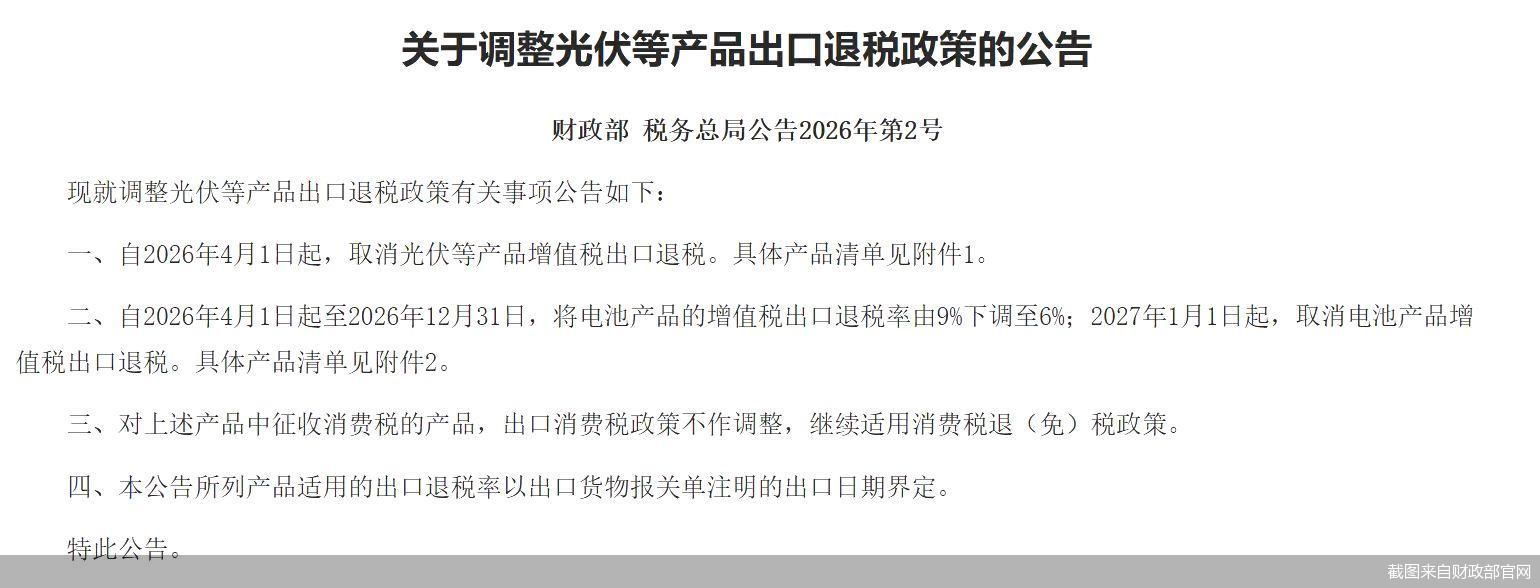
期货交易咨询业务资格:证监许可【2011】1285号 请务必阅读正文后的免责声明。本报告的信息均来自己公开信息,关于信息的准确性与完整性,建议投资者谨慎判断,据此入市,风险自担。 华联期货工业硅、多晶硅周报 将取消光伏等产品增值税出口退税 20260111 作者:陈小国 0769-22116880 从业资格号:F03100622 交易咨询号:Z0021111 审核:萧勇辉,从业资格号:F03091536,交易咨询号:Z0019917 2 行业格局 3 期现市场 4 库存 1 周度观点及热点资讯 8 进出口 5 成本利润 6 供给 7 需求 请务必阅读正文后的免责声明。本报告的信息均来自己公开信息,关于信息的准确性与完整性,建议投资者谨慎判断,据此入市,风险自担。 请务必阅读正文后的免责声明。本报告的信息均来自己公开信息,关于信息的准确性与完整性,建议投资者谨慎判断,据此入市,风险自担。 周度观点及热点资讯 热点资讯 请务必阅读正文后的免责声明。本报告的信息均来自己公开信息,关于信息的准确性与完整性,建议投资者谨慎判断,据此入市,风险自担。 u 自2026年4月1日起,取消光伏等产品增值税出口退税。自2026年 ...
每周经济观察:华创宏观WEI指数回升-20260111
Huachuang Securities· 2026-01-11 14:43
Economic Indicators - The Huachuang Macro WEI index rose to 6.05% as of January 4, 2026, an increase of 0.46 percentage points from the previous week[2] - Subway passenger volume in 26 cities increased by 6% year-on-year in the first week of January, while domestic flight operations averaged 12,400 flights per day, down 0.6% year-on-year[2] - Container throughput at Chinese ports rebounded slightly, with a week-on-week increase of 6.3% as of January 5, 2026, and a year-on-year increase of 7.7% over the past four weeks[2] Real Estate and Construction - Residential property sales in 67 cities saw a year-on-year decline of 43% in the first ten days of January, compared to a 24% decline in December 2025[3] - The average land premium rate in 100 cities fell to 0.45% as of January 4, 2026, down from 1.64% in December 2025[3] - Cement shipment rates dropped to 29% as of January 2, 2026, a decrease of 2.4 percentage points from the previous week[3] Commodity Prices - Gold prices rose to $4,473 per ounce, an increase of 3.6%, while copper prices reached $12,990 per ton, up 3.8%[2] - Crude oil prices increased, with WTI at $59.1 per barrel (up 3.1%) and Brent at $63.3 per barrel (up 4.3%)[2] - Lithium carbonate prices surged by 15.6% in the latest trading session[2] Financial Markets - The stock-bond Sharpe ratio difference stood at 4.25, indicating a high relative value for equities compared to bonds[9] - New special bond issuance in early January totaled 874 billion yuan, significantly higher than zero in the same period last year[4] - Interest rates fell post-year-end, with DR001 at 1.2727% and DR007 at 1.4727%, reflecting decreases of 5.98 and 50.94 basis points respectively since December 31, 2025[4]
4月1日起执行!光伏出口退税全面取消,行业影响几何
Bei Jing Shang Bao· 2026-01-11 13:01
Core Viewpoint - The cancellation of the export VAT rebate for photovoltaic products marks the end of the "rebate subsidy era," significantly impacting component manufacturers and potentially leading to a surge in exports before the policy takes effect [1][3][5]. Policy Changes - The Ministry of Finance and the State Taxation Administration announced the cancellation of the export VAT rebate for photovoltaic products effective April 1, 2026, with a reduction in the rebate rate for battery products from 9% to 6% until the end of 2026 [3][4]. - The announcement includes a list of 249 products related to photovoltaic and 22 battery products affected by the policy change [4]. Industry Impact - The cancellation of the export VAT rebate is expected to have a significant impact on component manufacturers, with predictions of a "rush to export" before the policy takes effect [5][6]. - Major manufacturers such as JinkoSolar, Trina Solar, JA Solar, and LONGi Green Energy reported substantial losses in the first three quarters of 2025, with JinkoSolar's overseas revenue exceeding 60% of its total revenue [5][6]. Market Dynamics - The Chinese Photovoltaic Industry Association indicated that the adjustment of export VAT rebates could help stabilize overseas market prices, which have been declining due to fierce competition [4][10]. - The industry is experiencing a shift from "price competition" to "value competition," as companies will need to focus on technological upgrades and high-value segments to maintain competitiveness [10][11]. Regulatory Environment - Recent meetings involving the China Photovoltaic Industry Association and leading polysilicon companies addressed concerns about monopolistic practices and market regulation, indicating a tightening regulatory environment [8][9]. - The cancellation of export rebates and potential changes in the polysilicon storage plan are seen as part of a broader effort to combat "internal competition" within the industry [10].




光伏行业:太空光伏或成行业第二成长曲线,利好HJT、钙钛矿新技术
Dongxing Securities· 2026-01-11 11:46
Investment Rating - The industry investment rating is "Positive" [6] Core Insights - The space photovoltaic sector may become the second growth curve for the industry, benefiting HJT and perovskite technologies [3] - The demand for space photovoltaics is expected to grow significantly, with potential installation demand exceeding 800 GW if the proposed space data center concept is realized [3] - Leading companies are focusing on the space photovoltaic market, accelerating technology research and scenario exploration, indicating a shift from concept validation to explosive growth [3] Summary by Sections Market Demand - Solar energy is the preferred energy source for space activities, with increasing power requirements for satellites driving demand for larger solar wings [3] - The current market size is small but expanding rapidly, with a potential for significant growth in the future [3] Technology Development - The main requirements for space photovoltaic technology are high efficiency, lightweight, and adaptability to extreme temperatures and radiation [4] - The mainstream technology for space photovoltaics is currently gallium arsenide (GaAs), which has a conversion efficiency exceeding 30% but comes with high production costs of approximately 1000 RMB/W [4] - P-type HJT batteries are seen as a potential alternative due to their compatibility with space conditions, offering reduced weight and excellent low-temperature performance [4] Future Prospects - Perovskite tandem batteries are expected to become a key option for next-generation space photovoltaics, with theoretical conversion efficiencies reaching 45% and significant weight advantages over GaAs [5] - The flexibility of perovskite batteries allows for diverse solar wing designs, making them suitable for various space applications [5] Investment Strategy - The short-term acceleration of low Earth orbit satellites is expected to drive demand for space photovoltaics, while the long-term vision of space data centers opens up new opportunities [5] - HJT and perovskite technologies are viewed as optimal solutions for extreme space environments, benefiting related battery component manufacturers and equipment producers [5]
市场化下光伏产业链面临价值重估
Di Yi Cai Jing Zi Xun· 2026-01-11 11:37
Group 1 - The core viewpoint of the article highlights a significant policy shift in the photovoltaic (PV) industry, marked by the cancellation of export VAT rebates and the cessation of industry self-regulation, indicating a historical turning point for the sector [2][3]. - The Ministry of Finance and the State Taxation Administration announced the cancellation of export VAT rebates for PV products starting April 1, 2026, transitioning the industry into a "no rebate subsidy" phase [3]. - The cancellation of the export VAT rebate follows a period of declining export prices and increased competition in overseas markets, leading to substantial losses across the industry [3][4]. Group 2 - The market reacted sharply to these changes, with significant declines in the prices of polysilicon futures and related stocks, indicating a loss of investor confidence [4][8]. - The recent discussions between the State Administration for Market Regulation and leading companies in the PV sector, including Tongwei Co. and Daqo New Energy, focused on addressing monopoly risks and enforcing compliance with new regulations [4][5]. - Despite rising prices for upstream materials like polysilicon and silicon wafers, downstream component prices have not followed suit, leading to squeezed margins for developers [5][6]. Group 3 - The first quarter is traditionally a slow season for the PV industry, and the anticipated price increases for components face resistance due to weak demand [6][7]. - The shift in policy is prompting a reevaluation of the PV sector's value in the capital markets, with significant sell-offs observed in the stock prices of major companies [7][8]. - Analysts suggest that while the overall valuation of the PV industry is at historical lows, the uncertainty surrounding future profitability and market dynamics poses challenges for attracting investment [8].
市场化下光伏产业链面临价值重估
第一财经· 2026-01-11 11:28
Core Viewpoint - The photovoltaic industry in China is facing a significant policy shift with the complete cancellation of export VAT rebates and the halting of industry self-regulation, marking a historical turning point for the sector [3][4]. Policy Changes - Starting April 1, 2026, the export VAT rebate for photovoltaic products will be fully canceled, transitioning the industry into a "no rebate subsidy" phase [4]. - The export VAT rebate policy, initiated in October 2013, has seen a gradual decline in rebate rates, dropping from 13% to 9% as of December 1, 2024, indicating a move towards the cancellation of rebates [4]. Market Reactions - The market reacted sharply to these policy changes, with the price of multicrystalline silicon contracts dropping significantly, and major companies like Daqo New Energy and Tongwei Co. experiencing substantial stock declines [3][5]. - On January 8 and 9, 2026, the main contract for multicrystalline silicon futures fell by 9% and 8% respectively, reaching a low of 50,080 yuan/ton [5][11]. Industry Self-Regulation - The recent discussions between the State Administration for Market Regulation and leading companies in the silicon material sector indicate a shift away from previous self-regulatory practices, which had aimed to stabilize prices through coordinated production and sales strategies [5][6]. - The new regulatory environment prohibits companies from coordinating on production capacity, sales volumes, and pricing, which could lead to increased market volatility [5][6]. Price Dynamics - Despite rising prices for upstream materials like silicon and silicon wafers, the prices for downstream components have not followed suit, squeezing profit margins for developers [9]. - The average transaction price for N-type multicrystalline silicon was reported at 59,200 yuan/ton, reflecting a week-on-week increase of 9.83%, while N-type G10L monocrystalline silicon wafers saw a price increase of 9.17% [9]. Demand and Market Outlook - The first quarter is traditionally a low-demand season for the photovoltaic industry, complicating the acceptance of price increases by end-users [10]. - The overall market demand has been weakening, with a decline in order visibility for both domestic and overseas markets as the year-end approaches [10]. Capital Market Impact - The shift in policy is prompting a "value reassessment" in the capital markets for the photovoltaic sector, leading to significant sell-offs and pressure on valuations [11]. - From January 8 to 9, 2026, the photovoltaic sector experienced a notable sell-off, with major companies like Tongwei Co. and GCL-Poly Energy facing significant stock price declines [11].