华为

Search documents
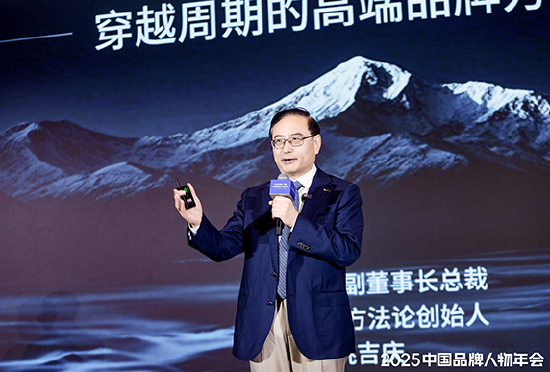
慕思集团副董事姚吉庆:穿越周期的高端品牌方法论
Xin Lang Cai Jing· 2026-01-19 07:08
Core Viewpoint - The 20th China Brand Person Annual Conference emphasizes the theme "Who Earns Respect for China" and aims to gather insights and power for the development of Chinese brands, showcasing the evolution and future opportunities in brand building [3][16]. Group 1: High-End Brand Methodology - The founder of the high-end brand methodology shared insights from 30 years of experience in building brands like Vatti, Oppein, and Mousse, highlighting the importance of adapting Western management theories to the Chinese market [3][17]. - The methodology focuses on "seizing the high ground and building deep moats" as a way to navigate through market cycles and establish high-end brands [4][18]. - A high-quality development cycle is proposed, emphasizing increased investment in technology and product innovation to create unique selling points and achieve high standards, quality, and profitability [6][20]. Group 2: Key Challenges for High-End Brands - Three critical barriers for entrepreneurs aiming to establish high-end brands include system management, long-term commitment, and understanding market trends [7][21]. - System management requires a comprehensive tactical approach, moving beyond traditional advertising to a structured strategy that includes a "Nine Virtues Training" for brand success [7][21]. - Long-term commitment is essential, as demonstrated by successful brands like Moutai and Casarte, which persisted through initial losses to achieve growth [8][22]. Group 3: Strategic High Grounds and Moats - Four strategic high grounds identified are strategy, organizational culture, product, and brand, which are essential for establishing a high-end brand [8][22]. - Building three moats is crucial: a digital intelligence moat, a marketing moat, and a service and experience moat, which collectively enhance brand competitiveness [12][25]. - The digital intelligence moat involves restructuring ecosystems through digital transformation, while the marketing moat focuses on creating brand asset value through effective campaigns [12][25][26]. Group 4: Market Opportunities - The current era presents a unique opportunity for Chinese brands to transition from manufacturing powerhouses to brand leaders, with examples like Huawei and BYD reshaping the global brand landscape [14][27]. - The call to action encourages companies to move away from price wars and strive for true pricing power, aiming to create iconic brands that resonate on the global stage [14][27].

珍酒李渡董事长吴向东:没有超级产品就不会有超级企业
Xin Lang Cai Jing· 2026-01-19 07:08
Core Viewpoint - The 20th China Brand Person Annual Conference will be held on December 29, 2025, in Shenzhen, focusing on the theme "Who Earns Respect for China," gathering over 2,000 elites from various sectors to reflect on the development of Chinese brands and explore new trends and opportunities in brand building [3][12]. Group 1: Innovation and Achievements - The company has implemented an innovative business model through the "Zunyi Forum," hosting 75 forums that attracted over 10,000 participants and generated over 600 million in revenue within 200 days, a significant achievement in a declining industry [5][14]. - The company has adopted a strategy of "one out, one in" for recruitment in certain regions, indicating a shift in operational focus [5][14]. Group 2: Seven Innovations for Business Breakthrough - The company has identified seven areas of innovation: super links, super products, super channels, super communication, super organization, super brand, and super experience, which have contributed to its business breakthroughs [5][14]. - A shift from large conferences to smaller forums has improved conversion rates from initially low percentages to significantly higher levels [5][14]. Group 3: Industry Challenges and Successful Case Studies - The liquor industry is facing challenges such as severe price inversion, affecting all channels [6][15]. - Successful case studies include Pop Mart, which saw a 16-fold increase in market value by creating a super product, LABUBU, and Huawei, which transformed its business model to achieve significant market success [6][15][16]. Group 4: Product Development and Market Positioning - The company has launched a super product, "Dazhen," priced at 600 yuan, which competes with products priced at 3,600 yuan, and is recognized as one of the hottest liquors in the market [8][18]. - The company is also developing a super beer with 20 times the amount of hops used in regular beer, positioning it as a leading new brand in the premium beer segment [8][18]. Group 5: Future Exploration and Incentives - The company is exploring new product lines, including a low-alcohol beverage and a health drink for women, aiming to maintain health into old age [9][19]. - A special equity incentive policy is in place to encourage sales, offering free shares of the listed company to those who assist in selling products [9][19].
千万用户之后:一汽奥迪如何重塑合资模式的价值坐标
Jing Ji Guan Cha Wang· 2026-01-19 05:00
Core Insights - The core message of the article revolves around the milestone of FAW Audi surpassing 10 million users in China, questioning whether this achievement serves as a protective moat for transformation or a burden of path dependency in the face of new competitors [1][10] Group 1: Evolution of Joint Venture Model - FAW Audi's development over 38 years highlights its role as a deep participant in shaping the rules of the Chinese automotive industry, moving beyond merely being a brand importer to a key player in the luxury car market [1][3] - The concept of "joint venture sovereignty" has been continuously strengthened, allowing FAW Audi to make proactive decisions based on market trends rather than following industry consensus [3][10] Group 2: Industry Chain Empowerment - FAW Audi has integrated international manufacturing standards and quality management systems with local supply chains, supporting its stable growth and enabling local parts manufacturers to enter the global automotive industry [4][6] - Collaborations with local companies like CATL and Huawei represent a shift from simple supply chain partnerships to a system-level integration of top-tier Chinese technologies with global luxury manufacturing standards [4][6] Group 3: Challenges and Future Directions - The scale of 10 million users does not guarantee safety; the core challenge for FAW Audi lies in integrating its established "hard capabilities" with the "soft agility" required in the era of smart technology [7][9] - FAW Audi's strategy of "parallel development" aims to maintain the stability of its manufacturing and supply chain while enhancing user experience through smart collaborations, thus balancing traditional strengths with new technological demands [7][9] Group 4: Implications for the Industry - The evolution of FAW Audi's model serves as a microcosm for the broader transformation of the joint venture model in China, emphasizing the need for a redefinition of sovereignty and collaboration in the face of industry upgrades [10][12] - The insights gained from FAW Audi's experience are applicable to the entire Chinese automotive industry, highlighting the importance of joint ventures as key participants in industrial upgrades rather than mere supplementary forces [12]
用ChatGPT要看广告了;萝卜快跑开启阿布扎比运营【巨头风向标】
2 1 Shi Ji Jing Ji Bao Dao· 2026-01-19 04:35
Group 1: OpenAI and Advertising - OpenAI announced the introduction of advertising in the free version and the entry-level subscription tier ChatGPT Go, starting with adult users in the U.S. [2] - The ChatGPT Go subscription service offers enhanced features, including access to the GPT-5.2 Instant model, ten times more messages, and improved memory and context capabilities [2] - OpenAI aims to diversify its revenue model through advertising while maintaining the objectivity of responses [2] Group 2: Apple Trade-In Program - Apple updated its trade-in program to include devices from Huawei and Xiaomi, offering significant trade-in values for various products [4] - The maximum trade-in value for the iPhone 16 Pro Max in China is 5,800 yuan, while the iPad Pro can be traded in for up to 5,800 yuan as well [4] - The program allows consumers to upgrade their devices within a specified period, enhancing customer retention [4] Group 3: Tesla AI Chip Development - Tesla CEO Elon Musk announced that the design of the AI5 chip is nearing completion, with the AI6 chip in early development [5] - Musk emphasized the goal of achieving a nine-month design cycle for future AI chips, including AI7, AI8, and AI9 [5] - The AI chips are expected to become the highest-volume AI chips globally [5] Group 4: Meituan's LongCat Model - Meituan's LongCat team released the open-source model LongCat-Flash-Thinking-2601, achieving state-of-the-art performance in key evaluation benchmarks [8] - The model excels in tool invocation and interaction reasoning, significantly reducing training costs for adapting to new tools [8] - It is the first fully open-source model supporting online free experiences in the rethinking mode, ensuring comprehensive decision-making in complex tasks [8] Group 5: SpaceX and Commercial Spaceflight - SpaceX successfully launched the Falcon 9 rocket, completing its 600th mission by sending the NROL-105 satellite into orbit [11] - The successful launch highlights SpaceX's continued leadership in the commercial spaceflight sector [11] Group 6: Investment Activities - Xiangzhong Technology plans to invest 50 million yuan in Zhejiang Hexin Integrated Circuit Co., acquiring a 2.27% stake, focusing on advanced packaging and testing in the semiconductor industry [12] - Minexplosion Optoelectronics is planning to acquire 100% of the shares of Xiamen Zhizhi Precision Technology Co., Ltd. and Jiangxi Maida Intelligent Technology Co., Ltd., focusing on PCB manufacturing [13] - Yanjing Co. intends to purchase 98.54% of Yongqiang Technology's shares, expanding its business into high-end electronic interconnection materials for integrated circuits [14]
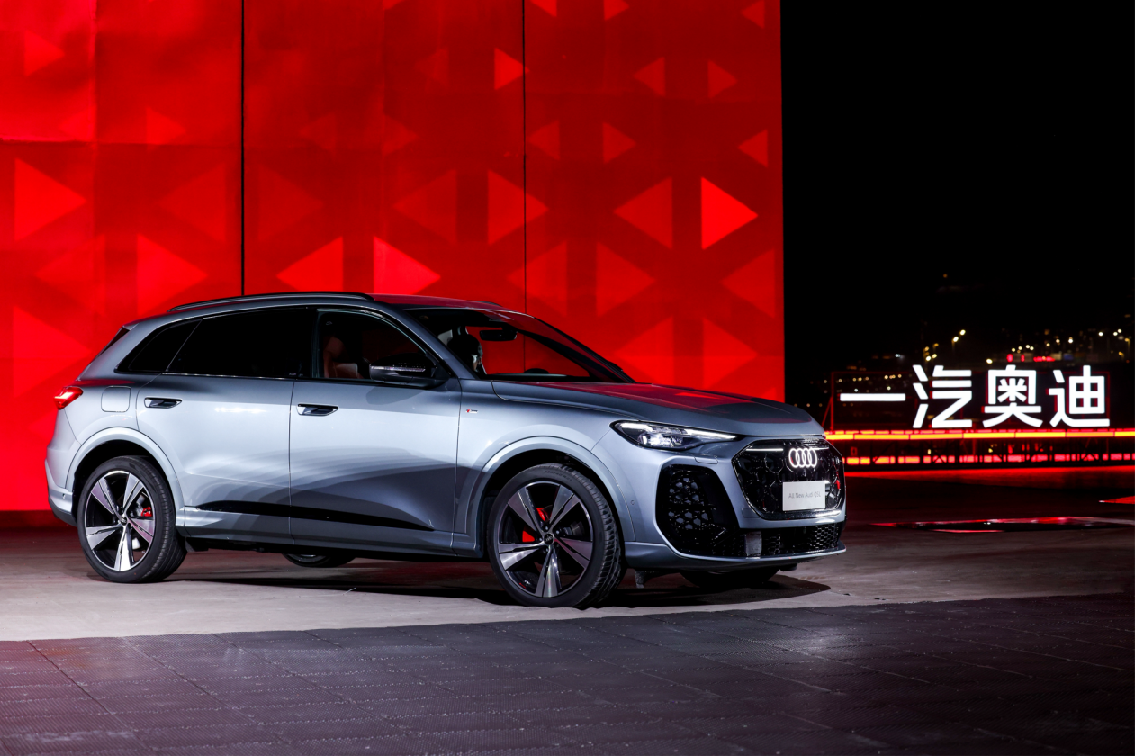
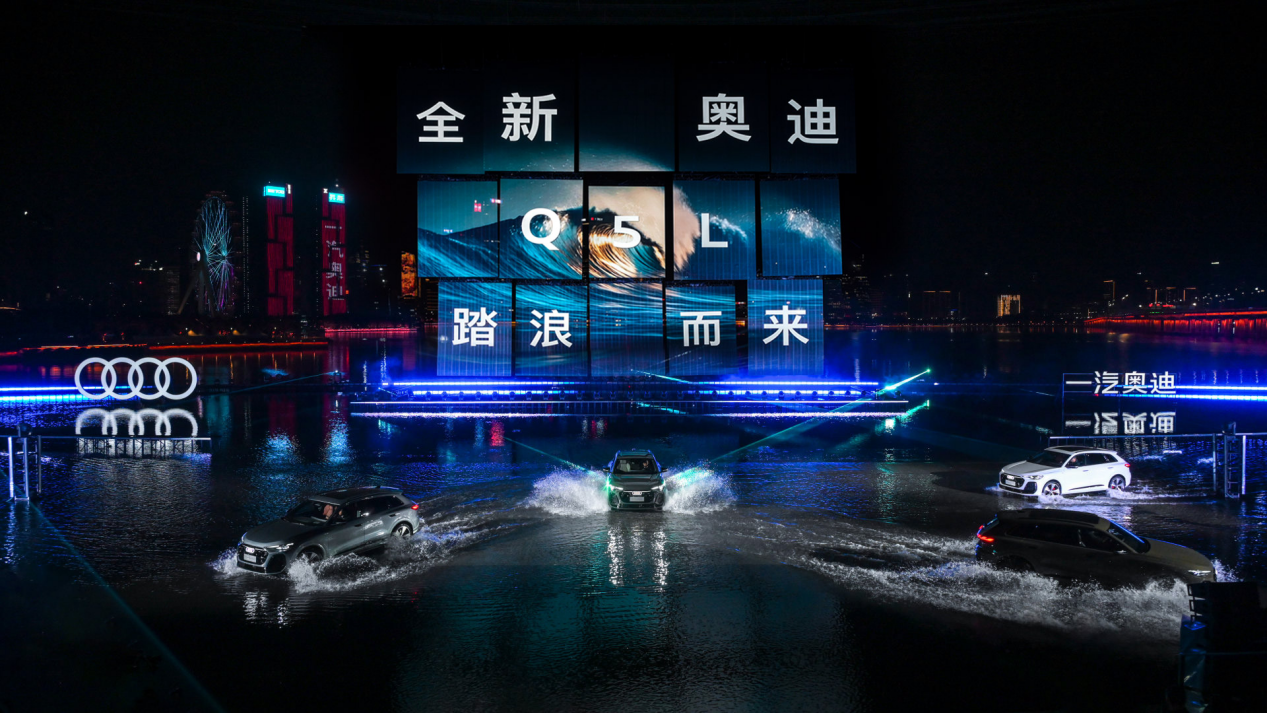
搭载新一代智能座舱 全新奥迪Q5L上市
Yang Shi Wang· 2026-01-19 04:23
Group 1 - The new generation Audi Q5L has been officially launched with a price range of 309,800 to 384,800 yuan [1] - The Audi Q5L is built on the Audi PPC luxury fuel intelligent platform, featuring comprehensive upgrades in design, intelligence, driving control, and luxury experience [3] - The new model has an extended wheelbase of 2,945 mm and a total length of 4,842 mm, catering to the Chinese market's demand for interior space [3] Group 2 - The vehicle is equipped with the fifth-generation EA888 2.0 TFSI inline four-cylinder turbocharged engine, enhancing performance, fuel economy, emissions standards, comfort, and reliability [5] - The entire Audi Q5L lineup features HDI dual-motor intelligent hybrid technology, balancing the driving dynamics of traditional fuel vehicles with the comfort of electric vehicles [5] Group 3 - A key highlight of the new generation is its intelligent features, including a new generation smart cockpit with multi-screen interaction and a voice assistant optimized for Chinese users [7] - The Audi Q5L is the world's first luxury fuel SUV equipped with Huawei's advanced driving technology, featuring a comprehensive driving assistance system with urban and highway NOA capabilities [7] - The model includes high-end features such as a Bang & Olufsen sound system, privacy headrest speakers, and "cloud feel" seats tailored to the physique of Chinese users [7] Group 4 - The launch of the Audi Q5L coincides with FAW Audi reaching a milestone of ten million users, marking a new phase for the brand in the intelligent fuel vehicle sector [8]
记者手记:在阿拉木图,看见具体而生动的“出海”
2 1 Shi Ji Jing Ji Bao Dao· 2026-01-19 04:17
Group 1 - Almaty, known as the "Apple City," remains an economic and cultural center of Kazakhstan despite the capital moving to Astana, showcasing a blend of old Soviet-style buildings and modern architecture [1] - The digital economy is rapidly developing in Kazakhstan, with 95% of the population using smartphones, leading to a mobile-first internet ecosystem that bypassed traditional PC usage [1][2] - Chinese brands have significantly penetrated the Almaty market, with high visibility of logos from companies like Geely, BYD, and Huawei, indicating a strong acceptance and recognition of these brands among local consumers [2] Group 2 - Kazakhstan is viewed as a strategic market for internet companies, particularly Yandex, which sees it as a key area for growth outside of Russia, with a developing consumer base and established habits [2][4] - The market is characterized by rapid change and growth, similar to China's market a decade ago, presenting numerous opportunities for brands looking to expand [4] - The local ride-hailing platform Yandex Go predominantly features Chinese cars, reflecting the increasing presence of Chinese automotive brands in the region [2]
GYBrand发布2026年全球品牌价值500强榜单!中国78家企业名单一览
Sou Hu Cai Jing· 2026-01-19 04:13
Core Insights - The globalization of Chinese brands is accelerating, with brand value assessment becoming a strategic priority for sustainable development, shifting from an optional to a necessary approach for companies [2] - The GYBrand 2026 World Brand 500 list emphasizes a comprehensive evaluation system based on brand value, financial performance, brand strength, contribution, and sustainability [2] Group 1: Brand Rankings and Distribution - The 2026 GYBrand World Brand 500 includes brands from 33 countries, with a total value exceeding $14 trillion, representing a 7.11% increase from the previous year, and an average brand value of $28.544 billion [3] - The United States leads with 180 companies, while China ranks second with 78 companies, accounting for 15.6% of the total list [3] - Major cities like Beijing, Shanghai, Shenzhen, Guangzhou, and Hangzhou show significant brand concentration, with "Beijing, Shanghai, Shenzhen, Guangzhou, and Hangzhou" collectively contributing 60 companies to the list [3][12] Group 2: Chinese Brand Performance - In 2026, 78 Chinese companies made the GYBrand list, with a total brand value of $22,764 billion, representing 15.9% of the global total, and an average brand value of approximately $292 million [12] - Beijing is the leading city with 38 companies and a total brand value of $12,178 billion, while Shenzhen has 7 companies, all from the private sector [13] - The presence of state-owned enterprises in Beijing highlights its advantages in innovation resources and industrial clusters, reinforcing its leading position in brand value [13] Group 3: Challenges and Opportunities - Chinese brands face a "large but weak" dilemma, needing to transition from scale expansion to value deepening to enhance brand strength [16] - Comparisons with the Fortune Global 500 reveal that while China has a significant number of companies, their average revenue and profit lag behind those of U.S. companies [16] - The ongoing technological revolution and industrial transformation present new opportunities for Chinese brands to enhance their value through innovation, emotional connection, and cultural empowerment [17]



“碰一下”奇袭扫码支付
Xin Lang Cai Jing· 2026-01-19 03:55
Core Insights - The introduction of "Tap" payment based on NFC technology aims to streamline the payment process, reducing the time taken to complete a transaction to under 1 second [1][17] - Alipay's "Tap" payment has rapidly gained popularity, reaching over 100 million users in just 321 days, significantly faster than previous payment methods [2][18] - The competitive landscape in the payment industry is evolving, with other companies like Douyin and UnionPay beginning to explore similar NFC payment solutions [2][19] Group 1: Payment Innovations - "Tap" payment allows users to complete transactions with a simple touch, enhancing user experience and efficiency [1][17] - Alipay's aggressive marketing strategy, including a substantial initial budget of 300 billion yuan for promotion, has contributed to the rapid adoption of "Tap" [18] - The technology behind "Tap" leverages NFC, which has become more accessible as smartphone manufacturers increasingly support it [14][15] Group 2: Market Dynamics - The competitive rivalry between Alipay and WeChat Pay has intensified, with both companies adopting different strategies to capture market share [6][10] - WeChat Pay has chosen to focus on traditional payment methods, while Alipay is pushing forward with NFC technology [2][19] - The shift in user preferences and payment habits is evident, with Alipay seeking to regain lost market share in offline payments [12][18] Group 3: User Engagement and Feedback - Alipay's "Tap" payment has been integrated into various everyday scenarios, aiming to create a comprehensive ecosystem for users [19][21] - User feedback on the "Tap" payment system is mixed, with some appreciating the convenience while others express concerns about security and compliance [22][23] - The initiative has sparked discussions about the implications of aggressive marketing tactics and user consent in public spaces [23][24]
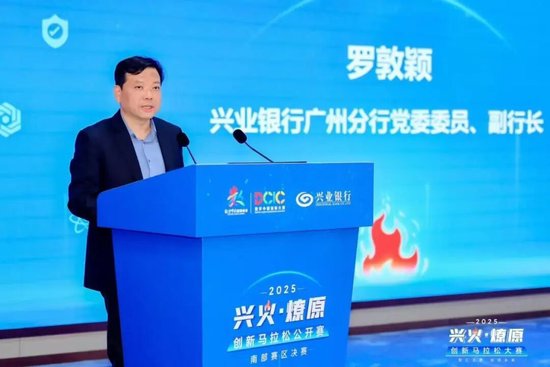
首战捷报!2025年“兴火·燎原”创新马拉松公开赛 南部赛区决赛圆满落幕
Xin Lang Cai Jing· 2026-01-19 03:04
Core Viewpoint - The "Xinghuo·Liaoyuan" Innovation Marathon Finals for the Southern Region successfully concluded in Guangzhou, showcasing the vibrant innovation potential of the South China region through a collaborative effort involving multiple authoritative institutions [1][11]. Group 1: Event Overview - The competition was guided by the Digital China Construction Summit Committee and organized by Industrial Bank in partnership with various organizations, including the China Communications Society and Huawei [1][11]. - The Southern Region finals featured 14 projects that advanced to the final round, highlighting the innovative capabilities in the financial technology and ecological scene sectors [1][11]. Group 2: Institutional Role - Industrial Bank's Guangzhou branch emphasized its commitment to innovation as a core value and development strategy, aiming to discover real value and foster genuine cooperation through the competition [3][13]. - The bank plans to leverage its resources, including technology and market networks, to support promising projects, positioning itself as an "innovation partner" [3][13]. Group 3: Competition Details - A total of 223 projects from regions including Fujian, Guangdong, Guangxi, Hunan, Jiangxi, Hainan, and Hong Kong and Taiwan participated in the selection process [8][17]. - The evaluation panel, consisting of experts from Industrial Bank, Huawei, and other institutions, assessed projects based on innovation, feasibility, and overall value [5][14]. Group 4: Award Winners - The first prize was awarded to the AI self-learning system for financial big data by China Electronics Technology Group Corporation [10][19]. - The second prize went to the "AI Quality Inspection + Trusted Space" project for the textile industry by Xiamen University, and the financial quantum integrated OTN dedicated line system by Fujian Broadcasting Network Group [10][19]. - Additional awards included third prizes and excellence awards for various innovative projects in AI applications, data modeling, and intelligent risk control [10][19].

这个“10万亿”,意味着什么
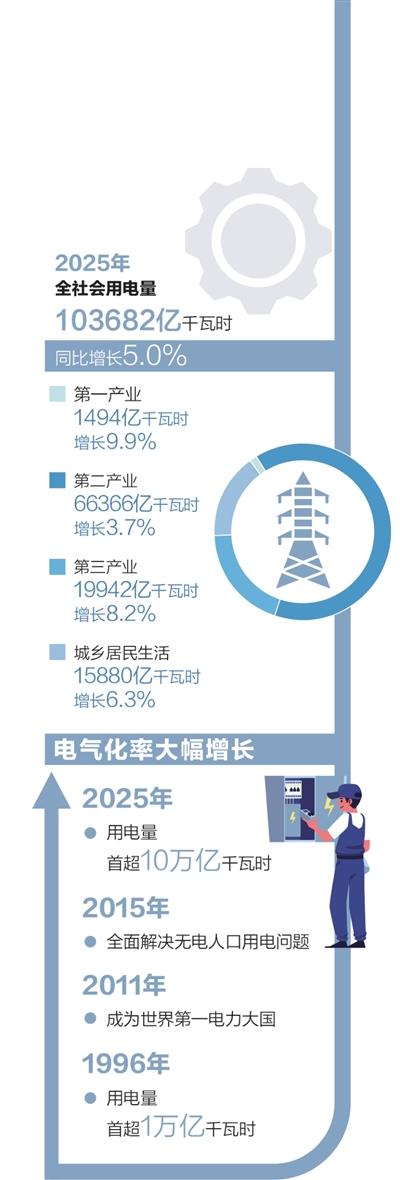
Ren Min Ri Bao· 2026-01-19 02:42
Core Insights - In 2025, China's total electricity consumption will exceed 10 trillion kilowatt-hours for the first time, marking a significant milestone in global energy consumption [2][11] - This consumption level is more than double that of the United States and surpasses the total consumption of the EU, Russia, India, and Japan combined [2] - The growth in electricity consumption reflects China's robust manufacturing capabilities and enhanced energy security [2] Electricity Consumption by Sector - The total electricity consumption in 2025 is projected to be 10,368.2 billion kilowatt-hours, with the primary industry consuming 149.4 billion kilowatt-hours (up 9.9%), the secondary industry 66,366 billion kilowatt-hours (up 3.7%), and the tertiary industry 19,942 billion kilowatt-hours (up 8.2%) [1][3] - The secondary industry remains the largest consumer, accounting for approximately 64% of total consumption, with significant growth in high-value and technology-intensive sectors [3][4] - The tertiary industry is also a key driver of electricity consumption, with notable growth in data centers and information technology services [4] Electrification and Energy Efficiency - The electrification rate of end-use energy is around 30%, which is higher than that of major developed economies, contributing to increased electricity consumption [6][5] - Rural electrification efforts have led to a narrowing gap in electricity consumption between urban and rural residents, supported by significant investments in rural power infrastructure [6][5] Renewable Energy and Power Supply - China has the world's largest power supply system, with renewable energy sources like wind and solar surpassing traditional coal power in installed capacity [8][9] - The country has made substantial investments in clean energy and grid infrastructure, with over 46 ultra-high voltage projects completed to enhance energy distribution [9][10] - The national electricity market has seen a significant increase in trading volume, reflecting a more dynamic and integrated energy market [10] Industry Trends - The shift towards high-end, intelligent, and green development is evident, with new electricity growth points emerging from high-tech manufacturing and renewable energy sectors [4][3] - The demand for electricity in the artificial intelligence sector and data centers is driving substantial increases in consumption, particularly in regions like Zhejiang and Jiangsu [3][4] Conclusion - The anticipated growth in electricity consumption to over 10 trillion kilowatt-hours by 2025 signifies not only an upgrade in power supply capabilities but also a transition towards a more modern and efficient economy [11]