
问界

Search documents
有多少年轻人,被新能源甩晕在通勤路上?
虎嗅APP· 2025-11-02 02:22
以下文章来源于三联电子厂Pro ,作者森赛 三联电子厂Pro . 有限解释车间 本文来自微信公众号: 三联电子厂Pro ,作者:森赛,题图来自:AI生成 在城市里打车,有时候不是在赶路,是在闯一个副本。 社交平台上出现了"新能源晕车互助区",里面的人互相分享经验。有人说自己以前在大巴上都能吃泡 面,现在坐电车打个快车就想下车换人生。也有人试图冷静分析,说自己不是矫情,是三半规管不太 争气,还有人直接把司机当成对手,在心里暗暗祈求大哥,稳点,别带节奏。 即使是老司机,也开始扛不住,有些人开了十几年油车,换到电车后,突然对自己产生怀疑。原来方 向盘握得再稳,也救不了那种突然被推一把的加速。更不用说下班高峰去接小孩,小孩上车第一句话 不是问吃什么,而是说想吐。 越来越多人发现,坐新能源车的快车,容易晕。尤其是那种"加一下、刹一下、再加一下"的通勤路 段,红绿灯像是专门为折磨人设计的节奏点。你坐在后排,本来想趁这十几分钟刷会手机,结果五分 钟后鼻子发酸、胃里翻浪,手机界面开始像梦里一样漂移。 图源:@Amy 有人形容那感觉:脑袋在做点头机,身体像摆在烧烤架上被翻面。车窗外城市一片文明,车窗内灵魂 已经开始躺平。以前晕 ...


10月汽车新势力“黑马”成群
Jing Ji Guan Cha Wang· 2025-11-01 16:21
Core Insights - The Chinese automotive market continues to show strong performance in October, particularly in the new energy vehicle (NEV) segment, indicating a shift in industry dynamics and growth logic [2][6] NEV Market Performance - NEVs are becoming the primary growth driver, with companies like Chery achieving over 110,000 NEV sales, Geely experiencing eight consecutive months of growth, and Great Wall Motors reporting a 44% year-on-year increase [2] - BYD remains the leader with over 440,000 units sold, although its growth momentum has slowed, showing a 12% decline compared to October last year [2][3] New Entrants and Competition - New entrants in the market are gaining traction, with Leap Motor surpassing 70,000 units, Xiaopeng achieving 42,000 units in sales, and NIO returning to growth with a monthly sales figure of 40,000 units [3][4] - The competition among new players has shifted from a focus on technology to one centered on production capacity, distribution channels, and after-sales service [4] Traditional Automakers' Strategies - Traditional automakers are experiencing a clear divide, with Geely and Great Wall Motors showing robust growth through diversified brand strategies and product lines [4][5] - SAIC's Roewe and MG brands have seen a 59% increase in NEV retail sales, but overall sales growth remains modest at 3% [4] Export Growth and Challenges - Exports are emerging as a new growth engine for automakers, with Great Wall's overseas sales reaching 57,000 units, a 28% increase year-on-year [5] - However, the risks associated with localization and profit dilution are significant as companies expand internationally [6] Industry Trends and Future Outlook - The industry is approaching a critical juncture, with NEV penetration nearing 60% and a normalization of price competition leading to declining average gross margins [6][7] - The focus is shifting from rapid growth to quality and operational efficiency, as companies must balance efficiency and profitability to succeed in the evolving market landscape [7]




购置税新规将近,新势力们抢占窗口期
Xin Lang Cai Jing· 2025-11-01 12:16
Core Viewpoint - The new policy regarding the purchase tax for electric vehicles (EVs) in China marks a significant shift, transitioning from full exemption to a 50% reduction starting in 2026, which indicates a gradual reduction in government support for the EV sector after a decade of incentives [1][4]. Policy Changes - The Ministry of Industry and Information Technology, the Ministry of Finance, and the State Taxation Administration announced that from 2026, the purchase tax for EVs will be halved, with a maximum tax reduction of 15,000 yuan per vehicle [1]. - This change signifies the end of the full exemption policy that has been in place since 2014, reflecting a broader trend of decreasing government support for the EV industry [1][4]. Market Performance - In the first nine months of this year, China's retail sales of new energy vehicles grew by 24.4%, with a retail penetration rate reaching 57.8% in September [2]. - The data indicates that the EV industry has crossed the critical threshold of market cultivation and is entering a period of mainstream consumer adoption [4]. Company Strategies - In anticipation of the new tax policy, over ten car manufacturers, including Xiaomi, NIO, and Li Auto, have announced plans to cover the tax difference for customers to retain users during this transition period [4][6]. - Xiaomi has committed to fully covering the tax difference for orders placed by November 30, 2025, if delivery is delayed due to the company’s reasons, with a maximum subsidy of 15,000 yuan [6][7]. Competitive Landscape - The competition among new energy vehicle manufacturers remains intense, with companies like Li Auto and NIO also introducing tax subsidy policies for their new models launched in September [7][8]. - The introduction of tax subsidies for new models is seen as a strategy to maintain competitiveness and build market presence ahead of the upcoming sales season [8][9]. Production and Delivery Challenges - Many manufacturers are facing production ramp-up challenges, particularly for new models launched recently, which necessitates the implementation of tax subsidies to secure customer orders [9][10]. - Companies like Xiaomi are experiencing long delivery times, with some customers needing to wait until 2026 for their vehicles, prompting the need for subsidies to alleviate customer concerns about increased costs [9][10]. Future Outlook - As the policy support diminishes, new energy vehicle manufacturers will need to enhance their competitiveness through core technology, product excellence, and efficient cost control to thrive in the evolving market landscape [13][14]. - The industry is expected to shift from being policy-driven to market-driven, with a focus on technological innovation and service quality becoming critical for long-term success [13][16].



新能源车购置税减半征收落地在即 小米、理想等车企发布补贴方案
Zhong Guo Jing Ying Bao· 2025-10-31 20:54
Core Viewpoint - The article discusses the recent trend of automotive companies in China, such as Xiaomi, Li Auto, and NIO, launching subsidy plans to mitigate the impact of the upcoming reduction in the new energy vehicle (NEV) purchase tax, which is set to be halved in 2026. This strategy aims to secure consumer demand and stabilize cash flow amid changing policies and production challenges [3][4][5]. Group 1: Policy Changes and Industry Response - The NEV purchase tax exemption will continue until 2027, but the reduction will gradually adjust, with a full exemption until 2025 and a 50% reduction from 2026 [3][4]. - Automotive companies are implementing "purchase tax subsidy" plans to lock in orders before the tax changes take effect, with the aim of stabilizing production and cash flow [4][5]. - The Chinese automotive market is expected to see significant growth, with predictions of a 7% year-on-year increase in retail sales, reaching 24.5 million units in 2023 [3][11]. Group 2: Company Strategies and Market Dynamics - Companies like Xiaomi and Li Auto are offering subsidies that cover the purchase tax for vehicles ordered by the end of 2025, which will be delivered in 2026, effectively allowing consumers to benefit from the current tax exemption [5][6]. - The push for these subsidy plans is linked to the need for companies to manage production ramp-up and long delivery times, as well as to counteract potential consumer hesitation due to increased costs from the tax changes [7][8]. - The fourth quarter is traditionally a peak sales period, and companies are intensifying promotional efforts to meet annual sales targets, with expectations of increased market activity [9][10]. Group 3: Market Performance and Future Outlook - In the first nine months of 2023, the automotive industry in China saw production and sales growth of 13.3% and 12.9%, respectively, with NEV sales reaching 46.1% of total new car sales [11][12]. - The industry aims for a total vehicle sales target of approximately 32.3 million units in 2025, with NEV sales projected to reach around 1.55 million units, reflecting a 20% year-on-year increase [11]. - The introduction of stricter technical requirements for NEVs is expected to drive companies to accelerate promotions and clear out lower-range inventory in anticipation of the new regulations [10].
技术破局者零跑汽车D19如何重塑高端市场格局?
Zhi Tong Cai Jing· 2025-10-31 10:41
Core Insights - Leap Motor officially launched its flagship D platform and the D19 SUV, marking its entry into the high-end market priced at 300,000 CNY [1] - The D19 features groundbreaking technology and pricing strategies, initiating a new wave of "technological equality" in the electric vehicle market [1] - The vehicle is equipped with multiple industry-first technologies, including an 80.3 kWh battery for over 500 km range and a 115 kWh battery for over 700 km range [1][2] Product Features - The D19 is a six-seat luxury family SUV with a length of 5.25 meters and a wheelbase exceeding 3.1 meters, emphasizing spaciousness [2] - It incorporates advanced intelligent features, including a dual Qualcomm SA8797 chip with 1280 TOPS computing power and a 14.6-inch 2K display [2] - The vehicle's pricing is significantly lower than competitors, with a pre-sale range of 250,000 to 300,000 CNY, making it a "cost-performance king" [2] Market Impact - The launch of the D19 has boosted investor confidence, with significant stock purchases by company founders, leading to a 6.19% increase in stock price [3] - Citic Lyon maintains a "outperform" rating for Leap Motor, with a target price of 80 HKD, suggesting that the D19 could enhance the company's brand value and profitability recognition [3] - Leap Motor has delivered nearly 400,000 vehicles in the first three quarters of 2025, maintaining its position as a leader among new energy vehicle manufacturers [3]

技术破局者零跑汽车(09863)D19如何重塑高端市场格局?
智通财经网· 2025-10-31 10:38
Core Insights - Leap Motor officially launched its flagship D platform and the D19 SUV, marking its entry into the high-end market priced at 300,000 CNY [1][2] - The D19 features groundbreaking technology and pricing strategies, initiating a "technology equality" movement in the new energy vehicle market [1][2] Product Features - The D19 is equipped with multiple industry-first technologies, including an 80.3 kWh battery for the range-extended version, achieving over 500 km of pure electric range under CLTC conditions [1] - The pure electric version utilizes a 115 kWh battery pack with 800V fast charging capabilities, allowing 30%-80% charging in just 15 minutes and a range exceeding 700 km [1][2] - The D19 is positioned as a luxury family SUV with a length of 5.25 meters and a wheelbase over 3.1 meters, emphasizing spaciousness [2] Competitive Positioning - The D19 directly competes with mainstream high-end new energy SUVs like Li Auto L9 and AITO M9, but is priced 150,000 CNY lower, making it a "cost-performance king" [2] - Leap Motor's founder emphasized that the D series is not a luxury car but a high-end series, adhering to the principle of "good but not expensive" [2] Market Impact - The launch of the D19 has significantly boosted investor confidence, with key stakeholders increasing their holdings in the company [3] - Following the announcement, Leap Motor's stock price rose by 6.19%, closing at 59.15 HKD [3] - Citic Lyon maintained a "outperform" rating for Leap Motor, setting a target price of 80 HKD, suggesting that the D19 could help resolve the company's "high growth, low valuation" dilemma [3]
车企纷纷“兜底”抢客 跨年交付最高补贴1.5万元
Mei Ri Shang Bao· 2025-10-29 23:50
Core Viewpoint - The impending reduction of the new energy vehicle (NEV) purchase tax is prompting consumers to consider whether now is a good time to buy a vehicle, as various automakers introduce "tax coverage" policies to alleviate consumer concerns about future costs [1][2][3]. Group 1: Policy Changes and Impacts - The purchase tax exemption for NEVs will end in 2025, with a new policy reducing the tax by half from 2026 to 2027, significantly affecting the cost of purchasing vehicles [1]. - For a vehicle priced at 300,000 yuan, the tax savings in 2025 would be approximately 26,500 yuan, while in 2026, consumers would need to pay 13,000 yuan in taxes, highlighting a substantial cost difference [1]. Group 2: Automaker Strategies - Automakers like NIO, Li Auto, Xiaomi, and others are implementing "tax coverage" policies to assure consumers that they will cover the tax difference for vehicles ordered this year but delivered next year [2]. - Various brands are offering cash subsidies or reductions in final payments to offset the tax burden for consumers who place orders before specific deadlines [2]. Group 3: Consumer Considerations - Industry experts suggest that while the current period may be seen as a "high cost-performance purchase window," consumers should carefully assess their actual needs and consider vehicles that meet the stricter 2026 technical requirements to avoid potential policy risks [3]. - Consumers are advised to prioritize purchasing pure electric vehicles with a range of over 100 km and lower energy consumption to mitigate the impact of future policy changes on their vehicle experience and resale value [3]. Group 4: Market Dynamics - The introduction of tax coverage policies by automakers is not only aimed at easing consumer burdens but also serves to boost sales during the traditional peak season for automotive consumption [3]. - The Chinese automotive market is experiencing a surge in demand, with a reported 35.4% increase in customer traffic and a 13% rise in order volume in early October [3]. Group 5: Industry Evolution - The narrowing of purchase tax benefits signifies the end of the policy support phase for the NEV industry, transitioning into a new stage of market competition where automakers must rely on product quality, technological advancements, and service experience to succeed [5].
新能源购置税退坡倒计时 车企“自掏腰包”兜底政策汇总
Zhong Guo Zhi Liang Xin Wen Wang· 2025-10-29 05:23
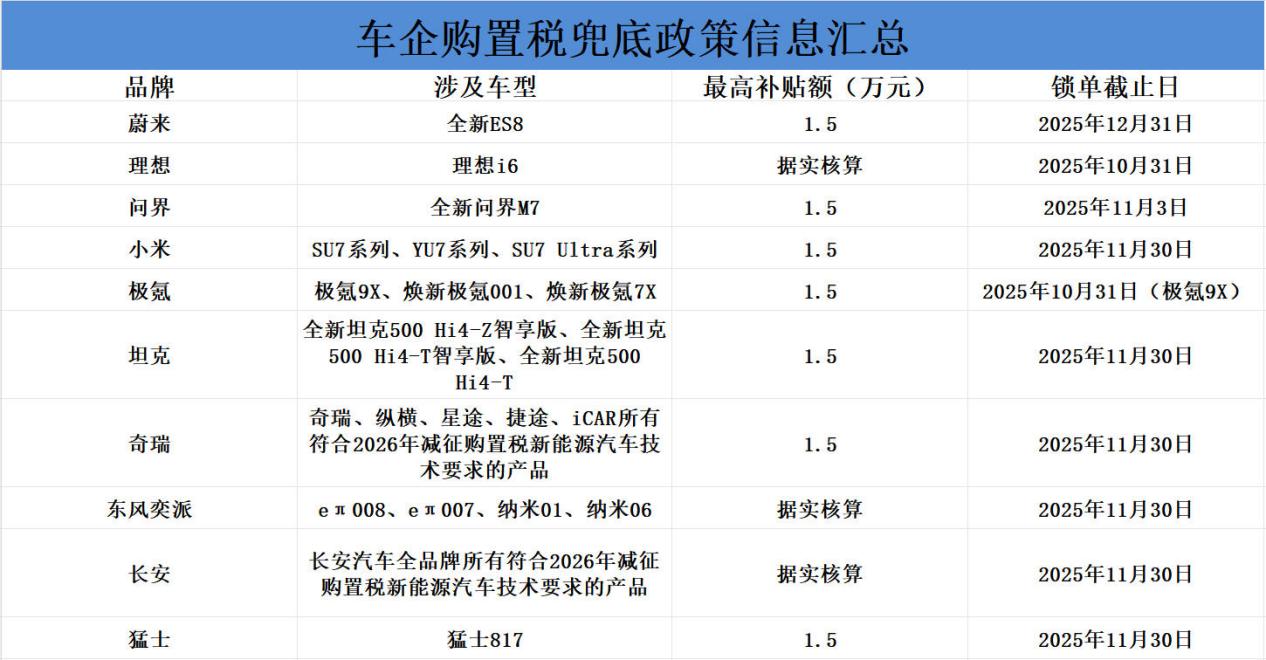
Core Viewpoint - The exemption policy for new energy vehicle purchase tax will end on December 31, 2025, transitioning to a half-tax collection starting January 1, 2026, prompting various automakers to implement "bottom-line" subsidy policies to attract orders before the policy change [1] Summary by Category Automaker Subsidy Policies - NIO offers a subsidy of up to 15,000 yuan for orders of the new ES8 locked by December 31, 2025, ensuring customers are not burdened by tax changes if delivery occurs in 2026 [4] - Li Auto's i6 model provides a tax subsidy based on actual calculations for orders locked by October 31, 2025, with cash reductions on final payments to cover tax differences [6] - Aito's new M7 model offers a similar subsidy structure, with a maximum of 15,000 yuan for orders locked by November 3, 2025 [6] - Xiaomi's SU7 series and others provide a subsidy of up to 15,000 yuan for orders locked by November 30, 2025 [8] - Zeekr offers a tax subsidy for orders of the 9X model locked by October 31, 2025, with a maximum of 15,000 yuan [8] - Tank SUV's new models provide a subsidy for orders locked by November 30, 2025, ensuring customers are covered if delivery is delayed to 2026 [9] - Chery announces a subsidy for all eligible models if orders are locked by November 30, 2025, covering tax differences for delayed deliveries [11] - Dongfeng Yipai offers cash subsidies for orders locked by November 30, 2025, applicable to specific models [13] - Changan announces a subsidy for all eligible models with orders locked by November 30, 2025 [13] - Haval's M817 model provides a subsidy for orders locked by November 30, 2025, with a maximum of 15,000 yuan [15] Market Dynamics and Implications - The impending tax policy change has triggered automakers to adopt subsidy policies to mitigate the risk of losing customers who may delay purchases due to increased costs [16] - The long delivery cycles for popular new energy vehicles exacerbate the issue, leading to potential order losses if customers face tax liabilities due to delayed deliveries [16] - The subsidy policies are not merely promotional tactics but are seen as trust-building contracts between brands and consumers, enhancing brand loyalty and competitive advantage in a rationalizing market [16] - Companies that prioritize customer interests through these policies are likely to gain a competitive edge in the evolving market landscape [16]
电车购置税补贴减半在即,这场兜底之战谁敢不打?
3 6 Ke· 2025-10-29 02:04
Core Viewpoint - The Chinese government will reduce the purchase tax exemption for new energy vehicles from full exemption to a 50% reduction starting January 1, 2026, increasing the cost for consumers by 15,000 yuan per vehicle [1] Group 1: Policy Changes - From 2026 to 2027, the purchase tax for new energy vehicles will be halved, impacting consumer costs significantly [1] - Various car manufacturers are introducing tax subsidy programs to mitigate the impact of the upcoming tax changes for consumers who place orders before the deadline [3][5] Group 2: Manufacturer Responses - Xiaomi, Li Auto, NIO, and other brands have announced cross-year purchase tax subsidy plans to ensure that customers do not incur additional costs due to policy changes [3][5] - NIO's new ES8 offers a purchase tax subsidy coupon for orders placed by December 31, 2025, to offset potential tax increases for delayed deliveries [5] Group 3: Market Dynamics - The competition among car manufacturers has intensified, leading to a "bottom-line battle" as they seek to secure orders before the tax changes take effect [2][12] - The market is experiencing a surge in demand, with a 35.4% increase in customer engagement in October compared to September, driven by the impending tax changes and other subsidies [10] Group 4: Consumer Behavior - Consumers are adjusting their purchasing decisions in light of the upcoming tax changes, leading to potential order cancellations if they perceive better options elsewhere [8][10] - The anxiety among consumers regarding tax changes is being addressed by manufacturers through various subsidy offers, aiming to maintain order volumes [8][12]

碳酸锂:现货招投标高位,偏强运行
Guo Tai Jun An Qi Huo· 2025-10-29 01:46
Group 1: Report Industry Investment Rating - The report indicates that the trend strength of lithium carbonate is 1, suggesting a "moderately strong" outlook [4]. Group 2: Core Viewpoints of the Report - The lithium carbonate market is in a state of high - level spot bidding and is expected to run strongly [1]. Group 3: Summary by Relevant Catalogs 1. Fundamental Tracking - **Futures Contracts**: For the 2511 contract, the closing price was 80,800, with a change of - 320 compared to T - 1. The trading volume was 64,993, down 4,495 from T - 1, and the open interest was 36,653, a decrease of 12,932 from T - 1. For the 2601 contract, the closing price was 81,640, down 260 from T - 1. The trading volume was 729,307, an increase of 214,852 from T - 1, and the open interest was 488,803, up 5,325 from T - 1 [1]. - **Warehouse Receipts**: The warehouse receipt volume was 27,335, a decrease of 404 from T - 1 [1]. - **Basis**: The basis of spot - 2511 was - 2,300, and that of spot - 2601 was - 3,140. The basis of 2511 - 2601 was - 840 [1]. - **Raw Materials**: The price of lithium spodumene concentrate (6%, CIF China) was 925, up 19 from T - 1. The price of lithium mica (2.0% - 2.5%) was 2,065, up 75 from T - 1 [1]. - **Lithium Salts**: The price of battery - grade lithium carbonate was 78,500, up 1,950 from T - 1. The price of industrial - grade lithium carbonate was 76,300, up 2,000 from T - 1 [1]. 2. Macroeconomic and Industry News - **Price Information**: The SMM battery - grade lithium carbonate index price was 78,553 yuan/ton, a daily increase of 1,958 yuan/ton. The average price of battery - grade lithium carbonate was 78,500 yuan/ton, up 1,950 yuan/ton from the previous workday, and the average price of industrial - grade lithium carbonate was 76,300 yuan/ton, up 2,000 yuan/ton [2]. - **Automobile Industry**: Chery Automobile announced a purchase tax subsidy plan, and currently, 10 brands have announced similar plans [2][4]. - **Mining Rights**: A subsidiary of Dazhong Mining Co., Ltd. obtained a 30 - year mining license for the Hunan Jijiaoshan lithium mine, with an annual production capacity of 80,000 tons of lithium carbonate [4].