
TCL电子

Search documents
年终盘点|2025年全球彩电市场微跌,中国双雄进一步逼近三星
Di Yi Cai Jing· 2025-12-28 02:36
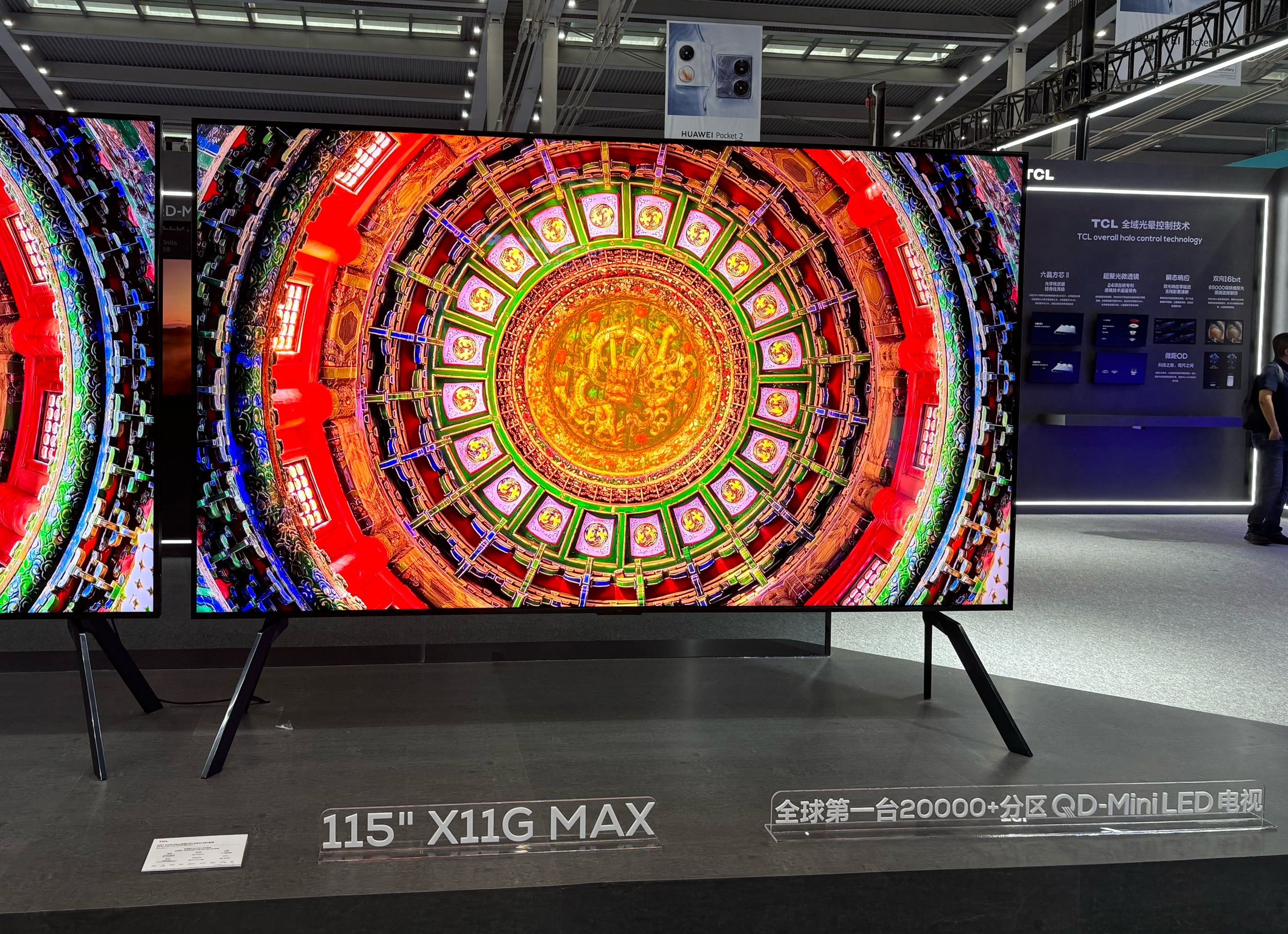
Core Insights - The market share gap between TCL, Hisense, and Samsung in the global TV market has narrowed to 2.2 and 2.7 percentage points respectively [1] Group 1: Market Trends - Despite a slight decline in overall global TV sales, leading Chinese companies are gaining market share, with TCL and Hisense approaching Samsung's dominance [4] - Global TV shipment volume is projected to decrease by 0.7% to 221 million units in 2025, while TCL's shipments are expected to grow by 5.4% to 30.41 million units, increasing its market share to 13.8% [4] - Hisense is projected to ship 29.26 million units in 2025, a 1.4% increase, raising its market share to 13.3% [4] Group 2: Mini LED Opportunity - The global TV market is under pressure, but there is significant growth potential in Mini LED TVs, with shipments expected to rise by 57.8% to 12.39 million units globally in 2025 [5] - In China, Mini LED TV shipments are projected to surge by 92.7% to 8.02 million units, capturing a market share of 23.9% [5] - TCL and Hisense are capitalizing on this opportunity, with TCL's Mini LED TV shipments increasing by 153.3% to 2.24 million units in the first three quarters of the year [6] Group 3: Competitive Landscape - Samsung's global TV shipment volume is expected to remain stable at 35.27 million units in 2025, with a slight market share increase of 0.1% to 16% [6] - The competitive advantage of Samsung over Chinese brands is diminishing, as Hisense is set to launch RGB-Mini LED TVs, prompting responses from Samsung and Sony [6] - Chinese brands are increasingly challenging the dominance of Korean brands in the high-end TV market, particularly with the rise of Mini LED technology [6] Group 4: Supply Chain and Market Expansion - Changing tariff policies are impacting manufacturing bases in China and Southeast Asia, affecting retail prices and consumer demand [7] - TCL and Hisense are expanding their market presence in North America and Europe while leveraging production capabilities in Vietnam, Brazil, and Mexico to mitigate tariff impacts [7] - Hisense is enhancing its localized operations and expanding production capacity in Vietnam to target Southeast Asia and the EU markets [8] Group 5: Brand Performance - Chinese brands like TCL, Hisense, Xiaomi, and others are gaining market share, while Japanese brands like LG and Sony are experiencing declines [9] - TCL and Hisense are positioned to challenge for the top global TV sales spot within three years, driven by technological advancements and market strategies [11] - The upcoming 2026 sports events, including the World Cup and Winter Olympics, are expected to boost TV demand, with TCL and Hisense sponsoring these events [10]

家电行业周报20251227:错期影响下空调1月排产反弹,冰冷新兴地区贡献增长-20251227
SINOLINK SECURITIES· 2025-12-27 11:13
Investment Rating - The report maintains a "Buy" rating for the home appliance industry, expecting a price increase exceeding 15% over the next 3-6 months compared to the market [42]. Core Insights - The report highlights a rebound in air conditioner production in January 2026 due to a shift in production schedules, although end-user demand is expected to remain weak. Home air conditioner domestic production reached 7.86 million units, up 8.9% year-on-year, while export production was 10.65 million units, up 1.2% year-on-year [13][14]. - Refrigerator production showed a decline in both domestic and export markets, with domestic production at 3.52 million units, down 6.9% year-on-year, and export production at 4.4 million units, down 3.4% year-on-year. The market is experiencing regional differentiation, with emerging markets being the main growth points [16]. - Washing machine production also faced challenges, with domestic production at 3.65 million units, down 4.1% year-on-year, and export production at 4.45 million units, down 0.7% year-on-year. The "trade-in" policy's effectiveness is diminishing, and companies need to innovate to find breakthroughs [17]. Market and Sector Performance - The Shanghai and Shenzhen 300 Index increased by 1.95%, while the home appliance index rose by 0.54%. Notable stock performances included Feike Electric (+24.57%), Jinhai High-Tech (+22.57%), and Tianyin Electromechanical (+17.91%) [20]. - The report tracks raw material prices, noting a 2.62% increase in copper prices and a 1.16% increase in aluminum prices, while cold-rolled steel and plastic prices saw slight declines [24]. - The exchange rate for USD to RMB was reported at 7.04, with a slight decrease of 0.02% week-on-week, and container shipping rates showed a small increase of 1.95% [27]. Real Estate Data - Real estate data for November 2025 indicates a significant decline in new construction, with a year-on-year decrease of 20% in new starts, 10% in construction, and 20.2% in completions. Sales also fell by 8.9% year-on-year, indicating ongoing pressure on the home appliance sector's long-term demand [31][32]. Investment Recommendations - The report suggests that leading brands are likely to achieve stable growth due to their integrated advantages and strong pricing power. The external market is expected to benefit from a potential recovery in the U.S. housing market and gradual improvement in European consumption. Emerging markets are anticipated to maintain strong demand due to demographic advantages [40]. Recommended companies include Hisense, Midea Group, Haier, and TCL Electronics [40].



家电行业专题研究:拥抱龙头,重视出海
Xin Lang Cai Jing· 2025-12-26 12:24
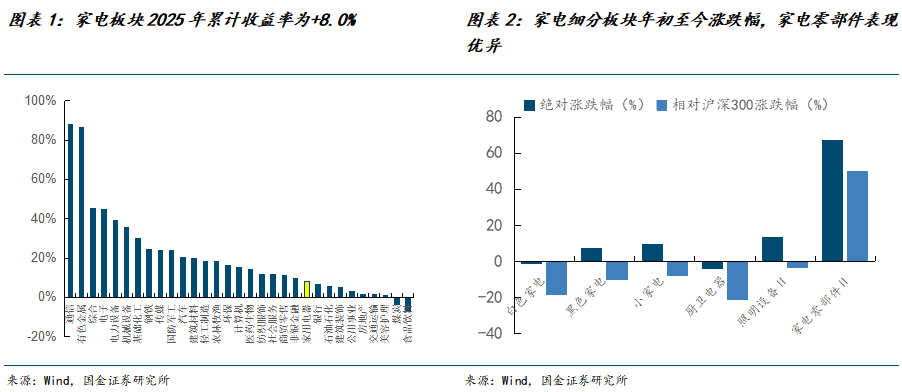
Group 1: Domestic Demand and Market Outlook - The home appliance sector is expected to show a "high first half and stable second half" trend in 2025, driven by policy continuation and consumption peaks [1] - In the first three quarters of 2025, air conditioner shipments increased by 8.4%, refrigerators by 2.4%, and washing machines by 4.1% year-on-year [1][13] - For 2026, the continuation of subsidies is anticipated to mitigate the impact of high base effects and demand pull-forward, with projected declines in overall appliance sales of -4% to -7.3% under various subsidy scenarios [1][16][19] Group 2: Export Performance and Global Market Trends - Home appliance exports have slowed down due to tariff policies and global supply chain adjustments, but still show resilience and structural highlights [2] - In 2025, the export growth rate for air conditioners is expected to be weaker than that of washing machines and refrigerators, primarily due to adverse weather conditions affecting overseas demand [2][39] - The U.S. market is projected to benefit from a rate cut, which may enhance demand for home appliances, while the European market is expected to maintain a slow recovery [42][44][50] Group 3: Investment Themes - The narrative in the black appliance sector is shifting from "market share chasing" to "profit and pricing power," with Chinese brands like Hisense and TCL expected to convert market share into higher profits [3][55] - White appliances are seen as having strong growth potential due to their historical resilience through cycles, with leading brands like Midea and Haier expected to maintain stable growth and generous dividends [3][83] - The global competition in new consumer products, particularly in smart imaging and robotic vacuum cleaners, is expected to favor Chinese brands, highlighting their competitive advantages [3] Group 4: Financial Metrics and Valuation - As of December 22, 2025, the home appliance sector's PE TTM is 16.27 times, remaining below the 10-year average of 32.8% [7] - The white appliance segment's current PE is 11.22, while black appliances stand at 25.94, indicating varying levels of market valuation [9] - The home appliance sector has seen a decline in public fund holdings, with a heavy allocation of only 2.46% in Q3 2025, reflecting concerns over demand in 2026 [9]

国金证券:家电行业内需趋稳 投资聚焦三大主线
智通财经网· 2025-12-26 02:13
Core Viewpoint - The report from Guojin Securities indicates that the home appliance industry will experience a "front high and back stable" trend in domestic demand by 2025, with a focus on volume growth in white goods and structural upgrades in black goods [1][2]. Domestic Demand - In 2025, the home appliance market is expected to show a "front high and back stable" trend driven by policy continuation and seasonal consumption [2]. - For white goods, volume growth is the main focus, with air conditioning performing better than refrigerators and washing machines in the first three quarters of 2025. The shipment growth rates for air conditioners, refrigerators, and washing machines are projected at +8.4%, +2.4%, and +4.1% year-on-year respectively [2]. - Black goods are expected to continue structural upgrades, with Mini LED penetration reaching 33% in Q2 2025, more than doubling year-on-year. Despite a decline in growth due to subsidy reductions in Q3, Mini LED penetration remains high at 28.3% [2]. - For 2026, the continuation of national subsidies may help mitigate pressures from high baselines and overspending. The report estimates potential declines in the overall home appliance market under different subsidy scenarios, with expected declines of -4%, -5.7%, and -7.3% for "same scale subsidy," "half scale," and "no subsidy" respectively [2]. External Demand - From early 2025, home appliance export growth has slowed due to tariff policies and global supply chain adjustments, but it still shows resilience and structural highlights [3]. - The export performance of refrigerators and washing machines is better than that of air conditioners, influenced by weather factors and a high baseline from 2024 [3]. - Black goods have shown resilience, with a notable recovery in TV exports since July 2025, attributed to easing tariffs and replenishment in overseas channels [3]. - The global home appliance demand is expected to remain relatively stable in 2025, with various regional outlooks indicating neutral to negative sentiments [3]. Investment Themes - Investment Theme 1: The global narrative for black goods is shifting from "market share pursuit" to "profit and pricing power." Chinese companies are expected to leverage their integrated supply chain advantages to convert market share into profits, with recommendations for Hisense and TCL [4]. - Investment Theme 2: White goods maintain growth potential due to their historical resilience through cycles, with strong cash flow and high dividend willingness. Recommended companies include Midea Group and Haier Smart Home [4]. - Investment Theme 3: The emerging consumption sector shows significant global competitiveness, particularly in smart imaging and robotic vacuum markets, with recommendations for companies like Roborock and Ecovacs [4].

首席联合电话会-消费专场
2025-12-26 02:12
Summary of Conference Call Records Industry and Company Focus Home Appliances Industry - The tightening of national subsidy policies is focusing on core categories such as black and white appliances, which supports companies like Midea, Haier, TCL Electronics, and Hisense Visual. However, competition remains fierce for brands like Hisense Home Appliances and Gree Electric, with better investment opportunities expected after Q1 [1][4] Pet Industry - The pet industry continues to experience high single-digit growth, with pet food growth around 10%. Online channels, particularly Douyin and Pinduoduo, are seeing significant growth, while offline channels face pressure. The industry is expected to add approximately 4 million new pet owners in 2025, driving demand [5][6] - Head brands are growing significantly faster than the industry average, while smaller brands are struggling, often focusing on offline channels to maintain profitability. The trend is increasingly favoring market concentration towards head brands [6] Education Industry - China Oriental Education is benefiting from post-pandemic expansion and a national focus on employment, with double-digit growth in enrollment numbers. The company specializes in vocational education with a high employment rate, which provides a competitive advantage. New training programs are rapidly growing, and the company is expanding into emerging fields [8][10] Pharmaceutical Industry - The pharmaceutical industry is focusing on the small nucleic acid supply chain, with Novartis's Inqisiran entering medical insurance but facing capacity shortages. Companies that meet FDA audit standards and enter multinational supply chains, such as Lianhua Technology and Chen Da Pharmaceutical, are recommended for attention [11] Food and Beverage Industry - The food and beverage industry is seeing trends towards spring excitement, health directions, new products, and cyclical growth. Health products and oatmeal sectors are performing well, with companies like Dongpeng Beverage expected to grow over 20% next year [12][13] Light Industry - The light industry is adopting a dual strategy focusing on both domestic and international sales. The two-wheeler market is performing well, and solid-state batteries may drive growth in the electric vehicle sector. The industry is expected to have a positive outlook in the near future [14] Key Points and Arguments Home Appliances - The 2026 home appliance replacement policy will focus more on traditional large appliances, reducing the variety of small appliances eligible for subsidies. The overall subsidy amount may decrease, but support for core categories is expected to remain stable or even increase [2] Pet Industry - The pet industry is facing a bottleneck in product innovation, with most developments being minor improvements. There is a consensus on the need for functional and specialized products, requiring more investment in consumer education and brand building [5][6][7] Education Industry - The company expects to achieve a revenue of 1 billion yuan in 2026, with a projected compound profit growth rate of 15%-20% over the next three years. The current valuation is low, with a high dividend rate, making it a recommended investment target [9][10] Pharmaceutical Industry - The small nucleic acid supply chain is critical, with China being the largest production market. The industry faces challenges in meeting quality standards for FDA compliance, making it essential to focus on companies that can meet these standards [11] Food and Beverage Industry - Companies with strong operational momentum are expected to perform well, and the white liquor sector is seen as having good investment value [12][13] Light Industry - The light industry is expected to see sales growth due to inventory levels being low and potential technological effects in the upcoming quarters [14][15] Globalization and Export Markets - The export market is influenced by the appreciation of the RMB and pessimistic expectations regarding the US real estate market. However, long-term focus should be on new product development and self-owned brands [17][18] Pulp Industry - The pulp sector is expected to have significant elasticity in the first half of next year due to external factors affecting wood chip supply and no new capacity expansion, leading to potential price increases [19][20]
为何家电巨头都做起了「AI眼镜」?
Hua Er Jie Jian Wen· 2025-12-26 01:55
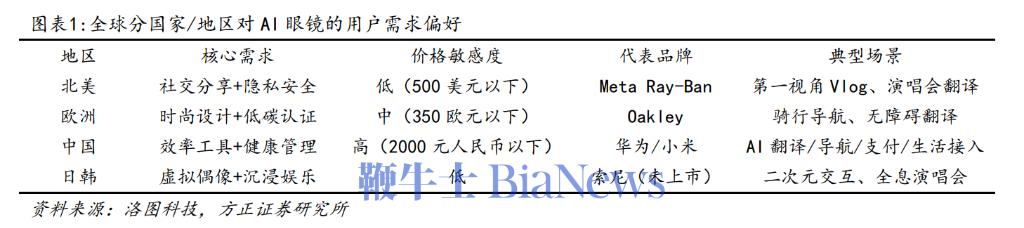
Core Insights - The article discusses the strategic entry of home appliance giants into the AI glasses market, leveraging their expertise in display technology, supply chain, and precision manufacturing to tap into a potential market worth hundreds of billions [1][29] - The demand for AI glasses is driven by consumer needs in mature markets seeking emotional value and developing markets focusing on productivity and tools, with AI+AR glasses serving as an ideal carrier for AI technology [1][29] Market Potential - The global annual sales of traditional glasses are approximately 2.3 billion pairs, with 1.45 billion pairs excluding sunglasses. If AI glasses penetrate 10% of the remaining 1.45 billion pairs, the expected global shipment could reach 145 million pairs, resulting in a market size exceeding 100 billion RMB [1][9][29] - The retail market for traditional glasses in China is significant, with a projected retail value of 128.3 billion RMB by 2029, driven by increasing demand for functional lenses [9] Technological Advancements - AI glasses are rapidly evolving, with advancements in hardware miniaturization, AI-driven interaction upgrades, ecosystem integration, and social features related to the metaverse [2][30] - Key components of AI glasses include optical display modules (35%-45%), main AI chips (20%-30%), and sensors and batteries (15%), with the remaining costs attributed to structural components and software [2][30] Industry Dynamics - Major players in the AI glasses market include TCL Electronics, Hisense, and Biyi Co., each leveraging their strengths in brand, manufacturing, and optical technology [3][4][31] - TCL Electronics has invested in Thunder Innovation, focusing on self-developed optical modules, while Hisense has launched its own AI glasses and partnered with XREAL for technology integration [3][4][31] - Biyi Co. has strategically invested in Shanghai Lihui Optoelectronics to enhance its AR glasses assembly capabilities, aiming to leverage its home appliance manufacturing expertise [23][31] Competitive Landscape - The AI glasses industry is characterized by rapid product iteration, with a focus on optical, chip, and operating system ecosystems as high-value segments [2][30] - Companies with established operating system ecosystems are expected to capture significant system value, similar to the smartphone industry's evolution where Apple and Google dominate through their OS platforms [16][30] Future Outlook - The future of AI glasses includes the potential for holographic AR products, with expectations for significant growth in shipments and market size driven by technological breakthroughs [2][30] - The integration of AI capabilities into glasses is anticipated to enhance user experience through features like real-time scene understanding and personalized content delivery [13][30]
可选消费行业2026年度策略:新的消费观,新的格局
Huafu Securities· 2025-12-25 11:23
Core Insights - The report maintains a strong market rating for the home appliance sector, emphasizing the shift in consumer behavior towards a more present-focused consumption mindset, driven by the new generation of consumers [1] - The report highlights the expected leadership of the new consumption sector in 2025, while traditional consumption sectors are anticipated to show lackluster performance [4] Macro Consumption Trends - The report notes a significant transformation in consumer attitudes, moving from a culture of saving to one of cautious spending and living in the moment, which is expected to create new investment opportunities [4][11] - It identifies a structural opportunity in consumption, with the main drivers shifting from broad-based recovery to specific demographic groups, particularly the elderly and single-person households [32] Global Economic Landscape - The report emphasizes the importance of global emerging markets, suggesting that Chinese companies are well-positioned to lead in new product categories with significant growth potential [4] - It points out that the export structure is evolving towards innovation-driven categories, enhancing resilience against geopolitical risks [4] Domestic Consumption Dynamics - The report indicates that domestic consumption is entering a phase of refinement, with strong companies benefiting from the changing consumption landscape [4] - It highlights the ongoing growth in the pet economy and health supplements, suggesting that companies with e-commerce capabilities will be favored [4] Export Opportunities - The report discusses the resilience of exports, noting a shift from reliance on developed markets to emerging markets, with significant growth in exports to countries like India and Indonesia [49] - It highlights the importance of diversifying export markets and supporting new business models such as cross-border e-commerce [49] Sector-Specific Insights - The report identifies specific sectors poised for growth, including cleaning appliances, which are expected to benefit from government subsidies and increasing consumer demand [53] - It suggests that the pet economy and health products will continue to thrive, driven by changing consumer preferences and increased awareness [4] Consumer Income and Spending - The report notes that while income growth is stabilizing across different income groups, the spending power of high-income households is expected to drive consumption growth [35] - It emphasizes the importance of asset conditions, particularly housing, in influencing consumer behavior and spending patterns [35] Rural Consumption Potential - The report highlights the growing consumption potential in rural areas, where income growth is outpacing urban areas, suggesting a shift in focus towards rural markets [39] - It notes that rural high-income groups are likely to lead in spending on services, healthcare, and entertainment [39]
2026港股科技投资图谱:从算力到终端 四大AI主线引领结构性行情
智通财经网· 2025-12-24 08:21
Core Viewpoint - The report from Everbright Securities indicates that the Hong Kong stock market is expected to experience a "Davis Double Play" in 2026, driven by valuation recovery, profit growth, and a return to main themes, particularly in the TMT sector [1] Group 1: Investment Strategy - The report establishes a framework of "Four AI Main Lines" to help investors navigate opportunities in the Hong Kong tech sector during the AI era [1] - It suggests a strategic investment rhythm of "computing power foundation → application blossoming → terminal and robotics realization" to select leading companies under each main line [1] Group 2: Main Line One - Internet Giants - AI is driving internet giants to shift from traffic competition to ecosystem capability competition, with cloud business capital expenditure doubling and advertising click-through rates increasing by 15%-20% due to AI [2] - Key investment focuses include Tencent Holdings, Alibaba-W, and Kuaishou, which are positioned to leverage AI for ecosystem development [2] Group 3: Main Line Two - AI Computing Power Industry Chain - Leading companies continue to exceed earnings expectations, with strong capital expenditure from cloud vendors and tight chip supply countering "bubble theories" [3] - The report identifies three areas of certainty: communication networking benefiting from global tech upgrades, semiconductor manufacturing for domestic substitution, and key equipment and materials for computing power upgrades [3] Group 4: Main Line Three - AI Applications - AI application investments are entering a phase where performance is critical, with clear signals of commercialization acceleration in SaaS, content ecosystems, and advertising [4] - The evolution of enterprise tools into "intelligent agents" is driving ARPU growth, while programmatic advertising is beginning to release profits [4] Group 5: Main Line Four - AI Hardware and Robotics - 2026 is projected to be a pivotal year for AI-defined hardware and the mass production of robots [5] - Major hardware manufacturers like Apple and Xiaomi are enhancing AI capabilities, while global tech giants are entering hardware sectors, revealing investment opportunities across the robotics supply chain [5] Group 6: Specific Investment Targets - Sunny Optical Technology: A global leader in mobile and automotive optics, with growth driven by increased project shares and rapid growth in automotive lenses/modules [6] - Lenovo Group: Holds the largest share in AIPC, with valuation catalysts pending from server business profitability and AIPC demand [6] - AAC Technologies: A platform company in acoustics, optics, and motors, with growth linked to A customer strategies and AI edge [7] - BYD Electronics: A leader in precision manufacturing, with growth contingent on Apple business performance and new automotive products [7] - Xiaomi Group: The "people-car-home + AI" strategy opens long-term growth potential, though short-term challenges exist [7]



TCL电子获年度投资价值奖:透视公司的创新引擎与长期价值
Sou Hu Cai Jing· 2025-12-23 13:22
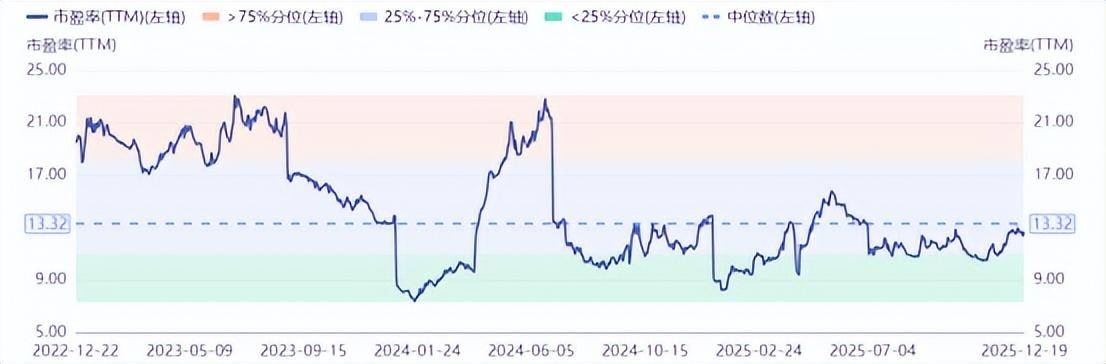
Core Insights - TCL Electronics has been awarded the "Annual Investment Value Award" and "Annual Outstanding IR Team" at the 2026 Gelonghui "Golden Award" annual selection, recognizing its achievements in display technology innovation, global expansion, and business innovation [1] Group 1: Technological Leadership and Innovation Breakthroughs - The television industry, previously seen as a slow-growth sector, has entered a new product upgrade cycle driven by TCL's Mini LED technology [3] - In the first three quarters of 2025, TCL's global television sales revenue increased by 8.7%, with a shipment volume of 21.08 million units, a year-on-year increase of 5.3%, and an average price increase of 3.2% [3] - TCL's Mini LED television shipments reached 2.24 million units in the first nine months of 2025, a year-on-year surge of 153.3%, capturing a global market share of 11.4% [3][4] - TCL launched the world's first SQD Mini LED television, X11L, and two RGB-Mini LED televisions, marking a significant breakthrough in color control technology [4] - The integration of artificial intelligence (AI) into TCL's product ecosystem is enhancing user experience and operational efficiency, with various AI-driven products showcased at the 2025 TCL Global Technology Innovation Conference [5] Group 2: Growth Potential and Dividend Stability - TCL's projected net profit for 2025 is approximately HKD 2.33 billion, with a target growth rate of 45%, 75%, and 100% for 2025-2027 [8] - The current valuation of TCL Electronics is misaligned with its growth potential, with a PE ratio of only 11.4 times based on the 2025 forecasted EPS of HKD 0.94 [10] - The company has a stable dividend policy, with an average payout ratio of 42.33% since 2000, and a projected dividend yield of over 3.5% for 2025 [10] - The recognition of TCL's long-term value through the "Annual Investment Value Award" indicates a potential revaluation opportunity as it transitions from a "consumer electronics cyclical stock" to a "technology growth stock" [11]
“两新”政策优化及延续,11月家用空调内外销数据出炉
Jianghai Securities· 2025-12-23 12:13
Investment Rating - The industry rating is "Overweight" (maintained) [6] Core Insights - The Central Economic Work Conference emphasized the implementation of consumption-boosting actions and the optimization of the "Two New" policy, which is expected to support domestic demand growth in the household appliance sector [6] - In November 2025, China's household air conditioner production reached 10.577 million units, a year-on-year decline of 36.7%, with sales at 10.492 million units, down 31.8% year-on-year [6] - The "old-for-new" policy has significantly boosted sales, with related product sales exceeding 2.5 trillion yuan from January to November 2025, benefiting over 360 million consumers [6] - The household air conditioner market is currently experiencing a downturn due to multiple factors, including weak terminal demand following the reduction of national subsidies and high inventory levels in overseas markets [6] Summary by Sections Industry Performance - The relative performance over the last 12 months shows a decline of 9.87% compared to the CSI 300 index, while absolute returns were positive at 7.54% [3] Market Dynamics - The report highlights that the household appliance industry is under pressure, particularly in the air conditioning segment, which is facing a phase of adjustment [6] - The future competition in the vacuum cleaner market is expected to shift towards ecosystem building and service capabilities, moving beyond just product offerings [6] Investment Recommendations - The report suggests focusing on leading white goods companies such as Midea Group, Gree Electric Appliances, and Hisense Home Appliances, as well as black goods exporters like TCL Electronics and Hisense Visual [6]