协鑫科技

Search documents
供需结构改善,工业硅企稳反弹
Tong Guan Jin Yuan Qi Huo· 2025-12-19 01:56
Report Industry Investment Rating No relevant content provided. Core Views of the Report - In 2026, the Fed will gradually slow down the pace of interest rate cuts, and the US government's vision to revitalize traditional manufacturing will restrict the growth rate of the global photovoltaic industry. China is expected to implement an expansionary fiscal policy and a moderately loose monetary policy, aiming for a good start in the 15th Five - Year Plan [3][57]. - In terms of supply, Xinjiang's production share has increased this year, while Sichuan and Yunnan's operations are generally low. New production in Inner Mongolia and Gansu has been released steadily. The number of operating furnaces has decreased, and social inventory is high. Silicon enterprises' production profits turned positive in the second half of this year. The planned new production capacity in 2026 is only 700,000 tons. Domestic cumulative production is expected to drop to 4.15 million tons this year and further to 4 million tons in 2026, a year - on - year decrease of 3.6% [3][57]. - In terms of demand, with the establishment of a new polysilicon platform company, a new sustainable industry ecosystem will be built. The production capacity of downstream battery and component markets will be further compressed, and photovoltaic terminal installations will enter a self - adaptive deceleration period. The silicone industry will enter a new balance cycle through production cuts. The aluminum alloy industry's production growth is limited due to the decline in construction and building materials demand. The overall demand growth rate of industrial silicon will continue to slow down in 2026, with a projected 3% decline in consumption growth [3][58]. - In 2026, the supply - demand structure of industrial silicon is expected to improve. The anti - involution policy will be further implemented. The photovoltaic industry will shift from high - growth to high - quality development, and the futures price center may stabilize and recover. The main operating range of industrial silicon in 2026 is expected to be between 8,000 - 11,000 yuan/ton [3][58]. Summary by Directory 2025 Market Review - In 2025, the industrial silicon market showed a trend of bottoming out and rebounding. The futures price dropped from a maximum of 11,130 yuan/ton at the beginning of the year to a minimum of 6,990 yuan/ton in early June, a decline of 37.2%. In the second half of the year, due to supply contraction and improved market sentiment, the price gradually recovered. By December 12, the main contract SI2605 closed at 8,390 yuan/ton, a significant drop of 2595 yuan/ton compared to the end of last year, a decline of 23.6%. The annual price fluctuated between 6,990 - 11,130 yuan/ton [8]. Macroeconomic Analysis Fourth Plenary Session Focuses on High - Quality Development and Domestic Demand - China's traditional manufacturing faces internal and external pressures. The "15th Five - Year Plan" proposes requirements for economic development, including promoting high - quality development, technological innovation, and the development of strategic emerging industries such as new energy and new materials. The development of artificial intelligence is also emphasized in multiple aspects [11][12]. Dual Loose Monetary and Fiscal Policies for Stable Economic Growth - China's Q3 GDP grew by 4.8% year - on - year, and the cumulative GDP in the first three quarters increased by 5.2% year - on - year. The official manufacturing PMI in November was 50.2. The economy has maintained a stable and progressive development trend, with rapid industrial growth, stable employment, and increasing resident income. In 2026, China is expected to implement an expansionary fiscal policy and a moderately loose monetary policy [14]. Fundamental Analysis Increasing Northern Production Share and Profit Turnaround in Southwest - In November 2025, China's industrial silicon production was 401,700 tons, a year - on - year decrease of 11.2%. From January to November, the cumulative production was 3.868 million tons, a year - on - year decrease of 14.7%. Xinjiang's production showed a trend of low - to - high, while Sichuan and Yunnan increased production from the dry season to the wet season. The new production capacity in Inner Mongolia and Gansu was limited. In the context of anti - involution policies, the supply side has contracted [16]. Only 700,000 Tons of New Production Capacity Planned in 2026 - As of now, China's total industrial silicon production capacity is 7.879 million tons, with an effective capacity of 7.846 million tons. The new and expanded production capacity projects from the second half of 2025 to 2026 have significantly slowed down. The planned new production capacity in 2026 is only 700,000 tons, a significant drop compared to 2025. It is expected that the total production capacity in 2026 will reach about 8.3 million tons, with a decreasing growth rate [27][30]. High Social Inventory and Stable Export Growth - As of December 12, the social inventory of industrial silicon reached 561,000 tons, a 4.6% increase from the end of last year. The exchange's average warehouse receipt inventory was between 150,000 - 180,000 tons. From January to October, the export volume was 607,000 tons, a 1% year - on - year decrease. In 2026, the domestic social inventory is expected to be high in the first half and low in the second half, and the export growth rate is expected to be 5 - 8% [36][37]. Industrial Silicon Demand Analysis New Polysilicon Platform Company and Anti - Involution in Photovoltaic Industry - From January to November 2024, China's polysilicon production was 1.206 million tons, a 27.3% year - on - year decrease. In December 2025, the "polysilicon capacity integration and acquisition platform" was officially established. In 2026, the photovoltaic industry will focus on capacity regulation, price monitoring, and eliminating backward production capacity. The industry is expected to enter a new balance cycle [40][43]. Silicone Industry Enters a New Ecosystem - From January to November 2025, China's silicone DMC production was 2.272 million tons, a 4.6% year - on - year increase. After the industry's anti - involution meeting in November, enterprises reached a consensus on a 30% production cut and joint price support. The DMC price has rebounded from 11,050 yuan/ton to 13,600 yuan/ton. In 2026, the silicone production is expected to grow limitedly and enter a sustainable development model [44]. Limited Growth in Aluminum Alloy Production - From January to October, China's aluminum alloy production was 15.76 million tons, a 15.7% year - on - year increase. Affected by the real estate industry, the demand for aluminum processing products was weak. In the fourth quarter, there were both production increases and decreases in different regions. It is expected that the aluminum alloy production will maintain a low growth rate in 2026 [46]. Slowing Demand Growth but More Balanced Supply - Demand in 2026 - In 2026, the demand growth rate of industrial silicon will continue to slow down, but the supply - demand structure will be more balanced. The consumption growth rate is expected to decline by about 3% [47][48]. 2026 Market Outlook - In 2026, the Fed will slow down the interest rate cut, and the US government's policy will restrict the global photovoltaic industry. China will implement expansionary fiscal and monetary policies. The supply of industrial silicon will contract, and the demand growth will slow down. The supply - demand structure is expected to improve, and the futures price may stabilize and recover, with a main operating range of 8,000 - 11,000 yuan/ton [57][58].
光伏业2025:“反内卷”,创价值,见曙光
Shang Hai Zheng Quan Bao· 2025-12-18 18:24
Group 1: Industry Trends - The core consensus among solar companies is a shift from cost competition to value creation, indicating a transition towards high-quality development in the solar industry [1][5][8] - The "136 Document" is a pivotal policy that promotes market-driven pricing for renewable energy, marking a shift from fixed pricing to market-oriented evaluations [2][3] - The solar industry is expected to mature and stabilize by 2026, focusing on value creation and technological innovation as key drivers [9][10] Group 2: Market Dynamics - The market is witnessing a gradual recovery in prices since July, with key components like polysilicon and solar cells showing price increases, indicating a potential turning point for profitability [4][7] - The integration of energy storage with solar power is emerging as a new growth avenue, with companies like Canadian Solar and JinkoSolar positioning themselves to capitalize on this trend [6][10] - The industry is experiencing a phase of capacity clearing, with smaller players exiting the market, leading to a more competitive landscape focused on value rather than scale [8][9] Group 3: Future Outlook - The 2026 energy market is anticipated to be crucial for the solar industry, with a focus on self-regulation and adherence to market mechanisms to ensure sustainable growth [9][10] - Companies are expected to enhance their technological capabilities to improve efficiency and power output, which will be essential for navigating the upcoming market challenges [10]



电力设备新能源行业周报:“反内卷”促扭亏,供需逐步修复-20251218
Guoyuan Securities· 2025-12-18 09:31
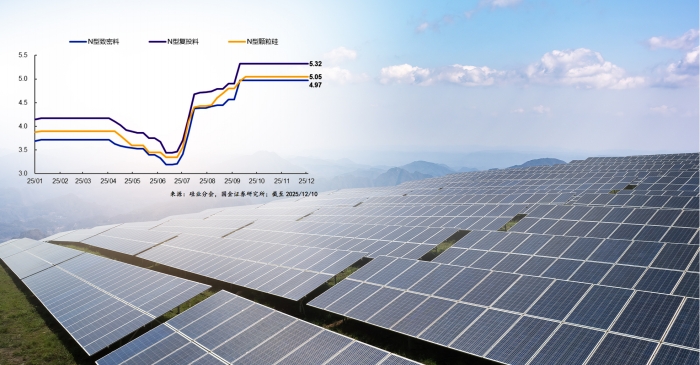
Investment Rating - The report maintains a positive investment outlook for the renewable energy sector, particularly focusing on solar and wind energy, indicating a recovery in supply and demand dynamics [2][3]. Core Insights - The report highlights a significant government initiative to optimize market pricing for centralized renewable energy generation, which is expected to enhance industry stability and competitiveness [3][20]. - The solar industry is positioned at the bottom of its cycle, with upcoming policy support likely to be a critical variable influencing future trends. The focus is on capacity consolidation in the silicon material segment and price regulation across the supply chain [3]. - The wind energy sector shows a balanced supply-demand structure, with strong profitability among companies. The report anticipates continued growth in offshore wind projects and an improving export situation [4]. - The electric vehicle (EV) sector is experiencing rapid growth, with a focus on cost benefits from low upstream raw material prices. The report suggests prioritizing companies that are likely to benefit from industry recovery [4]. Weekly Market Review - From December 8 to December 13, 2025, the Shanghai Composite Index fell by 0.34%, while the Shenzhen Component Index rose by 0.84%, and the ChiNext Index increased by 2.74%. The Shenwan Electric Equipment Index rose by 1.19%, outperforming the CSI 300 by 1.27 percentage points [10]. - Within sub-sectors, solar equipment, wind equipment, batteries, and grid equipment experienced varied performance, with notable increases in wind equipment (1.94%) and grid equipment (3.65%) [10][12]. Key Sector Tracking - The report emphasizes the importance of monitoring key players in the solar and wind sectors, recommending companies such as Aiko Solar, Flat Glass, GCL-Poly Energy, and JunDa Technology for solar, and Goldwind Technology and Yunda Co. for wind [3][4]. - The report also notes significant developments in the EV battery sector, highlighting companies like CATL and EVE Energy as key beneficiaries of the current market dynamics [4]. Industry News Highlights - A new 20GWh battery project by De Yi Energy was launched, focusing on high-performance battery production [18]. - Beijing Weilan New Energy has initiated IPO guidance, expanding its production capabilities across multiple regions [18]. - Samsung SDI secured a significant contract for lithium iron phosphate batteries, valued at over 96 billion RMB, indicating strong demand in the energy storage market [19]. - LG Energy Solution signed a battery supply agreement with Mercedes-Benz worth approximately 98.86 billion RMB, further solidifying its market position [20].
交银国际:多晶硅产能收储平台正式成立 内地光伏反内卷变“深入整治”
Zhi Tong Cai Jing· 2025-12-18 06:12
Group 1 - The core viewpoint of the report is that after a recent stock price correction, valuations of certain leading photovoltaic companies have become attractive, with a particular focus on polysilicon as a benchmark for "anti-involution" [1] - The report highlights that the preferred choice is the leading granular silicon company, GCL-Poly Energy Holdings Limited (03800), and also favors the undervalued rod silicon leader, Xinte Energy Co., Ltd. (01799), which is expected to benefit more from capacity consolidation [1] - The recent Central Work Conference emphasized the need for deeper regulation of "involution-style" competition, marking a shift from "comprehensive regulation" to "in-depth regulation," which suggests that substantial capacity reduction policies may gradually be introduced [1] Group 2 - The establishment of a polysilicon capacity consolidation platform has been officially completed, as reported by the China Photovoltaic Industry Association, indicating a significant step in the long-anticipated integration of the photovoltaic industry [1] - Beijing Huaguang Qiancheng Technology Co., Ltd. has completed its registration, marking the formal launch of the "polysilicon capacity integration acquisition platform" [1]

年内涨幅68%!多晶硅期货溢价空间凸显,光伏上游反内卷见效?
Hua Xia Shi Bao· 2025-12-17 11:19
Core Viewpoint - The recent surge in polysilicon futures prices is attributed to multiple factors, including supply contraction, rising costs, and policy expectations, rather than an increase in downstream demand [2][4][8] Group 1: Price Movements - Polysilicon futures reached a high of 61,235 CNY/ton on December 17, with a cumulative increase of 68% this year [1] - The current price of polysilicon N-type dense material is around 50 CNY/kg, while N-type re-investment material is approximately 51.5 CNY/kg [4] - The market is experiencing a disconnect between futures and spot prices, with spot prices remaining stable despite the rise in futures [4][8] Group 2: Supply and Demand Dynamics - Domestic polysilicon production dropped to about 115,000 tons in November, a decrease of approximately 14% month-on-month, primarily due to proactive production cuts by leading companies during the dry season [2] - The average operating rate in the polysilicon industry has fallen to 40%, with many second and third-tier companies halting production [6] - High inventory levels exceeding 300,000 tons are putting pressure on the market, with weak demand from downstream sectors [6] Group 3: Market Expectations and Policies - A recent meeting among 11 leading manufacturers emphasized production control and price stabilization, reinforcing market expectations for industry self-discipline and the establishment of a storage platform [2][3] - The establishment of a capacity integration acquisition platform is seen as a second wave of market sentiment boost, although details remain unclear [3][7] - The market is closely monitoring the potential announcement of a "debt-for-equity" acquisition and flexible capacity plans, which could further influence sentiment [7][9] Group 4: Trading Strategies - Current high premiums suggest strategies such as "selling futures and buying spot" or "registered warehouse delivery" to lock in basis profits [9] - Investors are advised to reduce leverage and implement strict stop-loss measures due to increased volatility in polysilicon futures [9]
硅业分会:本周多晶硅市场成交清淡 新单报价探涨
智通财经网· 2025-12-17 06:18
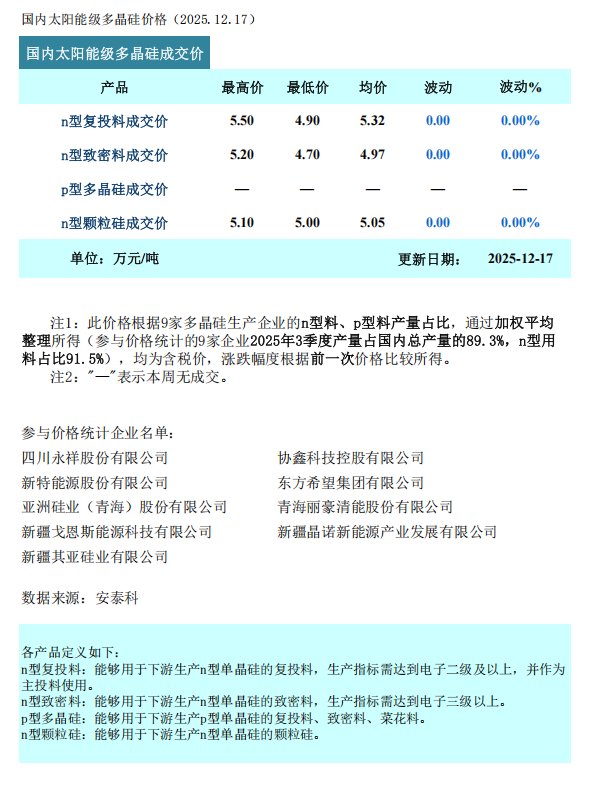
Core Insights - The domestic polysilicon market is experiencing a "sluggish transaction and rising quotes" situation, with the average transaction price for n-type re-investment material remaining stable at 53,200 yuan/ton [1] - The industry anticipates a recovery in terminal demand by the end of Q1 2026, prompting polysilicon companies to raise new order quotes to above 65,000 yuan/ton to stabilize the price system and inventory [1][2] - The overall supply of polysilicon remains stable, with production expected to stay within 120,000 tons in December, while demand continues to be weak due to high inventory levels and slow project initiation [2] Price Trends - The transaction price range for n-type re-investment material is between 49,000 and 55,000 yuan/ton, with an average price of 53,200 yuan/ton, showing no fluctuation [3] - The transaction price for n-type granular silicon is between 50,000 and 51,000 yuan/ton, with an average price of 50,500 yuan/ton, also stable [3] - The price statistics are based on nine polysilicon production companies, which account for 89.3% of the domestic total production in Q3 2025 [3][4] Supply and Demand Dynamics - The number of operating polysilicon companies remains at 11, with production limited by maintenance and low operating rates, while the southwest region faces reductions due to dry conditions [2] - The expected annual production of polysilicon in 2025 is around 1.33 million tons, with the top five companies accounting for approximately 78% of this output [2] - The current supply-demand imbalance is expected to lead to continued inventory accumulation, with an estimated increase of 70,000 tons for the year [2]
关注挖掘机销售超预期和流感持续爆发后的产业链机会
Tebon Securities· 2025-12-17 06:06
Market Overview - During the week of December 8-12, the Shanghai Composite Index fell by 0.34%, while the Shenzhen Component Index rose by 0.84% and the ChiNext Index increased by 2.74%[6] - The average daily trading volume in the market was 1.95 trillion yuan, up from 1.70 trillion yuan the previous week[6] E-commerce in Latin America - Latin America's e-commerce market is experiencing rapid growth, with a total transaction volume of $507 billion in 2023, reflecting a year-on-year growth rate of 27%[16] - The e-commerce penetration rate in Latin America is currently between 12-15%, which is higher than Southeast Asia's 10-13% but significantly lower than China's approximately 45%[16] Health Sector Insights - The percentage of flu-like illness (ILI) cases in southern provinces reached 11.1%, up from 10.3% the previous week and significantly higher than the 2022-2024 average of 3.9%[28] - The demand for flu vaccines and antiviral medications is expected to rise, with sales of oseltamivir increasing by 237% in the last week of November[33] Hard Technology Sector - The panel industry reported a cumulative net profit of 6.035 billion yuan in Q3 2025, a year-on-year increase of 161%[38] - The depreciation costs for panel manufacturers are expected to decline as production lines built during the 2018-2020 expansion phase reach the end of their depreciation periods[38] High-end Manufacturing - In November 2025, excavator sales reached 20,027 units, a year-on-year increase of 13.9%, with domestic sales up by 9.11% and exports up by 18.8%[45] - The demand for excavators is driven by infrastructure projects and equipment upgrades, supported by the Belt and Road Initiative[46]
[安泰科]多晶硅周评-市场成交清淡 新单报价探涨(2025年12月17日)
中国有色金属工业协会硅业分会· 2025-12-17 06:06
Core Insights - The domestic polysilicon market is experiencing a "sluggish transaction and rising quotes" situation, with most polysilicon companies raising new order quotes to around 65,000 yuan/ton, despite a significant drop in new orders [1][2] - The core motivation for the price increase is the expectation of improved terminal demand by the end of Q1 2026, making it crucial to maintain price stability and inventory during the transitional period of January-February [1][2] Market Conditions - The transaction price range for n-type recycled material is between 49,000 to 55,000 yuan/ton, with an average price of 53,200 yuan/ton, remaining stable week-on-week [1][3] - The supply side remains stable, with 11 polysilicon companies in production and an expected December output of no more than 120,000 tons, despite minor increases from some companies [2] - The overall production capacity is expected to reach approximately 1.33 million tons in 2025, with the top five companies accounting for about 78% of the total output [2] Demand Dynamics - The downstream sectors, including silicon wafers, battery cells, and modules, are facing high inventory levels and slow project initiation, leading to increased production cuts [2] - The expected annual silicon wafer production is around 640 GW, corresponding to a silicon material demand of approximately 1.26 million tons [2] Inventory Trends - The current supply-demand imbalance is expected to lead to continued accumulation of polysilicon social inventory, with an estimated increase of about 70,000 tons for the year [2] - The prevailing high inventory and weak demand fundamentals have not changed, but a stronger consensus on price stability is currently influencing market sentiment [2]
优必选获AI大模型公司订单,两部委优化集中式新能源市场报价 | 投研报告
Zhong Guo Neng Yuan Wang· 2025-12-17 05:08
Group 1: Industry Overview - The average price of 130um 182-183.75mm N-type silicon wafers is 1.18 RMB/piece, remaining stable compared to last week, while the 130um 210mm silicon wafers are priced at 1.23 RMB/piece, also unchanged [1][3] - Silicon wafer prices show signs of stabilization after a period of decline, with a production cut of approximately 16% in December, leading to a new low in output for the year [1][3] - The reduction in production is a consensus decision among companies due to insufficient demand, losses, and inventory pressure, indicating that silicon wafer prices are expected to remain in a consolidation phase in the short term [1][3] Group 2: Company Developments - UBTECH has secured over 50 million RMB in orders for humanoid robots from a leading AI model company, with the WalkerS2 robot being the primary product, set for delivery within the year [1] - Midea has officially launched the MIROU, a six-arm wheeled humanoid robot, which features stable elevation and 360-degree rotation capabilities, along with six bio-inspired mechanical arms for versatile operations [1] Group 3: Market Dynamics - The average price of polysilicon is 52.0 RMB/kg, remaining stable, while granular silicon is priced at 50.0 RMB/kg, also unchanged, with a projected production of 113,500 tons in December [3] - The average price of 182-183.75mm N-type battery cells is 0.28 RMB/W, reflecting a 1.8% decrease from last week, with a planned production cut of approximately 12.5% in December [4] - The average price of 182*182-210mm TOPCon double-glass modules is 0.693 RMB/W, remaining stable, while the 210mm N-type HJT modules have seen a price decrease [5] Group 4: Investment Recommendations - Key recommendations include companies focusing on BC new technology such as Aiko and Longi Green Energy, supply-side companies like Daqo New Energy and Flat Glass, and energy storage companies like HBS and Sungrow [6] - Companies to actively monitor include GCL-Poly, Tongwei, Xinyi Solar, TCL Zhonghuan, and others in the solar energy sector [6]
山西证券研究早观点-20251217
Shanxi Securities· 2025-12-17 00:57
Market Overview - The domestic retail sales in November 2025 showed a year-on-year growth of 1.3%, which is below market expectations, with a total retail sales amounting to 4.39 trillion yuan [8] - Cumulative retail sales from January to November 2025 reached 45.61 trillion yuan, reflecting a year-on-year growth of 4.0% [8] - The consumer confidence index in October 2025 was recorded at 89.4, indicating a slight decline of 0.2 from the previous month [8] Industry Insights Textile and Apparel Sector - The textile and apparel retail sales growth in November 2025 decreased by 2.8 percentage points, with a year-on-year growth of 3.5% [7][10] - The performance of major brands such as Bosideng is expected to remain strong due to continuous innovation in core products and a favorable comparison to last year's low base [7] - Recommendations include brands like 361 Degrees and Anta Sports, with a focus on their potential for growth in the upcoming seasons [7] Jewelry and Retail Sector - The jewelry retail sales in November 2025 increased by 8.5% year-on-year, driven primarily by price increases, despite a slight month-on-month decline [10] - Companies with strong terminal performance and differentiated products in the jewelry sector are recommended for investment [10] Electric Equipment and New Energy Sector - The report highlights that the company UBTECH has secured orders exceeding 50 million yuan for humanoid robots, indicating a growing demand in the AI and robotics market [11] - The central economic meeting emphasized the importance of green transformation and the establishment of a new energy system, which could benefit companies in the renewable energy sector [12] Supply Chain and Pricing Trends - The report notes that the prices of polysilicon and silicon wafers have remained stable, with polysilicon prices at 52.0 yuan/kg and silicon wafer prices showing signs of stabilization after previous declines [12] - The battery cell prices have seen a slight decrease, with N-type battery cells priced at 0.28 yuan/W, indicating ongoing price pressures in the market [12] Investment Recommendations - The report recommends focusing on companies in the photovoltaic sector such as LONGi Green Energy and Aiko Solar, as well as those involved in supply chain improvements and market-oriented energy solutions [13] - Companies like Miniso and Yonghui Supermarket are highlighted for their strong performance and growth potential in the retail sector [10]