
中宠股份

Search documents
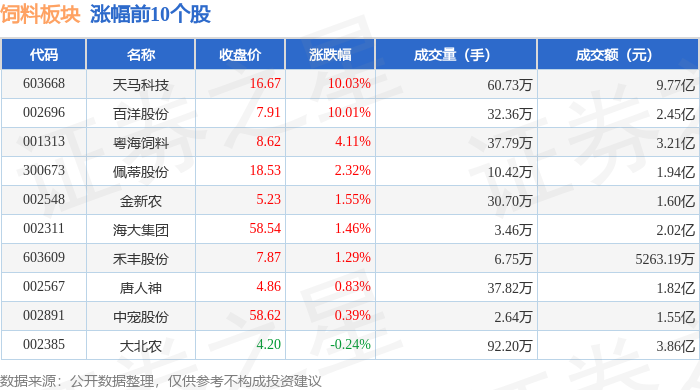
饲料板块11月19日涨1.19%,天马科技领涨,主力资金净流入1.93亿元
Zheng Xing Xing Ye Ri Bao· 2025-11-19 08:46
Group 1: Market Performance - The feed sector increased by 1.19% on November 19, with Tianma Technology leading the gains [1] - The Shanghai Composite Index closed at 3946.74, up 0.18%, while the Shenzhen Component Index closed at 13080.09, unchanged [1] Group 2: Individual Stock Performance - Tianma Technology (603668) closed at 16.67, up 10.03% with a trading volume of 607,300 shares and a transaction value of 977 million [1] - Baiyang Co., Ltd. (002696) closed at 7.91, up 10.01% with a trading volume of 323,600 shares and a transaction value of 24.5 million [1] - Other notable stocks include: - Yuehai Feed (001313) at 8.62, up 4.11% [1] - Petty Holdings (300673) at 18.53, up 2.32% [1] - Jinxinnong (002548) at 5.23, up 1.55% [1] Group 3: Capital Flow Analysis - The feed sector saw a net inflow of 193 million from institutional investors, while retail investors experienced a net outflow of 117 million [2] - The main capital inflow and outflow for key stocks include: - Tianma Technology had a net inflow of 230 million from main investors [3] - Baiyang Co., Ltd. had a net inflow of 56.5 million from main investors [3] - Other stocks like Petty Holdings and Jinxinnong also showed varying levels of net inflow and outflow [3]


估值全球最低,中国消费要反转了?瑞银:Alpha藏在这些赛道里
Hua Er Jie Jian Wen· 2025-11-19 06:27
Core Viewpoint - The valuation of China's consumer sector has reached a global low, presenting significant investment opportunities in specific segments and companies, as highlighted in UBS's latest report [1][2]. Valuation Insights - The consumer sector's valuation is low both historically and in global comparisons, with the 12-month forward P/E ratio for discretionary consumption approximately 40% lower than the global average, and the ratio for staples at a 10% discount [2]. Performance Metrics - The MSCI China discretionary consumption index has recorded a 35% year-to-date return, aligning closely with the 38% increase in the MSCI China index, indicating higher investor expectations in travel and entertainment sectors compared to the 10% rise in staples [3]. Business Model Innovations - UBS emphasizes the importance of business model innovation for identifying Alpha opportunities, particularly through the adoption of asset-light franchise models, which are helping some restaurant brands overcome traditional expansion barriers [3]. - Yum China is highlighted as a case study, with UBS predicting its store count could reach 30,000 by 2030, driven by lower-capital investment store formats that significantly reduce entry barriers for franchisees [3]. - UBS has also raised the long-term potential for Mixue Ice Cream to 80,000 stores, citing significant opportunities in lower-tier cities [3]. New Market Opportunities - UBS identifies structural growth potential in new markets, such as whiskey and trendy toys, as key themes for creating Alpha [4]. - The whiskey market in China is experiencing a shift in consumer preferences, particularly among women and young middle-class individuals in lower-tier cities, with UBS upgrading Baijiu Holdings to a "buy" rating due to its advantageous position in this growing segment [4]. - Pop Mart, a trendy toy company, reported a 245%-250% year-on-year revenue increase in Q3, with strong performance in both domestic and international markets, particularly in the U.S. [4]. Resilience in Pet Economy - The pet food market in China is projected to grow by 8.5% year-on-year in 2024, outpacing the overall pet industry growth, with increasing consumer confidence in domestic brands providing a solid growth foundation for local leaders like Zhongchong Co., which UBS rates as a "buy" [5].

中宠股份:截至11月10日股东数为31981户
Zheng Quan Ri Bao· 2025-11-18 11:35
Core Viewpoint - Zhongchong Co., Ltd. reported that as of November 10, 2025, the number of shareholders is 31,981 [2] Summary by Category - Company Information - Zhongchong Co., Ltd. has a total of 31,981 shareholders as of the specified date [2]
农林牧渔行业月报:猪价持续下行,宠物食品“双十一”表现亮眼-20251118
Zhongyuan Securities· 2025-11-18 08:59
Investment Rating - The report maintains an "Outperform" rating for the agriculture, forestry, animal husbandry, and fishery industry [1]. Core Views - The report highlights a continued decline in pig prices and strong performance in pet food sales during the "Double Eleven" shopping festival [1]. - The industry is currently trading at lower price-to-earnings (P/E) and price-to-book (P/B) ratios compared to historical averages, indicating potential for valuation recovery [1]. Summary by Sections Market Review - In October 2025, the agriculture, forestry, animal husbandry, and fishery index rose by 0.19%, outperforming the CSI 300 index, which had a return of approximately 0% [8][11]. - The pet food sector experienced a decline, while the wood processing sector showed strong gains [11]. Livestock Farming Data Tracking - Pig prices continued to decline in October 2025, with an average price of 11.52 yuan/kg, down 11.46% month-on-month and 34.77% year-on-year [16]. - The average price for white feather broilers was 3.38 yuan/jin, showing a slight decrease of 0.29% month-on-month and 7.65% year-on-year [26]. Pet Food Sales Performance - During the "Double Eleven" period in 2025, total sales of pet food reached 9.4 billion yuan, a year-on-year increase of 59.3% [35]. - Pet food exports in September 2025 totaled 30,500 tons, up 18.78% year-on-year, while the cumulative export amount from January to September was 1.057 billion USD, down 3.73% year-on-year [32][35]. Investment Recommendations - The report suggests focusing on companies such as Muyuan Foods, Pulaike, QiuLe Seed Industry, GuaiBao Pet, ZhongChong Co., and Petty Co., all rated as "Buy" [1].



“宠物经济”持续升温 头部公司自主品牌业绩迎突破
Zheng Quan Shi Bao Wang· 2025-11-18 06:30
Core Insights - The pet consumption market in China continues to thrive, with significant sales growth reported during the 2025 "Double 11" shopping festival, particularly for domestic brands like Guibao Pet and its brands Maifudi and Fleagart [1][2] - The overall pet market in China is projected to exceed 811.4 billion yuan by 2025, with pet food being the largest segment, indicating strong demand and growth potential in the pet economy [3] Company Performance - Guibao Pet's self-owned brand sales reached nearly 1.1 billion yuan during the 2025 "Double 11," with Maifudi and Fleagart achieving sales of 688 million yuan and 335 million yuan, respectively, marking year-on-year growth of 35% and 51% [1] - Other leading companies like Zhongchong Co. and Petty Co. also reported strong sales growth during the same period, confirming the robust demand in the pet food market [1][2] - Guibao Pet maintained its leading position in the domestic pet food market, with a strong brand presence and high user recognition [2] Market Trends - The consumer base for pet products is increasingly favoring online purchasing, particularly through short videos and social media, reflecting a shift towards more informed and quality-focused buying decisions [3] - The pet industry is transitioning from basic feeding to a more refined approach, with consumers seeking higher quality and brand reputation in their purchases [3] Global and Local Strategies - Zhongchong Co. has established over 22 modern production bases globally and is actively promoting its brands internationally, achieving significant market recognition [4] - Petty Co. is focusing on the pet baking food segment and is investing in product innovation and supply chain collaboration to ensure quality and stability in new product offerings [4] - The industry is witnessing a shift from price competitiveness to technological advantages, with companies leveraging digitalization across their operations to enhance user insights and product iterations [4]
2026年农林牧渔行业投资策略:布局周期,掘金成长
Shenwan Hongyuan Securities· 2025-11-18 06:00
Core Insights - The report emphasizes the cyclical nature of the pig farming industry, indicating that the downward cycle is nearing its end, with a potential upward turning point expected in 2026 [3][19] - The pet economy remains a key growth area, highlighting investment opportunities in niche sectors [4] Group 1: Industry Overview - The agricultural sector, particularly the pig farming segment, is experiencing a downturn, with 2025 expected to see continued losses, leading to a price bottom in the first half of 2026 [5][19] - The chicken farming sector is also under pressure, with expectations of supply-side stabilization and demand recovery in 2026 [20] - The cattle farming sector is projected to face a supply contraction starting in 2026, which may last until 2027 [21] Group 2: Investment Opportunities - The pet food industry is anticipated to maintain its growth trajectory, with leading companies increasing their market share despite challenges in export performance [5][4] - The blueberry market in Yunnan is expected to see profit realization from 2024 to 2025, with growth potential continuing into 2026-2027 [5] - The artificial cultivation of Cordyceps is gaining traction as natural production declines, with early movers in this space likely to see performance improvements [5] Group 3: Key Companies to Watch - The report identifies several key companies for investment consideration, including Muyuan Foods, Wens Foodstuff Group, DeKang Agriculture, TianKang Biological, and others in the pet food sector [5]


渤海证券研究所晨会纪要(2025.11.18)-20251118
BOHAI SECURITIES· 2025-11-18 03:00
Macro and Strategy Research - The scale of off-balance sheet financing and direct financing has increased, with a notable rise in entrusted loans and corporate bond financing, while overall social financing showed a year-on-year decrease of nearly 600 billion yuan in October [2][3] - The loan data indicates a weak demand, with a year-on-year decrease of 280 billion yuan in RMB loans, and a significant increase in corporate bill financing, reflecting a trend of companies being cautious about expanding capacity [2][3] - M2 growth rate slightly declined to 8.2% in October, primarily due to base effects and reduced loan-generated deposits, while M1 growth rate fell to 6.2% [3] Mergers and Acquisitions - Mergers and acquisitions are seen as crucial tools for supporting economic transformation and achieving high-quality development, with a significant increase in market activity following the introduction of new policies in 2024 [4][5] - Historical trends show that the U.S. mergers and acquisitions market has experienced several waves, characterized by horizontal, vertical, diversification, and cross-border mergers [5] - The previous wave of mergers and acquisitions in China (2014-2015) positively impacted listed companies' performance, with a notable improvement in ROE following successful mergers [6] Economic Data Analysis - In October 2025, the industrial added value grew by 4.9% year-on-year, below expectations, while retail sales increased by 2.9% [7][8] - Seasonal factors and reduced working days contributed to the slowdown in industrial production, with certain sectors like transportation equipment manufacturing performing well [8] - Fixed asset investment showed a cumulative year-on-year decline of 1.7%, with manufacturing and infrastructure investments particularly affected by weak demand and policy implementations [10] Fund Research - The cross-border ETF market continues to see net inflows, with an expansion of the "Southbound ETF Connect" list, indicating growing interest in international investments [12][13] - The overall ETF market experienced a net inflow of 24.426 billion yuan, with significant contributions from cross-border ETFs [13][14] Industry Research - The medical and biological sector is witnessing a surge in flu cases, with the proportion of flu-like cases in the northern region reaching a four-year high, suggesting potential investment opportunities in diagnostics and vaccine production [16][17] - The light industry and textile sectors are benefiting from strong performance during the "Double Eleven" shopping festival, with apparel sales leading the growth [18][20]
情感需求推动消费升级,经济恢复夯实增长韧性
Haitong Securities International· 2025-11-17 12:02
Economic Overview - In 2024, China's GDP is projected to grow by 5.0%, with per capita disposable income increasing by 5.3%[3] - National spending on "other goods and services" is expected to rise by 10.8% year-on-year, with pet consumption significantly outpacing broader categories[3] Pet Market Growth - The total market size of the pet industry in China is anticipated to reach 528.8 billion yuan in 2024, with pet food accounting for nearly half of this market[6] - The compound annual growth rate (CAGR) for the pet food sector from 2020 to 2024 is projected at 7.11%[6] Consumer Demographics - The Z generation (ages 18-30) contributes over 60% of pet consumption, with over half of new pet owners being born after 2000[1] - The elderly population (65 years and older) has increased to 15.4%, indicating a growing market for emotional companionship through pets[1] Brand Dynamics - Domestic brands now hold 70% of the top 20 market positions in pet food, with the top five local brands accounting for 11.2% of the market share[1] - The market concentration remains low, with the top three brands holding only 29.5% of the market share, compared to 54.2% in the U.S.[1] Online Sales Trends - E-commerce accounts for 67.5% of pet food sales in China, significantly higher than Japan (26.2%) and the U.S. (37.2%) in 2024[1] - Platforms like Xiaohongshu and Douyin are pivotal in driving consumer engagement and sales conversion, with Douyin contributing over 50% of weekly GMV for pet food[1] Health and Technology Trends - There is a notable shift towards health-oriented pet food, with 57.3% of consumers preferring products that promote digestion[1] - Smart pet products, such as automated feeders and odor eliminators, have seen sales growth exceeding 100% during promotional periods[1]
——农林牧渔周观点(2025.11.9-2025.11.16):猪价震荡走弱亏损幅度扩大,上市宠企双十一销售表现亮眼-20251117
Shenwan Hongyuan Securities· 2025-11-17 11:55
Investment Rating - The report suggests a positive outlook for the agricultural sector, indicating an "Overweight" rating for the industry, as it is expected to outperform the overall market [46]. Core Insights - The agricultural sector index rose by 2.7% while the Shanghai and Shenzhen 300 index fell by 1.1%, highlighting a divergence in performance [2][3]. - The report emphasizes the ongoing decline in pig prices, leading to increased losses and a potential acceleration in capacity reduction within the industry [2][3]. - The "Double Eleven" sales event showed strong performance for pet food brands, indicating growth potential for leading companies in this segment [2][3]. Summary by Sections Pig Farming - Pig prices have continued to decline, with the average selling price for external three yuan pigs at 11.56 yuan/kg, down 2.9% year-on-year [2]. - Losses for self-breeding sows are significant, with a reported loss of 71.95 yuan per head, a week-on-week increase of 30.89 yuan [2]. - The report anticipates that the fourth quarter will see a lackluster peak season for pig prices, with proactive capacity reduction expected to accelerate [2][3]. Pet Food - Major e-commerce platforms reported strong sales during the "Double Eleven" event, with leading brands achieving high rankings in sales [2]. - The report highlights that domestic pet food brands are experiencing a growth trajectory, despite short-term export challenges due to trade tensions [2]. - Companies such as Guai Bao Pet, Zhong Chong Co., and Pei Di Co. are recommended for their strong market positions and growth potential [2][3]. Poultry Farming - The price of white feather broiler chicks has slightly decreased to an average of 3.35 yuan per chick, while chicken prices remain stable at 3.45 yuan/kg [2]. - The report notes that the supply of white chickens is expected to remain abundant, which may impact pricing dynamics in 2025 [2]. - Recommendations include focusing on leading companies like Sheng Nong Development for long-term value [2]. Beef Cattle - Prices for beef cattle and calves have seen a slight decline, with the average price for fattened bulls at 25.6 yuan/kg, down 0.16% week-on-week [2]. - The wholesale price of beef has increased slightly to 66.73 yuan/kg, reflecting a potential upward trend in beef pricing [2].
农林牧渔周观点:猪价震荡走弱亏损幅度扩大,上市宠企“双十一”销售表现亮眼-20251117
Shenwan Hongyuan Securities· 2025-11-17 10:12
Investment Rating - The report maintains an "Overweight" rating for the agriculture, forestry, animal husbandry, and fishery industry, indicating a positive outlook compared to the overall market performance [2][46]. Core Insights - The Swine price continues to decline, leading to an increase in losses, while the capacity reduction is expected to accelerate. The pressure on fat pig supply remains significant, and the seasonal demand for pigs may not boost prices, potentially undermining industry confidence [2][3]. - The pet food sector showed strong sales performance during the "Double Eleven" shopping festival, with leading companies achieving significant market share growth. The report suggests focusing on the growth potential of top-tier companies in this sector [2][3]. - The report highlights the stable performance of the white feather broiler chicken market, with slight declines in chick prices but stable chicken meat prices. The overall supply remains abundant, indicating a focus on leading companies for long-term value [2][3]. Summary by Sections Market Performance - The Shenwan Agriculture, Forestry, Animal Husbandry, and Fishery Index rose by 2.7%, while the CSI 300 Index fell by 1.1%. The top five gainers included Green Kang Bio (27.6%), ST Jiawo (23.2%), and Pingtan Development (22.2%) [2][3][9]. Swine Farming - The report notes a continued decline in swine prices, with the average price for external three yuan pigs at 11.56 yuan/kg, down 2.9% year-on-year. Losses for self-breeding sows are reported at -71.95 yuan per head, a week-on-week increase in losses [2][3][41]. Pet Food - The report emphasizes the strong sales of domestic pet food brands during the "Double Eleven" event, with major brands like Guobao Pet and Zhongchong leading in sales rankings across various platforms [2][3]. Poultry Farming - The average selling price for white feather broiler chicks is reported at 3.35 yuan per chick, a week-on-week decrease of 2.9%. The average price for white feather broiler meat is stable at 3.45 yuan/kg [2][3]. Beef Cattle - The report indicates a slight decrease in the prices of beef cattle and calves, with the average price for fattened bulls at 25.6 yuan/kg, down 0.16% week-on-week [2][3].