
万华化学

Search documents
化工板块午后异动拉升,三棵树狂飙9%!化工ETF(516020)上探1.7%,板块重估进行时?
Xin Lang Ji Jin· 2026-01-20 06:32
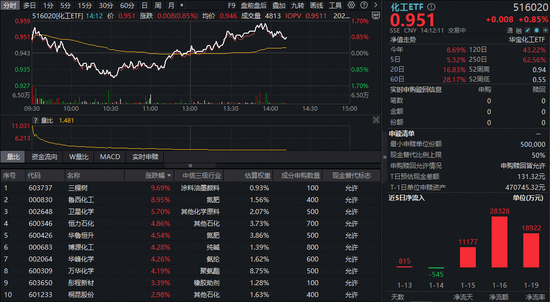
Group 1 - The chemical sector experienced a significant afternoon rally on January 20, with the chemical ETF (516020) reaching an intraday high of 1.7% before closing up 0.85% [1] - Key stocks in the sector saw substantial gains, including Sanhe Tree up over 9%, Luxi Chemical up over 8%, and Satellite Chemical up over 5% [1] - The Ministry of Industry and Information Technology, along with four other departments, issued guidelines on January 19 to promote zero-carbon factory construction, targeting the petrochemical and chemical industries [3] Group 2 - Tianfeng Securities noted that a turning point in policy and capital expenditure is expected by 2025, with the "anti-involution" concept providing a positive outlook for industry profitability and healthier long-term development [3] - The restructuring of supply and demand dynamics, along with the upgrading of industry attributes, is prompting a reevaluation of traditional chemical companies' value [3] - Despite the overall weak performance in the chemical sector, certain sub-industries, such as lubricants, have exceeded expectations, indicating potential investment opportunities in glyphosate, fertilizers, and domestic demand [3] Group 3 - The chemical ETF (516020) tracks the CSI sub-sector chemical industry theme index, with nearly 50% of its holdings concentrated in large-cap leading stocks like Wanhua Chemical and Salt Lake Co., allowing investors to capitalize on strong performers [4] - The remaining 50% of the ETF's holdings include leading stocks in niche areas such as phosphate fertilizers, fluorine chemicals, and nitrogen fertilizers, providing comprehensive exposure to investment opportunities in the chemical sector [4]


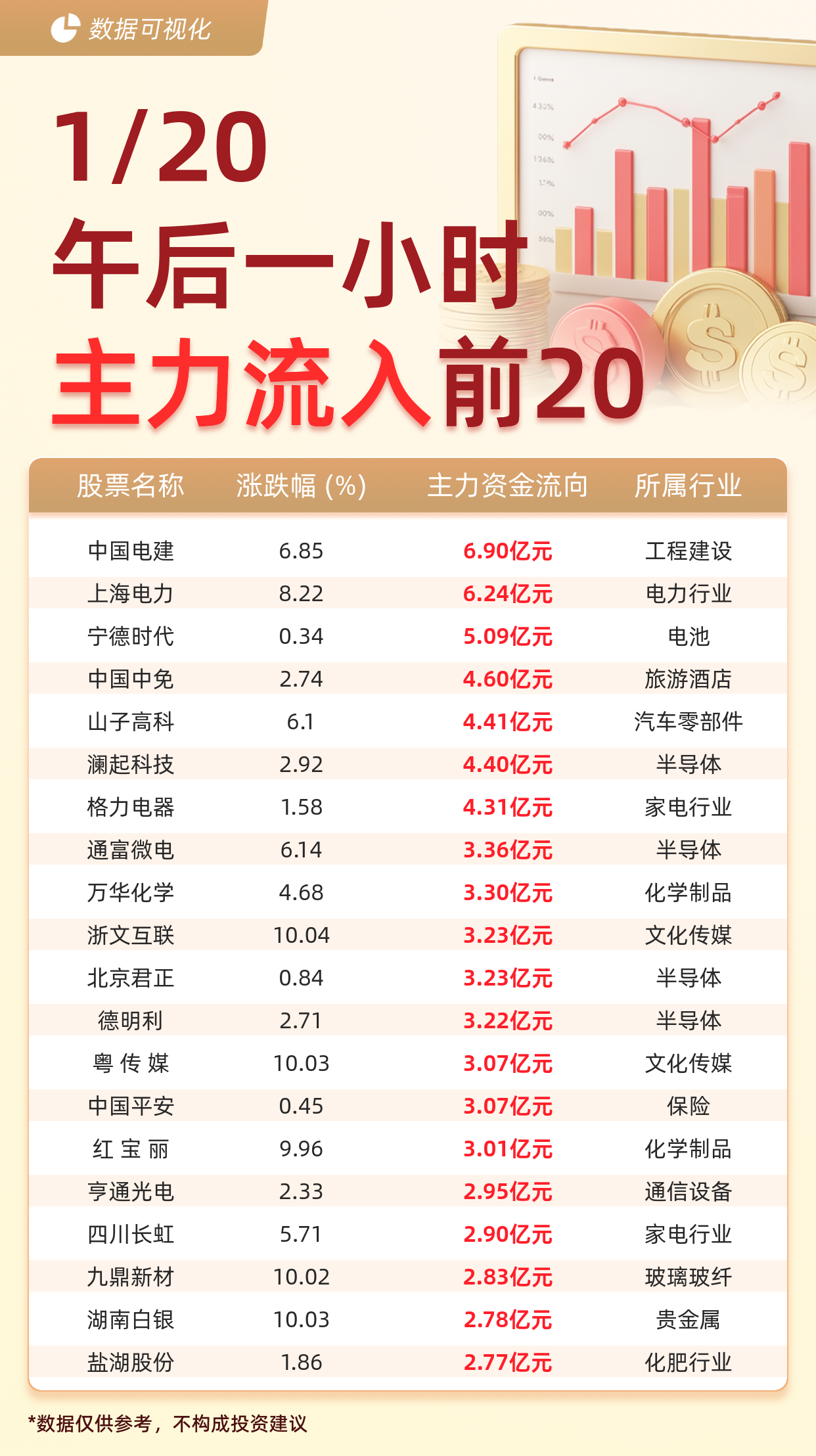
主力资金流入前20:中国电建流入6.90亿元、上海电力流入6.24亿元
Jin Rong Jie· 2026-01-20 06:26
Core Insights - The main focus of the news is on the significant inflow of capital into various stocks, highlighting the top 20 stocks with the highest capital inflow as of January 20, with specific amounts listed for each company [1][2][3] Group 1: Stock Performance - China Power Construction saw a capital inflow of 690 million yuan with a price increase of 6.85% [2] - Shanghai Electric experienced a capital inflow of 624 million yuan and a price increase of 8.22% [2] - Contemporary Amperex Technology reported a capital inflow of 509 million yuan with a modest price increase of 0.34% [2] - China Duty Free Group had a capital inflow of 460 million yuan and a price increase of 2.74% [2] - Sanzi Gaoke recorded a capital inflow of 441 million yuan with a price increase of 6.1% [2] Group 2: Industry Insights - The engineering sector, represented by China Power Construction, is showing strong investor interest with significant capital inflow [2] - The electric power industry, highlighted by Shanghai Electric, is also attracting substantial investments [2] - The battery industry, represented by Contemporary Amperex Technology, is experiencing steady capital inflow despite a small price increase [2] - The tourism and liquor sector, represented by China Duty Free Group, is seeing positive capital movement [2] - The automotive parts sector, represented by Sanzi Gaoke, is gaining traction with notable capital inflow [2]





DT新叶奖竞选⑩ | 华澄生物:生物基蓝色素、印染绿色解决方案
合成生物学与绿色生物制造· 2026-01-20 06:25
Core Viewpoint - The article highlights the participation of Jiangsu Huacheng Biotechnology Co., Ltd. in the 2026 DT New Leaf Award, focusing on its innovative bio-based blue pigment and green dyeing solutions aimed at promoting sustainable practices in the textile industry [2][13]. Group 1: Company Overview - Jiangsu Huacheng Biotechnology Co., Ltd. was established in 2024, focusing on synthetic biology research and product commercialization, particularly in bio-based materials and biochemicals for pharmaceuticals, cosmetics, food, and health products [3]. - The company aims to drive industrial upgrades through technological innovation, emphasizing large-scale bio-manufacturing of food colorants, chemical dyes, and functional food ingredients [3]. Group 2: Bio-based Blue Pigment - The bio-based blue pigment is produced using synthetic biology techniques, utilizing engineered microorganisms as "cell factories" for efficient fermentation [4]. - Compared to chemical dyes, bio-based dyes are natural, non-toxic, and exhibit excellent antibacterial and anti-yellowing properties, with lower damage to high-end fabrics like silk and wool [4][10]. - The production process avoids traditional petroleum-based methods, reducing harmful substance generation and wastewater treatment costs, while achieving USDA bio-based product certification [8][10]. Group 3: Green Dyeing Solutions - Traditional chemical dyes pose significant health and environmental risks, leading to complex pollution issues in the textile industry [9]. - Huacheng's approach involves replacing chemical dyes with bio-based alternatives, providing scalable clean dyeing solutions that align with national environmental goals [9]. - The innovative process utilizes renewable carbon sources and mild fermentation conditions, significantly lowering wastewater chemical oxygen demand and overall energy consumption [9]. Group 4: Awards and Recognition - The DT New Leaf Award features four categories: Innovation Material Award, Innovation Application Award, Most Commercially Valuable Award, and Innovative Industry Solution Award, with the first round of applications closing on February 10, 2026 [5][13]. - Huacheng's participation in the award reflects its commitment to sustainable practices and innovation in the bio-based industry [2][13].
涨超1.6%,化工ETF(159870)盘中净申购超10亿份
Xin Lang Cai Jing· 2026-01-20 06:23
Group 1 - The core viewpoint of the news is that the global urea market continues to strengthen, with spot prices rising in major production areas due to a significant rebound in European natural gas prices, which increases fertilizer production costs. This situation is compounded by strong agricultural demand in India and simultaneous market strength in Brazil and China, leading to new challenges in the global fertilizer supply chain [1] - The chemical industry, particularly the chemical fertilizer sector and certain sub-products in the pesticide industry, is expected to bear more growth responsibility amid tariff uncertainties, with nitrogen and phosphorus fertilizers and compound fertilizers being relatively self-sufficient and having rigid demand [1] - As of January 20, 2026, the CSI Sub-Industry Chemical Theme Index (000813) rose by 1.66%, with constituent stocks such as Luxi Chemical up by 9.87%, Sankeshu up by 7.91%, and Satellite Chemical up by 6.57%. The Chemical ETF (159870) also increased by 1.69%, with a latest price of 0.9 yuan and a net subscription of 1.066 billion shares, marking 14 consecutive days of net inflow [1] Group 2 - As of December 31, 2025, the top ten weighted stocks in the CSI Sub-Industry Chemical Theme Index (000813) include Wanhua Chemical, Salt Lake Shares, Cangge Mining, Tianci Materials, Juhua Co., Hengli Petrochemical, Hualu Hengsheng, Baofeng Energy, Yuntianhua, and Jinfa Technology, collectively accounting for 45.31% of the index [2] - The Chemical ETF (159870) has formed a MACD golden cross signal, indicating a positive trend in stock performance [3]
万华化学股价涨5.12%,惠升基金旗下1只基金重仓,持有1.73万股浮盈赚取7.3万元
Xin Lang Cai Jing· 2026-01-20 06:12
Group 1 - Wanhua Chemical's stock increased by 5.12%, reaching 86.62 CNY per share, with a trading volume of 4.855 billion CNY and a turnover rate of 1.83%, resulting in a total market capitalization of 271.161 billion CNY [1] - Wanhua Chemical, established on December 16, 1998, and listed on January 5, 2001, is located in Yantai, Shandong Province. The company specializes in the development, production, and operation of various isocyanate products and their derivatives, as well as polyurethane systems and additives [1] - The revenue composition of Wanhua Chemical includes: polyurethane series 40.58%, petrochemical series 38.43%, fine chemicals and new materials series 17.19%, and others 12.46% [1] Group 2 - Huisheng Fund has a significant holding in Wanhua Chemical, with the Huisheng Huicheng Stable One-Year Holding Mixed A Fund (013726) holding 17,300 shares, accounting for 1.44% of the fund's net value, ranking as the seventh largest holding [2] - The Huisheng Huicheng Stable One-Year Holding Mixed A Fund was established on November 30, 2021, with a latest scale of 75.9828 million CNY. Year-to-date return is 2.39%, ranking 6211 out of 8848 in its category, while the one-year return is 8.56%, ranking 6606 out of 8093 [2]

化工股午后大面积走高 新乡化纤触及涨停
Jing Ji Guan Cha Wang· 2026-01-20 05:59
Group 1 - The chemical sector experienced a significant rally in the afternoon, with multiple stocks showing strong performance [1] - Xinxiang Chemical Fiber (000949) hit the daily limit up, indicating robust investor interest [1] - Luxi Chemical (000830) also approached the daily limit up, reflecting positive market sentiment [1] Group 2 - Xinjiang Tianye (600075) saw an increase of over 8%, contributing to the overall upward trend in the sector [1] - Wanhu Chemical (600309) and Jinniu Chemical (600722) were among several stocks that rose, indicating a broad-based recovery in the chemical industry [1]


万华化学投资成立新能源材料科技公司
Zheng Quan Shi Bao Wang· 2026-01-20 05:42
Core Viewpoint - Recently, Wanhua Chemical Group established a new subsidiary focused on new energy materials, indicating the company's strategic expansion into the electronic materials sector and renewable energy technologies [1] Group 1: Company Overview - Wanhua Chemical Group (Laizhou) New Energy Materials Technology Co., Ltd. has been established with a registered capital of 740 million yuan [1] - The legal representative of the new company is Zou Jie [1] - The new subsidiary is fully owned by Wanhua Chemical's Yantai Battery Industry Co., Ltd. [1] Group 2: Business Scope - The business scope of the new company includes research and development, manufacturing, and sales of electronic specialty materials [1] - Additionally, the company will provide technical services related to wind power generation [1]
化工ETF(159870)早盘净申购7.7亿份,冲刺连续14天净申购
Xin Lang Cai Jing· 2026-01-20 04:06
Group 1 - Strong capital inflow into the chemical sector, with the chemical ETF (159870) seeing a net subscription of 770 million shares, marking 14 consecutive days of net subscriptions [1] - On the supply side, capital expenditure in the chemical industry is expected to decline in 2024, leading to gradual consumption of existing capacity, while the "anti-involution" trend in China accelerates the elimination of outdated overseas capacity, indicating a potential contraction in supply [1] - On the demand side, the "14th Five-Year Plan" draft emphasizes expanding domestic demand, suggesting that the transition between old and new growth drivers will continue, coupled with the onset of the U.S. interest rate cut cycle, which is expected to boost demand for chemical products [1] Group 2 - As of January 20, 2026, the CSI sub-industry chemical theme index (000813) rose by 0.11%, with notable increases in constituent stocks such as Sanhe Tree (up 7.75%), Satellite Chemical (up 5.34%), and Luxi Chemical (up 5.29%) [1] - The chemical ETF (159870) closely tracks the CSI sub-industry chemical theme index, which consists of seven sub-indices reflecting the overall performance of listed companies in related sub-industries [1] - As of December 31, 2025, the top ten weighted stocks in the CSI sub-industry chemical theme index include Wanhua Chemical, Salt Lake Shares, and Cangge Mining, collectively accounting for 45.31% of the index [2]
化工:近期行业变化和历次周期牛市中龙头表现复盘
2026-01-20 03:54
Summary of Conference Call on Chemical Industry and Petrochemical Sector Industry Overview - The conference call focused on the chemical and petrochemical sectors, discussing recent investment opportunities and market dynamics [1][2]. Key Points from Petrochemical Sector - **Oil Price Outlook**: Current geopolitical issues have caused some disturbances in oil prices, with expectations of prices stabilizing around $65 during the off-season. However, there is a bullish outlook for oil prices in 2023 and 2024, with potential peaks between $70 and $80 [2][3]. - **Market Sentiment**: The market sentiment is currently bearish, but the analysis suggests a more optimistic view on oil prices, contradicting the majority opinion [2]. - **Midstream Developments**: There have been minor changes in the midstream sector, with some production cuts due to seasonal factors. The price differentials in certain products have improved, indicating a recovery in margins [3][4]. Key Points from Chemical Sector - **Market Trends**: The chemical industry is expected to experience a sustained uptrend in 2026 and 2027, potentially surpassing previous cycles. The valuation of chemical companies may exceed historical highs due to lower interest rates and improved market conditions [5][6]. - **Inventory Dynamics**: There is an expectation of a price increase post-Chinese New Year due to inventory replenishment, which has been absent in previous years due to trade tensions [6][7]. - **Supply Chain Constraints**: The expansion phase for many sub-industries has peaked, with capacity growth expected to slow down significantly by 2027. This will likely lead to tighter supply conditions [6][7]. - **Government Policies**: Recent government initiatives aimed at upgrading traditional industries for greener practices are expected to impact supply dynamics positively [6][7]. Investment Recommendations - **Focus on Cyclical Stocks**: The analysis emphasizes investing in cyclical stocks, particularly those with strong fundamentals and cost advantages. Companies like Wanhua Chemical and Longbai Group are highlighted for their potential to outperform the market [8][9]. - **Performance of Leading Companies**: Historical data shows that leading companies in the chemical sector have significantly outperformed the broader market during previous bull cycles, with returns of up to 5 times for some stocks [9][10]. - **Cost Advantages**: Leading firms maintain strong cost advantages, allowing them to remain profitable even during downturns. This positions them well for future price recoveries [10][11]. Sector-Specific Insights - **Urea and Acetic Acid**: The urea market is under observation for export policies, while acetic acid prices are expected to stabilize due to limited capacity expansion [12][13]. - **Titanium Dioxide**: The titanium dioxide market is facing challenges with profitability, and any new environmental regulations could further impact pricing [13][14]. - **Polyester and PTA**: The polyester chain is currently experiencing price adjustments due to seasonal demand fluctuations, with expectations of price increases as the market enters a recovery phase [16][17]. - **Refrigerants**: Prices for refrigerants are expected to rise as demand increases during the peak season, with current prices around 60,000 to 162,000 [20]. Conclusion - The overall sentiment in the chemical and petrochemical sectors is cautiously optimistic, with expectations of price increases and improved market conditions in the coming years. Investors are encouraged to focus on leading companies with strong fundamentals and cost advantages to capitalize on the anticipated market recovery [21].
机构看好化工板块供给侧改革下周期反转,化工ETF嘉实(159129)聚焦化工板块投资机遇
Xin Lang Cai Jing· 2026-01-20 03:51
Group 1 - The core viewpoint of the news highlights the positive changes in the chemical industry supply side, driven by capital expenditure decline and policy support, which may lead to a reversal in the industry cycle [2] - The Ministry of Industry and Information Technology has issued guidelines for zero-carbon factory construction, focusing on industries with urgent decarbonization needs and aiming to establish a batch of zero-carbon factories in various sectors by 2027 and 2030 [1] - The top ten weighted stocks in the CSI Chemical Industry Theme Index account for 45.31% of the index, indicating a concentrated investment opportunity within the sector [2] Group 2 - The chemical sector is expected to benefit from the "14th Five-Year Plan" aimed at expanding domestic demand and the onset of a U.S. interest rate cut cycle, which could stimulate demand for chemical products [2] - Investors can also explore investment opportunities in the chemical sector through the Chemical ETF linked fund [3]