
伯特利

Search documents
机构:内需与出口叠加向好 全年乘用车销量或上行
Zheng Quan Shi Bao Wang· 2025-06-25 09:52
Group 1 - The core viewpoint indicates that the retail sales of passenger cars in China reached 1.269 million units from June 1 to June 22, representing a year-on-year increase of 24% and an 8% increase compared to the previous month [1] - Cumulative retail sales for the year have reached 10.086 million units, showing an 11% year-on-year growth [1] - The retail sales of new energy vehicles (NEVs) during the same period totaled 691,000 units, marking a 38% year-on-year increase and an 11% increase from the previous month, with a market penetration rate of 54.5% [1] - Cumulative NEV retail sales for the year stand at 5.049 million units, reflecting a 35% year-on-year growth [1] Group 2 - According to Galaxy Securities, the combination of domestic demand and exports is expected to drive a 6.7% increase in annual passenger car sales [1] - The sales proportion of vehicles priced below 300,000 yuan is anticipated to continue rising, with "high-level intelligent driving equality" further concentrating the competitive landscape [1] - Supportive policies such as trade-in programs, NEV promotion in rural areas, and the expiration of the tax exemption for NEVs at the end of the year are expected to bolster domestic demand [1] - The competitive landscape is shifting, with increased costs related to intelligent driving technology and a focus on R&D capabilities among automakers [1] Group 3 - The report suggests focusing on specific companies within the passenger car sector, recommending BYD (002594) and Li Auto-W, with beneficiaries including Geely, Xpeng, and Leap Motor [2] - In the motorcycle sector, recommended beneficiaries include Chunfeng Power (603129) and Longxin General (603766) [2] - For commercial vehicles, beneficiaries include China National Heavy Duty Truck (000951) and Yutong Bus (600066) [2] - In the intelligent components sector, recommended companies include Sutech (002920), Desay SV (002920), and others [2] - The humanoid robot sector highlights Top Group (601689) and Jingzhan Technology (300258) as recommended companies, with additional beneficiaries listed [2]

2025年安徽省芜湖市新质生产力发展研判:构建“鸠兹科创湾”等创新载体,新质生产力规模持续扩大[图]
Chan Ye Xin Xi Wang· 2025-06-25 01:11
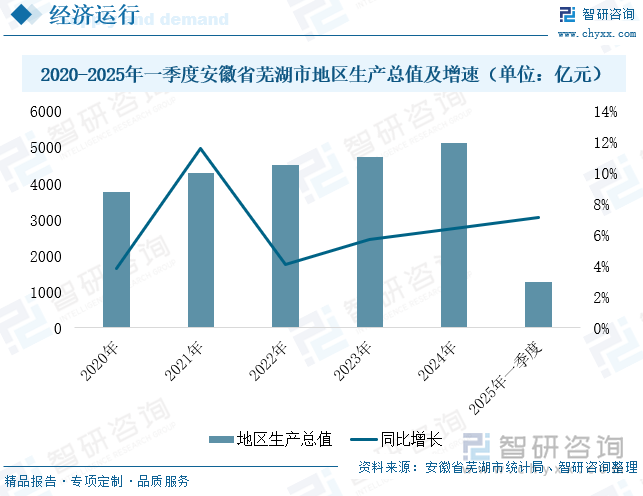
Core Viewpoint - Wuhu City is leveraging a spatial strategy of "one core, three belts, and multiple nodes" to drive technological innovation and high-end industrial cluster development, focusing on strategic emerging industries and traditional industries' transformation towards intelligence and sustainability [1][18]. Group 1: New Quality Productive Forces Overview - New Quality Productive Forces, introduced by President Xi Jinping, emphasize innovation as the main driver, characterized by high technology, efficiency, and quality, aligning with advanced production capabilities [2]. - This concept is crucial for promoting high-quality economic development and constructing a modern industrial system [2]. Group 2: Economic Performance of Wuhu City - Wuhu City, as a key node in the Yangtze River Delta G60 Science and Technology Innovation Corridor, has seen its GDP exceed 512.05 billion yuan in 2024, with a year-on-year growth of 6.4% [3]. - The secondary industry has shown remarkable performance with an added value of 55.29 billion yuan and a growth rate of 8.7% [3]. Group 3: Industrial Development and Innovation - Wuhu is focusing on the "Jiuzi Science and Technology Innovation Bay" to create a highland for industrial innovation, planning 18 specialized innovation parks with a total construction area of 5.95 million square meters [5]. - The city's industrial enterprises achieved over 850 billion yuan in revenue, with a profit margin of 6%, and strategic emerging industries grew by 22% [5]. Group 4: Policy Framework for New Quality Productive Forces - Wuhu City has implemented several policies to support the development of New Quality Productive Forces, including action plans for modern service industries and digital transformation [9][11]. - These policies aim to create a comprehensive system covering technological innovation, industrial upgrading, and digital empowerment [9]. Group 5: Modern Industrial System - Wuhu has established a "4+10+6" industrial system, focusing on traditional industries like automotive and electronics while promoting strategic emerging industries such as robotics and new energy [13]. - The city aims to enhance its industrial capacity towards high-end, specialized, and cutting-edge sectors [13]. Group 6: Future Development Trends - Wuhu's development of New Quality Productive Forces will focus on technological innovation, particularly in smart connected vehicles and robotics [26]. - The city plans to foster a modern industrial cluster system that integrates traditional and emerging industries, enhancing collaborative efficiency through digital technologies [27]. - Wuhu will deepen cooperation within the G60 Science and Technology Innovation Corridor and optimize policies to attract global high-end resources [28].

八成胜率,当被动投资装上主动引擎,指增ETF正在焕发第二春
市值风云· 2025-06-24 10:17
Core Viewpoint - The traditional divide between ETFs and actively managed funds is being disrupted by the emergence of enhanced index ETFs, which combine the advantages of both product types [2][23]. Group 1: Enhanced Index ETFs Overview - Enhanced index ETFs track indices but allow fund managers to adjust the composition and weight of the underlying stocks to achieve outperformance [2]. - Since the launch of the first enhanced index ETF in December 2021, the product has rapidly expanded, with 35 such ETFs in the A-share market by May 2025, totaling a scale of 6.72 billion [2]. - In the U.S., actively managed ETFs reached a size of 857.9 billion, accounting for 8.1% of the total ETF market, indicating significant growth potential for enhanced index ETFs [2]. Group 2: Performance of Enhanced Index ETFs - Among 19 enhanced index ETFs analyzed, 16 have generated excess returns, with the 500 Enhanced ETF leading at 6.1% [4]. - The 500 Enhanced ETF (561550.SH) and the China Securities 500 Enhanced ETF (563030.SH) have both achieved over 5% excess returns this year [4][6]. - The top ten holdings of the China Securities 500 Enhanced ETF have an average increase of 8.3%, with notable performers like Chifeng Jilong Gold Mining rising 73% this year [6][7]. Group 3: Market Trends and Future Prospects - The small-cap enhanced index ETFs, such as the China Securities 2000 Enhanced ETF, have shown explosive growth, with a year-to-date increase of over 20% and a 328.7% rise in scale [9]. - The development of enhanced index ETFs is driven by both policy and technological advancements, with new regulations promoting the growth of index-based investments [10]. - Fund companies are increasingly adopting AI-driven models to enhance investment strategies, moving from traditional multi-factor approaches to machine learning [11]. Group 4: Investment Strategies and Considerations - Investors are advised to adopt a core-satellite strategy, using broad-based enhanced index ETFs as the core of their portfolio while allocating to sector-specific or style-specific ETFs for additional exposure [14]. - The enhanced index ETFs focused on technology, such as the Sci-Tech 50 Enhanced ETF, offer significant policy benefits but require careful consideration of industry cycles [15][19]. - The Sci-Tech index has shown high elasticity, with a beta of 1.18 and a cumulative increase of 17.2% since its base date, indicating its potential for capturing innovation opportunities [16][19].


问题更严重!电池厂账期反超整车
第一财经· 2025-06-24 02:45
Core Viewpoint - The automotive industry is facing significant challenges due to extended payment terms, which are adversely affecting small and medium-sized suppliers, with the issue primarily directed at vehicle manufacturers [1][2]. Group 1: Payment Terms in the Automotive Supply Chain - The automotive supply chain has a clear hierarchical structure, consisting of Tier 1, Tier 2, and Tier 3 suppliers, where smaller suppliers often have weaker negotiating power [2]. - Vehicle manufacturers have historically held significant bargaining power, reflected in the disparity between accounts payable and accounts receivable turnover days, with the former being much higher [2]. - In a study of eight A-share listed passenger car companies, the average accounts receivable turnover period was 66 days, while the accounts payable turnover period averaged 182 days, resulting in a 116-day gap [2]. Group 2: Battery Manufacturers' Payment Terms - The issue of payment terms is even more pronounced among battery manufacturers, with an average accounts receivable turnover period of 103 days and an accounts payable turnover period of 255 days, leading to a 152-day difference [4]. - Leading battery manufacturer CATL exhibited a 2024 accounts receivable turnover period of 65 days, contrasted with a 259-day accounts payable turnover period, highlighting its strong negotiating position [5]. Group 3: Performance of Automotive Parts Companies - Among 255 A-share listed automotive parts companies, the average accounts payable turnover period was 142 days, while the accounts receivable turnover period was 116 days, resulting in a 26-day difference [5]. - Larger companies tend to have better cash collection capabilities, with a trend showing that as market capitalization increases, the accounts receivable turnover period decreases [6]. - Notable companies with strong performance include Fuyao Glass and Weichai Power, with accounts payable turnover periods of 81 days and 194 days, respectively [6]. Group 4: Industry Responsibility and Future Directions - To address the issue of extended payment terms, both vehicle manufacturers and leading parts suppliers must take responsibility for promoting healthy and high-quality industry development [7]. - The China Iron and Steel Industry Association emphasized the need for industry players, especially leading companies, to set an example and combat unhealthy competition to foster a healthier supply chain [7].


特斯拉正式启动无人驾驶出租车,国内刚刚也有重磅政策推动智能驾驶发展
Xuan Gu Bao· 2025-06-23 23:16
Group 1 - Guangzhou government issued a three-year action plan to promote the development of intelligent connected new energy vehicles, aiming for over 90% of new cars to be L2 (or above) by 2027 [1] - Tesla's RoboTaxi service has quietly launched in Texas, with a fixed fare of $4.2, initially deploying a fleet of 10 to 20 modified Model Y vehicles equipped with Tesla's vision perception system and FSD software [1] - Tesla plans to rapidly expand the RoboTaxi fleet to 1,000 vehicles within a few months, with an expectation of over 1 million autonomous Teslas operating in the U.S. by the end of 2026 [1] Group 2 - The domestic ride-hailing taxi market in China has an annual fleet size of nearly 5 million vehicles, with an estimated market size of approximately 500 billion yuan based on average monthly orders and pricing [2] - Robotaxi is expected to accelerate the replacement of public transport and private cars, with projected domestic Robotaxi fleet sizes of 1.01 million and 4.15 million by 2030 and 2035, respectively, and market sizes of 102.1 billion and 566.8 billion yuan [2] - Key component companies related to Robotaxi include Jingwei Hirain, Bertel, and Zhejiang Shibao [2]

摩根士丹利:从轮式到步式⸺汽车如何跨足人形机器人
摩根· 2025-06-23 02:30
Investment Rating - The report upgrades Sanhua's rating to Overweight (OW) and Xusheng's rating to Equal-weight (EW) [3][5][27] Core Insights - The humanoid robot market is seen as the third wave of growth for automotive parts suppliers, following the electric vehicle and smart vehicle trends [3][22] - The report emphasizes the importance of companies with order visibility and business synergies in the early stages of the humanoid robot industry [3][22] - The potential global market for humanoid robots is estimated to reach USD 5 trillion by 2050, with USD 800 billion coming from China [23][24] Summary by Sections Investment Ratings Overview - Sanhua's new rating is Overweight with a target price of RMB 30, up from RMB 29, due to expected strong revenue in 2025 and long-term growth potential in the global electric vehicle market [5][28] - Xusheng's rating is upgraded to Equal-weight with a target price of RMB 12, reflecting anticipated revenue recovery with the launch of new electric models [5][28] - Tuopu maintains an Overweight rating but has a reduced target price of RMB 63, down from RMB 72, due to lower-than-expected shipments to major electric vehicle clients [5][28] Industry Opportunities - Automotive companies are leveraging their expertise in the automotive sector to enter the humanoid robot market, with a focus on integrating autonomous driving technologies [4][23] - The report identifies key players in the humanoid robot supply chain, highlighting the advantages of first-tier suppliers like Sanhua and Tuopu over second-tier component manufacturers [4][26] - The automotive supply chain is expected to capture 47-60% of the cost share in humanoid robots, driven by their expertise in large-scale manufacturing and mechanical structures [22][24] SWOT Analysis - Strengths include know-how in autonomous driving algorithms and existing sales networks, while weaknesses involve slower decision-making processes compared to startups [14] - Opportunities are significant, with the potential for global expansion for parts suppliers, while threats include geopolitical tensions affecting collaboration [14]



中原证券晨会聚焦-20250623
Zhongyuan Securities· 2025-06-23 00:24
Core Insights - The report emphasizes the importance of strategic collaboration between China and Russia in the context of evolving international dynamics, highlighting the need to maintain supply chain stability and support multilateral trade systems [5][8] - The macroeconomic environment in China shows signs of gradual recovery, with consumer spending and investment being the main drivers of growth, while the A-share market is expected to experience steady fluctuations [9][12] - The report suggests a focus on sectors such as technology, consumer goods, and dividend-paying assets for investment opportunities in the second half of 2025, driven by supportive policies and improving market conditions [15][30] Domestic Market Performance - The A-share market has shown mixed performance, with the Shanghai Composite Index closing at 3,359.90, down 0.07%, and the Shenzhen Component Index at 10,005.03, down 0.47% [3] - The average price-to-earnings ratios for the Shanghai Composite and ChiNext indices are at 13.83 and 36.38 respectively, indicating a suitable environment for medium to long-term investments [9][17] International Market Performance - Major international indices such as the Dow Jones and S&P 500 have experienced declines, with the Dow closing at 30,772.79, down 0.67%, and the S&P 500 at 3,801.78, down 0.45% [4] Industry Strategies - The report outlines several industry strategies for the second half of 2025, focusing on technology self-sufficiency, boosting domestic consumption, and identifying dividend-paying assets as key investment themes [15][32] - The semiconductor industry is highlighted for its potential growth due to increasing demand for domestic production capabilities amid external pressures [26][34] Key Data Updates - The report includes updates on stock performance, with significant trading volumes indicating active market participation, and highlights the importance of monitoring market trends and external factors [7][11] Investment Recommendations - The report recommends focusing on sectors such as artificial intelligence, consumer electronics, and telecommunications for potential investment opportunities, given their expected growth trajectories [23][30] - Specific companies within the semiconductor and AI sectors are identified as having strong growth potential, driven by technological advancements and market demand [27][34]
汽车和汽车零部件行业周报20250622:新车型密集催化,自主高端化向上-20250622
Minsheng Securities· 2025-06-22 05:07
Investment Rating - The report maintains a positive investment rating for the automotive and automotive parts industry, highlighting strong growth potential in specific segments [5]. Core Insights - The automotive sector is experiencing a robust recovery, with passenger car sales reaching 459,000 units in the second week of June 2025, representing a year-on-year increase of 26.4% and a month-on-month increase of 26.8% [1][10]. - The report emphasizes the importance of new model launches and the shift towards high-end domestic brands, suggesting that companies like Geely, BYD, Li Auto, and Xpeng are well-positioned for growth [1][12]. - The report identifies a trend towards intelligent driving technologies, with significant advancements expected in the second half of 2025, particularly with the launch of new models equipped with advanced AI capabilities [2][14]. Summary by Sections 1. Weekly Insights - The automotive market is benefiting from promotional activities and a temporary pause in price wars, leading to improved consumer sentiment and sales performance [2][10]. - The report suggests that the upcoming release of new models, including Xiaomi YU7 and Li Auto i8, will further enhance market dynamics [2][10]. 2. Market Performance - The automotive sector underperformed the broader market, with a decline of 2.44% from June 16 to June 20, 2025, ranking 24th among sub-industries [1][26]. 3. Sales Data - Passenger car sales for the second week of June 2025 were 459,000 units, with a year-on-year increase of 26.4% and a month-on-month increase of 26.8% [1][35]. 4. Key Developments - The report highlights the significance of the 2025 Global AI and Robotics Summit held in Hangzhou, showcasing advancements in robotics that could impact the automotive sector [3][11]. - The report notes the introduction of new policies aimed at stimulating consumer demand, including subsidies for vehicle replacements, which are expected to support sales growth [12][36]. 5. Investment Recommendations - The report recommends focusing on high-quality domestic brands that are accelerating in both intelligence and globalization, specifically naming Geely, BYD, Li Auto, and Xpeng as key players [2][12][14]. - In the automotive parts sector, companies like Top Group and Berteli are highlighted for their strong positions in the intelligent driving and new energy vehicle supply chains [4][17].
转债周度跟踪:利好因素增多,大盘转债继续领涨-20250621
Shenwan Hongyuan Securities· 2025-06-21 14:27
1. Report Industry Investment Rating The document does not mention the industry investment rating. 2. Core Viewpoints of the Report - Affected by factors such as weakened upward momentum and overseas disturbances, the equity market declined. With non - banking convertible bonds intensively proposing downward revisions, the large - cap convertible bond market performed better than the small - cap one. Sectors like non - banking, public utilities, banks, and power equipment led the gains, and the underlying positions performed well. The market sentiment remained high, and the convertible bond valuation broke through a key point upwards [1][6]. - From May to June 20, 2025, 11 convertible bonds had their ratings downgraded (13 in the same period of 2024). Although the downgraded par - bond - type convertible bonds generally performed poorly, the parity level and default expectation were better than last year, so the credit risk expectation did not spread significantly. Photovoltaic convertible bonds fluctuated strongly [1][6]. - In the expected stock - bond volatile market, convertible bond assets with strong valuation support are expected to achieve good relative returns. It is recommended to maintain a neutral position, trade frequently, and accumulate small gains. In terms of allocation, it is advisable to focus on high - dividend large - cap par - bond convertible bonds, combined with a balanced and stock - biased direction. Pay attention to recent cases of proposed downward revisions and look for potential targets with strong willingness to promote conversion. Asymmetrical trading, double - low momentum, and clause - based gaming are still recommended [1][6]. 3. Summary by Relevant Catalogs 3.1 Convertible Bond Valuation - This week, the equity and convertible bond markets declined slightly, but the convertible bond valuation continued to rise. The 100 - yuan premium rate rose to the key point of 30%. The overall market's 100 - yuan premium rate was 30%, with a slight weekly increase of 0.29%. The latest quantile level was at the 78.60% percentile since 2017. There was a slight differentiation in the valuations of high - and low - rated convertible bonds, with low - rated ones performing relatively strongly [5][7]. - This week, convertible bonds followed the decline of the underlying stocks, and the yield to maturity increased slightly. As of the latest data, the conversion premium rate index, pure - bond premium rate index, and yield to maturity were 49.07%, 25.45%, and - 2.59% respectively, with changes of + 2.11%, - 0.87%, and + 0.17% compared to last week. Their current quantile levels were at the 78.00, 30.80, and 12.60 percentiles since 2017 [5][11]. 3.2 Clause Tracking 3.2.1 Redemption - This week, Jindan Convertible Bond and Tianyang Convertible Bond issued early redemption announcements. Currently, there are 7 convertible bonds that have issued early redemption or maturity redemption announcements but have not yet delisted. Among the non - delisted convertible bonds, the potential maturity or conversion balance of redeemable and maturing bonds is 6.3 billion yuan. There are currently 37 convertible bonds in the redemption process, and 8 are expected to meet the redemption conditions next week. Five convertible bonds issued non - redemption announcements this week [5][14][20]. 3.2.2 Downward Revision - One convertible bond announced a downward revision this week but did not revise to the bottom. Bonds such as Lanfan, Qibin, Jiali, Ruida, and Caitong proposed downward revisions. As of the latest, 158 convertible bonds are in the non - downward - revision period, 2 have triggered the condition and the stock price is still below the downward - revision trigger price but no announcement has been made, 48 are accumulating downward - revision days, and 6 have issued downward - revision board preliminary plans but have not yet been submitted to the general meeting of shareholders [5][22][24]. 3.2.3 Put Option - No convertible bond issued a put - option announcement this week. As of the latest, 3 convertible bonds are in the put - option process, and 8 are accumulating put - option trigger days. Among them, 4 are in the downward - revision process, 3 are in the non - downward - revision period, and 1 has proposed a downward revision [5][27]. 3.3 Primary Issuance - Four convertible bonds issued issuance announcements this week. According to the latest announcement, no convertible bonds are scheduled to be listed next week. As of the latest, there are 6 convertible bonds in the approval - registration process, with a to - be - issued scale of 13.4 billion yuan, and 4 in the listing - committee - approved process, with a to - be - issued scale of 2.9 billion yuan [5][30].
汽车行业半年度策略:“双轮”驱动,智能引领
Zhongyuan Securities· 2025-06-20 07:48
Group 1 - The automotive industry has shown strong performance, with the CITIC automotive index rising by 8.23% as of June 18, 2025, outperforming major indices such as the Shanghai Composite and CSI 300 by 7.12 percentage points and 9.75 percentage points respectively [5][11][12] - The automotive sector's price-to-earnings (PE) ratio is at 36.29 times, which is at a historically low level compared to the past five years, indicating potential undervaluation [21][26][28] - The industry has experienced consistent revenue and profit growth, with a reported revenue of 36,976.27 billion yuan in 2024, reflecting a year-on-year increase of 3.35%, and a net profit of 1,363.61 billion yuan, up by 9.98% [36][39] Group 2 - The automotive market in China has continued to grow, with production and sales reaching historical highs in the first five months of 2025, totaling 12.82 million vehicles, a year-on-year increase of 12.7% and 10.9% respectively [44][46] - New energy vehicles (NEVs) have shown remarkable performance, with a penetration rate of 48.65% in May 2025, up from 39.51% a year earlier, indicating a strong shift towards electric mobility [46][51] - The industry is witnessing a trend of increasing concentration, with the top 15 automotive groups accounting for 92.1% of total sales in the first five months of 2025, highlighting the dominance of leading brands like BYD [58][60] Group 3 - The inventory levels in the automotive sector have been rising, with a total of 3.45 million passenger vehicles in stock as of May 2025, reflecting a 16,000-unit increase compared to the same period in 2024 [62][64] - The policies promoting vehicle trade-in and tax exemptions for NEVs have significantly stimulated consumer demand, with expectations that over 14 million vehicles will be replaced under these initiatives in 2025 [51][57] - The automotive industry is experiencing a diversification in powertrains, with hybrid vehicles becoming a crucial growth segment in exports, as global markets adapt to various electrification strategies [6][60]