江西铜业

Search documents
LME铜价录得25%年涨幅 上游矿企业绩大增 下游企业成本承压
Xi Niu Cai Jing· 2025-11-11 03:22
Core Viewpoint - The copper prices have surged significantly due to supply-demand imbalances, geopolitical risks, and domestic policy expectations, with LME copper futures reaching a high of $11,146 per ton, marking an annual increase of over 25% [2][3]. Supply Factors - Multiple supply disruptions have occurred, including seismic events at major copper mines, which are expected to widen the supply-demand gap for copper by 2026 [3]. - The global copper supply is under pressure, with significant incidents reported at major mines such as the Kamoa-Kakula and Grasberg mines [3]. Demand Factors - The demand for copper is being driven by new economic sectors, particularly in renewable energy and electric vehicles, which are expected to significantly increase copper consumption [4][5]. - The U.S. has imposed a 50% tariff on imported copper, leading to a regional mismatch in inventory and demand, further tightening the supply in non-U.S. regions [3]. Performance of Leading Companies - Major copper mining companies like Zijin Mining and Jiangxi Copper have reported substantial revenue and profit growth due to rising copper prices and increased production [6][7]. - Zijin Mining's revenue for the first three quarters of 2025 reached 254.2 billion yuan, a year-on-year increase of 10.33%, with net profit rising by 55.45% [6]. - Jiangxi Copper maintained stable production levels and reported a significant stock price increase, with a year-to-date rise of over 116% [7]. Downstream Companies' Challenges - Downstream companies are facing cost pressures due to high copper prices, leading to mixed opinions on whether to adjust product prices [9]. - Companies like Shengyi Technology have already adjusted prices, while others like Nanya PCB have opted not to increase prices, focusing on maintaining strong supplier relationships [9][10]. Market Outlook - There are differing views on the future trajectory of copper prices, with some analysts predicting a potential stabilization in prices due to macroeconomic factors and demand uncertainties [11]. - The focus for future copper price movements will be on global economic expectations and potential easing of geopolitical tensions, which could support price increases [11].






紫金矿业、徐工机械“入股送订单”,海安集团毛利率远超同行|IPO观察
Di Yi Cai Jing· 2025-11-10 10:17
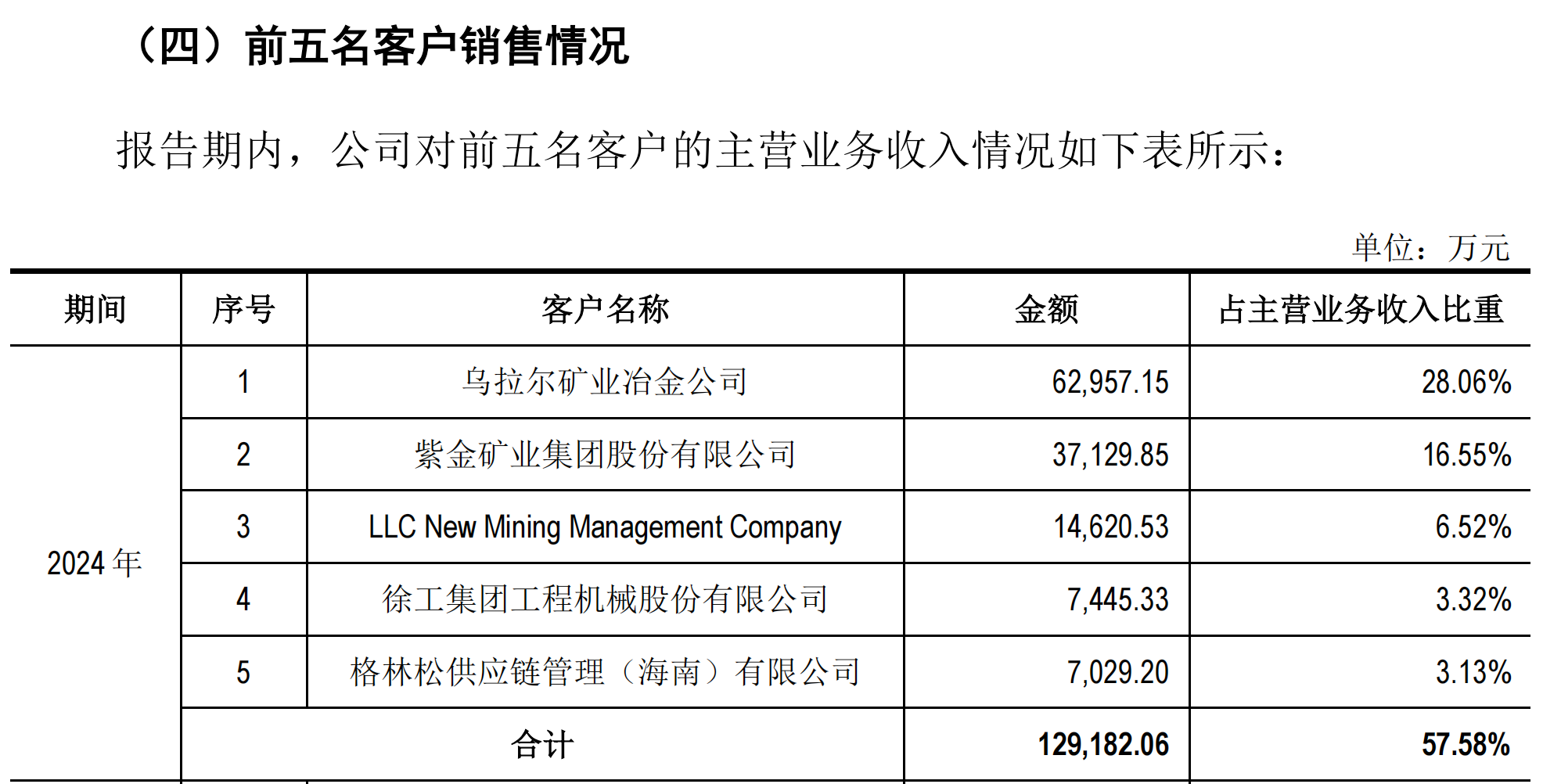
Core Viewpoint - Hai'an Group is in the IPO stage on the Shenzhen Stock Exchange, with a focus on engineering machinery tires and has experienced rapid growth over the past three years [1] Group 1: Business Overview - Hai'an Group specializes in the research, production, and sales of giant all-steel engineering radial tires and mining tire operation management, breaking the monopoly of international brands in the domestic market [2][3] - The company has seen significant sales growth from major clients such as Zijin Mining and XCMG after their investments, raising concerns about the company's independence [2][3] Group 2: Financial Performance - The gross profit margin of Hai'an Group reached 48% in 2024, significantly higher than the industry average of less than 20%, attributed to a higher proportion of high-value-added products [8] - From 2020 to 2022, sales to Zijin Mining surged from 65.03 million yuan to 213 million yuan, while sales to XCMG increased from 34.15 million yuan to 74.45 million yuan [3] Group 3: Market Dynamics - Approximately 44% of Hai'an Group's revenue comes from Russia, with exports accounting for about 75% of total revenue [1][7] - The company has benefited from the exit of major international tire brands from the Russian market, filling the gap and achieving rapid growth [6][8] Group 4: Future Prospects - Hai'an Group plans to invest nearly 3 billion yuan in expanding production and upgrading automation for giant all-steel engineering radial tires [6] - The company reported a slight increase in revenue for the first half of 2025, with net profit growth driven by exchange rate fluctuations and price adjustments with mining clients [9][10]

大中华区材料 - 稀土当前动态-Greater China Materials-are Earths What’s Happening Now
2025-11-10 03:34
Summary of Key Points from the Conference Call on Rare Earths Industry Overview - The report focuses on the **Rare Earths** industry, particularly in **Greater China** and the **Asia Pacific** region [1][6]. Core Insights and Arguments - **Temporary Relaxation of Export Controls**: On October 30, 2025, China's Ministry of Commerce announced a suspension of extensive export controls on rare earths for one year, with general export licenses likely to be issued for compliant producers [2][3]. - **Supply-Demand Outlook**: The supply-demand situation for major rare earth elements is expected to tighten further into **2026**, indicating potential price increases and supply constraints [1][5]. - **Trade Data Trends**: China's rare earth and magnet trade data for the first nine months of 2025 show mixed trends, with significant year-over-year declines in medium-to-heavy rare earth exports (over 40%) and growth in light rare earth exports (over 30%) [10]. - **Production and Quotas**: China's production of NdFeB (Neodymium Iron Boron) blanks is projected to grow approximately **8% YoY** to **390-400kt** in 2025, with further growth of **10-15% YoY** to **420-430kt** in 2026. Export demand may account for **15-18%** of this production [10]. Additional Important Information - **Import Trends**: Rare earth imports into China have slowed by **36.5% YoY**, primarily due to reduced imports from Myanmar and the US, although imports from Laos and monazite from Nigeria and Madagascar have increased [10]. - **Export Performance**: Exports of rare earth magnets from China fell by **5% YoY**, with a **25% YoY** decline in exports to the US, reflecting a decrease in high-end product exports due to the controls [10]. - **Recycling Contribution**: Supply from recycling, which constitutes about **one-third** of total supply, is not included in the mining quota and is expected to continue rising [10]. Conclusion - The rare earths industry is experiencing significant changes due to China's policy adjustments and market dynamics. The temporary relaxation of export controls may provide short-term relief, but the long-term outlook suggests tightening supply and increasing demand, particularly as production quotas and recycling efforts evolve.
华夏标普港股通低波红利ETF:低利率时代掘金港股的高股息机会
Quan Jing Wang· 2025-11-10 03:28
Core Viewpoint - The article highlights the increasing attractiveness of the Hong Kong stock market due to its relatively low valuations and the influx of southbound capital, with a focus on the launch of the China Asset Management's Hong Kong Stock Connect Dividend Low Volatility ETF (code: 159118) as a new investment tool for high dividend assets in Hong Kong [1][2][8]. Group 1: Market Conditions - The global low interest rate environment is prompting investors to seek stable returns, with Hong Kong stocks currently at historically low valuations, making them an appealing choice for investment [1][2]. - As of October 21, 2025, the Hang Seng Index's PE (TTM) is approximately 11.94 times and PB (LF) is about 1.22 times, placing it in the 79% and 83% percentiles of the past decade, respectively [2]. - Southbound capital has seen a net inflow of over 12 billion HKD into Hong Kong stocks since the beginning of 2025, marking a significant increase compared to previous years [3]. Group 2: Investment Strategy - The Hong Kong Stock Connect Dividend Low Volatility ETF (159118) utilizes a "dividend + low volatility" dual-factor strategy, selecting high dividend yield stocks with low volatility to provide investors with a streamlined investment option [6][8]. - The index tracks the top 75 stocks with the highest dividend yields from the Hong Kong Stock Connect, further narrowing down to the 50 stocks with the lowest volatility, ensuring a focus on cash flow and liquidity [6]. - Historical performance shows that the index has achieved a cumulative increase of approximately 94.95% since 2021, with an annualized return exceeding 16%, significantly outperforming the Hang Seng Index [6]. Group 3: Sector Distribution - The index maintains a balanced sector distribution, with the top three sectors being real estate (approximately 16%), utilities (about 15%), and banking (around 14%), ensuring no single sector exceeds 25% [7]. - The index includes high dividend leaders across various sectors, such as Jiangxi Copper, China Shenhua, and CNOOC, with a notable valuation discount of approximately 34.5% compared to A-shares, indicating significant potential for valuation recovery [7]. Group 4: Fund Management - China Asset Management is recognized for its expertise in index investment, with a team of 43 professionals and an average industry experience of over 12 years, providing strong support for its index products [7]. - The fund manager for the ETF, Yan Xiaoxian, has 10 years of experience in the securities industry, including over 4 years in public fund management, enhancing the fund's credibility [7]. - The ETF employs a complete replication strategy with low management fees of 0.15% and custody fees of 0.05%, aimed at reducing costs for investors [7].
供给短缺是利好铜价的中期逻辑,积极锚定资源增储或成行业趋势
Orient Securities· 2025-11-09 05:27
Investment Rating - The industry investment rating is maintained as "Positive" [4] Core Insights - The supply shortage is a favorable mid-term logic for copper prices, and actively anchoring resource reserves may become a trend in the industry [2] - The copper supply chain is experiencing frequent disruptions, leading to a significant reduction in expected increments, with a projected copper concentrate output of approximately 22.92 million tons in 2025, which is flat or slightly down from 2024 [7] - The demand for copper is expected to rise significantly due to emerging fields such as renewable energy and AI data centers, with the International Energy Agency predicting a demand of over 12 million tons by 2040 [7] - Companies in the copper sector are actively seeking to increase their resource reserves, which is expected to enhance their profitability [7] Summary by Sections Investment Recommendations and Targets - It is recommended to focus on companies with substantial resource reserves and expected mid-term copper production increases, such as Zijin Mining (601899, Buy) [7] - Other notable companies include Luoyang Molybdenum (603993, Not Rated) and Jincheng Mining (603979, Not Rated) [7] - For copper smelting, companies like Tongling Nonferrous Metals (000630, Not Rated) and Jiangxi Copper (600362, Not Rated) are highlighted [7]

特朗普出手截胡!中企谈妥百亿钨矿遭美企夺走,哈为何“转向”?
Sou Hu Cai Jing· 2025-11-09 05:04
Core Viewpoint - The competition for tungsten resources between the U.S. and China has intensified, with Kazakhstan unexpectedly granting development rights of a valuable tungsten mine to U.S. company Cove Capital LLC, undermining years of negotiations by Chinese firms [1][3]. Group 1: Geopolitical Dynamics - The tungsten mine in Kazakhstan is not just a commercial transaction but a geopolitical struggle, with the U.S. government intervening to secure the deal [3][5]. - The U.S. offered Kazakhstan a package including technology transfer, financial loans, and a $4.2 billion railway infrastructure contract, employing a "carrot and stick" strategy to sway Kazakhstan's decision [5][7]. - The deal resulted in Cove Capital LLC acquiring a 70% stake, while Kazakhstan's state-owned enterprise retained only 30%, highlighting the political nature of the transaction rather than market forces [7][11]. Group 2: Importance of Tungsten - Tungsten, despite its low profile, is critical for various industries, including military applications, due to its high melting point and hardness, making it essential for manufacturing armor-piercing ammunition and aerospace components [9][11]. - The U.S. has classified tungsten as a "critical strategic material," yet it currently produces almost none domestically and relies heavily on China for processing [9][11]. Group 3: China's Resource Strategy - China controls 80% of global tungsten production and has a complete processing chain, but its high-grade tungsten resources are depleting, necessitating overseas resource acquisition to maintain its global influence [9][11]. - The loss of the Kazakhstan tungsten mine represents a significant setback for China, emphasizing the need for a more nuanced approach to resource diplomacy that includes political sensitivity and strategic flexibility [18][21]. Group 4: Kazakhstan's Diplomatic Maneuvering - Kazakhstan's decision to pivot towards the U.S. reflects its "multi-vector diplomacy," aiming to balance influences from China, Russia, and the West [12][14]. - The introduction of U.S. investment is not merely financial but also serves to counterbalance Chinese influence and expand Kazakhstan's diplomatic options [14][16]. Group 5: Future Implications - The competition for tungsten is indicative of a broader shift in global resource competition, moving from capital-driven to strategic control, where resource ownership equates to future industrial power [20][21]. - The situation serves as a wake-up call for Chinese companies, highlighting the necessity to adopt a comprehensive strategy that integrates funding, technology, localization, and diplomatic engagement in resource acquisition [18][21].
重视铝的配置机会,稀土继续涨价
Guotou Securities· 2025-11-08 23:32
Investment Rating - The industry investment rating is "Outperform the Market" [4] Core Views - The report emphasizes the investment opportunities in aluminum and the continued price increase of rare earth metals. Recent expectations of reduced production in overseas electrolytic aluminum plants have raised concerns about supply. The rapid expansion of AI computing power may alter the electricity consumption structure, potentially impacting future electrolytic aluminum projects due to the long construction cycle of power plants. The Ministry of Commerce has announced the suspension of the implementation of four rare earth export control measures, leading to a moderate increase in rare earth spot prices. The overall outlook remains positive for aluminum, rare earths, copper, tin, gold, silver, cobalt, tantalum, and uranium [1][2][3]. Summary by Sections Non-Ferrous Metals - Concerns about electrolytic aluminum supply have arisen due to expected production cuts in overseas plants. The rapid growth of AI computing may change electricity consumption patterns, affecting future electrolytic aluminum projects [1]. - The Ministry of Commerce's decision to suspend certain rare earth export controls has led to a moderate increase in rare earth prices, with low inventory levels suggesting a potential replenishment cycle [1]. - The report maintains a positive outlook on metals including aluminum, rare earths, copper, tin, gold, silver, cobalt, tantalum, and uranium [1]. Precious Metals - COMEX gold and silver closed at $3995.2 and $48.0 per ounce, with slight increases of +0.33% and +0.04% respectively. The Federal Reserve may soon need to expand its balance sheet through bond purchases to meet liquidity demands [2]. - The report suggests a continued long-term upward trend in gold prices, supported by central bank and ETF buying. Silver prices may experience short-term volatility but are expected to maintain long-term elasticity [2]. Industrial Metals - Copper prices on LME closed at $10,695 per ton, down 1.1% from the previous week. Supply chain issues in Tanzania and Zambia are affecting copper trade, while downstream demand is showing signs of recovery [2][3]. - Aluminum prices on LME closed at $2,862 per ton, with a slight decrease of 1.6%. The report notes stable domestic electrolytic aluminum production capacity and tight liquidity in aluminum ingots [3]. - Tin prices are expected to remain stable due to a recovery in domestic refined tin production and slow progress in Myanmar's tin mining exports [8]. Strategic Metals - Rare earth prices have shown a slight increase, with the report anticipating a recovery in export demand and increased purchasing intentions from downstream manufacturers [9]. - Cobalt prices are under pressure due to tight supply and reduced purchasing intentions from downstream manufacturers, but a long-term upward trend is expected due to supply constraints [10].
什么情况!10万亿的“世界铜王”还不起5000块
Sou Hu Cai Jing· 2025-11-06 10:10
Core Viewpoint - The surge in international copper prices, exceeding 86,000 yuan/ton, is driven by increased demand from AI and electric vehicles, leading to significant profit increases for companies related to copper [2][3]. Group 1: Copper Price and Market Impact - The LME copper price has risen by 0.919% to 10,761.5 USD, while domestic copper prices in Shanghai range from 85,660 to 86,330 yuan/ton, reflecting a daily increase of 660 yuan [3]. - Companies such as Jiangxi Copper and China Aluminum have seen profit increases of 20.85% and 20.65% respectively, while Zijin Mining and Luoyang Molybdenum have experienced even higher gains of 55.45% and 72.61% [3]. Group 2: Zhengwei Group's Financial Issues - Zhengwei Group, led by Wang Wenyin, claims to possess 30 million tons of copper, valued at approximately 2.6 trillion yuan, but faces significant financial distress, including 90 legal cases totaling 9.98 billion yuan [5][6]. - Despite being a former Fortune Global 500 company with annual revenues of 700 billion yuan, Zhengwei's assets and claims have come under scrutiny, raising questions about the actual existence of its copper reserves [4][5]. Group 3: Business Practices and Controversies - Zhengwei's business model includes trade practices that inflate revenue through internal transactions and financing of accounts receivable, involving local government financing and listed companies [10][11]. - The company has engaged in real estate ventures, acquiring land for industrial parks and reselling it for profit, but has faced challenges in delivering actual economic benefits to local governments [16][18]. - Recent projects, such as a 6 billion yuan copper project in Fu'an, have stalled, leading to legal actions from local authorities seeking to reclaim land and address grievances [19][20].

江西铜业涨2.02%,成交额10.97亿元,主力资金净流出3033.98万元
Xin Lang Zheng Quan· 2025-11-06 02:41
Core Viewpoint - Jiangxi Copper's stock price has shown significant volatility, with a year-to-date increase of 100.36%, but a recent decline of 7.82% over the past five trading days [1] Group 1: Stock Performance - As of November 6, Jiangxi Copper's stock price reached 39.96 CNY per share, with a trading volume of 10.97 billion CNY and a turnover rate of 1.34%, resulting in a total market capitalization of 138.37 billion CNY [1] - The company has appeared on the "Dragon and Tiger List" once this year, with the most recent occurrence on October 9 [1] Group 2: Financial Performance - For the period from January to September 2025, Jiangxi Copper reported a revenue of 396.05 billion CNY, a slight decrease of 0.08% year-on-year, while the net profit attributable to shareholders increased by 20.85% to 6.02 billion CNY [2] Group 3: Shareholder Information - As of September 30, 2025, Jiangxi Copper had 125,600 shareholders, an increase of 6.64% from the previous period [2] - The company has distributed a total of 22.18 billion CNY in dividends since its A-share listing, with 6.22 billion CNY distributed over the last three years [3] Group 4: Major Shareholders - Among the top ten circulating shareholders, China Securities Finance Corporation holds 104 million shares, remaining unchanged from the previous period, while Hong Kong Central Clearing Limited reduced its holdings by 24.08 million shares to 44.51 million shares [3]
11月5日投资时钟(399391)指数涨0.03%,成份股国城矿业(000688)领涨
Sou Hu Cai Jing· 2025-11-05 09:55
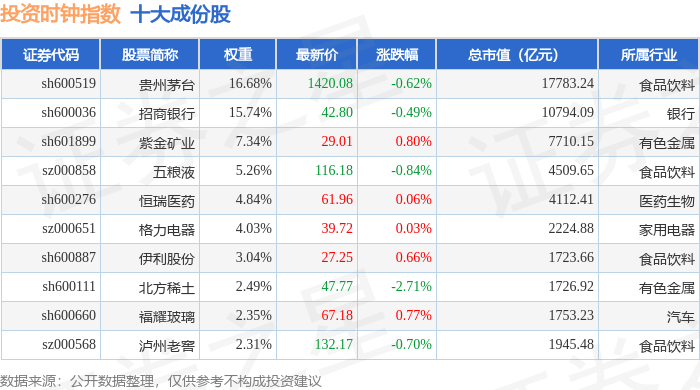
Market Overview - The Investment Clock Index (399391) closed at 3348.13 points, up 0.03%, with a trading volume of 78.792 billion yuan and a turnover rate of 0.81% [1] - Among the index constituents, 71 stocks rose while 28 stocks fell, with Guocheng Mining leading the gainers at a 9.42% increase and Dalian Shengya leading the decliners at a 9.99% decrease [1] Top Constituents - The top ten constituents of the Investment Clock Index are as follows: - Kweichow Moutai (sh600519) holds a weight of 16.68% and closed at 1420.08 yuan, down 0.62% with a market cap of 1778.324 billion yuan [1] - China Merchants Bank (sh600036) has a weight of 15.74%, closing at 42.80 yuan, down 0.49% with a market cap of 1079.409 billion yuan [1] - Yunnan Tin Company (sh601899) has a weight of 7.34%, closing at 29.01 yuan, up 0.80% with a market cap of 771.015 billion yuan [1] - Wuliangye Yibin (sz000858) has a weight of 5.26%, closing at 116.18 yuan, down 0.84% with a market cap of 450.965 billion yuan [1] - Hengrui Medicine (sh600276) has a weight of 4.84%, closing at 61.96 yuan, up 0.06% with a market cap of 411.241 billion yuan [1] - Gree Electric Appliances (sz000651) has a weight of 4.03%, closing at 39.72 yuan, up 0.03% with a market cap of 222.488 billion yuan [1] - Yili Industrial Group (sh600887) has a weight of 3.04%, closing at 27.25 yuan, up 0.66% with a market cap of 172.366 billion yuan [1] - Northern Rare Earth (sh600111) has a weight of 2.49%, closing at 47.77 yuan, down 2.71% with a market cap of 172.692 billion yuan [1] - Fuyao Glass (sh600660) has a weight of 2.35%, closing at 67.18 yuan, up 0.77% with a market cap of 175.323 billion yuan [1] - Jilin Chemical (sz000568) has a weight of 2.31%, closing at 132.17 yuan, down 0.70% with a market cap of 194.548 billion yuan [1] Capital Flow - The net outflow of main funds from the index constituents totaled 677 million yuan, while retail investors saw a net inflow of 708 million yuan [3] - Detailed capital flow for selected stocks includes: - China Zhongjin (601888) saw a main fund net inflow of 36.4 million yuan, while retail funds had a net outflow of 93.414 million yuan [3] - Jiangxi Copper (600362) had a main fund net inflow of 18.2 million yuan, with retail funds experiencing a net outflow of 70.3612 million yuan [3] - Weichai Power (000338) had a main fund net inflow of 13.5 million yuan, while retail funds had a net inflow of 1.60758 million yuan [3] - Giant Network (002558) had a main fund net inflow of 11.8 million yuan, with retail funds experiencing a net outflow of 65.0268 million yuan [3] - China Coal Energy (601898) had a main fund net inflow of 11.7 million yuan, while retail funds had a net outflow of 79.0666 million yuan [3]