赛力斯

Search documents
整车主线周报:2026年以旧换新政策落地,景气度向上-20260105
Soochow Securities· 2026-01-05 05:12
Investment Rating - The industry investment rating is "Overweight," indicating an expected outperformance of the industry index relative to the benchmark by more than 5% over the next six months [35]. Core Insights - The implementation of the vehicle trade-in policy in 2026 is expected to boost the industry's outlook, particularly for passenger vehicles, heavy trucks, and buses, with a focus on high-end electric vehicles and established export-oriented companies [2][26]. - The heavy truck segment is anticipated to see a sales volume of 800,000 to 850,000 units in 2026, reflecting a year-on-year increase of 3% [30]. - The bus segment is projected to maintain growth, with an estimated sales volume of 40,000 units in 2026, a 5% increase year-on-year [30]. - The motorcycle industry is expected to achieve total sales of 19.38 million units in 2026, a 14% increase, with large-displacement motorcycles projected to grow by 31% [27]. Summary by Sections Passenger Vehicles - The short-term outlook is positive due to the new subsidy policies, with expectations for a recovery in demand in Q1 2026. Key companies to watch include Jianghuai Automobile, Geely, Great Wall Motors, and BYD [2][26]. - The 2026 subsidy budget is projected at 125 billion yuan, which could drive an additional sales increase of 780,000 to 1.54 million units [15]. Heavy Trucks - The 2026 trade-in policy for heavy trucks has exceeded expectations, with subsidies remaining at previous levels. The anticipated sales volume for 2026 is optimistic, with a target of 800,000 to 850,000 units [30][19]. - Recommended companies in this segment include China National Heavy Duty Truck Group, Weichai Power, and FAW Jiefang [30]. Buses - The bus segment's policy has also exceeded expectations, with a projected sales volume of 40,000 units in 2026, reflecting a 5% year-on-year increase [30][18]. - Key recommendations include Yutong Bus and King Long [30]. Motorcycles - The motorcycle industry is expected to see a total sales volume of 19.38 million units in 2026, with large-displacement motorcycles projected to grow significantly [27]. - Recommended companies include Chunfeng Power and Longxin General [27].




汽车以旧换新补贴政策如期落地,26年新能源车同比增速有望维持高个位数增长:电力设备
Huafu Securities· 2026-01-05 03:45
Investment Rating - The industry investment rating is "Outperform the Market" [8][30]. Core Insights - The new vehicle replacement subsidy policy has been implemented as expected, with continued support for mid-to-high-end vehicles [2][13]. - The expected year-on-year growth rate for new energy passenger vehicles in 2025 is approximately 18%, with a forecasted high single-digit growth rate for 2026 [4][15]. - The performance of leading new energy vehicle companies is showing significant differentiation, with brands like Leap Motor, Xpeng, and NIO performing well [5][19]. Summary by Sections Investment Highlights - The 2026 vehicle replacement subsidy policy includes changes such as a shift from fixed subsidies to price-linked subsidies, with scrapping subsidies set at 12% for electric vehicles and 10% for gasoline vehicles, with caps of 20,000 and 15,000 yuan respectively [3][13]. - The overall subsidy policy is expected to stabilize, with a gradual reduction in subsidies for vehicles priced below 200,000 yuan, while maintaining support for those above this price point [3][13]. Market Dynamics - In the narrow passenger vehicle market, the cumulative wholesale volume from January to November 2025 is approximately 26.726 million units, representing a year-on-year increase of 11.2% [4][15]. - The cumulative wholesale volume for new energy vehicles during the same period is about 13.742 million units, with a year-on-year growth of 28.2% [4][15]. - The retail penetration rate for new energy vehicles is expected to reach approximately 54.1% in 2025, reflecting a year-on-year increase of 6.5 percentage points [4][15]. Investment Recommendations - The report suggests focusing on brands with strong mid-to-high-end potential, such as Geely, Seres, JAC Motors, and NIO, as well as export brands with sustained high growth, including BYD, Leap Motor, and Great Wall Motors [6][20].
港股汽车集体走低,长城汽车跌近7%,,蔚来汽车、小鹏汽车跌超4.2%,奇瑞汽车、零跑汽车、吉利汽车跌近4%
Ge Long Hui· 2026-01-05 02:45
Group 1 - The core viewpoint indicates that Hong Kong automotive stocks experienced a collective decline, with Great Wall Motors falling nearly 7% and NIO and Xpeng down over 4.2% [1] - The report from CICC suggests that the domestic automotive industry in mainland China will face certain challenges in demand due to ongoing policies, while overseas sales are expected to grow steadily [1] - Investment strategy emphasizes that auto parts are favored over complete vehicles, with a focus on opportunities arising from AI-related developments in robotics, intelligent driving, and data center liquid cooling [1] Group 2 - The report highlights that new policies are expected to support the passenger vehicle market, but domestic demand still faces challenges [2] - A study by Benchmark Mineral Intelligence predicts that global electric vehicle sales growth will reach its lowest level since the pandemic, with an expected increase of only 13% to 24 million units by 2026, significantly lower than the 22% growth forecast for 2025 [2] - The slowdown in the European market and rapid decline in the U.S. market are identified as new obstacles in the transition away from fuel vehicles [2]

雷军再谈丢轮保车:非常成熟的安全设计 奔驰最早使用
Sou Hu Cai Jing· 2026-01-05 02:43
Core Viewpoint - Xiaomi's chairman Lei Jun addressed recent controversies regarding the company's automotive safety design, emphasizing that the "wheel detachment" concept is a well-established safety design principle in luxury brands, originally proposed by Mercedes-Benz [1][3]. Group 1: Historical Context - The "wheel detachment" safety concept can be traced back to the 1950s, with Mercedes-Benz safety engineer Béla Barényi being the first to propose modern passive safety principles, including crumple zones and "force transfer paths" [3]. - The first implementation of this concept was in the 1959 Mercedes-Benz W111 model, marking the inception of the "wheel detachment for vehicle protection" safety logic [3]. Group 2: Design Philosophy - The design is not intended to allow wheels to "fly off" but aims to dissipate impact energy in extreme collision scenarios by sacrificing non-critical components like wheels and suspension, thereby maximizing occupant safety [3]. - Other brands such as Volvo, BMW, and Audi have adopted and optimized similar structural designs, making it a common practice in automotive safety engineering [3]. Group 3: Xiaomi's Commitment - During a recent live stream of the Xiaomi YU7 teardown, viewers could clearly see the structural design details, showcasing Xiaomi's significant investment in automotive safety [5]. - The company has established safety as a foundational principle from the outset of its vehicle development process [5].



2025年港股IPO募资额超2800亿港元,诞生8家百亿级融资企业
Huan Qiu Wang· 2026-01-05 01:35
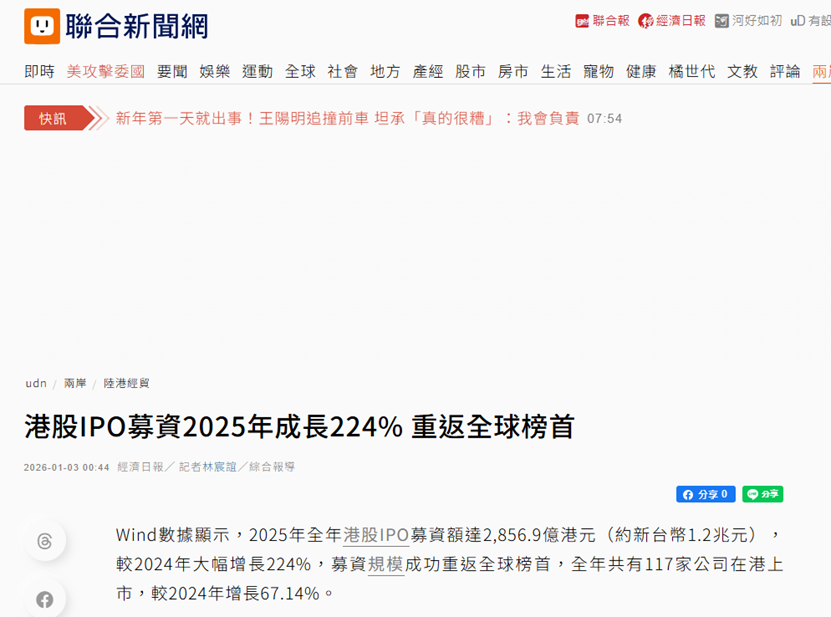
报道还提到,港股市场2025年全年诞生8家百亿级港元融资企业,分别为宁德时代、紫金黄金国际、三一重工、赛力 斯、恒瑞医药、三花智控、海天味业、奇瑞汽车。8家企业合计募资达1424.6亿港元,占全年募资总额的52.75%,龙头 效应显著,成为港股IPO市场复苏的"压舱石"。 另据港交所数据显示,截至2025年12月31日,共有逾612件上市申请,其中包括549家主板、11家GEM(原创业板), 还有52家根据"主板上市规则"第20章及第21章递交的上市申请,仍在排队处理的还有321件。 【环球网财经综合报道】据Wind资讯初步统计,截至2025年12月末,包括聚辰股份、天孚通信等在内的超20家A股上 市公司,披露赴港上市相关公告。对此有机构认为,港股"含A量"提高,释放出两地市场协同发力的积极信 号,"A+H"模式预计将持续火热。 联合新闻网近日发文称,2025年全年港股IPO募资额达2856.9亿港元,较2024年大幅增长224%,募资规模成功重返全 球榜首,排名超越纽交所、纳斯达克及印度股市;全年共有117家公司在港上市,较2024年增长67.14%。 ...





观车 · 论势 || 疾风知劲草,新局自此开
Zhong Guo Qi Che Bao Wang· 2026-01-05 01:24
Core Viewpoint - The Chinese automotive industry in 2025 is characterized by a "reversal," with a shift from irrational competition and price wars to a more regulated and innovative landscape [1][5]. Group 1: Industry Regulation and Order - The internal forces seeking order have awakened, leading to a collective consensus against "involution" in the industry, with various government departments implementing measures to regulate competition [1][2]. - The Ministry of Industry and Information Technology and other agencies have introduced comprehensive governance measures to address irrational competition, resulting in a significant reduction in promotional pricing and discounts in the passenger car market [1][2]. Group 2: Corporate Integration and Efficiency - Major automotive companies are undergoing integration to enhance efficiency and reduce costs, as seen with Geely's integration of Zeekr and NIO's consolidation of brands [2]. - The trend of corporate integration reflects a consensus among automakers to pool resources and strengthen their competitive positions in the market [2]. Group 3: Innovation and Technology - Innovation is driving the industry forward, with advancements in technology making features like assisted driving more accessible, as evidenced by a 64% penetration rate of combined assisted driving vehicles in the new car market [3]. - The automotive industry's boundaries are blurring as companies expand into areas like robotics and smart devices, indicating a long-term evolution of technology and business models [3]. Group 4: Market Expansion and Globalization - Incentive policies such as trade-in programs are effectively stimulating the existing market, while the expansion of charging networks and sales channels is awakening the potential of county-level markets [4]. - China's automotive exports reached 6.343 million units in the first 11 months of the year, marking an 18.7% year-on-year increase, with a shift towards new export models like technology and localized production [4]. Group 5: Future Outlook - The automotive industry is expected to continue addressing "involution" in 2026, with new guidelines being introduced to ensure compliance in pricing behavior [5]. - The industry aims to achieve stable growth while navigating uncertainties such as policy changes and international market conditions, striving for a more competitive and resilient automotive landscape [6].
小米汽车41万辆收官+首次盈利,雷军立55万Flag,四款新车轰炸增程市场
3 6 Ke· 2026-01-04 23:58
Core Insights - Xiaomi's CEO Lei Jun openly addressed controversies during the New Year live stream, emphasizing transparency and accountability in marketing practices [1][4] - In 2025, Xiaomi's automotive division exceeded its delivery target, achieving 410,000 units against an initial goal of 300,000, showcasing strong market performance despite skepticism [3][4] - The company plans to invest 200 billion yuan (approximately 28.5 billion USD) over the next five years in R&D, focusing on core technologies and generative AI to enhance vehicle performance and user experience [5][9] Delivery and Sales Performance - Xiaomi's automotive division adjusted its delivery target from 300,000 to 350,000 units mid-year, ultimately delivering 410,000 units [3] - The Xiaomi SU7 was the best-selling car in the 200,000 yuan and above segment, while the newly launched YU7 contributed significantly with over 150,000 units delivered [3][4] - The Q3 financial report indicated that Xiaomi's smart electric vehicles and AI innovations achieved profitability for the first time in a single quarter [3] R&D Investment and Strategic Focus - The planned 200 billion yuan investment will average 40 billion yuan annually, targeting advancements in battery technology, electric drive, and smart driving [5][9] - Generative AI will be integrated into all business operations to enhance user interaction and overall smart experience [5][9] - The automotive industry is increasingly relying on AI for efficiency and competitiveness, with companies like Geely and Seres demonstrating significant improvements through AI integration [8][9] Upcoming Product Launches - Xiaomi plans to launch four new vehicles in 2026, including an updated SU7 and two range-extended SUVs, aiming to capture the high-end family market [13][19] - The new models are expected to enhance user experience with features like increased cabin space and advanced technology [16][19] - The introduction of these vehicles aligns with Xiaomi's strategy to leverage its ecosystem and supply chain advantages [21] Production Capacity and Market Strategy - Xiaomi's combined production capacity is projected to reach 300,000 units annually, with potential to increase to 450,000 units through double-shift operations [25] - The company is preparing to enter the competitive large SUV market, targeting established players like Li Auto and Aion [25][26] - Xiaomi's strategy emphasizes understanding consumer needs and delivering value, which is crucial for competing in the high-end market [21][25] Future Outlook - The next five years will be critical for Xiaomi as it aims to solidify its position in the domestic market while preparing for international expansion by 2027 [27][28] - The company's ability to meet its ambitious delivery targets will be essential for building brand reputation and product strength ahead of global market entry [27][28]

国补落地及2026年消费趋势判断
2026-01-04 15:35
Summary of Conference Call Notes Industry Overview - The conference call primarily discusses the **automobile** and **home appliance** industries in China, focusing on government subsidy policies and their implications for market dynamics and consumer behavior [1][2][20]. Key Points on Government Subsidies - **2025 National Subsidy Funding**: The funding mainly comes from special government bonds, with a total government debt of **14 trillion RMB**. The narrow deficit is **5.66 trillion RMB**, and special bonds amount to **1.8 trillion RMB** [2][3]. - **Subsidy Strategy Changes**: The automobile industry will see a shift to a high-price, high-subsidy and low-price, low-subsidy model, which is expected to reduce demand. The subsidy for electric vehicles and traditional vehicles will be adjusted based on vehicle price [2][14]. - **Impact on Tax Revenue**: Consumer subsidies are expected to increase sales and tax revenues, but the tax revenue growth rate is projected to be **2%**, lower than the nominal GDP growth rate of **4%**, indicating fiscal pressure [9]. Automobile Industry Insights - **Market Trends**: The automobile sector is expected to face a decline in domestic demand by **3-4%** in 2026, but the penetration rate of new energy vehicles is anticipated to increase by **4-5%**. Exports are expected to grow by **15%**, with new energy vehicle exports increasing by **35%** [14][19]. - **Investment Opportunities**: Key growth areas include international expansion, high-end market development, and smart technology integration, particularly in L4 autonomous driving [15][17]. - **Consumer Behavior**: There is a significant consumer wait-and-see attitude, with **40-60%** of consumers hesitant to make purchases, leading to inventory buildup [19]. Home Appliance Industry Insights - **Subsidy Policy Changes for 2026**: The number of subsidized categories will be reduced from **12 to 6**, focusing on energy-efficient products. The maximum subsidy per product will decrease from **2000 RMB to 1500 RMB** [20]. - **Market Performance**: The home appliance sector showed mixed results in 2025, with overall sales growth in the first half but a decline in the second half due to tightening policies and high base effects [21]. - **Future Outlook**: If the government continues to provide **80 billion RMB** in subsidies, the home appliance market is expected to see modest growth, with air conditioning sales projected to increase by **4.7%** under reduced subsidy effectiveness [22]. Competitive Landscape - **Market Dynamics**: The competitive landscape in the home appliance industry is shifting towards larger companies like Midea and Haier, which are enhancing shareholder returns through dividends and stock buybacks. Emerging markets and new product exports are becoming crucial for growth [24]. - **Investment Potential**: The two-wheeler market and emerging products like robotic vacuums are highlighted as having strong investment potential due to resilient demand and low valuations [23]. Conclusion - The conference call emphasizes the cautious approach of the government in adjusting subsidy policies to stabilize investment and consumption while addressing fiscal pressures. The automobile and home appliance industries are adapting to these changes, with a focus on innovation and international expansion as key growth strategies.
汽车行业周报:2026年汽车以旧换新政策发布-20260104
GF SECURITIES· 2026-01-04 15:33
Investment Rating - The industry investment rating is "Buy" [6] Core Viewpoints - The report highlights the implementation of a large-scale equipment update and consumer goods replacement policy for 2026, which includes subsidies for scrapping and replacing vehicles. The policy is expected to significantly boost the sales of mid-to-high-end passenger cars [6][9][18]. - The report maintains a judgment of "price increase and stable volume" for domestic passenger car demand in 2026, indicating a positive outlook for the industry despite potential market fluctuations [18]. Summary by Sections 1. 2026 Vehicle Replacement Policy - The policy supports scrapping and replacing personal vehicles with subsidies of 12% (up to 20,000 CNY) for new energy vehicles and 10% (up to 15,000 CNY) for fuel vehicles with an engine size of 2.0 liters or less [9][10]. - It also includes support for scrapping old commercial vehicles and promoting the electrification of city buses [9][10]. 2. Market Share Tracking in PHEV Segment - The report focuses on the performance of PHEV market shares, particularly for BYD and Geely, as they adjust their market strategies and configurations [11]. - The analysis indicates significant variance in market shares due to increased supply and competitive strategies [11]. 3. Recent Report Insights - The continuation of the vehicle replacement policy aligns with expectations, and the report anticipates a rise in the proportion of mid-to-high-end passenger car sales due to the subsidy structure [18]. - The report reflects on the previous year's strategy of "emerging from deflation," which has proven to be correct, and emphasizes the importance of regulatory changes and strategic adjustments by leading companies [18]. 4. Investment Recommendations - The report suggests a "shelf-style" investment approach, recommending various companies across the passenger vehicle chain, including Geely, BYD, and others for potential growth [19]. - Specific companies are categorized into "right-side" and "left-side" targets based on their operational performance and market positioning [19].

周观点 | 2025销量圆满收官 2026关注新国补落地节奏【国联民生汽车 崔琰团队】
汽车琰究· 2026-01-04 14:18
Market Performance - The automotive sector outperformed the market this week, with a 1.9% increase, ranking 4th among Shenwan sub-industries, surpassing the CSI 300 by 1.8 percentage points [1] - Within the sub-sectors, automotive parts, commercial passenger vehicles, motorcycles and others, and commercial freight vehicles rose by 3.8%, 0.4%, 0.2%, and 0.1% respectively, while passenger vehicles and automotive services fell by 1.3% and 2.3% [1] Investment Recommendations - Recommended core stocks include Geely Automobile, Xpeng Motors, BYD, Berteli, Top Group, New Spring Co., Hu Guang Co., and Chunfeng Power [2][11] - For passenger vehicles, recommended stocks are Geely Automobile, Xpeng Motors, and BYD, with a focus on Jianghuai Automobile [5] - In the parts sector, recommendations include intelligent driving companies like Berteli, Horizon Robotics, and Kobot, as well as new force industry chains such as H chain (Xingyu Co., Hu Guang Co.) and T chain (Top Group, New Spring Co., Shuanghuan Transmission) [5][24] Robotics Sector - Huawei increased its investment in humanoid robots, with Dongguan Jimu Robotics Co., Ltd. raising its registered capital from 3.89 billion to 4.69 billion yuan, focusing on key technologies like machine vision and natural language processing [3][11] - The production progress and technological iteration of Tesla remain core themes, with domestic robot manufacturers like Yushut Technology expected to enter the IPO stage soon, potentially catalyzing the sector [3][11] Policy Impact on Demand - The new national subsidy policy for 2026 aims to stimulate domestic demand, transitioning from a fixed subsidy model to a flexible mechanism based on vehicle price [4][12] - The policy is expected to improve the structure of subsidized models, activating demand for mid-to-high-end vehicle replacements and reducing low-level price competition [4][18] Sales Performance - In December, BYD, Geely, and Changan ranked as the top three automakers by sales, with respective sales of 420,398, 255,000, and 236,817 units, showing a year-on-year change of -18.3%, +1.6%, and +12.7% [4][19] - New energy vehicle sales are projected to benefit from the new subsidy policy, with a focus on the sales targets set by Geely, Zero Run, and Xiaomi for 2026 [19][20] Motorcycle Market - The large-displacement motorcycle market is expanding rapidly, with sales of 250cc and above motorcycles reaching 61,000 units in November, a year-on-year increase of 11.3% [31] - Recommended companies in this sector include Chunfeng Power and Longxin General, which are leading in the large-displacement motorcycle market [31][33] Commercial Vehicle Sector - The heavy truck market saw a significant year-on-year increase of approximately 46% in November, driven by the old-for-new subsidy policy that supports the replacement of older diesel trucks [34][36] - Recommended companies in this sector include Weichai Power and China National Heavy Duty Truck Group [36] Tire Industry - The tire industry is experiencing a strong demand with high operating rates, particularly in the PCR segment, which stood at 72.05% [38] - Recommended companies include Sailun Tire and Senqilin, which are expected to benefit from the ongoing globalization and demand recovery [37][39]