
企业盈利修复

Search documents
盈利修复的喜和忧
Xinda Securities· 2026-03-27 14:35
Group 1: Corporate Profit Highlights - In the first two months of this year, corporate profit growth reached 15.2%, significantly higher than last year's overall performance[6] - Corporate profit margins have broken the two-year downward trend, indicating a positive signal for profit recovery[6] - Revenue growth has outpaced cost growth, with the cost per 100 yuan of revenue showing a negative year-on-year change for the first time since 2022[9] Group 2: Downstream Consumption Challenges - Despite overall profit improvement, profit margins in downstream consumption continue to decline, with consumer goods manufacturing margins dropping by 0.7 percentage points compared to last year[16] - The profit recovery has not yet transmitted to downstream consumption, indicating a structural divergence in corporate profitability[16] Group 3: A-Share Market Outlook - A-shares may enter a profit-driven phase, although recent geopolitical tensions have negatively impacted market performance[21] - The ongoing Middle East conflict has led to significant fluctuations in oil prices, with Brent crude reaching a peak of $112.19 per barrel before falling to $99.94[21] - If geopolitical tensions ease, A-shares could benefit from improved corporate profit margins and sustained positive profit growth[22] Group 4: Risk Factors - Potential risks include domestic policy measures falling short of expectations and ongoing geopolitical uncertainties[25]

——广发中证1000ETF投资价值分析:寻找盈利改善预期下的弹性
Huachuang Securities· 2026-03-13 07:46
Core Insights - The current liquidity remains relatively abundant, with the CSI 1000 index outperforming the overall market since the beginning of the year, increasing by 10.1% compared to 6.9% for the Wind All A and 1.6% for the CSI 300 [2][12] - Expectations for GDP deflation index to turn positive this year, coupled with strengthened policy support for technological innovation, are likely to restore risk appetite for growth sectors [2][19] - Corporate earnings are expected to continue recovering throughout the year, with the CSI 1000 showing greater fundamental elasticity [3][12] Group 1: Earnings Recovery and Market Dynamics - The current environment of abundant liquidity has led to a preference for small-cap growth stocks, with the CSI 1000 index showing a significant increase since the beginning of the year [14] - Historical trends suggest that monetary easing may lead to a return of inflation, which could positively impact corporate earnings, with an expected growth rate of 11%-17% for non-financial net profits in the entire A-share market in 2026 [3][23] Group 2: Investment Value Analysis of CSI 1000 Index - Valuation comparison indicates that the CSI 1000 index is at a medium level among major broad-based indices, with a price-to-earnings ratio of 50.8 times, which is at the 84th percentile over the past decade [4][30] - The industry distribution shows a strong focus on technology and growth sectors, with significant weights in TMT (Technology, Media, and Telecommunications) and high-end manufacturing [5][33] - The CSI 1000 index has historically outperformed the CSI 300 and CSI 800, with a cumulative return of 115% since 2010, although it is slightly lower than the Wind All A index [6][42] Group 3: Performance and Growth Expectations - The expected net profit growth rate for the CSI 1000 in 2026 is projected to be 25%, significantly higher than the overall market's 18.9% [7][46] - Recent improvements in earnings have been noted, with the CSI 1000's net profit growth recovering from a decline of -20% in Q4 2024 to -1.8% in Q3 2025 [7][46] - The CSI 1000 index's fundamental elasticity is expected to be greater during the earnings upcycle, making it a more attractive investment option [7][46] Group 4: Example of Investment Tool - The GF CSI 1000 ETF (560010) is designed to closely track the CSI 1000 index, providing investors with a tool for exposure to small-cap companies [8][47]
必看,保险大佬们的最新十大观点
表舅是养基大户· 2026-03-04 13:33
Core Viewpoint - The article emphasizes the importance of a long-term perspective in investment strategies, particularly in the context of the insurance asset management industry and its outlook for 2026 [1]. Group 1: Interest Rate Projections - The forecast for 10-year government bonds is between 1.8% and 1.9%, while 30-year bonds are expected to yield between 2.2% and 2.4% [6][9]. - Approximately 70-80% of institutions predict that 10-year bonds will remain below 2%, with a significant portion expecting 30-year bonds to stay within the 2.2%-2.4% range [9]. - The yield on AAA-rated credit bonds is projected to be between 2% and 2.5%, influencing the actual risk-free rate for residents [12]. Group 2: Asset Allocation Trends - A significant trend is the shift from non-standard to standardized assets, with a notable increase in allocations towards bonds and equities, while deposits and other non-standard investments are being reduced [13][15]. - The majority of institutions (over 70%) plan to increase their allocations to stocks, indicating a strong preference for equity investments [15]. Group 3: Insurance Liability and Product Trends - The reform in insurance liabilities is leading to a rise in the popularity of participating insurance products, which in turn reduces the demand for long-duration bonds [19][21]. - The shift towards participating insurance products is resulting in a higher allocation to equities compared to traditional insurance products [21]. Group 4: Factors Influencing A-Share Market - Three main factors are identified as influencing the A-share market in 2026: corporate profit recovery, liquidity environment, and industrial policy along with technological growth [22][26]. - 90% of institutions believe that corporate profit recovery is the most critical factor affecting market performance [26]. Group 5: Preferred Investment Indices - The most favored indices among insurance asset management institutions are the Sci-Tech 50, CSI 300, and A500, with 80%, 60%, and nearly 50% of institutions respectively selecting them [29][33]. - The preference for these indices is partly due to regulatory changes that have adjusted risk factors for insurance companies investing in stocks [33]. Group 6: Industry Focus Areas - The consensus among institutions highlights several key industry sectors: non-ferrous metals, electronics, computers, power equipment, telecommunications, chemicals, pharmaceuticals, and military industry [34][39]. - The intersection of preferences from both insurance asset management and insurance companies reveals a strong interest in semiconductor, AI computing, and defense sectors [39]. Group 7: Investment Vehicles - Secondary bond funds are becoming a primary vehicle for insurance capital entering the market, with a notable increase in their allocation among insurance companies [41]. - The demand for overseas investments, particularly in Hong Kong stocks, remains high, while the interest in US dollar bonds has significantly decreased [45][49].


广发证券:2026年险资预计稳步增配权益 久期策略基本维持不变
智通财经网· 2026-02-27 08:01
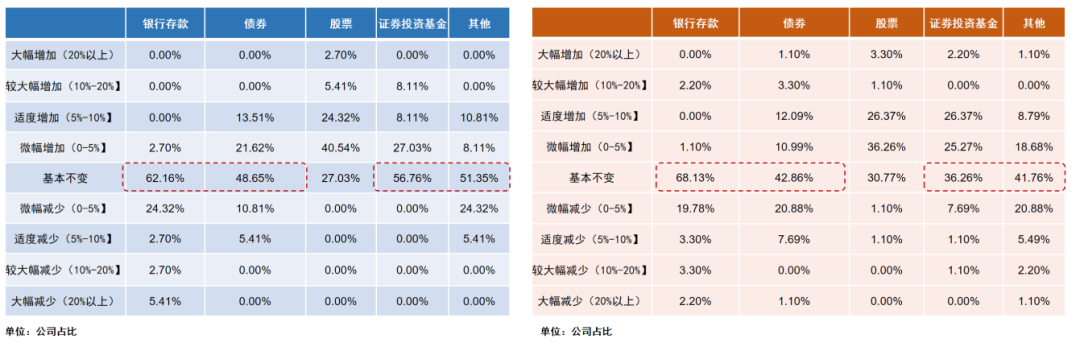
Core Insights - The report from GF Securities indicates that stocks and securities investment funds are the most favored domestic investment assets for insurance institutions in 2026 [1][3] - The survey conducted by the China Banking and Insurance Asset Management Association reflects the asset allocation outlook of 127 insurance institutions, covering major asset classes, market judgments, and preferences [2] Asset Allocation - Insurance institutions are expected to moderately or slightly increase their stock investments, while the allocation to bank deposits and bonds is anticipated to remain stable compared to 2025 [3] Bond Market Outlook - Most insurance institutions hold a neutral stance on the overall bond market for 2026, with duration strategies expected to remain unchanged. The 10-year government bond yield is projected to be in the range of 1.8%-1.9%, while the 30-year yield is expected to be between 2.2%-2.4% [4] - Over half of the insurance institutions expect the yield center for high-grade credit bonds to be in the range of 2.0%-2.5%, with credit spreads anticipated to show a fluctuating trend. High-grade industrial bonds, perpetual bonds from banks, secondary capital bonds, and convertible bonds are favored [4] A-Share Market Outlook - A majority of insurance institutions are optimistic about the A-share market in 2026, with plans to slightly increase their allocation to A-shares. They favor stocks in the Sci-Tech 50, CSI 300, CSI A500, and ChiNext, particularly in sectors such as electronics, non-ferrous metals, power equipment, computers, communications, pharmaceuticals, and basic chemicals [5] - Key investment themes include semiconductors, national defense, AI, robotics, energy metals, commercial aerospace, high-dividend stocks, and innovative pharmaceuticals, with corporate profit recovery and liquidity environment being the main factors influencing the A-share market [5] Overseas Investment Preferences - Hong Kong stocks are the most favored overseas investment option for insurance institutions in 2026, with gold and US stocks also receiving significant attention. Half of the asset management institutions plan to slightly increase their allocation to Hong Kong stocks, while 40% intend to maintain their current allocation [6] Long-term Trends for Listed Insurers - The investment asset scale of listed insurance companies has been growing at double-digit rates, with an increasing proportion of equity investments and enhanced active management capabilities, leading to improved equity investment elasticity. The long-term trend of the interest rate spread is expected to improve due to stable long-term rates and capital market growth [7] Investment Recommendations - The report suggests focusing on the insurance sector, with specific stock recommendations including China Ping An (A/H), China Life (A/H), China Taiping (H), New China Life (A/H), China Pacific Insurance (A), China People’s Insurance Group (H), China Property & Casualty Insurance (H), and AIA Group (H) [8]

看好境内投资资产!2026年险资配置展望来了
Guang Zhou Ri Bao· 2026-02-26 16:36
Core Insights - The China Banking and Insurance Asset Management Association released a survey indicating the investment intentions of insurance institutions for 2026, highlighting a positive outlook for domestic stocks and securities investment funds [1] Asset Allocation Overview - A total of 127 insurance institutions participated in the survey, including 36 asset management firms and 91 insurance companies [1] - Most insurance institutions plan to maintain their allocation ratios for bank deposits, bonds, securities investment funds, and other financial assets similar to 2025, with some showing a willingness to slightly increase stock investments [1] Detailed Asset Allocation Plans - In terms of bond market outlook, most insurance institutions hold a neutral stance, expecting 10-year government bond yields to be in the range of 1.8% to 1.9% and 30-year yields between 2.2% and 2.4% [3] - Over half of the institutions anticipate high-grade credit bond yields to center around 2.0% to 2.5%, with overall credit spreads expected to fluctuate [3] - The preferred bond types include high-grade industrial bonds, perpetual bonds, secondary capital bonds, and convertible bonds, with a focus on 10 to 30-year maturities [3] A-Share Market Outlook - Most insurance institutions are optimistic about the A-share market for 2026, favoring stocks in indices such as the Sci-Tech 50, CSI 300, and ChiNext [3] - Key sectors of interest include electronics, non-ferrous metals, power equipment, computers, communications, pharmaceuticals, and basic chemicals, with a focus on themes like semiconductor chips, defense, AI computing power, and high dividends [3] Fund Investment Preferences - For 2026, insurance asset management institutions prefer to allocate to equity funds, secondary bond funds, mixed equity funds, index funds, and ETFs, while insurance companies favor secondary bond funds and growth funds [5] - Nearly half of the insurance institutions plan to slightly increase their allocation to public funds [5] Offshore Investment Preferences - Hong Kong stocks are the most favored offshore investment for insurance institutions in 2026, with gold and US stocks also receiving attention [5] - About half of the asset management institutions plan to slightly increase their allocation to Hong Kong stocks, while 40% of insurance companies intend to maintain their current allocation [5]
看好A股结构性机遇 外资公募密集发声
Zhong Guo Jing Ji Wang· 2026-02-24 00:31
Group 1 - Foreign public funds are expressing positive signals regarding the mid-term outlook of the Chinese equity market, driven by a favorable global liquidity environment and expectations of a weaker dollar [1] - The proportion of long-term funds, such as pensions and insurance capital, is increasing, which helps optimize market investment structure [2] - There is a noticeable shift in residents' asset allocation towards equity assets, indicating a growing attractiveness of the equity market [1][2] Group 2 - The macroeconomic environment and policy direction are expected to lead to a "long cycle, structural bull market" in the A-share market, providing rich allocation opportunities for investors [2] - The ongoing "deposit migration" phenomenon is pushing residents to allocate more towards the equity market, which is expected to unfold gradually by 2026 [3] - The low interest rate environment may drive more funds towards emerging markets, benefiting the Chinese stock market [3] Group 3 - The recovery of the macroeconomic expansion and continuous improvement in corporate earnings are crucial for market confidence [4] - The shift from "policy support" to "endogenous growth" creates a healthier environment for active stock selection based on fundamentals [4] - The "going out" capability of companies is identified as a key alpha source, with the contrast between domestic sales pressure and overseas export opportunities in the home appliance industry highlighting the global competitiveness of Chinese manufacturing [4] Group 4 - Supply constraints and demand upgrades in certain industries reveal investment opportunities, particularly in industrial metals like aluminum [5] - The Chinese consumer market is experiencing an upgrade from quantity to quality, with strong recovery in leisure tourism and a demand for localized, in-depth experiences [5] Group 5 - The "14th Five-Year Plan" is expected to drive diverse growth paths for the Chinese economy, focusing on five key areas: technology, manufacturing, renewable energy, healthcare, and emerging, niche, experiential consumption [6]
南向资金开年净流入逾580亿元 机构看好港股中长期配置机会
Shang Hai Zheng Quan Bao· 2026-02-01 18:22
Group 1 - The Hong Kong stock market faced pressure in Q4 2025 but showed significant strength entering 2026, with net inflows from southbound funds exceeding 58 billion yuan [1] - In 2025, cumulative net inflows from southbound funds reached 1.3 trillion yuan, the highest since the launch of the Shanghai-Hong Kong and Shenzhen-Hong Kong Stock Connect programs [1] - As of January 29, 2026, the Hang Seng Index had risen by 9.12% year-to-date, ranking among the top global indices [1] Group 2 - Morgan Stanley's fund manager noted that the valuation of core technology assets in the Hong Kong stock market has improved following a value reassessment in 2025, indicating high cost-effectiveness for investment [2] - The outlook for 2026 is cautiously optimistic, with expectations of further recovery in corporate earnings driven by macro policies and liquidity improvements [2] - The Hong Kong stock market is still considered undervalued compared to U.S. and Japanese markets, presenting significant potential for valuation recovery [2] Group 3 - HSBC Jintrust Fund anticipates a positive performance for the Hong Kong stock market in 2026, supported by reduced overseas uncertainties and expected recovery in corporate earnings [3] - The overall earnings growth for the Hong Kong market is projected to achieve high single-digit growth in 2026, with the Hang Seng Technology sector potentially reaching double-digit growth [3] - The Hong Kong market demonstrates strong attractiveness in terms of both valuation and earnings growth compared to global markets [3]
春季行情向纵深演绎 机构判断市场风格或趋于均衡
Shang Hai Zheng Quan Bao· 2026-02-01 18:14
Group 1 - The A-share market is experiencing accelerated sector rotation, with previously strong-performing sectors like computer and new energy facing corrections, while previously lagging sectors such as liquor and real estate are performing well [2][5] - Despite external disturbances, the A-share market shows signs of a phase of adjustment, but the medium-term outlook remains positive with ample opportunities [3][4] - The upcoming Spring Festival holiday is not dampening trading activity, indicating strong market engagement and potential for further development in the spring market [2][3] Group 2 - The market may see a style switch as the spring rally progresses, with a shift from small-cap stocks to large-cap stocks and a focus on quality over speculation [5][6] - The recent performance of liquor and real estate sectors suggests a convergence in market structure as the spring rally enters its latter half, with expectations of balanced upward trends [5][6] - Long-term prospects for the metals sector remain positive due to anticipated demand from AI data centers and renewable energy, despite short-term corrections providing better entry points [6]

开年超283亿资金涌入港股ETF
21世纪经济报道· 2026-01-30 14:23
Core Viewpoint - The article highlights a significant inflow of funds into Hong Kong's technology sector through cross-border ETFs, indicating a growing interest in technology-themed investments as the market rebounds in early 2026 [1][3]. Fund Inflows and Performance - Since the beginning of 2026, over 160 Hong Kong ETFs have seen a net inflow of 28.389 billion yuan, with approximately 90% of this capital directed towards technology-themed products such as the Hong Kong Internet ETF and the Hang Seng Technology ETF [1][3][4]. - The total scale of Hong Kong ETFs has approached 800 billion yuan, marking an increase of nearly 79 billion yuan since the end of 2025, representing an 11% growth [6]. Product Development - At least 28 new Hong Kong-themed funds have been reported by public fund managers since the start of 2026, focusing primarily on technology, healthcare, and consumer sectors, with technology funds being the most prominent [1][8][9]. - The top 10 funds attracting significant capital include several technology ETFs, with inflows exceeding 10 billion yuan for products like the GF Hong Kong Non-Bank ETF and the FT Hong Kong Internet ETF [4][5]. Fund Performance - Most Hong Kong ETFs have recorded positive returns since the beginning of 2026, with several funds in the healthcare and non-bank sectors achieving returns over 10% [5][6]. - The performance of technology-themed ETFs has been particularly strong, with the Hong Kong Internet ETF and the Hang Seng Technology ETF yielding returns of approximately 8.9% and 8%, respectively [5]. Long-term Investment Outlook - The article emphasizes the long-term growth potential of the technology sector in Hong Kong, driven by global capital and talent influx, as well as favorable trends in artificial intelligence and innovation [10][11]. - The article also notes the potential for investment in upstream resources and companies expanding internationally, indicating a broader strategy for capital allocation in the Hong Kong market [10].

A股策略专题:2026年红利策略三问
SINOLINK SECURITIES· 2026-01-27 08:24
Group 1: Dividend Strategy Outlook for 2026 - The dividend strategy in 2025 significantly underperformed the market, primarily due to the emergence of new growth sectors like AI, which shifted market focus from dividend yield (d) to growth rate (g) from 2022 to mid-2024[2] - For 2026, the core judgment on whether dividend strategies can achieve excess returns hinges on whether the market continues to prioritize marginal changes in fundamentals[2] - With a low macro risk environment for AI investments and a recovery in corporate earnings expected, the focus may remain on growth rates rather than dividend yields, making excess returns from dividend strategies unlikely[2] Group 2: A-Shares vs. Hong Kong Stocks - Since April 2024, Hong Kong's low-volatility dividend index has outperformed A-shares by 49%, driven mainly by the industrial, financial, and energy sectors[3] - Despite the higher dividend yield of Hong Kong stocks, the PE valuation levels are now comparable to A-shares, indicating limited room for further convergence[3] - The relative performance of Hong Kong stocks is attributed more to stock selection rather than industry allocation, with financials, energy, and industrials contributing the most to excess returns[3] Group 3: Constructing the 2026 Dividend Portfolio - The 2026 dividend strategy should focus on sectors benefiting from AI investment, manufacturing recovery, and domestic consumption recovery, with traditional manufacturing and resource sectors expected to have the broadest benefits[3] - A scoring system combining payout ratios and stability with profitability metrics (ROE) is proposed to optimize sector allocation for dividends[3] - Recommended sectors for increased allocation include insurance, textile manufacturing, and logistics, while sectors with high potential but lower success rates, like banks and construction, should be considered for long-term investment[3]