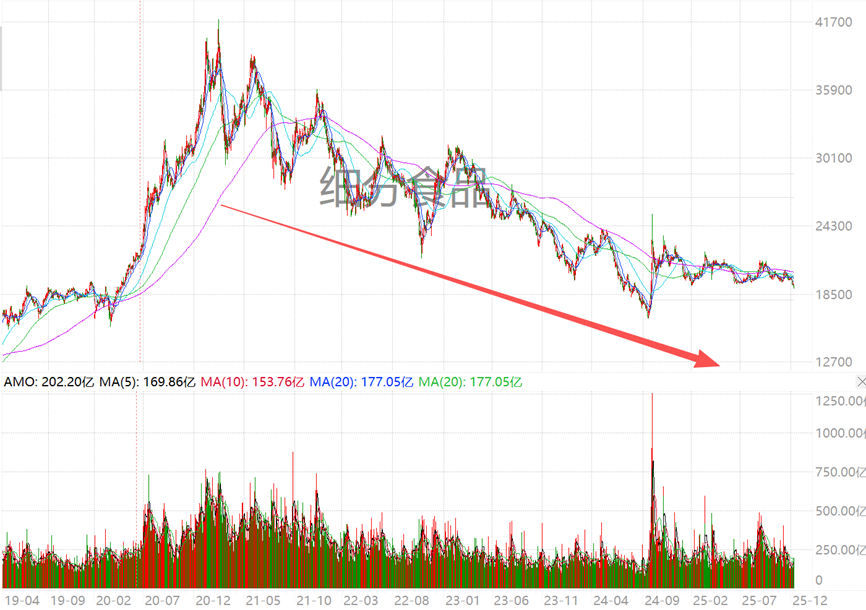
戴维斯双杀

Search documents
美光崩盘背后:一场被“增长见顶”提前定价的芯片周期
美股研究社· 2026-03-31 13:15
Core Viewpoint - The most dangerous moment in the market is not when the fundamentals deteriorate, but when the fundamentals are still improving while expectations have peaked [1]. Group 1: Market Dynamics - Micron Technology's Q2 2026 earnings report was nearly perfect, with EPS soaring 756% year-over-year and guidance for Q3 showing a 1140% increase, yet the stock price reacted negatively [5]. - The market is transitioning from a focus on "dream rates" to "earnings rates," indicating a harsh return to reality for high-valuation growth stocks [1][6]. - The core misjudgment in the current downturn is that the market continues to interpret stock prices through "fundamental growth," neglecting the critical variable of growth rate inflection points [3]. Group 2: Growth Rate and Market Sentiment - When year-over-year growth reaches four digits, the market struggles to trade on "higher growth," as maintaining high percentage growth becomes increasingly difficult [5]. - Historical examples, such as Tesla in 2021, illustrate that stock price peaks do not equate to fundamental peaks; rather, they signify peaks in growth rates and profit margins [5]. - As the market realizes that a 1140% year-over-year growth is a limit, sequential growth rates are expected to decline from 162% to 58%, indicating a shift from an "acceleration phase" to a "deceleration phase" for the AI-driven storage supercycle [5]. Group 3: Demand and Supply Factors - Demand-side issues are evident as DDR5 spot prices have rapidly declined, with some channels experiencing weekly drops exceeding 30%, indicating a sudden inability to sustain demand [8]. - Global laptop shipment forecasts have been revised down from -9.2% to -14.8%, and smartphone shipments are expected to decline by 10%-15%, suggesting that rising storage prices are undermining their own demand base [8]. - On the supply side, Micron's long-term contracts with major clients are interpreted as a lack of confidence in future demand, as companies typically prefer spot pricing during upcycles [9]. Group 4: Emotional and Psychological Factors - The "反指效应" (reverse indicator effect) in institutional narratives suggests that when positive reports coincide with price declines, it signals a shift in liquidity rather than a trend judgment [9]. - The market consensus has shifted, with institutions now using positive reports as a cover for portfolio adjustments, indicating that when everyone believes in a "super cycle," it is often the time when positions are most vulnerable [9]. Group 5: Helium Supply Risk - Helium's critical role in semiconductor manufacturing, particularly in EUV lithography, presents a unique risk due to its supply chain vulnerabilities, with 64.7% of helium in South Korea dependent on Qatar [11]. - A potential disruption in helium supply could lead to a significant decline in yield and a collapse in supply, marking a different level of risk compared to previous demand shocks [12]. Group 6: Investment Strategy Shift - The combination of peak growth rates, weakening demand, supply uncertainties, and emotional shifts in the market suggests a transition from a "Davis Double" to a "Davis Double Kill" scenario for storage chips [15]. - Investors are moving away from "certainty narratives" towards "structural hedging" strategies, focusing on companies with strong free cash flow and buyback capabilities, rather than those reliant on high capital expenditures and external financing [15]. - The market is transitioning from a "growth faith" to a "value defense" approach, emphasizing the importance of identifying style shifts over predicting quarterly revenues [15].



泡沫、关税与央行独立性:94 岁巴菲特留给市场的“最后遗产”
美股研究社· 2026-03-09 11:12
Group 1 - The current S&P 500 index has a price-to-earnings (PE) ratio exceeding 22, a level that has historically only occurred during the 2000 internet bubble and the 2020 liquidity-driven bull market, both of which ended in significant bear market corrections [5][6] - Berkshire Hathaway, led by Warren Buffett, holds a record cash reserve of $334 billion, surpassing the foreign exchange reserves of many countries, signaling a cautious approach amidst market exuberance [5][16] - The combination of high valuations and macroeconomic uncertainty poses a significant risk, as high valuations can persist only with ample liquidity and compelling growth narratives [7][8] Group 2 - The current market narrative has been driven by expectations of profit growth from the AI revolution and a declining inflation rate leading to a loosening monetary policy, which has led to inflated tech stock valuations [8][9] - Trade policy uncertainties have raised the average U.S. import tariff to its highest level in nearly 90 years, with over 80% of the costs expected to be borne by U.S. businesses and consumers, potentially squeezing corporate profit margins [9][10] - Concerns about the independence of the Federal Reserve are growing, as political pressures on monetary policy could undermine the foundation of asset pricing, leading to a potential spike in long-term interest rates and a compression of growth stock valuations [10][11] Group 3 - Corporate earnings growth expectations are being revised downward, indicating a dangerous phase where declining profit expectations coexist with high valuations, a scenario that historically does not last long [11][12] - The "scissors gap" between declining earnings expectations and high valuations often leads to market corrections, either through falling stock prices or valuation compression, with tech giants like Tesla and Meta Platforms being particularly vulnerable [12][13] - Investors are currently overly optimistic about AI's potential, neglecting the challenges of short-term profit realization, which could lead to significant volatility during earnings season if growth does not meet expectations [13][14] Group 4 - Buffett's cash reserve of $334 billion reflects a profound understanding of market cycles, emphasizing the importance of maintaining liquidity during periods of market optimism and fear [15][16] - Historically, Buffett's strategy has involved exercising restraint during market highs and providing liquidity during times of panic, highlighting the value of cash as a scarce asset that offers flexibility [16][17] - The key takeaway for investors is to build risk awareness and maintain cash reserves to capitalize on opportunities when they arise, rather than being fully invested at market peaks [17][18]

美国经济面临“戴维斯双杀”(国金宏观钟天)
雪涛宏观笔记· 2026-03-08 23:46
Core Viewpoint - The U.S. economy is facing significant downward risks, characterized by a "Davis Double Kill" moment, where both the profit and valuation aspects of the economy are deteriorating due to the Federal Reserve's inaction and adverse political actions [2][6]. Group 1: Labor Market and Employment - The non-farm payroll data continues to show weakness, with a 4.44% unemployment rate and a loss of 86,000 jobs in the private sector, indicating that the labor market is not as robust as previously suggested by Federal Reserve officials [7][12]. - The permanent unemployment rate is slowly rising, and the full-time employment rate has declined more than seasonal trends would suggest, signaling further deterioration in the labor market [9][12]. - The core private sector employment growth turned negative in September 2024, which historically corresponds with recognized economic recessions, indicating a potential hard landing for the economy [13]. Group 2: Economic Growth and AI Dependency - The relationship between traditional economic growth and AI is highlighted, with the assertion that without AI, there is no growth. The core components of GDP, excluding volatile factors, have remained stable, but the cyclical parts are showing a significant slowdown [14][17]. - The cyclical economic portion, which constitutes 16.5% of nominal GDP, is the target of monetary policy, and its contraction since Q4 2022 raises concerns about the effectiveness of the Federal Reserve's actions [19][21]. Group 3: Inflation and Cost Pressures - Rising oil prices and the need for manufacturing restocking are putting pressure on U.S. residents' affordability, with the PMI showing only slight rebounds that are more reflective of forced restocking rather than genuine demand recovery [22]. Group 4: Valuation and Geopolitical Risks - The narrative surrounding AI is becoming unstable, with fears of both overestimation and underestimation of its impact on the economy. This uncertainty is affecting market valuations and investor sentiment [25][26]. - Ongoing geopolitical tensions, particularly in the Middle East, are expected to further challenge the attractiveness of dollar-denominated assets, as the U.S. may face prolonged military engagements [27].

美国经济的“戴维斯双杀”
SINOLINK SECURITIES· 2026-03-08 09:58
Economic Outlook - The potential for stagflation in the U.S. economy is increasing, driven by a poor non-farm payroll report and a 35% surge in oil futures prices[3] - The U.S. economy is facing significant downside risks, with weak non-farm data and a lack of improvement in corporate profits, indicating a "Davis Double Kill" scenario[6] - The unemployment rate stands at 4.44%, with a loss of 86,000 jobs in the private sector, highlighting a weak labor market[7] Labor Market Analysis - Non-farm payroll data shows a persistent trend of weakness, with the labor force participation rate significantly declining[7] - Core private sector employment has been in a year-on-year contraction since September 2024, indicating a potential recession[16] - Permanent unemployment numbers are slowly rising, and full-time employment rates have dropped significantly in recent months[15] GDP and Investment Insights - The core GDP growth remains stable, but the cyclical components are showing a marked decline, suggesting reduced sensitivity to monetary policy[23] - The cyclical economic portion, which constitutes 16.5% of nominal GDP, is the target of policy actions, but excluding AI-related growth, this portion has been contracting since Q4 2022[26] - The narrative around AI investments is becoming more complex, with potential impacts on valuation systems due to geopolitical tensions and economic uncertainties[34] Risks and Considerations - Uncertainty surrounding Trump's policies may lead to increased market volatility and faster capital flight from the dollar[4] - Global economic conditions may be significantly affected by tariffs, with expectations of synchronized easing in 2026 potentially alleviating long-term interest rate pressures[4] - The interplay of rising oil prices and manufacturing inventory replenishment could exert additional pressure on consumer affordability[29]
AI正在清算软件时代:下一批长期“价值陷阱”会是谁?
美股研究社· 2026-02-27 10:23
Core Viewpoint - The article emphasizes that the rise of artificial intelligence (AI) is fundamentally reshaping the software industry, leading to a reevaluation of traditional business models and valuations. Companies that once thrived on subscription-based models are now facing existential threats as AI capabilities replace traditional software functions [2][4]. Group 1: Structural Changes in the Software Industry - The market is undergoing a "stress test" where past growth narratives are no longer sufficient to justify high valuations. Investors are shifting focus from historical performance to current efficiency and profitability [2][4]. - AI is not merely an enhancement of software capabilities; it represents a paradigm shift that challenges the traditional software business model. Companies like Salesforce and Adobe are experiencing a revaluation of their competitive advantages as AI reduces the need for complex software tools [8][10]. Group 2: Categories of Companies Facing Risks - Companies relying on "functional software" that primarily enhances efficiency are at the highest risk. As AI can perform tasks at a lower cost or even for free, the pricing power of these software companies is severely threatened [10]. - "Middle-layer platforms" that do not possess core model capabilities are also vulnerable. Once AI capabilities become widespread, these companies may find themselves in a price war, unable to compete with larger players [10]. - "Labor-intensive tech companies" face challenges as AI reduces the need for human labor. If these companies cannot adapt by leveraging AI to improve efficiency, their profit margins will decline [11]. Group 3: Market Reactions and New Investment Criteria - The market is beginning to reward companies that optimize efficiency through AI, as evidenced by Block's significant stock price increase following a major workforce reduction. This indicates a shift in investor sentiment towards valuing efficiency over mere growth [13][14]. - Investors are now scrutinizing companies based on their ability to leverage AI for cost efficiency and whether their product barriers are weakened by AI advancements. Companies that fail to adapt may face permanent valuation declines [14][16]. Group 4: Future Outlook and Investment Strategy - The capital market may evolve to favor "AI amplifiers," which utilize AI to enhance productivity, while "AI casualties" may struggle to survive as their business models become obsolete [16]. - The article warns that the true risk lies not in short-term stock price fluctuations but in the structural changes within business models. Companies that do not adapt to the AI revolution may become "value traps" [16][17].

乳制品行业深度-原奶价格周期向上-板块配置价值愈显
2026-02-24 14:16
Summary of Dairy Industry Conference Call Industry Overview - The dairy industry in China has experienced cyclical fluctuations in milk prices since 2008, influenced by factors such as seasonal demand during the Spring Festival and supply declines in winter [1][2] - The domestic raw milk supply is affected by the number of dairy cows and their productivity, with feed prices, subsidy policies, environmental regulations, and breeding expectations impacting cow numbers [1][4] - The proportion of large-scale farming has approached 80%, improving production efficiency [1][4] Key Insights and Arguments - Recent trends indicate that while the number of dairy cows has increased since 2023, a decline in embryo numbers suggests a potential slowdown in herd expansion [1][4] - The price of imported dairy products has a substitutive effect on domestic milk prices, with fluctuations in international markets directly impacting local prices [1][4] - The beef price increase has implications for the milk price cycle, but significant recovery in milk prices is not expected in the short term (2026) due to ongoing operational pressures on farms [1][5] - The average milk yield per cow in China has been steadily increasing, but leading dairy companies are nearing biological limits, limiting further productivity gains [1][6][7] Demand Dynamics - Short-term demand for dairy products in China is weak, with a trend towards consumption downgrade; however, long-term prospects remain optimistic due to rising GDP and consumer preferences [9][10] - Structural opportunities exist in low-temperature dairy products, particularly in lower-tier cities, which may support demand in the medium to long term [10][11] - The development of deep processing dairy products is expected to significantly consume raw milk, with capacity releases projected to occur between 2027 and 2028 [11][12] Price Impact on Downstream Companies - Changes in milk prices directly affect the revenue and profitability of downstream dairy companies, with low prices leading to a "Davis double kill" scenario (both revenue and valuation decline) [13][15] - Conversely, during recovery phases, companies may experience a "Davis double hit" (both revenue and valuation increase) [15] - The cost structure of dairy companies, where raw material costs account for 60-70% of expenses, means that fluctuations in milk prices have significant implications for profit margins [14] Recommendations for Investment - Recommended leading dairy companies include Yili as a benchmark, followed by Miaokelando, which is expected to expand its market share through domestic substitution and consumer education [16] - New Hope Liuhe is noted for its strong performance in low-temperature products in lower-tier cities, while Tianrun is highlighted for its potential due to its fully owned raw material base [16]


光当世界钱袋子不够,要想人民币取代美元,中国得学会当世界债主
Sou Hu Cai Jing· 2026-02-18 13:40
Group 1 - The core argument is that for the renminbi (RMB) to replace the US dollar as a global reserve currency, China must learn to act as a global creditor rather than solely focusing on increasing its foreign exchange reserves [1][3] - Despite being the world's second-largest economy, the RMB only accounts for 1.9% of global official foreign exchange reserves, ranking seventh, which is significantly lower than the US dollar's 57% share [3][6] - The traditional view that a currency must be issued by a country with a trade deficit to achieve international status is challenged, suggesting that countries can also export currency through foreign investments and loans [3][6] Group 2 - The global debt landscape is predominantly denominated in US dollars, with approximately $23 trillion in cross-border debt, half of which is dollar-denominated, reinforcing the dollar's dominance [6][7] - The mismatch between asset and liability currencies in many countries has led to financial crises, prompting a reevaluation of reliance on dollar-denominated debt, especially among emerging markets [9][10] - Recent trends indicate a shift in China's lending practices, with a decrease in dollar loans and an increase in RMB loans, exemplified by cases in Kenya and Zambia where local debts are being converted to RMB [10][12] Group 3 - The RMB's integration into the economies of borrowing countries can significantly reduce exchange rate risks, transforming it from an optional currency to a necessity for economic operations [12][15] - The RMB's current use in cross-border transactions is limited, primarily in bilateral bank loans, while its presence in the global bond market remains minimal, which is crucial for liquidity and price benchmarks [12][13] - Transparency in financial reporting and alignment with international accounting standards are essential for RMB assets to gain global acceptance as a hard currency [13][15] Group 4 - The role of the People's Bank of China (PBOC) is critical; it must evolve from focusing solely on domestic inflation to acting as a stabilizing force in global financial crises, similar to the Federal Reserve's role [15] - The ultimate goal for RMB internationalization is for it to be widely used for financing, pricing risks, and measuring wealth globally, rather than merely increasing foreign holdings of RMB [15]

牧原股份:千亿负债压顶,港股上市是续命还是冒险?
Sou Hu Cai Jing· 2026-02-13 08:22
Core Viewpoint - The company, Muyuan Foods, faces significant financial challenges, including high debt levels, liquidity risks, and reliance on volatile pig prices, which could jeopardize its future performance and investor confidence [3][6][12]. Debt and Financial Structure - As of the end of 2024, the company's total liabilities reached 110.1 billion yuan, a decrease from the peak of 121.3 billion yuan in 2023, but short-term repayment pressures have increased [3]. - The company has 60.27 billion yuan in interest-bearing debt due within one year, marking a four-year high, with short-term loans amounting to 45.3 billion yuan and cash equivalents of only 12.8 billion yuan, resulting in a short-term repayment gap exceeding 32.5 billion yuan [3]. - The debt structure is characterized by a mismatch in maturity, with 70.3% of short-term loans, leading to a net current liability of 17.1 billion yuan [3][5]. Profitability and Cash Flow - In 2024, the company reported a net profit of 18.925 billion yuan, a 519% increase year-on-year, largely driven by a recovery in pig prices; however, a decline in average pig prices by 16.8% is expected in 2025, leading to a projected net profit drop to at least 15.1 billion yuan [6][8]. - The operating cash flow for 2024 was 37.5 billion yuan, but significant outflows from investment activities caused cash and cash equivalents to decrease from 19.4 billion yuan at the beginning of the year to 12.8 billion yuan by year-end [8]. - Concerns have been raised regarding the quality of earnings, with regulatory scrutiny highlighting discrepancies in cash management and insufficient provisions for inventory depreciation [8]. Market Position and Strategic Moves - The company's IPO on the Hong Kong Stock Exchange raised over 10 billion Hong Kong dollars, but the share price was set at 39 HKD, approximately 23.9% lower than its A-share price, reflecting market caution [9][11]. - The allocation of IPO proceeds includes 60% for overseas expansion, 30% for research and development, and 10% for working capital, raising concerns about the sustainability of this strategy given the existing debt burden [11]. - The company's international operations are still in the early stages, primarily involving technology transfer, and face various risks, including local policy challenges and disease control [11][12].


商业航天、脑机接口元年,也是头部白酒暴雷元年
阿尔法工场研究院· 2026-01-13 00:05
Core Viewpoint - The article discusses the significant shift in investment logic within the liquor industry, particularly highlighted by the poor performance of Kuozi Jiao, marking a transition from traditional investment in established brands to a focus on emerging sectors like commercial aerospace and brain-computer interfaces [2][33]. Group 1: Kuozi Jiao's Performance - Kuozi Jiao's 2025 annual profit forecast indicates a net profit of 662 million to 828 million CNY, representing a year-on-year decrease of 50% to 60% [6][7]. - The company's revenue for the first three quarters of 2025 was 3.174 billion CNY, down 27.24% year-on-year, with a net profit of 742 million CNY, a decline of 43.39% [9][18]. - The third quarter saw a dramatic revenue drop of 46.23% and a net profit decline of 92.55%, with only 26.97 million CNY recorded [9][10]. Group 2: Industry Context and Challenges - The liquor industry is experiencing a deep adjustment period, with Kuozi Jiao's warning serving as a clear signal of broader challenges facing the sector [14][20]. - The market is witnessing a significant divide between "future" and "present," with investors favoring high-potential narratives over established companies facing declining performance [6][27]. - The competitive landscape in Anhui province has intensified, leading to market share erosion for Kuozi Jiao as it failed to transition effectively from low-end to mid-range products [11][12]. Group 3: Market Sentiment and Valuation - Despite Kuozi Jiao's declining performance, its market valuation remains high, with a dynamic price-to-earnings ratio reaching 24.2 times based on a profit median of 725 million CNY [22]. - The article highlights a growing impatience among investors for traditional industries, as they prefer to chase emerging sectors with perceived growth potential [29][32]. - The anticipated challenges for the liquor industry in 2026 suggest a potential for further declines in both volume and price, indicating a tough road ahead for companies like Kuozi Jiao [30][33].


食品饮料板块抹平2021年以来的所有涨幅,何时反转?
Mei Ri Jing Ji Xin Wen· 2025-12-10 01:22
Core Viewpoint - The food and beverage sector has been experiencing a prolonged adjustment period, with prices of key products like Moutai declining, leading to a significant drop in the sector's index close to the levels seen at the end of 2019 [1][3]. Group 1: Reasons for Continuous Adjustment - The food and beverage sector has been in continuous adjustment since early 2021, lasting over four years, resulting in a significant clearing of positions and nearly erasing all gains since 2021 [1]. - Various interpretations of the adjustment reasons include valuation digestion, foreign capital outflow, macroeconomic downturns, low price cycles, and weakened demand in the liquor sector [3]. Group 2: Current Position of the Food and Beverage Sector - As of Q3 2025, the allocation of the food and beverage industry in public fund heavyweights has decreased to 6.4%, similar to levels seen in 2017 [4]. - The PE-TTM of the food and beverage ETF (515170.SH) is currently at 20.15 times, which is below 95% of the time over the past decade, indicating a significant deviation from the mean [4]. - Leading companies in the food and beverage sector emphasize shareholder returns, with many offering dividend yields above 4% [4]. - Historical trends show that sectors experiencing three to four years of decline often see a reversal, as evidenced by the recent performance of sectors like non-ferrous metals and chemicals [4]. Group 3: Indicators for Potential Reversal - The stabilization of the consumer sector depends on the recovery of domestic demand, which is closely linked to improvements in household income and employment [7]. - Past trends indicate that a recovery in corporate profits often precedes improvements in the labor market and income levels, suggesting a potential turnaround in the food and beverage sector [7]. - Key indicators for the liquor segment include the stabilization of Moutai prices and the narrowing of distributor losses, which could signal a recovery [7]. Group 4: Investment Opportunities - The food and beverage ETF (515170.SH) serves as a useful tool for individual investors to capture potential reversal opportunities in leading companies within the sector [8]. - This ETF includes major players across various sub-sectors such as liquor, dairy, soft drinks, and snacks, making it a low-threshold option for investors looking to capitalize on sector recovery [9].